Accuracy of Patient-Reported Exposure to New Psychoactive Substances and Other Illicit Drugs in Australian Emergency Departments: Findings From the Emerging Drugs Network of Australia.
Introduction New psychoactive substances (NPS) present a unique challenge in clinical, public health and drug-policy contexts. Continued diversity, unknown potency and often unintentional exposure can limit the accuracy of self-reported data. This study examined the accuracy of patient-reported NPS and illicit drug exposure in Australian emergency departments (ED). Methods Patient-reported drug exposure, clinical and toxicology data were extracted from the Emerging Drugs Network of Australia Clinical Registry between 1 July 2021 and 30 June 2024 for patients presenting with severe and/or unusual illicit drug toxicity in the ED. Blood samples were analysed using mass spectrometry. Agreement between reported and confirmed exposure was assessed using Cohen's kappa, sensitivity, specificity and likelihood ratios. Logistic regression analysis identified factors associated with discrepancies between reported and confirmed exposures. Results There were 2044 presentations: 64.6% male, median age 33 years (Q1-Q3, 26-41). Complete agreement between patient-reported and confirmed drug exposures was 14.3% (n = 293). Agreement between reported and confirmed NPS exposure was poor (κ = 0.38). 1522 (74.5%) had more drugs detected than reported. Older age (OR 1.03 [CI 1.02, 1.04]) was associated with higher odds of discrepancy. Attendance from a licensed venue (OR 0.44 [CI 0.28, 0.70]) and Glasgow Coma Scale of 13-15 (OR 0.44 [CI 0.33, 0.57]) were associated with lower odds. Discussion and conclusions Poor agreement between patient-reported and analytically confirmed drug exposure highlights the need for continued partnerships between EDs, clinical toxicologists, and forensic laboratories to identify substances involved in acute intoxications and support public health and harm reduction responses.
Introduction
New psychoactive substances (NPS) are increasingly implicated in non‐fatal and fatal poisonings, and present significant challenges for clinical, public health and global regulatory responses [1,2]. These substances are often active derivatives or analogues of ‘traditional’ illicit drugs (e.g., cocaine, heroin, methylamphetamine, 3,4‐methylenedioxymethylamphetamine [MDMA]) or of approved pharmaceutical drugs such as benzodiazepines [2,3]. The increasing diversity of new synthetic drugs and contemporary supply chains driven by darknet markets, social media and encrypted applications [4,5,6] make distribution easier, and hamper efforts to control supply [1]. The rising prominence of counterfeit pharmaceuticals [7] (including products containing unpredictable mixtures of novel benzodiazepines [8] and/or novel opioids [9]) and the economic appeal to organised crime syndicates of cheaper, more easily trafficked, higher‐potency substitutes are of particular concern [10,11].
In the emergency department (ED), management of acute intoxications is guided by presenting clinical features and, when available, drug exposure information reported by the patient and/or other sources (e.g., ambulance paramedics, bystanders, attending police). Reliable and practical tests for NPS are lacking within most hospital settings. Rapid analytical tests such as urine immunoassays are common practice, but are limited in both scope and sensitivity to accurately detect most NPS compounds [12]. Although mass spectrometry offers greater accuracy, it is expensive, time‐consuming and often restricted to offsite forensic laboratories [13].
An alternative to analytical testing is to rely on patient‐reported drug exposure. However, previous research on the accuracy of patient‐reported exposure to illicit drugs often used immunoassays as the gold standard and has yielded conflicting results [14]. Studies specifically examining the reliability of patient‐reported illicit drug and/or NPS exposure are sparse and limited in drug scope, detection methods and sample size [15,16,17]. This is also complicated by the unintentional nature of most NPS exposures, which typically occur via substitution or adulteration of other illicit drugs or via exposure to counterfeit pharmaceuticals [4,18,19].
As inaccurate self‐reporting potentially influences clinical management, this study sought to evaluate the accuracy of patient‐reported exposure to NPS and/or other illicit drugs in ED presentations with accompanying comprehensive analytical results recorded in the Emerging Drugs Network of Australia (EDNA) Clinical Registry between 1 July 2021 and 30 June 2024.
Methods
EDNAStudy Design
EDNA is an observational, prospective toxicosurveillance system of illicit drug‐related presentations to sentinel EDs across five Australian states (Queensland, South Australia, Tasmania, Victoria and Western Australia). Purposive sampling is based on the following inclusion criteria: patients aged 16 years and over (18 years and over in South Australia), presenting with severe and/or unusual clinical features of reported or suspected recreational illicit drug toxicity, and/or patients presenting as part of a suspected cluster of illicit drug intoxications, and with a requirement for intravenous cannulation as part of standard care [20,21]. Blood samples are collected and transferred to relevant state forensic laboratories for comprehensive analysis using mass spectrometry techniques to identify a broad range of NPS and illicit and pharmaceutical drugs. Detection capability is determined by each laboratory's in‐house testing procedures and access to certified reference materials. External databases (e.g.,HighResNPS.com) are utilised for tentative compound identification if certified reference material is unavailable. Detection thresholds are adopted by each laboratory to confirm drug exposure. Detailed inclusion criteria and protocols for blood sampling and analytical testing have been previously described [21].
Ethics approval, including waiver of consent, for the establishment of a de‐identified national ED toxicosurveillance registry was granted by the South Metropolitan Health Service Human Research Ethics Committee (RGS0000003673) in December 2019. EDNA is registered with the Australian and New Zealand Clinical Trials Registry (ACTRN12621001234808) and the Clinical Registry is hosted on a secure online data management system (REDCap) by Curtin University [22].
Participants
ED presentations included in the EDNA Clinical Registry were extracted for analysis if: (i) the triage date was between 1 July 2021 and 30 June 2024; and (ii) both patient‐reported drug exposure and laboratory confirmed toxicology results were complete at the time of data extraction (26 September 2024) (Figure1). The Clinical Registry contains two separate instruments for collecting reported drug exposure data: (i) patient‐reported; and (ii) other sources of reported drug exposure(s), including family or friends, ambulance paramedics, police, product labels, urine drug screens, other or unknown. As the aim of this study was to explore the accuracy of patient‐reported drug exposure, our analysis focuses only on documented patient self‐report information. Additional exclusion criteria for patient‐reported data are presented in Figure1. Patients who actively denied drug exposure were categorised as ‘did not report drug use’ and were retained in the analysis when corresponding toxicology results were available.
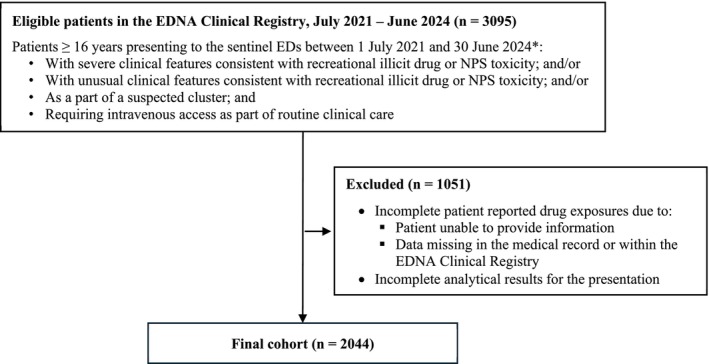
Flow chart of the study population. ED, emergency department; EDNA, emerging drugs network of Australia; NPS, new psychoactive substance. * ≥ 18 years old in South Australia.
Measures
The following data were extracted from the Clinical Registry for all eligible presentations: basic demographics (age and sex), patient‐reported drug exposure(s) (documented in the ambulance record and/or the medical record related to the ED presentation), ED presentation characteristics (arrival mode, Australasian Triage Scale [ATS] [23], setting of drug exposure or last known location prior to ED arrival), initial Glasgow Coma Score (GCS), clinical outcome data (ED disposition and length of stay), and laboratory confirmed toxicology results.
Categorisation of Self‐Report and Analytical Data
Patient‐reported and analytically confirmed drug exposures per presentation were stratified into the following categories: (i) NPS; (ii) traditional illicit; and (iii) pharmaceutical. NPS were organised into effect groups consistent with the United Nations Office on Drugs and Crime classification system [2]: novel benzodiazepines; other sedatives/hypnotics; novel opioids; novel stimulants; novel dissociatives; synthetic cannabinoid receptor agonists; and unassigned novel drugs. Traditional illicit drugs comprised cocaine, gamma‐hydroxybutyrate (GHB), heroin, MDMA, methamphetamine, ketamine and hallucinogens. Heroin was defined as detection of 6‐monoacetylmorphine. Although ketamine is a legally produced and restricted substance in Australia, it was classified as a traditional illicit drug in the current analysis if there was no documented evidence of medical administration pre‐hospital and/or in the ED. Cannabis was excluded from the current analysis due to interstate variability in laboratory testing protocols (e.g., two participating states do not routinely screen for tetrahydrocannabinol).
Pharmaceutical drugs included pharmaceutical benzodiazepines, pharmaceutical opioids, pharmaceutical stimulants, pregabalin, and quetiapine (TableS1). Benzodiazepine exposure reported by a patient was considered a novel benzodiazepine if there was reference to “street” or pharmaceutical brands not sold in Australia (e.g., “Xanax”) [8]. Free‐text drug exposure information entered into the Clinical Registry as patient‐reported is presented in TableS2.
Patient‐reported and analytical results were recorded as ‘none’ and ‘no drug detected’ respectively if none of the abovementioned drug categories were reported. To avoid double‐counting of primary compounds and metabolites in the same blood sample, metabolites were either: (i) excluded when the parent drug was also present; (ii) coded as the parent drug (e.g., 8‐aminoclonazolam was recorded as clonazolam in the absence of clonazolam identification); or (iii) retained as the metabolite (e.g., MDA was retained when MDMA was not detected). We were unable to determine if detected amphetamine represented a metabolite of methamphetamine, illegally produced amphetamine/speed, or use of pharmaceutical stimulants. Therefore, we did not include data on reported amphetamine/speed in our accuracy analysis. Pharmaceutical drugs administered pre‐hospital (recorded in ambulance records) and/or in the ED for patient management were excluded from analysis.
Outcomes
The primary outcome was to assess the agreement between patient‐reported and analytically confirmed drug exposures. ‘Complete’ agreement was defined as presentations whereallpatient‐reported drug exposures matchedalldrugs confirmed in analytical results. ‘Drug‐type’ agreement occurred when a patient‐reported drug type matched a detected drug type. Secondary outcomes included identification of factors associated with higher odds of discrepancy between reported and analytically confirmed drug exposure. Discrepancy was defined as instances when a patient did not report the drug detected.
Statistical Analysis
Categorical variables were presented as frequencies and percentages; continuous variables as medians with first and third quartiles (Q1–Q3) and range. The accuracy of patient‐reported drug exposures was measured using Cohen's Kappa (κ) (excellent (> 0.75), fair to good (0.4–0.75), or poor (< 0.4)) [24]. Sensitivity, specificity, positive likelihood ratio (LR+), and negative likelihood ratio (LR−) with 95% confidence intervals (CI) were calculated to quantify the accuracy of patient‐reported drug exposure. Accuracy was only measured when there were more than five reported drug exposures and more than five detected drug exposures in the same effect group.
To test for differences in baseline characteristics between ED presentations with and without confirmed NPS exposure, logistic regression was used for sex, age, arrival mode, setting, ATS and initial GCS. Multinomial logistic regression was used for ED disposition and truncated negative binomial regression was used for ED length of stay and total number of drugs detected. This accounted for overdispersion and truncation at zero. Regression techniques used robust variance due to the high likelihood of repeat presentations by patients over time, and therefore the potential violation of independence assumptions. Ap‐value of < 0.05 was considered statistically significant.
Univariate regression analysis was used to identify presentation characteristics associated with higher odds of discrepancy between reported and confirmed drug exposure. All univariate analyses with ap‐value < 0.2 were included in the final multivariate regression model. Given the exploratory nature of this research, no corrections for multiple testing were applied. Data processing and statistical analysis were conducted using IBM SPSS Statistics (Version 29.0.2.0.) and SAS software (Version 9.4.).
Results
Study Population
Between July 2021 and June 2024, 2044 ED presentations were eligible for inclusion in the current analysis, representing 66.0% of the 3095 ED presentations included in the Clinical Registry during the study period (Figure1). The median age was 33 years (range 16–76 years) and 64.6% were male (Table1). The majority (81.7%, 1669/2044) arrived at the ED by ambulance and over a third (37.3%, 752/2044) had a GCS of 3–8 and were triaged as high acuity presentations (ATS 1, 38.6%, 786/2044). Most were discharged home after their visit or were hospitalised in a short‐stay or observation ward (Table1). Presentations with NPS detected were more often male (p <0.001), younger (p <0.001) and more likely to present from a primary residence than a public environment (p =0.004) compared to presentations with no NPS detected (Table1).
Table: Characteristics of the study population stratified by presence of NPS.
Analytically Confirmed Drug Exposure
Analytical testing confirmed the presence of at least one pharmaceutical, traditional illicit drug, and/or NPS in 1916 (93.7%) presentations (Figure2and TableS3). The number of different substances detected in a single presentation ranged from one to 10, with the majority having two or more (73.9%). NPS were detected in 11.8% (227/1916) of presentations with detected drug(s), with up to six different NPS in a single presentation. Novel benzodiazepines were the most frequently detected NPS (n =181, 79.7%), followed by novel stimulants (n =24, 10.6%) and novel opioids (n =21, 9.3%) (Figure2). Traditional illicit drugs were detected in 1621 (84.6%) presentations. Methamphetamine was the most frequently detected traditional illicit drug, followed by GHB, cocaine and MDMA (Figure2and TableS3). Pharmaceutical drugs were detected in 1197 (62.5%) presentations. The most frequent pharmaceutical drug detections were benzodiazepines, opioids and pregabalin.
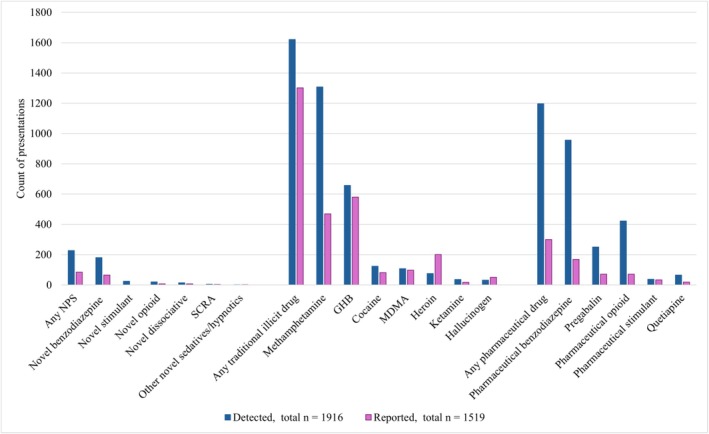
Patient‐reported versus analytically detected drug exposure in 2044 emergency department presentations included in the Emerging Drugs Network of Australia clinical registry. GHB, gamma‐hydroxybutyrate; MDMA, 3,4‐methylenedioxymethamphetamine; NPS, new psychoactive substance; SCRA, synthetic cannabinoid receptor agonist.
Patient‐Reported Drug Exposure
Any drug exposure was reported in 88.1% (1800/2044) of presentations. Of these, 74.3% (1519/2044) specified at least one drug within the categories reported in this study (Figure2and TableS3). Drug exposure was actively denied in 11.9% (244/2044) of presentations. NPS were reported in 5.6% (85/1519) of all presentations with a specified drug exposure, with novel benzodiazepines being the most frequently reported (n =66, or 77.6% of all presentations with patient‐reported NPS exposure) (Figure2and TableS3). For traditional illicit drugs, GHB, methamphetamine and heroin were most frequently reported. The most frequently reported pharmaceuticals were benzodiazepines, pregabalin and opioids (Figure2and TableS3). The number of different patient‐reported substances in a single presentation ranged from one to six, with most patients reporting only one substance (55.5%, 1135/2044).
Accuracy of Patient‐Reported Exposure
Complete agreement between patient‐reported and analytically confirmed drug exposures was observed in 14.3% of ED presentations (293/2044). For the subgroup of patients with at least one confirmed NPS, this was 2.6% (6/227). For individual drug types, agreement between analytically confirmed and patient‐reported NPS exposure was poor (κ= 0.38). The strongest agreement was found for novel benzodiazepines (κ= 0.42) and the poorest for novel dissociatives (κ= 0.09). Although the specificity (98.9%, CI 98.3, 99.3%) and LR+ for patient‐reporting of all NPS sub‐types was excellent, the sensitivity of patient‐reporting was very poor, ranging from 7.1% (CI 0.1, 16.2%) for novel dissociatives to 30.9% (CI 24.3, 38.2%) for novel benzodiazepines (Table2).
Table: Accuracy of patient‐reported exposure to NPS, traditional illicit and pharmaceutical drugs.
Agreement between analytically confirmed and patient‐reported exposure was fair to good for several traditional illicit drugs, with kappa values of 0.73 for GHB, 0.62 for MDMA, and 0.57 for hallucinogens (Table2). For other illicit drugs, agreement was poor, ranging from 0.25 (methamphetamine) to 0.52 (cocaine). For pharmaceutical drugs, agreement was universally poor, ranging from 0.12 to 0.32 (Table2). Whereas specificity and LR+ of patient‐reporting were generally high for all traditional illicit drugs and pharmaceutical drugs, sensitivity varied and was lowest for pharmaceutical drugs.
Factors Associated With Discrepancy Between Reported and Analytically Confirmed Exposure
Discrepancy between reported and analytically confirmed exposure was present in 78.4% (1603/2044) of ED presentations; 74.5% (1522/2044) had more drugs detected than reported (Table3). Univariate regression analyses identified older age as a factor associated with a higher odds of discrepancy (OR 1.04, CI 1.02, 1.05,p< 0.001). Patients attending the ED from a licensed venue (i.e., premises which are authorised to serve alcohol) or arriving by private transport or police/correctional services had significantly lower odds of discrepancy (p< 0.05). The odds of discrepancy were also lower in presentations with a GCS between 13 and 15 compared to presentations with a GCS between 3 and 8, and in presentations with higher acuity triage scores (p< 0.05) (Table3). Of these factors, age remained independently associated with a higher odds of discrepancy. Attendance from a licensed venue, arrival by private transport, and higher initial GCS remained independently associated with a lower odds of discrepancy (Table3).
Table: Univariate and multivariate logistic regression analysis for at least one false negative report.
Discussion
Our study reveals that in a large‐scale cohort of patients presenting to the ED with severe and/or unusual intoxications, a significant discrepancy exists between reported and analytically confirmed drug exposure for both traditional illicit drugs and NPS.
Poor agreement between patient‐reported drug exposure and analytical confirmation has been reported previously for several illicit and pharmaceutical drugs. Consistent with our findings, ElMehy et al. [14] reported fair agreement for cocaine (k= 0.51) but poor agreement for the pharmaceuticals pregabalin (k= 0.46) and methadone (k= 0.25). However, we observed lower agreement for methamphetamine and heroin compared to previous studies [14,25]. Low frequency of patient‐reported methamphetamine exposure may reflect the high prevalence of use in the Australian population [26], and stigma experienced by people who use methamphetamine [27,28]. Its long elimination half‐life may also explain the discrepancy between patient‐reported and confirmed methamphetamine exposure in the current study, as patients may not perceive methamphetamine as a contributing factor to their ED presentation despite remaining detectable in biological samples [29]. Higher agreement for heroin reported previously [25] may relate to variation in testing methodologies and (metabolite) detection criteria, including morphine/opiates besides 6‐monoacetylmorphine. Our results are based on a conservative definition for identifying heroin‐positive presentations (i.e., 6‐monoacetylmorphine), which has a short elimination half‐life. We did not utilise a broader criterion of co‐detected codeine and morphine as concentration data was inconsistently reported, therefore ratio calculations could not be established. While GHB was frequently detected in our cohort, this is not representative of the broader Australian population, where reported past‐year use remains low at approximately 0.2% [26]. Our results likely reflect EDNA's purposive sampling criteria, but also support evidence of increasing GHB‐related harms across multiple indicators in Australia (e.g., hospitalisations, deaths and treatment episodes) [30,31].
The Euro‐DEN plus network reported that NPS were identified in 7.6% of recreational drug toxicity ED presentations across Europe, compared to our 11.8%. However, only one out of every five Euro‐DEN plus presentations was analytically tested and inclusions mostly relied on self‐report [32]. A positive patient report of NPS exposure in EDNA increased the likelihood of its detection. However, negative self‐reporting cannot be used to rule out exposure.
Our findings of frequent underreporting of NPS are consistent with the often unintentional nature of exposure to these substances [33]. Unintentional exposure to potent NPS through substitution and/or adulteration of traditional illicit and pharmaceutical drugs is a growing public health concern [4,18]. The substantial rise in counterfeit benzodiazepine detections and related overdoses in Australia, including cases where multiple novel benzodiazepines were detected in single tablets sold as Xanax, Mylan or generic alprazolam [8,34] have highlighted increased harm from counterfeit medications circulating in the community [35]. The emergence of potent synthetic opioids, such as nitazenes, also poses a particular risk in circumstances of unknown exposure [9,21]. Multiple government‐issued public drug alerts directly informed by EDNA were disseminated during the current study period [36,37]. These alerts provide timely and objective information on drugs of concern circulating in the community, including analytically confirmed compounds, clinical effects and harm reduction advice.
Discordance between the high proportion of presentations with multiple confirmed drug exposures, despite patients most often reporting single exposures, provides important insight into underreported polydrug exposure. In addition to unintentional exposure, patients may only report the drug(s) perceived as most clinically relevant to their current ED presentation or omit information on drugs taken days beforehand that may still be identified through blood analysis. This may also reflect the complexities of drug pharmacokinetics and the timing of sample collection. Drugs with prolonged elimination half‐lives may remain detectable in blood after their psychoactive effects have subsided, leading to detection despite the patient not considering the drug relevant to their acute presentation. To obtain more accurate information, particularly regarding polydrug exposures, clinicians need to adopt taking a more comprehensive drug exposure history. This includes asking specific questions on both recent and longer‐term exposure.
Our finding that NPS were more frequently detected in younger male patients aligns with trends observed in European EDs [32]. The current study also revealed an interesting relationship between age, NPS confirmation and discrepancy between reported and analytically confirmed NPS exposure; NPS were more frequently detected in younger patients, but older age was associated with a larger discrepancy between reported and confirmed drug exposure. The ED context and data parameters of the current study limit our ability to draw meaningful conclusions regarding these findings. Available evidence demonstrates younger individuals are more likely to purchase drugs online, including from social media apps or websites. Further exploration into demographic characteristics and engagement with online vendors is needed to better inform preventive and harm reduction strategies in an increasingly accessible online drug market [6].
Significant barriers to accurate self‐reporting of illicit drug exposure also include the stigma experienced by people who use drugs and the criminalisation of drug use [27,28]. Fear of legal and social consequences and mistrust of healthcare providers may prevent patients from disclosing drug use to clinical staff [38]. Disclosure of drug exposure by patients can be improved by clinicians demonstrating non‐judgemental attitudes and explicitly reassuring patients about confidentiality. From a broader policy perspective, opportunities for community members to access drug checking services and receive tailored harm reduction advice have demonstrated both immediate impacts on drug use intentions and behaviour [39,40], and benefits that extend beyond the service interaction [41]. Greater availability and access to fixed‐site and event‐based drug checking services may potentially prevent some ED presentations in the first place. Future research should explore awareness, intentions, and experiences of NPS exposure through qualitative enquiry with people who use drugs and evaluate the role of drug checking services in preventing and reducing drug‐related harm in the community.
From a clinical perspective, this study highlights that NPS and polydrug intoxication should be considered, even in patients who do not report any or multiple drug exposures. Objective evidence of NPS and illicit drugs involved in ED presentations, coupled with the associated clinical profiles, should be utilised to improve clinician capacity to effectively assess and manage patients presenting with acute toxicity. In certain circumstances, access to rapid toxicology results may also provide additional intervention guidance in cases requiring prolonged management of unknown toxicity [42].
Limitations
The current study has several limitations. First, patient‐reported drug exposure information was drawn from ambulance and medical records and therefore dependent on the quality and completeness of clinical documentation and accurate interpretation when entering data into the EDNA Clinical Registry. Given other sources of reported drug exposure(s) are also documented in medical records, our findings rely on the ability to distinguish patient‐reported data from other sources during medical record review and data entry, which may be unclear. The exclusion of cannabis due to interstate variability in laboratory testing protocols likely results in an underrepresentation of both reported and detected exposures. Reduced consciousness associated with acute intoxication combined with the potential for unintentional drug exposure further impacts the reliability of patient‐reported data. Additionally, no interactions were tested between drug categories, and therefore interpretation may be limited. Our findings are based on a sentinel group of participating EDs and a small subset of total drug‐related ED presentations, limiting generalisability to the broader network of Australian EDs and to other settings and population groups. Finally, differences in data collection procedures across states may have introduced variability that could not be controlled for in this analysis.
Conclusion
Poor agreement between analytically confirmed and patient‐reported drug exposure highlights the need for continued partnerships between EDs, clinical toxicologists and forensic laboratories to enable identification of the specific substances involved in acute intoxication. Especially during NPS‐related cluster events, where timely detection plays an important role, rapid access to toxicology results can inform prompt public health drug alerts and other targeted harm reduction responses.
Author Contributions
Each author certifies that their contribution to this work meets the standards of the International Committee of Medical Journal Editors.
Funding
EDNA is supported by a 5‐year National Health and Medical Research Council (NHMRC GNT2001107, RORhttps://ror.org/011kf5r70). Additional state‐specific funding from the Government of Western Australia (East Metropolitan Health Service, the Mental Health Commission and the Department of Health) and the Government of Victoria, Department of Health, supported the current work. MJN was supported by a Marco Polo Grant from the University of Groningen.
Conflicts of Interest
The authors declare no conflicts of interest.
References
- United Nations Office on Drugs and Crime, World Drug Report 2025(UNODC, 2025), .
- United Nations Office on Drugs and Crime, Current NPS Threats (Volume VII)(UNODC, 2024), .
- A. Peacock, R. Bruno, N. Gisev, et al. , “New Psychoactive Substances: Challenges for Drug Surveillance, Control, and Public Health Responses, ”Lancet394, no. 10209(2019): 1668–1684. doi.org/10.1016/S0140-6736(19)32231-7
- M. J. Barratt, M. Ball, G. T. Wong, andA. Quinton, “Adulteration and Substitution of Drugs Purchased in Australia From Cryptomarkets: An Analysis of Test4Pay, ”Drug and Alcohol Review43, no. 4(2024): 969–974. doi.org/10.1111/dar.13825
- A. Fuller, M. Vasek, E. Mariconti, andS. D. Johnson, “Platforms, Risk Perceptions, and Reporting: The Impact of Illicit Drug Advertisements on Social Media Among UK Secondary Students, ”Harm Reduction Journal22, no. 1(2025): 154. doi.org/10.1186/s12954-025-01299-5
- R. van der Sanden, C. Wilkins, J. S. Romeo, M. Rychert, andM. J. Barratt, “Predictors of Using Social Media to Purchase Drugs in New Zealand: Findings From a Large‐Scale Online Survey, ”International Journal on Drug Policy98(2021): 103430. doi.org/10.1016/j.drugpo.2021.103430
- J. FriedmanandD. Ciccarone, “The Public Health Risks of Counterfeit Pills, ”Lancet Public Health10, no. 1(2025): e58–e62. doi.org/10.1016/S2468-2667(24)00273-1
- R. Syrjanen, S. L. Greene, S. E. Hodgson, et al. , “Counterfeit ‘Xanax’ Tablets: A Comparative Study of Clinical and Seizure Data in Victoria, Australia, ”Addiction120, no. 12(2025): 2465–2475. doi.org/10.1111/add.70174
- K. Z. Isoardi, S. Alfred, C. Weber, et al. , “Clinical Toxicity of Nitazene Detections in Two Australian Emergency Department Toxicosurveillance Systems, ”Drug and Alcohol Review45, no. 1(2026): e13998. doi.org/10.1111/dar.13998
- United Nations Office on Drugs and Crime, World Drug Report 2024 ‐ Drug Market Patterns and Trends(UNODC, 2024), .
- P. Griffiths, C. Parry, A. Ambekar, et al. , “The Need to Revitalise Drug Use Monitoring to Keep Pace With a More Dynamic, Digitally Enabled and Globally Connected Drug Market, ”Drug and Alcohol Review45, no. 1(2025): e70029. doi.org/10.1111/dar.70029
- T. G. Rosano, S. T. Islam, J. M. Rumberger, et al. , “Definitive Urine Drug Testing in Emergency Medicine: Recreational and Psychiatric Drug Findings, ”Journal of Mass Spectrometry and Advances in the Clinical Lab37(2025): 16–27. doi.org/10.1016/j.jmsacl.2025.04.008
- A. Shafi, A. J. Berry, H. Sumnall, D. M. Wood, andD. K. Tracy, “New Psychoactive Substances: A Review and Updates, ”Therapeutic Advances in Psychopharmacology10(2020): 2045125320967197. doi.org/10.1177/2045125320967197
- A. ElMehy, D. Wood, E. El Madah, N. Hassan, K. Saad, andP. Dargan, “A Study Comparing Self‐Reported Drugs and Results of an Immunoassay Test in Serum Samples in Patients Presenting to the Emergency Department With Acute Recreational Drug, ”Asia Pacific Journal of Medical Toxicology11, no. 1(2022): 4–12.
- I. Virmani, A. Oteo, M. Dunn, et al. , “Accuracy of Substance Exposure History in Patients Attending Emergency Departments After Substance Misuse; A Comparison With Biological Sample Analysis, ”Clinical Toxicology (Philadelphia, PA. )61, no. 1(2023): 39–46. doi.org/10.1080/15563650.2022.2131566
- C. E. Wolfe, A. Rowe, S. Hudson, J. R. Archer, P. I. Dargan, andD. M. Wood, “Reported Recreational Drug and New Psychoactive Substance Use Versus Laboratory Detection of Substances by High‐Resolution Mass Spectrometry in Patients Presenting to an Emergency Department in London With Acute Drug Toxicity, ”Clinical Toxicology (Philadelphia, PA. )62, no. 11(2024): 693–697. doi.org/10.1080/15563650.2024.2402070
- C. Bharat, P. Webb, Z. Wilkinson, et al. , “Agreement Between Self‐Reported Illicit Drug Use and Biological Samples: A Systematic Review and Meta‐Analysis, ”Addiction118, no. 9(2023): 1624–1648. doi.org/10.1111/add.16200
- R. Sutherland, S. Allsop, andA. Peacock, “New Psychoactive Substances in Australia: Patterns and Characteristics of Use, Adverse Effects, and Interventions to Reduce Harm, ”Current Opinion in Psychiatry33, no. 4(2020): 343–351. doi.org/10.1097/YCO.0000000000000606
- J. J. PalamarandA. Salomone, “Trends and Correlates of Discordant Reporting of Drug Use Among Nightclub/Festival Attendees, 2019–2022, ”Clinical Toxicology (Philadelphia, PA. )61, no. 9(2023): 665–673. doi.org/10.1080/15563650.2023.2273770
- J. L. Smith, J. Soderstrom, A. Dawson, et al. , “The Emerging Drugs Network of Australia: A Toxicosurveillance System of Illicit and Emerging Drugs in the Emergency Department, ”Emergency Medicine Australasia34, no. 1(2022): 58–64. doi.org/10.1111/1742-6723.13839
- J. L. Smith, C. C. Weber, J. L. Schumann, et al. , “Novel Psychoactive Substances in Australian Emergency Departments: Implications for Public Health Practice From Multi‐Centre Prospective Toxicosurveillance Across Five States, 2022–2023, ”International Journal on Drug Policy145(2025): 104969. doi.org/10.1016/j.drugpo.2025.104969
- P. A. Harris, R. Taylor, B. L. Minor, et al. , “The REDCap Consortium: Building an International Community of Software Platform Partners, ”Journal of Biomedical Informatics95(2019): 103208. doi.org/10.1016/j.jbi.2019.103208
- Australasian College for Emergency Medicine, “Policy on the Australasian Triage Scale 2013, ”.
- J. L. Fleiss, B. Levin, andC. P. Myunghee, “The Measurement of Interrater Agreement, ” inStatistical Methods for Rates and Proportions, ed. W. A. Shewart(J Wiley, 2003), 598–626.
- E. Liakoni, C. Yates, A. M. Dines, et al. , “Acute Recreational Drug Toxicity: Comparison of Self‐Reports and Results of Immunoassay and Additional Analytical Methods in a Multicenter European Case Series, ”Medicine97, no. 5(2018): e9784. doi.org/10.1097/MD.0000000000009784
- Australian Institute of Health and Welfare, Illicit Drug Use(AIHW, 2023), .
- J. Chalmers, K. Lancaster, andC. Hughes, “The Stigmatisation of ‘Ice’ and Under‐Reporting of Meth/Amphetamine Use in General Population Surveys: A Case Study From Australia, ”International Journal of Drug Policy36(2016): 15–24. doi.org/10.1016/j.drugpo.2016.06.001
- R. Sutherland, C. King, A. Karlsson, et al. , “Stigma, and Factors Associated With Experiencing Stigma, While Visiting Health‐Care Services Among Samples of People Who Use Illegal Drugs in Australia, ”Drug and Alcohol Review43, no. 5(2024): 1264–1279. doi.org/10.1111/dar.13846
- C. C. CruickshankandK. R. Dyer, “A Review of the Clinical Pharmacology of Methamphetamine, ”Addiction104, no. 7(2009): 1085–1099. doi.org/10.1111/j.1360-0443.2009.02564.x
- A. Peacock, A. Chrzanowska, N. Man, et al. , “Trends in Gamma‐Hydroxybutyrate Use, Harms and Treatment in Australia, 2013 to 2024, ”Addiction121, no. 5(2026): 1290–1305, . doi.org/10.1111/add.70308
- S. Darke, J. Duflou, A. Chrzanowska, M. Farrell, J. Lappin, andA. Peacock, “Changes in the Rates and Characteristics of Gamma Hydroxybutyrate (GHB)‐Related Death in Australia, 2001–2023, ”Drug and Alcohol Review44, no. 1(2025): 366–375. doi.org/10.1111/dar.13940
- B. Crulli, A. M. Dines, G. Blanco, et al. , “Novel Psychoactive Substances‐Related Presentations to the Emergency Departments of the European Drug Emergencies Network Plus (Euro‐DEN Plus) Over the Six‐Year Period 2014–2019, ”Clinical Toxicology (Philadelphia, Pa. )60, no. 12(2022): 1318–1327. doi.org/10.1080/15563650.2022.2137524
- J. J. Palamar, A. Salomone, andK. M. Keyes, “Underreporting of Drug Use Among Electronic Dance Music Party Attendees, ”Clinical Toxicology (Philadelphia, PA. )59, no. 3(2021): 185–192. doi.org/10.1080/15563650.2020.1785488
- R. Syrjanen, S. L. Greene, C. Weber, et al. , “Characteristics and Time Course of Benzodiazepine‐Type New Psychoactive Substance Detections in Australia: Results From the Emerging Drugs Network of Australia‐Victoria Project 2020–2022, ”International Journal on Drug Policy122(2023): 104245. doi.org/10.1016/j.drugpo.2023.104245
- J. Freestone, S. Kypri, J. L. Schumann, et al. , “The Emergence of Novel Benzodiazepines in Australia, Evidence, Alerts, Clinical Management and Harm Reduction—A Narrative Review, ”Drug and Alcohol Review45, no. 1(2026): e70086. doi.org/10.1111/dar.70086
- Victorian Department of Health, Drug Alerts(Victorian Government, 2025), .
- Aboriginal Health Council of South Australia, Drug Alert Notice: Protonitazene(AHCSA, 2025), .
- S. Mayer, V. Langheimer, S. Nolan, J. Boyd, W. Small, andR. McNeil, “Emergency Department Experiences of People Who Use Drugs Who Left or Were Discharged From Hospital Against Medical Advice, ”PLoS One18, no. 2(2023): e0282215. doi.org/10.1371/journal.pone.0282215
- N. Maghsoudi, J. Tanguay, K. Scarfone, et al. , “Drug Checking Services for People Who Use Drugs: A Systematic Review, ”Addiction117, no. 3(2022): 532–544. doi.org/10.1111/add.15734
- S. Tobias, C. Grant, M. Lysyshyn, et al. , “Risk Reduction Behaviours Following the Detection of Unexpected Drugs Through Community Drug Checking: A Cross‐Sectional Study, ”Harm Reduction Journal23, no. 1(2026): 72. doi.org/10.1186/s12954-025-01374-x
- F. MeashamandG. Turnbull, “Intentions, Actions and Outcomes: A Follow Up Survey on Harm Reduction Practices After Using an English Festival Drug Checking Service, ”International Journal on Drug Policy95(2021): 103270. doi.org/10.1016/j.drugpo.2021.103270
- K. E. Grafinger, M. E. Liechti, andE. Liakoni, “Clinical Value of Analytical Testing in Patients Presenting With New Psychoactive Substances Intoxication, ”British Journal of Clinical Pharmacology86, no. 3(2020): 429–436. doi.org/10.1111/bcp.14115
Republished from the open web under CC-BY. Authors: Nijmeijer MJ, Smith JL, Weber C, Bens BWJ, Fatovich DM, Greene SL, Schumann JL, Dessauer P, Syrjanen R, Isoardi KZ, Harris K, Alfred S, Tran V, Ter Avest E. Read the original.