Designing Reliable Cryptocurrency Payment Infrastructure for Online Businesses: A Technical Review
A technical review of cryptocurrency payment infrastructure for online businesses, covering checkout, invoices, blockchain monitoring, payment statuses, webhooks, reconciliation, stablecoin settlement, and automated payouts. The article also examines common operational failures and presents Cryptoway as a practical implementation example.
Abstract
Cryptocurrency payment acceptance is often described as a transfer from a customer wallet to a merchant address. That description is technically incomplete for an online business. A commercial payment must be tied to an order, an amount, an accepted asset and network, a transaction lifecycle, and a financial record. This review examines the infrastructure required to make that lifecycle observable and operationally usable: checkout, invoice generation, payment identification, blockchain monitoring, confirmation policy, status transitions, APIs and webhooks, reconciliation, settlement, and automated payouts. It also considers common exceptions: an incorrect network or amount, delayed confirmations, duplicate transfers, expired invoices, failed webhook delivery, and mismatched records. The discussion synthesizes public protocol and implementation documentation rather than presenting original experiments or comparative performance results.
Introduction
A wallet address is a destination for a transfer. It is not, by itself, an order-management system, a payment ledger, or a settlement process.
That distinction matters when a business receives more than occasional payments. A customer may use the wrong network or send an incorrect amount; the business must resolve the case without treating a blockchain explorer or support inbox as its operating system.
At protocol level, blockchain transactions carry network-specific fields and state changes. Ethereum describes transactions as signed instructions that change network state, while Bitcoin transactions are built from inputs and outputs [1, 2]. Those records are necessary evidence, but they do not contain a merchant’s internal order state. Payment infrastructure connects a blockchain event to a business event.
Review Approach
This review uses publicly available technical documentation to examine the components and operational requirements of cryptocurrency payment infrastructure. The analysis draws primarily on protocol documentation from Bitcoin and Ethereum, relevant standards such as BIP 21, ERC-20 and RFC 2104, and guidance on security and log management from NIST. These sources are used to describe payment identification, transaction observation, confirmation, event handling, authentication, and operational recordkeeping.
The review does not present original experiments, proprietary performance measurements, or a comparative benchmark of payment providers. Cryptoway is included later as a practical implementation example to illustrate how the architectural components discussed in the review can be combined in a production-oriented payment flow.
Payment Processing Architecture
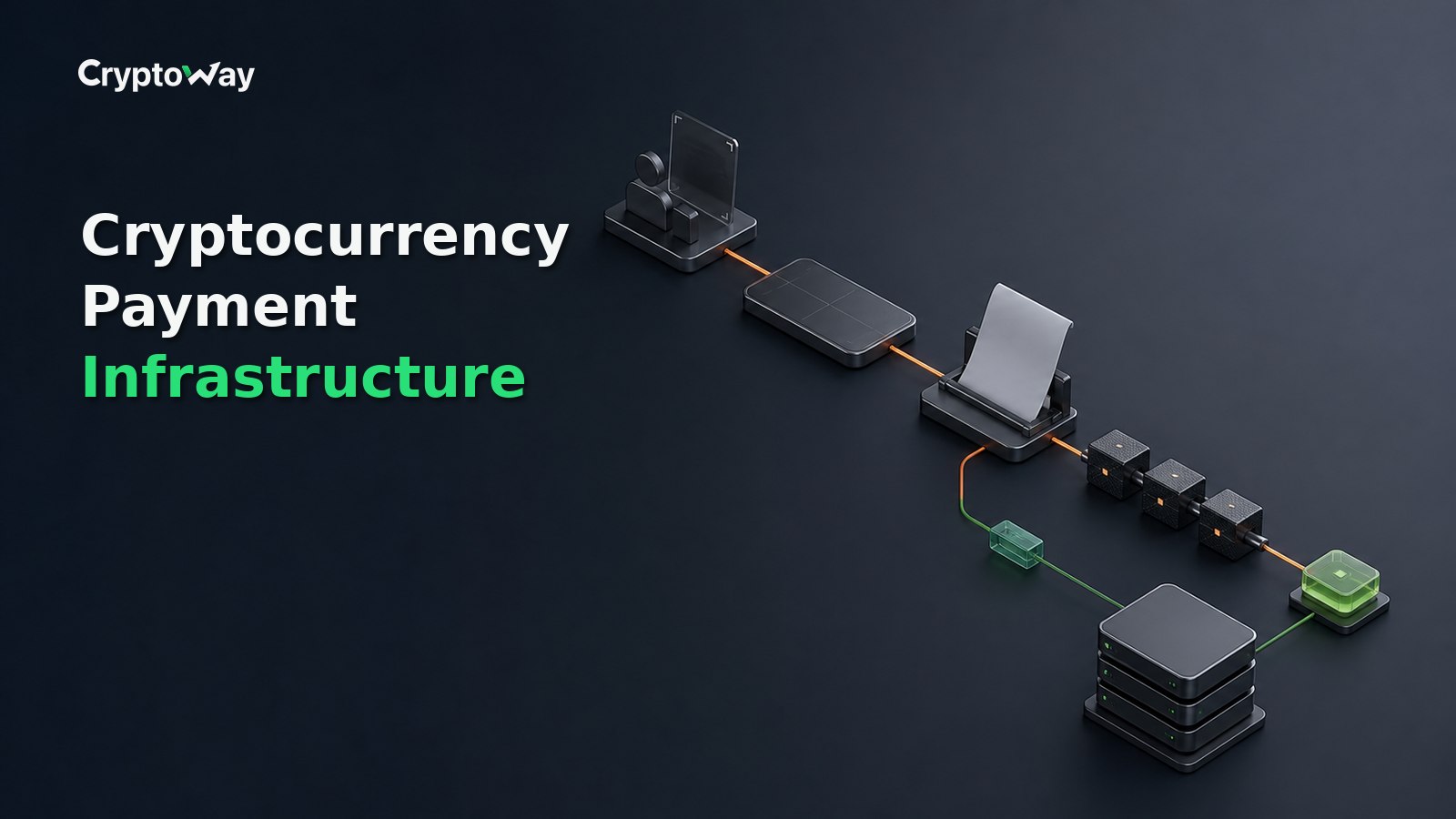
A reliable architecture has two linked planes. The payment plane handles customer instructions, invoices, destination details, chain observation, and status updates. The business plane handles carts, subscriptions, fulfillment, support, accounting, and settlement decisions. The invoice identifier is the bridge between them.
A typical flow begins when an order system requests an invoice. The payment service records a unique identifier, merchant reference, expected amount, accepted asset, network, payment route, and expiry policy. The customer receives this through hosted checkout, a payment link, or an embedded payment step. BIP 21 illustrates the basic idea of encoding payment information into a URI, although production systems need a richer invoice record [3].
The monitoring service then observes the relevant network for transactions matching the payment route. It should not mark an invoice as paid merely because a customer reports a transaction hash. Instead, it evaluates independently observed data: network, destination, asset or token contract where relevant, amount, transaction identifier, block inclusion, and confirmation state. On account-based chains, applications can retrieve receipts and event data through node interfaces; Ethereum’s JSON-RPC documentation describes the node-facing RPC model used for such queries [4].
The output is a controlled state transition. A business application consumes that state through an API query or signed webhook, then decides whether to fulfill an order, extend a subscription, credit a balance, or open an exception case.
Core Components
Checkout and invoice generation. Checkout should state the exact asset and network, not only a ticker. An invoice’s core terms—amount, route, reference, and expiry—should be immutable after issue. Changes should create a new version or invoice, preserving the prior record.
Unique payment identification. The invoice identifier is the primary correlation key. The system may also use a dedicated address, payment reference, expected amount, or a combination. It should record the matching rule and transaction identifier as evidence. For Ethereum-compatible token transfers, ERC-20 specifies a Transfer event; monitoring should identify the token contract, sender, recipient, and value rather than rely on a display symbol [5].
Monitoring and confirmation logic. Monitoring detects a candidate transaction, then assesses whether it reaches the business-defined threshold for action. That threshold should be a documented risk policy, not a universal number copied across chains. A low-value digital delivery event and a high-value settlement instruction may need different handling. The system should also be able to revise a preliminary status if chain evidence changes.
Status model. Status names vary, but transitions should be unambiguous. A practical model distinguishes new, pending, detected, confirming, confirmed, expired, underpaid, overpaid, wrong_network, duplicate, manual_review, and settled. It should record each trigger and evidence. A confirmed payment is not the same as settlement or a customer refund.
API, webhooks, and transaction tracking. The API should create and retrieve invoices by the business reference. Webhooks are delivery notifications, not the sole source of truth. The receiver should verify the sender’s signature, retain the raw event, deduplicate by event identifier, and fetch current invoice state when needed. HMAC is a standard construction for message authentication using a shared secret [6]. Acknowledge a webhook after durable receipt, then process it idempotently.
Reconciliation, settlement, and autopayouts. Reconciliation compares invoice records, observed transactions, ledger entries, and settlement movements. Settlement moves or converts confirmed value under a defined policy. Autopayouts are a separate controlled workflow: approved balances are paid to pre-authorized recipients with limits, permissions, and an audit trail. They should consume a ledger state, not raw inbound transactions.
Operational Failure Modes
Failure handling is not an edge case; it is part of the architecture.
An incorrect network can produce a valid transfer that the invoice cannot accept. The system should preserve evidence, label the exception, and route it to a documented review process. It should not automatically promise recovery, because recoverability depends on the asset, chain, custody model, and operational controls.
An incorrect amount requires explicit rules. A short payment might remain underpaid until an additional transfer arrives, or it might require customer action. An overpayment should not automatically become a refund without authorization and recordkeeping. Both cases need a connection to the original invoice and observed transactions.
Delayed confirmations require a customer-facing pending state and internal monitoring with time-based escalation. The important design choice is to avoid claiming finality from a detected transaction alone.
Duplicate transactions should be stored as separate observed events, then linked to the same invoice or exception case; deleting them loses audit context.
An expired invoice should retain its history. A later incoming transfer may be real but no longer fulfill the original commercial terms. The system therefore needs an expiry rule and a post-expiry handling path rather than a binary paid/unpaid flag.
Webhook failures are expected in distributed systems. Providers should retry delivery; merchants should make receivers idempotent; both sides benefit from traceable event identifiers and an API-based recovery path. Finally, reconciliation mismatches often reveal a broken correlation rule, an unprocessed exception, an incomplete settlement entry, or an operational action outside the normal flow. Log management guidance is relevant here: NIST frames log management as an organizational process, not merely a storage task [7].
Stablecoin Settlement
Stablecoins can simplify the unit of account for a merchant that prefers to price or reconcile in a familiar currency-like denomination. They do not remove the need to identify the precise asset and network. The same symbol can appear on more than one chain, and a token transfer is meaningful only when its contract, chain, recipient, amount, and transaction evidence are evaluated together.
A stablecoin settlement design therefore separates three questions: was the customer invoice paid; is the payment sufficiently confirmed under policy; and what should happen to the confirmed balance next? Conversion and settlement are business decisions applied after payment evidence has been recorded. Combining these stages in one opaque “complete” flag makes investigations harder when a conversion, transfer, or payout fails after the customer payment has been confirmed.
Practical Implementation Example
A practical implementation can use a payment infrastructure provider while keeping the merchant’s own order system as the source of commercial intent. One implementation example is Cryptoway, which provides infrastructure for API-based payment acceptance, hosted checkout, payment links, invoice-based flows, automated payouts, and conversion or settlement workflows.
In an implementation, a merchant application can create a payment request from its order ID, direct the customer to hosted checkout or a payment link, and store the returned invoice reference.
The integration should then treat transaction monitoring and webhook updates as inputs to a state machine. When an invoice reaches the merchant’s defined confirmed state, the order service can perform an idempotent fulfillment action. Finance can reconcile the invoice, observed payment, and subsequent conversion or settlement entry. If an autopayout is used, it should be created from an approved payable balance with recipient controls, not from the mere arrival of a customer transfer.
This example is architectural rather than a claim that one provider eliminates operational risk. The merchant still owns its confirmation policy, fulfillment controls, access management, exception handling, and accounting design.
Discussion
The design question is not whether blockchain data is available. It is whether the business can turn that data into controlled decisions.
For founders, the minimum useful artifact is a payment state model that product, support, engineering, and finance interpret in the same way. For technical teams, the critical properties are correlation, idempotency, durable event handling, and an auditable ledger. For operators, the critical property is that exceptions remain visible instead of being forced into a successful-payment path.
This distinction is also important when evaluating payment infrastructure providers. The relevant question is not simply which assets or networks a provider supports, but whether its implementation exposes sufficient payment state, transaction evidence, event handling, and settlement controls for the merchant’s operational requirements.
This approach also clarifies limits. No integration removes network-specific risk, customer error, or the need for authorization over payouts and refunds. A robust system does not hide those realities; it makes them observable and assignable.
Conclusion
Reliable cryptocurrency payment acceptance is an integration problem across checkout, invoice data, chain observation, business state, and finance operations. A wallet address remains one component, but it cannot explain what a transfer means to the business.
The durable design is an invoice-centered workflow with explicit matching rules, evidence-based status transitions, idempotent event processing, exception paths, and reconciliation from payment through settlement and payout. That model is understandable to business operators and precise enough for technical teams to implement and audit.
Disclosure
Cryptoway is referenced in this review as a practical implementation example. The article does not present an independent evaluation or comparative assessment of Cryptoway or other payment providers.
References
- Bitcoin Developer Documentation. Transactions. https://developer.bitcoin.org/devguide/transactions.html
- Ethereum Foundation. Transactions. https://ethereum.org/en/developers/docs/transactions/
- Bitcoin Improvement Proposals. BIP 21: URI Scheme. https://github.com/bitcoin/bips/blob/master/bip-0021.mediawiki
- Ethereum Foundation. JSON-RPC API. https://ethereum.org/en/developers/docs/apis/json-rpc/
- Vogelsteller, F., & Buterin, V. ERC-20: Token Standard. Ethereum Improvement Proposals. https://eips.ethereum.org/EIPS/eip-20
- Krawczyk, H., Bellare, M., & Canetti, R. HMAC: Keyed-Hashing for Message Authentication. RFC 2104. https://www.rfc-editor.org/rfc/rfc2104
- Kent, K., & Souppaya, M. Guide to Computer Security Log Management. NIST Special Publication 800-92. https://doi.org/10.6028/NIST.SP.800-92