Diagnostic performance of donor-derived cell-free DNA for acute rejection in kidney allograft biopsies.
Objective To determine the performance of donor-derived cell-free DNA (dd-cfDNA) as a noninvasive biomarker for the diagnosis of acute rejection in for-cause kidney transplant biopsies. Methods This cross-sectional single-center study (between May 2021 and June 2022) included for-cause biopsies performed in kidney transplant recipients with acute graft dysfunction (AGD) or suboptimal graft function (SGF). dd-cfDNA levels were correlated with histological diagnosis according to the Banff 2022 classification. Results Among 492 biopsies, 80.7% were performed for AGD and 19.3% for SGF. The distribution of histological phenotypes was 10.2% (category 1), 6.5% (category 2), 6.9% (category 3), 7.9% (category 4), 33.3% (category 5), and 35.2% (category 6). The respective median dd-cfDNA values were 0.25% (IQR 0.16-0.46), 1.88% (IQR 0.92-5.11), 0.45% (IQR 0.26-0.63), 0.51% (IQR 0.34-1.11), 0.27% (IQR 0.15-0.45), and 0.38% (IQR 0.23-0.64). Category 2 presented a higher median dd-cfDNA compared with the other groups (p Conclusion In this cohort, dd-cfDNA showed moderate diagnostic performance for acute graft rejection and high negative predictive value. dd-cfDNA threshold diagnostic varied according to the type of for-cause biopsies (AGD or SGF).
Introduction
Acute graft dysfunction is one of the main challenges in kidney transplantation, with acute rejection being a determining factor for long-term graft loss1,2. Studies indicate that the incidence of acute rejection ranges from 6% to 16% in the first year post-transplant, depending on the clinical context and the therapeutic strategies adopted3,4,5,6.
Suspicion of acute rejection often arises with an increase in serum creatinine, a widely used biomarker due to its accessibility and low cost7. However, its elevation may be delayed and influenced by extrarenal factors such as age, muscle mass, and patient hydration status7. Furthermore, variations in creatinine levels do not specify the cause of graft dysfunction, making diagnostic confirmation through kidney graft biopsy essential in clinical practice.
Kidney biopsy is considered the gold standard for diagnosing graft rejection, allowing histopathological analysis of lesions and differentiation between cellular and humoral rejection5. However, it is an invasive procedure associated with complications such as macroscopic hematuria, perirenal hematoma, and, in severe cases, the need for surgical intervention8,9,10. Thus, there is a need for less invasive methods that allow earlier and more accurate detection of rejection than changes in serum creatinine, while complementing, rather than replacing, kidney biopsy as the diagnostic gold standard.
In this context, several biomarkers have been studied to provide early and noninvasive diagnosis of kidney graft rejection11,12. Donor-derived cell-free DNA (dd-cfDNA) has emerged as a promising tool for monitoring rejection, enabling the detection of rejection episodes by quantifying DNA released from graft cells into the recipient’s bloodstream13. Evidence suggests that increased levels ofdd-cfDNAare directly correlated with rejection events, supporting its potential as an alternative or complement to kidney biopsy14.
The dd-cfDNA offers several advantages, including early detection of rejection and its noninvasive nature. However, its clinical use still faces challenges, such as high costs and the need for standardized cutoff values to optimize its clinical application15,16,17,18,19. Nonetheless, the incorporation of dd-cfDNA as a biomarker in kidney transplantation represents a significant advance, with the potential to reduce the need for unnecessary kidney graft biopsies and to contribute to improving long-term graft outcomes by enabling earlier and more accurate detection and treatment of alloimmune injury.
Despite growing international evidence, data on the diagnostic performance of dd-cfDNA in Brazilian kidney transplant recipients (KTRs) are lacking. Therefore, this study aimed to evaluate the diagnostic performance of the Prospera dd-cfDNA assay as a noninvasive biomarker for biopsy-proven acute rejection in for-cause kidney allograft biopsies in a Brazilian cohort.
Methods
This is a coss-sectional, exploratory, non interventional, single-center study designed to evaluate the performance of the Prospera dd-cfDNA test as a diagnostic tool for acute rejection in KTRs. Between May 17, 2021, and June 6, 2022, we screened all consecutive adult KTRs who underwent a for-cause kidney allograft biopsy.
Eligible patients included adults aged 18 years or older, recipients of living- or deceased-donor kidneys, who were scheduled for a for-cause allograft biopsy and agreed to participate by signing the informed consent form. Patients were excluded if the biopsy was performed within the first 15 days after transplantation, if they were recipients of an HLA-identical living-donor kidney, if they had previously received another solid organ transplant, or if they were pregnant. Once the patients met the inclusion and exclusion criteria, they were invited to participate in the study and signed an informed consent form.
Biopsies were indicated either for acute graft dysfunction (AGD, defined as a rise in serum creatinine compatible with possible acute rejection or other acute graft injury) or for suboptimal graft function (SGF, defined as incomplete recovery of graft function in the early post-transplant period, not referring to incomplete recovery following later episodes of acute graft injury), according to institutional criteria. Graft biopsy results were analyzed by one experienced renal pathologist from our institution and classified according to the Banff 2022 Classification20. Banff category 1 comprised biopsies with normal histology or only nonspecific/minimal changes. Category 2 corresponded to antibody-mediated rejection. Category 3 included borderline changes suggestive, but not diagnostic, of T-cell–mediated rejection. Category 4 encompassed T-cell–mediated rejection. Category 5 comprised chronic or chronic active rejection phenotypes, and category 6 included other diagnoses not related to rejection (such as recurrent orde novoglomerular diseases, interstitial fibrosis and tubular atrophy, or non-alloimmune lesions). For the diagnostic performance analyses, biopsies fulfilling Banff category 2 or category 4 were considered to show biopsy-proven acute rejection, whereas biopsies classified in categories 1, 3, 5, and 6 were grouped as nonrejection phenotypes.
Subsequently, for dd-cfDNA assessment, two 10 mL peripheral blood samples were collected in EDTA tubes immediately before the biopsy procedure. Plasma samples were handled according to the manufacturer’s instructions, centrifuged, stored at –80°C, and subsequently shipped under controlled temperature to the Natera laboratory (San Carlos, CA, USA) for analysis using the Prospera assay. dd-cfDNA levels were quantified using targeted next-generation sequencing and expressed as the percentage of donor-derived fragments relative to total cell-free DNA in plasma. For the primary analysis, and in line with previous studies and the Prospera assay labeling, a dd-cfDNA value ≥ 1.0% was prespecified as a positive test result for the detection of biopsy-proven acute rejection. The test results were not used to guide clinical decisions and did not interfere with medical management.
Clinical and laboratory data were extracted from the institutional electronic medical records using a standardized case report form. Continuous variables were presented as medians and interquartile ranges (IQR), and categorical variables as absolute numbers and percentages. The distribution of dd-cfDNA values across Banff histological categories was explored using nonparametric tests for independent samples. In the first step, we evaluated the diagnostic performance of the prespecified dd-cfDNA threshold of 1.0% for the detection of biopsy-proven acute rejection by calculating sensitivity, specificity, positive predictive value, negative predictive value, and overall accuracy, with corresponding 95% confidence intervals. In the second step, receiver operating characteristic (ROC) curves were constructed, and the area under the curve (AUC) was estimated. Optimal dd-cfDNA cutoff points for the overall cohort and for the subgroups of biopsies performed for acute graft dysfunction and for suboptimal graft function were determined using the Youden Index, without fixing the 1.0% thresholda priori. All statistical analyses were performed using the Statistical Package for the Social Sciences (SPSS), version 29 (IBM Corp., Released 2022)21. A p-value < 0.05 was considered statistically significant, with a 95% confidence interval. Clinical data were extracted from electronic medical records in the institution’s system and entered into the REDCap platform, with subsequent export for statistical analysis. The study protocol, as well as the informed consent form, was submitted to and approved by the Research Ethics Committee (approval number: 6,566,447). All study procedures were performed only after ethics committee approval.
Results
The study population consisted of a total of 492 biopsies from 446 KTRs, predominantly male (65%), Caucasian (63.4%), with a median age of 44 years (IQR: 34–55 years). Among recipients, 48.6% had chronic kidney disease of indeterminate etiology. Furthermore, 95.1% were recipients of a first kidney transplant, and 96.1% had undergone hemodialysis. Regarding donors, the median age was 48 years (IQR: 38–57 years), 53.7% were male, and 54.3% were Caucasian. There was a predominance of deceased donors (77.2%), with 23.9% having a Kidney Donor Profile Index (KDPI) > 85%. Regarding transplant characteristics, any positivity for panel reactive antibodies (PRA) was present in 23.2% of patients for class I and in 8.7% for class II. The median ABDR mismatch was 2.5. The mean cold ischemia time was 19.0 hours, and 141 patients (28.7%) had delayed graft function (DGF). The main indication for graft biopsy was acute graft dysfunction (AGD), identified in 80.7% of cases. The remaining 19.3% of patients underwent the procedure due to suboptimal graft function (SGF). The median time from transplant to biopsy was 17.5 months, with an IQR of 3.0 to 52.2 months (Figure 1,Table 1).
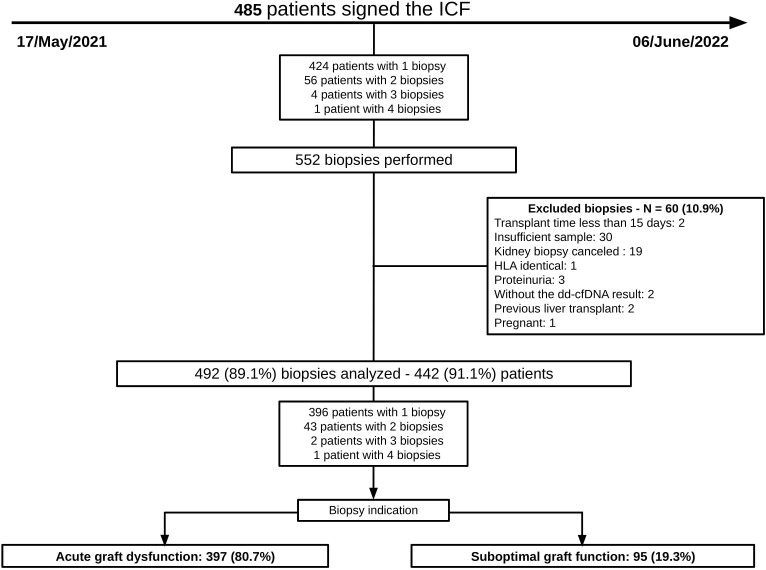
Disposition of study samples.
Table: Demographics of the study population
A total of 492 dd-cfDNA tests were performed, with results showing a mean value of 0.81%, ranging from 0.01% to 21.02%. The median was 0.35%, with an IQR of 0.18% to 0.63%. Most of the study population, corresponding to 419 cases (85.2%), had dd-cfDNA values below 1%.
Figure 2, represented by a boxplot of dd-cfDNA percentages according to the Banff 2022 classification, shows greater dispersion and higher values in category 2 compared with the other categories (p < 0.001). Biopsy-proven acute rejection was identified in 71 biopsies, corresponding to 14.4% of all for-cause biopsies in the cohort. Among these, 32 biopsies were classified as antibody-mediated rejection (Banff category 2) and 39 as T-cell-mediated rejection (Banff category 4). The distribution of histological phenotypes was 10.2% (N = 50) in category 1, 6.5% (N = 32) in category 2, 6.9% (N = 34) in category 3, 7.9% (N = 39) in category 4, 33.3% (N = 164) in category 5, and 35.2% (N = 173) in category 6. The respective median dd-cfDNA percentages were 0.25% (IQR 0.16–0.46), 1.88% (IQR 0.92–5.11), 0.45% (IQR 0.26–0.63), 0.51% (IQR 0.34–1.11), 0.27% (IQR 0.15–0.45), and 0.38% (IQR 0.23–0.64).
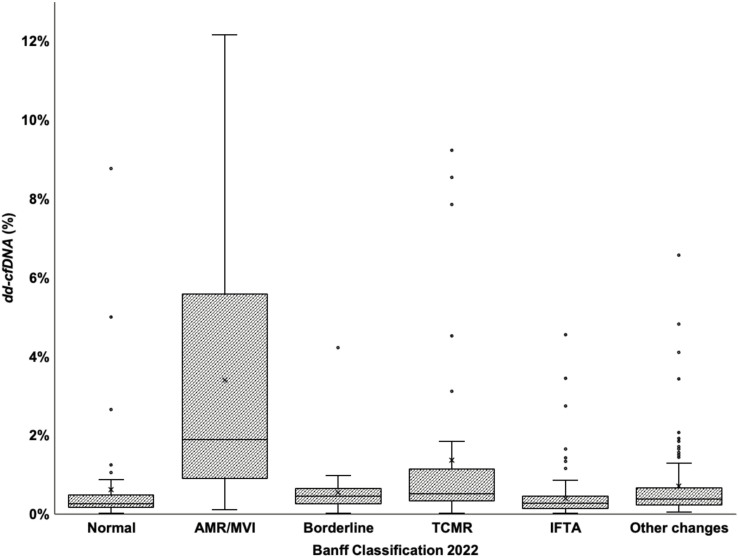
Boxplot showing dd-cfDNA test and 2022 Banff Category.
Using the prespecified threshold of 1.0% to define a positive dd-cfDNA test, the assay showed a sensitivity of 50.7% and a specificity of 91.2% for the detection of biopsy-proven acute rejection, with an overall accuracy of 85.4%. The area under the curve (AUC) was 0.77, suggesting a good ability of the test to discriminate between patients with and without rejection. The positive predictive value (PPV) was 49.3%, and the negative predictive value (NPV) reached 91.6% (Figure 3).
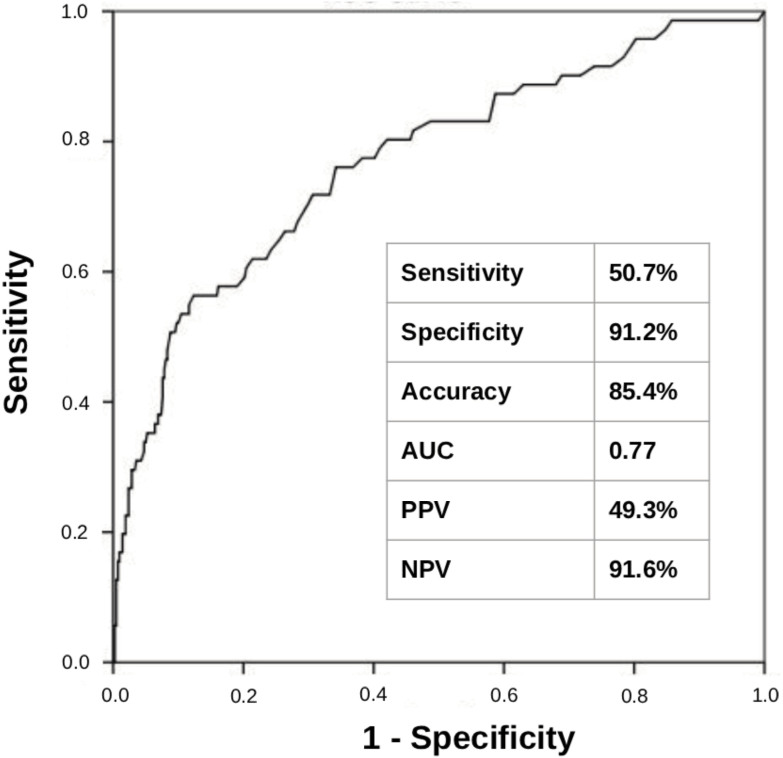
Analysis of dd-cfDNA test performance in the total population.
The optimal cutoff point for the dd-cfDNA test to diagnose rejection was determined for the overall cohort (N = 492) based on the Youden Index. The analysis revealed a cutoff of 0.81%, with a sensitivity of 56.3%, a specificity of 87.6%, and an accuracy of 83.1% for differentiating between active rejection and absence of rejection. The positive predictive value was 43.5%, and the negative predictive value was 92.3%. Overall, 81.3% of the samples had dd-cfDNA levels below the established cutoff point.
Furthermore, the optimal dd-cfDNA cutoff point was determined for the group that underwent biopsy due to acute graft dysfunction (N = 397). The optimal cutoff for dd-cfDNA was 0.46%, with a sensitivity of 75.4%, a specificity of 68.2%, and an accuracy of 69.3% for differentiating between active rejection and absence of rejection. The positive predictive value was 30.1%, and the negative predictive value was 93.9%. In this population, 61.5% of the samples had dd-cfDNA levels below the established cutoff of 0.46%.
The optimal dd-cfDNA cutoff point was also determined for the group that underwent biopsy due to suboptimal graft function (SGF) (N = 95). The optimal cutoff for dd-cfDNA was determined to be 0.81%, with a sensitivity of 70.0%, a specificity of 85.9%, and an accuracy of 84.2% for differentiating between active rejection and absence of rejection. The positive predictive value was 36.8%, and the negative predictive value was 96.1%. Most samples (80.0%) had dd-cfDNA levels below the established cutoff point.
Discussion
Early and accurate detection of kidney graft rejection remains a relevant clinical challenge. Conventional monitoring methods, such as serum creatinine, estimated glomerular filtration rate (eGFR), and biopsy, have limitations related to sensitivity, specificity, and the invasive nature of the procedure11,12. In response to this unmet need, dd-cfDNA has emerged as a promising noninvasive biomarker, capable of reflecting tissue injury almost in real time12. However, despite extensive international evidence, data on the diagnostic performance of this test in Brazilian KTRs—a population with a high incidence of delayed graft function (DGF) compared with other countries22—remain scarce.
This cross-sectional, exploratory, non interventional, single-center study evaluated 492 graft biopsies to investigate the performance of the Prospera dd-cfDNA test as a diagnostic tool for acute rejection in KTRs with a clinical indication for biopsy. In keeping with previous studies and the assay labeling, we initially evaluated the prespecified 1.0% threshold as a clinically meaningful cutoff and then explored data-driven optimal values using ROC curve analysis, which in our cohort suggested a slightly different threshold with comparable overall discrimination.
The diagnostic performance of the dd-cfDNA test in this study was consistent with findings reported in the literature. In the overall cohort, dd-cfDNA values ≥ 1.0% were observed in 14.8% (N = 73) of patients, a proportion very close to the 14.4% (N = 71) of cases undergoing biopsy with histological confirmation of rejection. In addition, dd-cfDNA showed a sensitivity of 50.7% and a specificity of 91.2%, reflecting a satisfactory capacity to identify rejection episodes. The area under the ROC curve was 0.77, indicating moderate performance, in line with previous studies reporting values between 0.71 and 0.88, which varied according to the adopted cutoff and cohort characteristics15,23,24,25,26,27. This epidemiologic context has a direct impact on predictive values: even with high specificity (91.2%), the positive predictive value of dd-cfDNA remained modest (48.3%), whereas the negative predictive value was very high (91.6%). In practical terms, a negative dd-cfDNA result at or below 1.0% is reassuring in a setting where the pretest probability of rejection is low and may help clinicians safely defer kidney biopsy in selected patients, whereas a positive result should be interpreted in conjunction with other clinical and laboratory data rather than as a stand-alone confirmatory test. Clinically, these findings suggest that dd-cfDNA is more useful for ruling out rejection (high NPV) than for confirming it, and that positive results should therefore be confirmed by biopsy.
Determining the optimal dd-cfDNA cutoff is essential to optimize its clinical performance as a diagnostic tool for kidney graft rejection. In the present study, the optimal cutoff identified for the overall sample was 0.81%, with a sensitivity of 56.3% and a specificity of 87.6%. This value differs from the cutoff traditionally adopted, which is usually 1.0% for most tests. However, more recent studies have explored lower cutoffs, around 0.5%15,16,17,18, reflecting the need for population-specific adjustments and reinforcing the trend that lower values may provide better diagnostic performance in certain clinical contexts.
When stratifying the analysis by clinical indication for biopsy, it was observed that the optimal cutoff for the AGD group was 0.46%, with a sensitivity of 75.4% and a specificity of 68.2%. In the SGF group, the optimal cutoff was 0.81%, with a sensitivity of 70.0% and a specificity of 85.9%. This differentiation underscores the importance of considering the clinical context and graft function at the time of dd-cfDNA assessment, as patients with SGF, often associated with ischemia–reperfusion injury or residual surgical trauma, may present elevated baseline levels of the biomarker in the first months post-transplant18,28,29.
Despite the promising performance of dd-cfDNA, it is important to emphasize that no single biomarker replaces kidney biopsy, which continues to provide indispensable information for diagnosis and therapeutic guidance. Thus, the integration of dd-cfDNA with conventional biomarkers has the potential to compose a safer and more individualized diagnostic strategy, being particularly useful for avoiding kidney biopsies in clinical scenarios in which the likelihood of acute rejection is low, given the high negative predictive value and modest positive predictive value observed in our cohort.
This study represents the first evaluation of dd-cfDNA performance in a Brazilian kidney transplant population, characterized by a high incidence of DGF and, consequently, incomplete recovery of graft function. This context highlights the need to generate local evidence on the applicability of dd-cfDNA in this population.
Another relevant aspect is the operational feasibility of using dd-cfDNA in a decentralized model of sample collection, storage, and shipping. The present study demonstrated that this decentralized logistics model is feasible and preserves test integrity, enabling results comparable to international data. Thus, dd-cfDNA proves to be a tool compatible with the logistical reality of the Brazilian healthcare system, potentially expanding the scope of follow-up for transplant recipients. However, the cost of the test represents a significant challenge for its large-scale implementation, both in Brazil and in the context reported by the group of Nissaisorakarn et al.19.
This study has some limitations that should be considered when interpreting the results. First, it is a single-center study; however, the analyzed sample is numerically larger than that of most studies available in the literature, which strengthens the robustness of the presented data. Furthermore, the cross-sectional design of the study did not allow for longitudinal monitoring of individual baseline dd-cfDNA levels.
The findings of this study contribute significantly to the advancement of dd-cfDNA use in kidney transplantation, especially in settings with a high incidence of delayed graft function, such as Brazil. In clinical practice, these results support the potential incorporation of dd-cfDNA as a complementary test in the investigation of graft dysfunction, aiding clinical decision-making regarding the need for biopsy.
Multicenter studies with a longitudinal design, involving different centers and population profiles, are essential to expand the external validity of the results. The incorporation of instruments to assess patient quality of life could provide relevant information on the clinical impact of the test and its potential benefits in terms of well-being, particularly considering the reduction in the need for invasive procedures. Additionally, it is imperative to validate and expand the applicability of dd-cfDNA in populations such as Brazil, as well as to establish specific cutoffs tailored to different epidemiological contexts.
The results obtained reinforce its potential for integration into clinical practice, provided that its use is supported by additional studies confirming its performance across different settings. In Brazil, challenges such as cost, implementation, and methodological standardization still need to be addressed to enable its large-scale adoption.
References
- LohéacCAubertOLoupyALegendreCÉtude des étiologies spécifiques de perte des greffons rénaux : place du rejet médié par les anticorps et approche en populationNephrol Ther201814S39S50 doi.org/10.1016/j.nephro.2018.02.018
- LiuYBaiHQianYAnalysis of causes of graft loss in 135 kidney transplant recipientsNan Fang Yi Ke Da Xue Xue Bao20234311338 doi.org/10.12122/j.issn.1673-4254.2023.01.19
- VazMLRequião-MouraLPestanaJMHospital do Rim: 25 anos como líder global em transplantes renaisBrazilian Journal of Nephrology2024463e20240076 doi.org/10.1590/2175-8239-jbn-2024-0076en
- NgaHSAndradeLGMConttiMMValiattiMFSilvaMMTakaseHMEvaluation of the 1000 renal transplants carried out at the University Hospital of the Botucatu Medical School (HCFMB) - UNESP and their evolution over the yearsJ Bras Nefrol20184021629 doi.org/10.1590/2175-8239-jbn-3871
- PestanaJMRequião-MouraLSandes-FreitasTTedesco-SilvaHTransplante renal: manual pratico - Uso diario ambulatorial e hospitalar2PiracicabaBalieiro2022
- LorentMFoucherYKerleauKBrouardSBaayenCLebouterSThe EKiTE network (epidemiology in kidney transplantation - a European validated database): an initiative epidemiological and translational European collaborative researchBMC Nephrol2019201365 doi.org/10.1186/s12882-019-1522-8
- ZhangWRParikhCRBiomarkers of acute and chronic kidney diseaseAnnu Rev Physiol201981130933 doi.org/10.1146/annurev-physiol-020518-114605
- HoQYLimCCTanHZSultanaRKeeTHtayHComplications of percutaneous kidney allograft biopsy: systematic review and meta-analysisTransplantation202210671497506 doi.org/10.1097/TP.0000000000004033
- RedfieldRRMcCuneKRRaoASadowskiEHansonMKoltermanAJNature, timing, and severity of complications from ultrasound-guided percutaneous renal transplant biopsyTranspl Int201629216772 doi.org/10.1111/tri.12660
- WhittierWLGashtiCSaltzbergSKorbetSComparison of native and transplant kidney biopsies: diagnostic yield and complicationsClin Kidney J201811561622 doi.org/10.1093/ckj/sfy051
- WestphalSGMannonRBBiomarkers of rejection in kidney transplantationAm J Kidney Dis202585336474 doi.org/10.1053/j.ajkd.2024.07.018
- ThongprayoonCVaitlaPCraiciIMLeeaphornNHansrivijitPSalimSAThe use of donor-derived cell-free DNA for assessment of allograft rejection and injury statusJ Clin Med2020951480 doi.org/10.3390/jcm9051480
- KatariaAAthreyaAGuptaGBiomarkers in kidney transplantationAdv Kidney Dis Health202431542735 doi.org/10.1053/j.akdh.2024.06.001
- JaikaransinghVMakadiaBKhanHSHasanIClinical use of donor-derived cell-free DNA in kidney transplantationWorld J Transplant202414497219 doi.org/10.5500/wjt.v14.i4.97219
- BuLGuptaGPaiAAnandSStitesEMoinuddinIClinical outcomes from the Assessing Donor-derived cell-free DNA Monitoring Insights of kidney Allografts with Longitudinal surveillance (ADMIRAL) studyKidney Int20221014793803 doi.org/10.1016/j.kint.2021.11.034
- AubertOUrsule-DufaitCBrousseRGueguenJRacapéMRaynaudMCell-free DNA for the detection of kidney allograft rejectionNat Med202430823202327 doi.org/10.1038/s41591-024-03087-3
- HiraiTBannoTOmotoKShimizuTHidakaSKijimaYDonor-derived cell-free DNA for diagnosing subclinical rejection: a pilot multicenter study in japanese living-donor kidney transplantationClin Transplant2025397e70221 doi.org/10.1111/ctr.70221
- LaneRNieJKaylerLKDonor-derived cell-free DNA as a graft injury marker following kidney transplantationTransplant Direct202283e1301 doi.org/10.1097/TXD.0000000000001301
- NissaisorakarnPPatelHAmtulAPavlakisMProtocol-based donor-derived cell-free DNA surveillance in kidney transplant recipients: A single-center experienceClin Nephrol20229826574 doi.org/10.5414/CN110760
- NaesensMRoufosseCHaasMLefaucheurCMannonRBAdamBAThe Banff 2022 Kidney Meeting Report: reappraisal of microvascular inflammation and the role of biopsy-based transcript diagnosticsAm J Transplant202424333849 doi.org/10.1016/j.ajt.2023.10.016
- IBM CorpIBM SPSS Statistics for Windows [software]Version 29. 0Armonk (NY)IBM Corp2022
- Sandes-FreitasTVMazzaliMManfroRCAndradeLGMVicariARSousaMVExploring the causes of the high incidence of delayed graft function after kidney transplantation in Brazil: a multicenter studyTranspl Int20213461093104 doi.org/10.1111/tri.13865
- BloomRDBrombergJSPoggioEDBunnapradistSLangoneAJSoodPCell-free DNA and active rejection in kidney allograftsJ Am Soc Nephrol2017287222132 doi.org/10.1681/ASN.2016091034
- HuangESethiSPengANajjarRMirochaJHaasMEarly clinical experience using donor-derived cell-free DNA to detect rejection in kidney transplant recipientsAm J Transplant2019196166370 doi.org/10.1111/ajt.15289
- HalloranPFReeveJMadill-ThomsenKSDemkoZPrewettABillingsPThe trifecta study: comparing plasma levels of donor-derived cell-free DNA with the molecular phenotype of kidney transplant biopsiesJ Am Soc Nephrol2022332387400 doi.org/10.1681/ASN.2021091191
- HalloranPFReeveJMadill-ThomsenKSKaurNAhmedECantosCCombining donor-derived cell-free DNA fraction and quantity to detect kidney transplant rejection using molecular diagnoses and histology as confirmationTransplantation202210612243542 doi.org/10.1097/TP.0000000000004212
- BrombergJSBunnapradistSSamaniego-PicotaMAnandSStitesEGauthierPElevation of donor-derived cell-free DNA before biopsy-proven rejection in kidney transplantTransplantation2024108919942004 doi.org/10.1097/TP.0000000000005007
- MirzaAGaniIParvezIWeaverCMulloyLKapoorRIdentification of factors influencing donor-derived cell-free DNA levels up to one year after kidney transplantJ Transplant2024202417673476 doi.org/10.1155/joot/7673476
- AnandSLopez-VerdugoFSanchez-GarciaJDongLFifeMKrongJLongitudinal variance of Donor-Derived Cell-Free DNA (dd-cfDNA) in Stable Kidney Transplant (KTx) patients are influenced by donor/recipient variablesClin Transplant2021359e14395 doi.org/10.1111/ctr.14395
Republished from the open web under CC-BY. Authors: Nakamura MR, Foresto RD, Gomes VRDS, Proença HM, Requião-Moura L, Medina-Pestana J, Tedesco-Silva H. Read the original.