Effects of a 4-Week Multi-Exercise Isometric Resistance Training Programme on Resting and Ambulatory Blood Pressure in Normotensive Adults.
Isometric resistance training (IRT) can reduce resting and ambulatory blood pressure (AmBP) yet established exercise methods lack versatility and may present with participation barriers. An isometric training band (ITB) has been identified as an alternative modality; however, its long-term effects on resting and ambulatory blood pressure (BP) remains unknown. This study assessed the effects of the ITB on resting BP and AmBP following 4 weeks of IRT. Forty-two normotensive adults (22 male, 20 female; mean ± SD, age 31 ± 14 years, systolic [sBP], 120 ± 5 mmHg, diastolic [dBP], 72 ± 7 mmHg), were randomised to a control (CON), isometric handgrip (IHG) or ITB group. Resting (systolic, diastolic, mean arterial BP and heart rate [HR]) and AmBP (24-h, daytime and night-time) were measured pre- and post-4 weeks of supervised IRT (4 x 2-min contractions at 30% MVC [IHG] or 4 x 2-min contractions at CR-10 values equivalent to 30% MVC [ITB]). Resting sBP was reduced for IHG (-4.6 mmHg, p 0.05 across all measures). These findings suggest 4 weeks of IRT using the ITB can elicit reductions in resting BP and night-time AmBP in normotensives comparable to IHG, indicating the ITB may offer a practical and cost-effective alternative to established interventions.
Introduction
High blood pressure (BP) is a significant global condition estimated to be prevalent in 1.3 billion people (Zhou et al.2021) attributable to a fifth of global deaths (∼10 million) and 235 million disability‐adjusted life years annually (Abbafati et al.2020). Left uncontrolled elevated systolic blood pressure (sBP) is the leading risk factor for cardiovascular disease‐related mortality (Abbafati et al.2020) and a significant risk factor for cerebrovascular disease (Webb and Werring2022) ischaemic stroke, intracerebral haemorrhage and chronic kidney disease (Burnier and Damianaki2023). Despite effective lifestyle interventions (Carey et al.2021), including physical activity and pharmacotherapy, adherence and compliance remain low with global estimates of only ∼17% of adults meeting physical activity guidelines (Garcia‐Hermoso et al.2023) and ∼50% discontinuing initial pharmacological treatment within a year of prescription (Vrijens et al.2008). Therefore, alternative efficacious and adherable strategies are required to combat this global public health challenge.
Isometric resistance training (IRT) is an established nonpharmacological therapeutic intervention to manage hypertension (Edwards et al.2024), with significant BP reductions achieved with reduced time requirements (∼24‐min per week) compared to commonly prescribed exercise guidelines (150‐min per week). Given a ‘lack of time’ is a significant barrier to physical activity participation (Healy et al.2024), IRT may offer a practical alternative. Despite evidence supporting reductions in resting BP, the impact on ambulatory blood pressure (AmBP) is largely confined to prehypertensive and hypertensive populations (Pagonas et al.2017; Stiller‐Moldovan et al.2012; Taylor et al.2019) with only Baross et al. (2024) and Somani et al. (2017) reporting significant reductions in young normotensive cohorts. Yet, with the prevalence of hypertension rising amongst younger populations (Haseler et al.2023) and the heightened lifetime risk associated with elevated BP at a younger age (Hamrahian and Falkner2022), AmBP represents an important clinical outcome for investigation. In normotensives, AmBP may provide greater clinical value for establishing risk and assessing the preventive effects of exercise interventions as it can establish hypertension phenotypes that remain undetected during resting office measurements, such as white‐coat and masked hypertension (Viera and Shimbo2014). Furthermore, AmBP enables the assessment of additional parameters, including ambulatory arterial stiffness index (AASI) and blood pressure variability (BPV). The AASI provides an indirect assessment of vascular stiffness (Li et al.2006), thus allows insight into potential vascular adaptation. Additionally, BPV can be calculated from individual 24‐h ambulatory profiles and is a clinically relevant marker associated with hypertension mediated organ damage, mortality and future development of hypertension (Parati et al.2020; Sega et al.2002; Stevens et al.2016). Collectively, these measures may help to elucidate the mechanisms through which isometric resistance training induces vascular adaptations and reduces long‐term hypertension risk.
Amongst IRT modalities, isometric handgrip (IHG) interventions are the most widely cited, evidencing significant reductions in resting BP irrespective of hypertensive status (Edwards et al.2023). Alternate methods (wall squat and bilateral leg extension) have demonstrative BP lowering capabilities (Baross et al.2013; Wiles et al.2017) though may present with participation barriers as bilateral leg extension requires the use of specialised inaccessible equipment occurring a high cost, and necessitates trained personnel for use. Whereas the isometric wall squat has been described as ‘difficult’ and ‘challenging’ (Roberts et al.2024), and require individuals to perform an incremental exercise test for intensity prescription which has been considered “complicated’’ and likely inaccessible for individuals with mobility limitations (Roberts et al.2024). Moreover, all current established IRT methods have reduced exercise variety, which may hinder long‐term adherence (Bachmann et al.2018). Thus, a recognised and inexpensive isometric training band (ITB) may enhance accessibility to IRT and offer a portable and practical alternative (Wright et al.2025). The ITB has the capacity to facilitate a range of isometric exercises of differing and multiple muscle groups, with the versatility of exercise choice having implications for long‐term exercise adherence (Wulf et al.2014). Although recently validated against IHG (Wright et al.2025), it remains unknown if an ITB training intervention will elicit a reduction in resting or AmBP. Moreover, it is of clinical interest to examine if a multiexercise ITB protocol utilising larger muscle groups may elicit superior BP reductions compared to conventional single exercise IRT modalities (Seals et al.1983). Hence, it is important to ascertain the efficacy of the ITB protocol to reduce resting and AmBP and to compare to volume‐matched established IRT modalities.
Therefore, the aims of this study were to determine if resting BP and AmBP are reduced following a 4‐week ITB intervention and to examine if effects on BP are comparable to a volume‐matched validated IHG protocol. It was hypothesised that the ITB protocol would elicit significant BP and AmBP reductions when compared to a volume‐matched IHG protocol following a 4‐week intervention.
Materials and Methods
Participants
Forty‐two healthy normotensive adults (22 male, 20 female, [mean ± SD], age 31 ± 14 years, height 170 ± 10 cm, mass 75 ± 16 kg, systolic [sBP], 120 ± 5 mmHg, diastolic [dBP], 72 ± 7 mmHg, mean arterial [mBP], 88 ± 6 mmHg, heart rate [HR], 67 ± 12 bpm·−1) were recruited and randomised to a control (CON), IHG or ITB group (Figure1) using block randomisation through an online number randomiser (Randomizer.org). As evidence suggests that sex does not influence the magnitude of BP reductions following IRT (Bentley et al.2015; Somani et al.2017), randomisation was not stratified by sex. Prior to the initial data collection session, participants provided written informed consent and completed a physical activity readiness questionnaire to determine eligibility. Participants were excluded if classified as pre or hypertensive (≥ 130 mmHg sBP and/or ≥ 85 mmHg dBP) from the initial baseline measurement of resting BP, if presenting with a diagnosed cardiovascular, metabolic or respiratory disease (type 1 or type 2 diabetes, CVD, stroke, atrial fibrillation and chronic obstructive pulmonary disease) or a musculoskeletal impairment preventing the ability to complete isometric exercise.
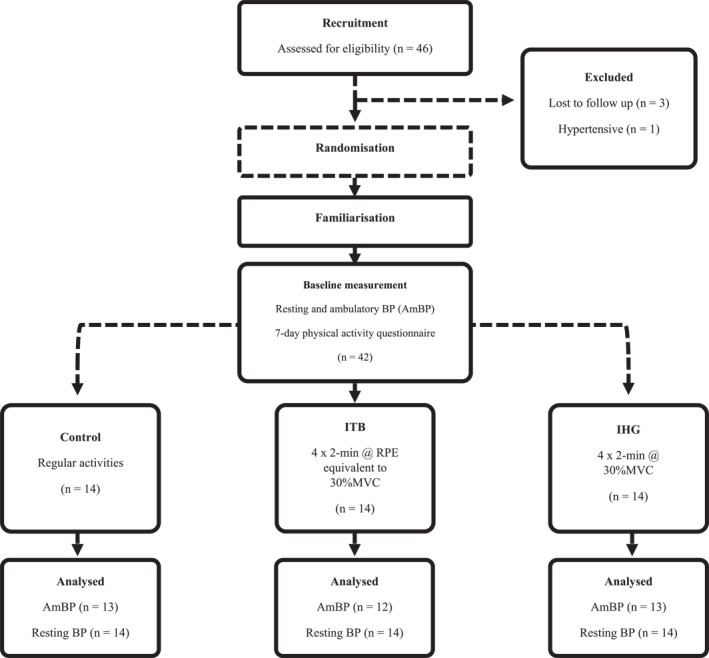
Schematic diagram of the study protocol including participant exclusion, randomisation, allocation of group and completed measurement. AmBP, ambulatory blood pressure measurement; BP, blood pressure; IHG, isometric handgrip; ITB, isometric training band; MVC, maximal voluntary contraction; RPE, rating of perceived exertion.
Study Design
The study employed a prospective randomised control trial design. Participants were nonsmokers, nonmedicated and recreationally active by self‐reported physical activity levels (IPAQ‐SF, Table1) and were instructed to maintain current habitual physical activity levels throughout the duration of the study. Adherence to habitual physical activity was confirmed through verbal confirmation, alongside the comparison of physical activity levels pre and postintervention. Participants were initially familiarised on each measurement procedures, alongside interpretation of the category‐ratio Scale (CR‐10), in addition to the assigned exercise modality if randomised to an exercise group. The CR‐10 scale was selected given its development to be used for localised muscle exertion, and in its application in eliciting comparable responses to the widely prescribed IHG protocol (Wright et al.2025). Recruitment was completed through advertisement on social media, word of mouth and organisational internal communications. Baseline measurements were completed a minimum of 24‐h from participants' previous physical activity session and for female participants during the same phase of the menstrual cycle. With postmeasurements completed ≥ 24‐h from the final isometric training session to prevent potential influence of exercise‐induced hypotensive effects (Chen and Bonham2010). Before each visit, participants verbally verified adherence to pretesting requirements, which required avoiding strenuous exercise for the preceding 24 h, refraining from alcohol and caffeine for 12 h and maintaining a 4‐h fasting period (Kallioinen et al.2017). Institutional ethical approval was obtained (ETH1920‐ 0152) in accordance with the latest Declaration of Helsinki. To estimate sample size, a priori power analyses were completed via G*Power (v.3.1 Düsseldorf, Germany), with effect size measures (Cohen'sd) calculated (1.2) from previous isometric resistance training studies of comparable duration (4 weeks) sampling normotensive adults (Baddeley‐White et al.2019; Devereux et al.2010) a total sample size of 34 participants was required. Accounting for an anticipated attrition rate of 20% (Linke et al.2011), the final estimated sample size was set at 42 participants.
Table: Comparison of participant baseline characteristics.
Procedures
Resting Blood Pressure Measurement
Resting BP (sBP, dBP and mBP) was measured using a digital automatic oscillometric BP device (Omron HEM‐907, Omron Healthcare, Japan). Resting BP was measured by placing the BP cuff covering 80% of the upper left arm ∼1.5 cm above the antecubital fossa and with the artery position marker set in line with the brachial artery. During measurement, participants were seated with legs uncrossed, feet flat and with their back supported, the upper arm was rested and supported at mid‐sternal level. After 10‐min of uninterrupted seated rest, three blood pressure readings were taken at 1‐min intervals and the average of these readings was used as the baseline resting measurement (Whelton et al.2018).
Ambulatory Blood Pressure Measurement
Ambulatory blood pressure was measured with fully automated BP monitors (ABPM‐06, Meditech, Hungary) programmed with CardioVisions software (Version 1.30.0, Meditech, Hungary). Devices were programmed to record BP at 30‐min intervals during daytime and 60‐min intervals at night‐time with both time periods individually defined by participant. During measurement, participants were advised to cease movement, remain still, and relax their hand by their side (Williams et al.2018). If participants were seated, they were recommended to support their arm at heart level. Participants wore devices on nonworking days and were advised that for day of measurement they were not to participate in sport or exercise but to continue usual habitual behaviours. On return of the device, participants verbally confirmed sleep periods were unchanged.
Blood Pressure Variability
To assess short‐term blood pressure variability (BPV), the average real variability (ARV) index was calculated for each individual 24‐h blood pressure measurement (Aizpu et al.2005).
Ambulatory Arterial Stiffness Index
To calculate the ambulatory arterial stiffness index (AASI), a linear regression was fitted to each participant's unedited 24‐h ambulatory blood pressure profile, with dBP regressed on sBP, with AASI defined as 1 minus the resulting regression slope (Dolan et al.2006).
Physical Activity Measurement
The international physical activity questionnaire short‐form (IPAQ‐SF) was completed by each participant pre and post the 4‐week training intervention to confirm habitual activity levels were maintained. This provided support that any observed changes in BP may be attributed to the isometric training intervention rather than a consequence of changes in weekly physical activity (Gribble et al.2025). Data were analysed through a scoring spreadsheet providing an automatic calculation of IPAQ results and individual activity reports. MET‐min per week for each activity domain were recorded, and total weekly MET‐min per week. Weekly physical activity levels were classified as low (failing to meet required MET‐min per week for moderately active), moderate (achieving at least 600 MET‐min per week) and high achieving at least 3000 MET‐min per week (Kim et al.2012).
Isometric Resistance Training
Both exercise groups were required to complete 4 weeks of supervised IRT programme. Exercise sessions were completed 3 days·a week for 4 weeks. Each exercise session was supervised by the lead researcher, and sessions were separated by at least 48 h.
Isometric Handgrip
Isometric handgrip exercise was completed using a digital handgrip dynamometer (Zona Plus, Zona Health, USA). Participants completed a 3‐s maximal contraction to determine MVC, once established participants completed 4 x 2‐min contractions of alternating hands at 30% MVC, interspersed with a 1‐min rest period. During each 2‐min contraction participants received standardised verbal feedback, delivered at 30‐s intervals and were instructed to use visual and auditory cues provided from the digital display of the dynamometer to ensure the correct intensity was adhered to. On completion of a full training bout (4 x 2‐min), a session was deemed successful if participants were able to maintain the contraction intensity (30% MVC) for at least 80% of the prescribed training session to the extent that individual repetitions were held for ∼96 s at 30% MVC (Correia et al.2020). Adherence was presented visually on the IHG device and recorded after each individual training, and data exported from the IHG device at the end of each training week. Handgrip strength was determined by calculating the mean weekly MVC value for each hand, with differences in week 1–4 analysed to determine changes in handgrip strength across the intervention.
Isometric Training Band
Participants completed the ITB exercises in the following order: chest fly, seated lunge, seated pull and the bicep curl and tricep extension (Wright et al.2025). A fixed order sequence of the individual exercises was prescribed to ensure a consistent and standardised protocol across the intervention. As it has been observed that specific ITB exercises may elicit a larger HR response to a single IHG contraction when performed in isolation (Wright et al.2025), standardising the exercise order reduces order effects disproportionately affecting the cumulative exercise load. Moreover, Wright et al. (2025) demonstrated that when examining complete ITB bouts, in which exercise order was randomised, cardiovascular responses remained modest and safe regardless of exercise sequence. In the present protocol, the seated pull was positioned towards the end of the bout to avoid front‐loading the possibility of an elevated cardiovascular response. A complete ITB bout consisted of a 2‐min contraction for each of the 4 exercises separated by a 2‐min rest period. Contraction intensity was regulated following findings from Wright et al. (2025) shown to be equivalent to 30% MVC of IHG. This required participants to complete each exercise at a perceived localised exertion (CR‐10) that represents 4 at min−1, which progressed to an RPE of 5 by the end of min−2. Participants were shown the CR‐10 scale throughout each contraction to support adherence to the required intensity, alongside a verbal reminder of the required CR‐10 value delivered at fixed 30‐s intervals, ensuring consistency across both isometric training modes.
Data Analysis
Statistical analysis was completed using the Statistical Package of Social Sciences for Windows (SPSS, Version 28.0 IBM, Armonk, New York). Data were assessed for parametric assumptions (Field2017) with normality of distribution analysed through Shapiro–Wilk tests. Where the distribution of data were non‐normal (Night‐time HR), data were logarithmically transformed (Log10). For nonparametric data (dBPNight‐time), a nonparametric Friedman's test was completed to analyse differences within group and a Kruskal–Wallis to assess differences between groups with Wilcoxon signed‐rank tests used for a post hoc assessment. All other normally distributed data were analysed using two‐way mixed model ANOVAs (time [pre and post] x group [CON, ITB and IHG]) to assess interaction effects and main effects for time and group. Moreover, absolute differences (post–pre) were analysed using a one‐way ANOVA with independentt‐tests used for the post hoc assessment. Sphericity assumption was satisfied as the repeated measure treatment variable consisted of two levels (pre and post). Estimates of effect sizes were calculated using partial eta squared (ηp2) with Cohen'sdcalculated for all pairwise comparison and interpreted as small (0.2–0.49), medium (0.5–0.79) and large (> 0.8) (Cohen1992). Moreover, For the CON group, all BP variables were analysed for group variation calculated by coefficient of variation (CoV) expressed as a percentage. Between group variable data, change data and results of pairwise comparisons were reported as mean ± standard error (SE). Alpha was set at 0.05 for all analysis.
Results
Participant Baseline Characteristics
There were no significant differences between groups at baseline for all measures (p> 0.05, Table1). Self‐reported physical activity did not significantly change over the course of the intervention with no significant main effect of time, (F(1, 39)= 0.011,p= 0.916), interaction effect (F(2, 39)= 1.847,p= 0.171) or main effect of group (F(2, 39)= 0.294,p= 0.747). Adherence for both exercise groups (ITB and IHG) was 100% with both successfully completing the twelve supervised training sessions over the 4‐week intervention. No change in MVC was observed between week‐1 and week‐4 for IHG (51.9 ± 2.1 vs. 51.2 ± 1.9,p> 0.05), with participants achieving an average of 93.2% from the 80% requirement for maintaining IHG contraction intensity. In both exercise groups, no adverse events were reported. The reliability of measurement for CON were (CoV with 95% CI) resting sBP 1.1% (0.4%–1.8%), dBP 4.8% (3.0%–6.6%), mBP 2.9% (1.6%–4.3%), HR 5.0% (3.2%–6.8%), sBP24Hour2.5% (0.7%–4.2%), sBPDaytime2.5% (0.8%–4.3%) and sBPNight‐time2.9% (1.1%–4.8%).
Resting Blood Pressure Measures
There was a significant interaction effect for resting sBP (F(1, 39)= 13.35,p= < 0.001,ηp2= 0.406). Post hoc pairwise comparisons revealed significant reductions for IHG (−4.6 ± 3.6 mmHg,p< 0.05) and ITB (−4.5 ± 3 mmHg,p< 0.05) but not CON (0.57 ± 0.8 mmHg,p= 0.489). Group mean reductions in resting sBP were significantly greater than CON for both training groups ITB (−5.1 ± 1.2 mmHg,p= < 0.001,d= 1.89) and IHG (−5.2 ± 1.6 mmHg,p= < 0.001,d= 1.70). However, there were no significant differences in the magnitude of BP reduction between training groups (0.071 ± 1.1 mmHg,p= > 0.05,d= 0.021, Figure2). For resting dBP, there were no main effect for time (F(1,39)= 0.440,p= 0.511,ηp2= 0.011), no significant interaction effect (F(2,39)= 700,p= 0.503,ηp2=0.035) or main effect of group (F(2,39)= 1.02,p= 0.368,ηp2= 0.050, Table2). Group mean reductions in resting dBP were not significantly different between groups (F(2,39)= 0.902,p= < 0.414,ηp2= 0.044).
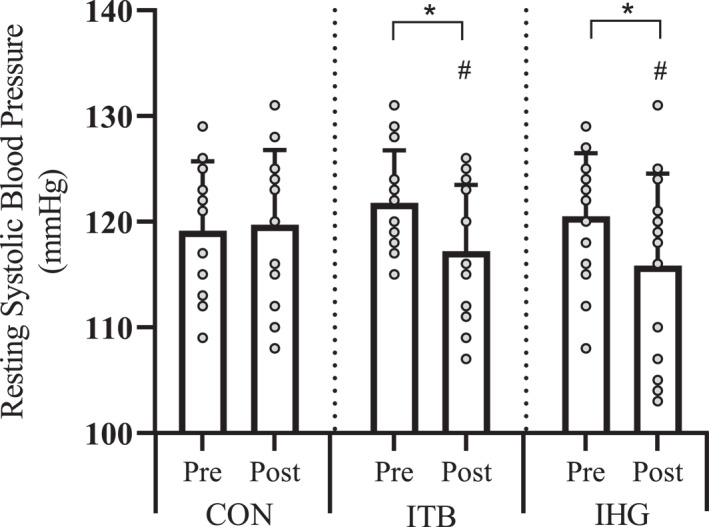
Changes in resting systolic blood pressure pre to postintervention in control (CON), isometric training band (ITB) and isometric handgrip (IHG) groups. Columns represent mean and SD with individual data points overlaid. * indicates a significant within‐group difference (p< 0.05). # indicates significant difference compared to CON (p< 0.05).
Table: Within group pre and post, resting and ambulatory blood pressure changes.
Resting mBP
Equally, for resting mBP, there were no main effect for time (F(1,39)= 3.29,p= 0.077,ηp2= 0.078) and no significant interaction effect between time and group (F(2,39)= 2.023,p= 0.146,ηp2= 0.094), alongside no main effect of group (F(2,39)= 0.543,p= 0.585,ηp2= 0.027) with the magnitude of change not significant between groups (F(2,39)= 2.898,p= 0.067,ηp2= 0.129).
Resting HR
For resting HR, there were no interaction effects (F(2,39)= 0.003,p= 0.997,ηp2= 0.000) or main effects of time (F(1,39)= 0.088,p= 0.768,ηp2= 0.002) or group (F(2,39)= 0.125,p= 0.883,ηp2= 0.006, Table2) with the magnitude of change not significant between groups (F(2,39)= 0.008,p= 0.993,ηp2= 0.01).
Ambulatory Blood Pressure Measures
Attrition for CON, ITB and IHG for AmBP measurement were 7.4% (13/14) 14.29% (12/14) and 7.4% (13/14), respectively. Causes of attrition were reported to be participant discomfort, failure to wear on a nonworking day and a failure to achieve the required number of measurements necessary for data analysis.
Ambulatory 24‐Hour Measurement
No interaction effects (F(2,35)= 0.711–2.811,p= 0.074–0.498,ηp2= 0.039–0.138) or main effects of time (F(1,35)= 0.011–1.894,p= 0.177–0.918,ηp2= 0.006–0.051) or group (F(2,35)= 0.294–1.583,p= 0.220–0.747,ηp2= 0.017–0.083) were identified for 24‐h dBP, mBP and HR (Table2).
Ambulatory Daytime Measurement
No interaction effects (F(2,35)= 0.136–0.873,p= 0.414–873,ηp2= 0.008–0.049) or main effects of time (F(1,35)= 0.084–2.531,p= 0.121–0.773,ηp2= 0.002–0.067) or group (F(2,35)= 0.080–1.739,p= 0.191–923,ηp2= 0.005–0.090) were observed for daytime sBP, dBP, mBP or HR (Table2).
Ambulatory Night‐Time Measurement
A significant interaction effect was revealed for sBPNight‐time(F(2,35)= 5.256,p= 0.010,ηp2= 0.231). Post hoc pairwise comparisons revealed significant reductions (p< 0.05) in both training groups (ITB −4 ± 1.8 mmHg, IHG, −4.7 ± 1.8 mmHg). Group mean reductions were significantly greater than CON (F(2,35)= 5.347,p= < 0.009,ηp2= 0.234), for the ITB (−6.9 ± 2.6 mmHg,p= 0.036,d= 1.17) and IHG (−7.6 ± 2.5 mmHg,p= 0.016,d= 1.2), though between training groups there was no significant difference (0.67 ± 2.6 mmHg,p= > 0.05,d= 0.094. Figure3).
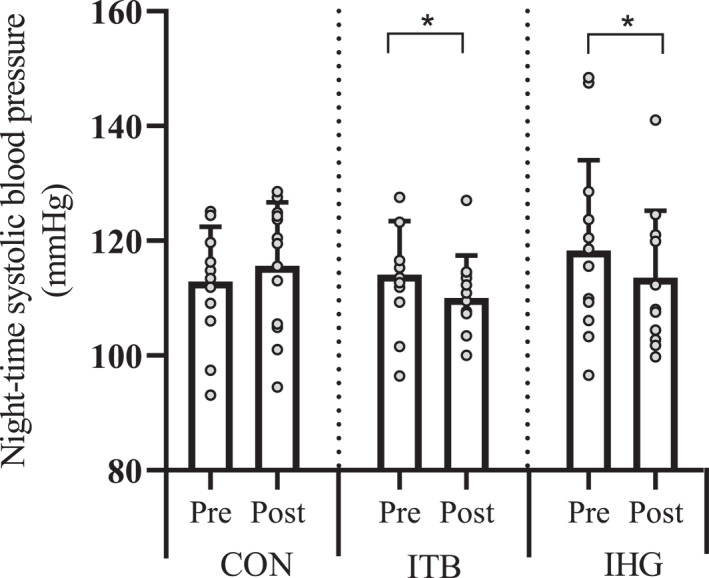
Changes in night‐time systolic blood pressure pre to postintervention in control (CON), isometric training band (ITB) and isometric handgrip (IHG) groups. Columns represent mean ± SD with individual data points overlaid. * indicates a significant within‐group difference (p< 0.05).
There were no significant differences in dBPNight‐timebetween groups at baseline χ2(2) = 4.052,p= 0.132 or post‐4 weeks of IRT χ2(2) = 4.519,p= 0.104. With no significant differences across time within groups χ2(1) = 0.243 andp= 0.622. Similarly, no interaction effects (F(2,35)= 1.023,p= 0.370,ηp2= 0.055) or main effects of time (F(1,35)= 0.113,p= 0.738, ηp2= 0.003) or group (F(2,35)= 0.137,p= 0.872,ηp2= 0.008) were identified for night‐time HR(Log10).
Ambulatory Arterial Stiffness Index
There was a significant interaction effect between time and group (F(2,35)= 3.359,p= 0.046,ηp2= 0.161) with no main effect of time (F(1,35)= 0.028,p= 0.896,ηp2= 0.001) or main effect of group (F(2,35)= 1.459,p= 0.246,ηp2= 0.077). Pairwise comparisons identified a significant increase in AASI for the control group (0.36 ± 0.04 vs. 0.48 ± 0.05,p= 0.043,d= 0.57), with no significant pre‐to‐post changes observed in the training groups. Analysis of change scores showed no significant differences between groups (F(2,37)= 0.253,p= 0.094,ηp2= 0.126).
Blood Pressure Variability
For systolic ARV, there were no interaction effects (F(2,35)= 0.505,p= 0.608,ηp2= 0.028) alongside no main effects for time (F(1,35)= 0.046,p= 0.831,ηp2= 0.001) or group (F(2,35)= 0.038,p= 0.963,ηp2= 0.002) alongside no significant differences in absolute change scores (F(2,37)= 0.328,p= 0.722,ηp2= 0.018). Similarly, for diastolic ARV, no interaction effects were observed (F(2,35)= 0.761,p= 0.475,ηp2= 0.042) with no main effect for time (F(1,35)= 1.064,p= 0.309,ηp2= 0.029) or group (F(2,35)= 1.212,p= 0.310,ηp2= 0.065) alongside no significant between‐group absolute differences (F(2,37)= 0.761,p= 0.475,ηp2= 0.042).
Discussion
The primary aims of this study were to establish whether a 4‐week novel ITB exercise intervention reduces resting and AmBP and to examine BP changes following contraction volume‐matched IRT, specifically comparing the ITB with a validated IHG protocol. Findings suggest 4 weeks of IRT performed with the ITB can induce significant reductions in resting sBP and night‐time sBP in a normotensive cohort that are comparable to an established IHG protocol. Moreover, to the authors' knowledge, this is the first study to report significant reductions in night‐time sBP following 4 weeks of IRT in a normotensive cohort. These findings provide support for the ITB being an effective, practical and cost‐effective alternative IRT mode for reducing resting and night‐time sBP.
Reductions in Resting Measures
The significant reductions in resting sBP for both exercise groups are in agreement with those reported in meta‐analyses (Carlson et al.2014; Inder et al.2016) and studies implementing an equivalent IHG protocol (Badrov et al.2013). Moreover, comparable reductions in sBP are reported in 4‐week IRT studies utilising larger muscle groups and prescribing 96 min of total isometric contraction volume (Devereux et al.2010; Wiles et al.2017). Collectively, these findings strengthen the evidence that 4 weeks of IRT totalling 96 min of contraction volume can elicit significant reductions in resting sBP independent of isometric mode, further supporting IRT as a time‐efficient exercise modality in hypertension management. Findings evidence efficacy for the ITB protocol as a novel therapeutic IRT intervention with equivalent sBP reductions to established IHG methods. However, significant reductions in dBP and mBP were not observed for either exercise group (Table2), though not an uncommon finding in IRT research (Baross et al.2012; Carlson et al.2016; Gordon et al.2018; Hess et al.2016) and may be attributed to baseline values being in normal ranges for both exercise groups (ITB, 71 mmHg and IHG, 74 mmHg) thusly limiting capacity for reduction (Carlson et al.2014).
The Impact of Exercising Muscle Mass
Given muscle mass is suggested to be a variable influencing IRT‐induced BP reductions (Lawrence et al.2015), surprisingly the ITB did not elicit superior sBP decreases compared to the IHG. However, this may be explained by the ITB protocol being purposefully designed to elicit a haemodynamic response equivalent to IHG (Wright et al.2025). Larger reductions in sBP have been observed in studies prescribing IRT of larger muscle mass (Decaux et al.2022; Lea et al.2023), though in a prehypertensive population (resting sBP 131 & 134 mmHg, respectively). Variation in the intervention should be acknowledged as the aforementioned studies prescribed repeat contractions of the same muscle groups, producing a consistent cardiovascular stress to the working muscle and local vasculature. In contrast, due to the multiexercise approach of the ITB, each individual bout would have elicited a diminished localised blood flow, shear and haemodynamic stress aligned with the reduced contraction volume for each individual exercise. Over the course of the 4‐week intervention, each individual ITB exercise was prescribed as 24‐min of contraction volume as opposed to 96‐min for singular‐exercise modes. This training volume disparity could have implications on vasculature adaptations through repeat exposure to haemodynamic shear stress. Accordingly, it is of interest to examine if longer application of the ITB protocol may result in typical time‐dependent phasic vascular adaptations (Tinken et al.2010) Furthermore, as within‐session cardiovascular responses were not recorded, the subsequent load may have been variable between participants, which may relate to the interindividual variability in BP reductions observed with IRT (Kelley et al.2021). Also, as the ITB protocol has only safely been established in normotensives (Wright et al.2025), prior to application in pre and hypertensive populations, assessment of the acute response is necessary to prevent any heightened risk of CV events especially as baseline BP may impact the magnitude of the pressor response (Greaney et al.2014).
Changes in Ambulatory Blood Pressure Measures
It is suggested that changes in night‐time sBP provide greater prognostic value for cardiovascular events and all‐cause mortality than daytime or resting BP (Staplin et al.2023). The significant reductions in night‐time sBP combined with the cost of the ITB are encouraging, and further provide evidence for the efficacy of this novel method for IRT. The magnitude of reductions for night‐time sBP agree with those reported following traditional exercise modes (Saco‐ledo et al.2020) and are comparable to other novel IRT modalities (Lea et al.2023). Notably, the ITB protocol employed in the current study adopted a similar method of intensity prescription to that used by Lea et al. (2021) by utilising RPE, further supporting its potential as an effective and accessible alternative method for IRT intensity regulation. The absence of changes in 24‐h and daytime AmBP indices is not uncommon in IRT studies (Goessler et al.2018; Pagonas et al.2017; Stiller‐Moldovan et al.2012) and may be attributed to various factors, including, dropout and attrition rates, absence of a full habituation period (Kleiber et al.2023) alongside baseline sample characteristics. In the present study, attrition in the ITB group was double that of the IHG group, which may have contributed to the observed AmBP results. Some participants were unable to complete AmBP measurements due to discomfort though not an uncommon issue when faced with repeated cuff inflation (Thomsen et al.2023). Furthermore, daily recordings may have been influenced by cuff‐inflation induced hypertension with repeated measurements elevating average daily pressure (Charmoy et al.2007). Reduced measurement frequency is seen to reduce cuff‐related discomfort (Thomsen et al.2023) with low‐frequency (every 60‐min) showing better association with resting BP (Dabrowski et al.2021). Yet, the current study adopted an established protocol (Williams et al.2018) with the frequency of recordings allowing measurement of other parameters such as AASI and BPV. This change of protocol may require the adoption of a 48‐h measurement period, nevertheless longer recording periods are uncommon in clinical practice and participant comfort, adherence and measurement attrition need to be considered.
Effects of Isometric Resistance Training on Blood Pressure Variability and Ambulatory Arterial Stiffness Index
Irrespective of exercise mode, the present study found 4‐week of IRT did not alter BPV which contrast the limited existing literature and likely the result of contrasting methodological approaches as both Baross et al. (2022) and Taylor et al. (2019) prescribed a longer (8‐week) intervention with the latter sampling unmedicated hypertensives. Whereas, the current study sampled normotensives participants who may have limited capacity for change in factors influencing short‐term BPV (Chadachan et al.2018) such as baroreceptor reflex sensitivity, vascular dysfunction and sympathetic activity (Parati et al.2020). On the contrary, longer interventions (≥ 8 weeks) have shown significant changes parallel with improved baroreceptor reflex sensitivity and markers of vascular function (Taylor et al.2019) that agree with time‐course patterns of vascular adaptation (Tinken et al.2010).
This is the first study to examine changes to AASI following an exercise intervention as earlier studies have focused on acute exercise responses (Michalski et al.2023). The absence of AASI changes in both exercise groups suggests a lack of peripheral vascular adaptation, likely due to the intervention's short duration being insufficient to trigger the biphasic pattern of vascular remodelling. Additionally, baseline AASI values were within the normal range < 0.50 (Li et al.2006), potentially limiting the scope for adaptation. Interestingly, the CON group displayed a significant increase without a corresponding increase in resting BP or AmBP, which is unexpected given the contribution of peripheral resistance to BP. Although unexpected, this may be a consequence of the increased 24‐h dBP postintervention as the AASI is derived from the regression of dBP on sBP, its value is sensitive to the variability of the 24‐h profile of dBP (Schillaci and Pucci2015). Moreover, authors cannot rule out this finding being subjective to variability in reproducibility of the AASI (Kollias et al.2012). Kollias et al. (2015) found no changes in AASI despite significant reductions in AmBP and pulse wave velocity following antihypertensive treatment, suggesting AASI may be affected by alternative mechanisms (Schillaci and Pucci2015) which warrants consideration if used interchangeably as a measure of arterial stiffness and compliance. Though without a direct assessment of arterial stiffness caution is required when associating these findings to theoretical BP‐reducing mechanisms.
Limitations and Future Directions
A limitation of the present study is that findings are limited to a healthy normotensive population, thusly not representative of pre and hypertensive adults. Moreover, authors cannot rule out changes to physical activity during measurement and other confounding psychological, and environmental factors potentially influencing AmBP readings (Brook et al.2011; Tomitani et al.2023). This may be a possible reason for the disparity in BP reductions between resting, night‐time and 24‐h and daytime AmBP. Laboratory clinical‐based measurement allows a greater control of external factors allowing mitigation of environmental stressors known to cause transient increases and fluctuations of BP (Brook et al.2011).
Given the multiexercise capability of the ITB future interventions may prescribe individual exercises to optimise the precision of exercise and enhance enjoyment, aligning with the growing interest on personalised exercise prescription, recently emphasised by the European Society of Cardiology (Hanssen et al.2021). However, further research is warranted to establish the BP‐lowering ability of additional ITB exercises of varied prescription. Findings are promising as observed reductions are found in normotensives who typically exhibit a limited capacity for BP change compared to pre and hypertensive populations (MacDonald and Pescatello2018) and in active adults to whom the prevalence of hypertension is rising (Hamrahian and Falkner2022). Moreover, all exercises performed with the ITB were completed in a seated position increasing the potential application for IRT in those with limited mobility.
Conclusion
Overall, these findings suggest that a 4‐week ITB protocol can elicit reductions in resting and night‐time sBP in normotensives comparable to IHG and provide additional evidence supporting the efficacy of IRT as a BP‐lowering exercise modality. The comparable BP reductions between training methods coupled with absence of any adverse events are encouraging for the ITB as a novel approach to IRT in normotensive adults. As such, the ITB may offer a practical and cost‐effective alternative to long‐established IRT methods.
Author Contributions
All authors contributed to the study conception and design. Material preparation, data collection and analysis were performed by the lead author. The first draft of the manuscript was written by the lead author and all authors commented on previous versions of the manuscript. All authors have read and approved the final manuscript for publication.
Funding
The authors have nothing to report.
Ethics Statement
Institutional ethical approval was obtained (ETH1920‐ 0152) from the University of Northampton Research Ethics Panel in accordance with the latest Declaration of Helsinki.
Conflicts of Interest
The authors declare no conflicts of interest.
References
- Abbafati, C. , K. M. Abbas, M. Abbasi‐Kangevari, et al. 2020. “Global Burden of 87 Risk Factors in 204 Countries and Territories, 1990–2019: A Systematic Analysis for the Global Burden of Disease Study 2019. ”Lancet396, no. 10258: 1223–1249. . doi.org/10.1016/S0140-6736(20)30752-2
- Aizpu, A. , L. Mena, S. Pintos, N. V. Queipo, G. Maestre, andT. Sulbarán. 2005. “A Reliable Index for the Prognostic Significance of Blood Pressure Variability A Reliable Index for the Prognostic Significance of Blood Pressure Variability Gladys Maestre C and Tulio Sulbara. ”Journal of Hypertension23, no. 3: 505–511. . doi.org/10.1097/01.hjh.0000160205.81652.5a
- Bachmann, C. , P. Oesch, andS. Bachmann. 2018. “Recommendations for Improving Adherence to Home‐Based Exercise: A Systematic Review. ”Physikalische Medizin, Rehabilitationsmedizin, Kurortmedizin28, no. 1: 20–31. . doi.org/10.1055/s-0043-120527
- Baddeley‐White, D. S. , C. L. Mcgowan, R. Howden, B. Dh Gordon, P. Kyberd, andI. L. Swaine. 2019. “Blood Pressure Lowering Effects of a Novel Isometric Exercise Device Following a 4‐Week Isometric Handgrip Intervention. ”Open Access Journal of Sports Medicine10: 89–98. . doi.org/10.2147/OAJSM.S193008
- Badrov, M. B. , C. L. Bartol, M. A. Dibartolomeo, P. J. Millar, N. H. McNevin, andC. L. McGowan. 2013. “Effects of Isometric Handgrip Training Dose on Resting Blood Pressure and Resistance Vessel Endothelial Function in Normotensive Women. ”European Journal of Applied Physiology113, no. 8: 2091–2100. . doi.org/10.1007/s00421-013-2644-5
- Baross, A. W. , B. A. Baxter, B. H. Wright, andA. D. Kay. 2024. “Effects of a Maintenance Period on Ambulatory Blood Pressure and Morning Blood Pressure Surge in Young Normotensives Post Isometric Training. ”Frontiers in Physiology15: 1–9. . doi.org/10.3389/fphys.2024.1405230
- Baross, A. W. , A. D. Kay, B. A. Baxter, et al. 2022. “Effects of Isometric Resistance Training and Detraining on Ambulatory Blood Pressure and Morning Blood Pressure Surge in Young Normotensives. ”Frontiers in Physiology13. . doi.org/10.3389/fphys.2022.958135
- Baross, A. W. , J. D. Wiles, andI. L. Swaine. 2012. “Effects of the Intensity of Leg Isometric Training on the Vasculature of Trained and Untrained Limbs and Resting Blood Pressure in Middle‐Aged Men. ”International Journal of Vascular Medicine2012: 964697–964698. . doi.org/10.1155/2012/964697
- Baross, A. W. , J. D. Wiles, andI. L. Swaine. 2013. “Double‐Leg Isometric Exercise Training in Older Men. ”Open Access Journal of Sports Medicine2014: 33. . doi.org/10.2147/oajsm.s39375
- Bentley, D. C. , C. H. Nguyen, andS. G. Thomas. 2015. “Resting Blood Pressure Reductions Following Isometric Handgrip Exercise Training and the Impact of Age and Sex: Protocol for a Systematic Review. ”Systematic Reviews4, no. 1: 176. . doi.org/10.1186/s13643-015-0164-6
- Brook, R. D. , A. B. Weder, andS. Rajagopalan. 2011. “Environmental Hypertensionology’ the Effects of Environmental Factors on Blood Pressure in Clinical Practice and Research. ”Journal of Clinical Hypertension13, no. 11: 836–842. . doi.org/10.1111/j.1751-7176.2011.00543.x
- Burnier, M. , andA. Damianaki. 2023. “Hypertension as Cardiovascular Risk Factor in Chronic Kidney Disease. ”Circulation Research132, no. 8: 1050–1063. . doi.org/10.1161/CIRCRESAHA.122.321762
- Carey, R. M. , J. T. Wright, S. J. Taler, andP. K. Whelton. 2021. “Guideline‐Driven Management of Hypertension: An Evidence‐Based Update. ”Circulation Research128, no. 7: 827–846. . doi.org/10.1161/CIRCRESAHA.121.318083
- Carlson, D. J. , G. Dieberg, N. C. Hess, P. J. Millar, andN. A. Smart. 2014. “Isometric Exercise Training for Blood Pressure Management: A Systematic Review and Meta‐Analysis. ”Mayo Clinic Proceedings89, no. 3: 327–334. . doi.org/10.1016/j.mayocp.2013.10.030
- Carlson, D. J. , J. Inder, S. K. A. Palanisamy, J. R. McFarlane, G. Dieberg, andN. A. Smart. 2016. “The Efficacy of Isometric Resistance Training Utilizing Handgrip Exercise for Blood Pressure Management: A Randomized Trial. ”Medicine (United States)95, no. 52: e5791. . doi.org/10.1097/MD.0000000000005791
- Chadachan, V. M. , M. T. Ye, J. C. Tay, K. Subramaniam, andS. Setia. 2018. “Understanding Short‐Term Blood‐Pressure‐Variability Phenotypes: From Concept to Clinical Practice. ”International Journal of General Medicine11: 241–254. . doi.org/10.2147/IJGM.S164903
- Charmoy, A. , G. Würzner, C. Ruffieux, et al. 2007. “Reactive Rise in Blood Pressure Upon Cuff Inflation: Cuff Inflation at the Arm Causes a Greater Rise in Pressure Than at the Wrist in Hypertensive Patients. ”Blood Pressure Monitoring12, no. 5: 275–280. . doi.org/10.1097/MBP.0b013e3282c9ac9a
- Chen, C. Y. , andA. C. Bonham. 2010. “Postexercise Hypotension: Central Mechanisms. ”Exercise and Sport Sciences Reviews38, no. 3: 122–127. . doi.org/10.1097/JES.0b013e3181e372b5
- Cohen, J. 1992. “A Power Primer. ”Psychological Bulletin112, no. 1: 155–159. . doi.org/10.1037/0033-2909.112.1.155
- Correia, M. A. , P. L. Oliveira, B. Q. Farah, et al. 2020. “Effects of Isometric Handgrip Training in Patients With Peripheral Artery Disease: A Randomized Controlled Trial. ”Journal of the American Heart Association9, no. 4: 1–12. . doi.org/10.1161/JAHA.119.013596
- Dabrowski, K. M. , J. Nyvad, M. B. Thomsen, J. B. Bertelsen, andK. L. Christensen. 2021. “Ambulatory Blood Pressure Using 60 Rather Than 20‐Min Intervals May Better Reflect the Resting Blood Pressure. ”Blood Pressure30, no. 6: 341–347. . doi.org/10.1080/08037051.2021.1953372
- Decaux, A. , J. J. Edwards, H. T. Swift, et al. 2022. “Blood Pressure and Cardiac Autonomic Adaptations to Isometric Exercise Training: A Randomized Sham‐Controlled Study. ”Physiological Reports10, no. 2: 1–9. . doi.org/10.14814/phy2.15112
- Devereux, G. R. , J. D. Wiles, andI. L. Swaine. 2010. “Reductions in Resting Blood Pressure After 4 Weeks of Isometric Exercise Training. ”European Journal of Applied Physiology109, no. 4: 601–606. . doi.org/10.1007/s00421-010-1394-x
- Dolan, E. , Thijs, L. , Li, Y. , et al. 2006. “Ambulatory Arterial Stiffness Index as a Predictor of Cardiovascular Mortality in the Dublin Outcome Study. ”Hypertension47, no. 3: 365–370. . doi.org/10.1161/01.hyp.0000200699.74641.c5
- Hanssen, H. , H. Boardman, A. Deiseroth, et al. 2021. “Personalized Exercise Prescription in the Prevention and Treatment of Arterial Hypertension: A Consensus Document From the European Association of Preventive Cardiology (EAPC) and the ESC Council on Hypertension. ”European Journal of Preventive Cardiology29, no. 1: 205–215. . doi.org/10.1093/eurjpc/zwaa141
- Edwards, J. J. , D. A. Coleman, R. M. Ritti‐Dias, et al. 2024. “Isometric Exercise Training and Arterial Hypertension: An Updated Review. ” InSports Medicine (Issue 0123456789). Springer International Publishing. . doi.org/10.1007/s40279-024-02036-x
- Edwards, J. J. , A. H. P. Deenmamode, M. Griffiths, et al. 2023. “Exercise Training and Resting Blood Pressure: A Large‐Scale Pairwise and Network Meta‐Analysis of Randomised Controlled Trials. ”British Journal of Sports Medicine57, no. 20: 1317–1326. . doi.org/10.1136/bjsports-2022-106503
- Field, A. 2017. Discovering Statistics Using IBM SPSS Statistics. SAGE PublicationsSage UK.
- Garcia‐Hermoso, A. , J. F. López‐Gil, R. Ramírez‐Vélez, A. M. Alonso‐Martínez, M. Izquierdo, andY. Ezzatvar. 2023. “Adherence to Aerobic and Muscle‐Strengthening Activities Guidelines: A Systematic Review and meta‐analysis of 3. 3 Million Participants Across 32 Countries. ”British Journal of Sports Medicine57, no. 4: 225–229. . doi.org/10.1136/bjsports-2022-106189
- Goessler, K. F. , R. Buys, D. VanderTrappen, L. Vanhumbeeck, andV. A. Cornelissen. 2018. “A Randomized Controlled Trial Comparing Home‐Based Isometric Handgrip Exercise Versus Endurance Training for Blood Pressure Management. ”Journal of the American Society of Hypertension12, no. 4: 285–293. . doi.org/10.1016/j.jash.2018.01.007
- Gordon, B. D. H. , E. V. Thomas, J. Warren‐Findlow, et al. 2018. “A Comparison of Blood Pressure Reductions Following 12‐Weeks of Isometric Exercise Training Either in the Laboratory or at Home. ”Journal of the American Society of Hypertension12, no. 11: 798–808. . doi.org/10.1016/j.jash.2018.09.003
- Greaney, J. L. , E. L. Matthews, M. E. Boggs, D. G. Edwards, R. L. Duncan, andW. B. Farquhar. 2014. “Exaggerated Exercise Pressor Reflex in Adults With Moderately Elevated Systolic Blood Pressure: Role of Purinergic Receptors. ”American Journal of Physiology—Heart and Circulatory Physiology306, no. 1: 132–141. . doi.org/10.1152/ajpheart.00575.2013
- Gribble, A. K. , M. S. Hershey, J. F. López‐Gil, et al. 2025. “Role of the Intensity of Habitual Physical Activity in the Maintenance of Normal Blood Pressure: Findings From the SUN Longitudinal Cohort Study. ”Journal of the American Heart Association14, no. 12: 1–13. . doi.org/10.1161/JAHA.124.038664
- Hamrahian, S. M. , andB. Falkner. 2022. “Approach to Hypertension in Adolescents and Young Adults. ”Current Cardiology Reports24, no. 2: 131–140. . doi.org/10.1007/s11886-021-01632-x
- Haseler, E. , C. Singh, J. Newton, N. Melhem, andM. D. Sinha. 2023. “Demographics of Childhood Hypertension in the UK: A Report From the Southeast England. ”Journal of Human Hypertension37, no. 7: 554–559. . doi.org/10.1038/s41371-022-00732-7
- Healy, S. , F. Patterson, S. Biddle, et al. 2024. “It’s About Time to Exercise: Development of the Exercise Participation Explained in Relation to Time Model. ”British Journal of Sports Medicine58, no. 19: 1131–1144. . doi.org/10.1136/bjsports-2024-108500
- Hess, N. C. L. , D. J. Carlson, J. D. Inder, E. Jesulola, J. R. Mcfarlane, andN. A. Smart. 2016. “Clinically Meaningful Blood Pressure Reductions With Low Intensity Isometric Handgrip Exercise. A Randomized Trial. ”Physiological Research65, no. 3: 461–468. . doi.org/10.33549/physiolres.933120
- Inder, J. D. , D. J. Carlson, G. Dieberg, J. R. Mcfarlane, N. C. L. Hess, andN. A. Smart. 2016. “Isometric Exercise Training for Blood Pressure Management: A Systematic Review and Meta‐Analysis to Optimize Benefit. ”Hypertension Research39, no. 2: 88–94. . doi.org/10.1038/hr.2015.111
- Kallioinen, N. , A. Hill, M. S. Horswill, H. E. Ward, andM. O. Watson. 2017. “Sources of Inaccuracy in the Measurement of Adult Patients’ Resting Blood Pressure in Clinical Settings: A Systematic Review. ”Journal of Hypertension35, no. 3: 421–441. . doi.org/10.1097/HJH.0000000000001197
- Kelley, G. A. , K. S. Kelley, andB. L. Stauffer. 2021. “Isometric Exercise and Inter‐Individual Response Differences on Resting Systolic and Diastolic Blood Pressure in Adults: A Meta‐Analysis of Randomized Controlled Trials. ”Blood Pressure30, no. 5: 310–321. . doi.org/10.1080/08037051.2021.1940837
- Kim, Y. , I. Park, andM. Kang. 2012. “Convergent Validity of the International Physical Activity Questionnaire (IPAQ): Meta‐Analysis. ”Public Health Nutrition16, no. 3: 440–452. . doi.org/10.1017/S1368980012002996
- Kleiber, K. , C. J. Smith, S. D. Beck, et al. 2023. “Familiarization With Ambulatory Sleep and Blood Pressure Monitoring Is Necessary for Representative Data Collection. ”Physiological Reports11, no. 20: 1–6. . doi.org/10.14814/phy2.15843
- Kollias, A. , V. Rarra, N. Karpettas, L. Roussias, E. O’Brien, andG. S. Stergiou. 2015. “Treatment‐Induced Changes in Ambulatory Arterial Stiffness Index: One‐Year Prospective Study and Meta‐Analysis of Evidence. ”Hypertension Research38, no. 9: 627–631. . doi.org/10.1038/hr.2015.44
- Kollias, A. , G. S. Stergiou, E. Dolan, andE. O’Brien. 2012. “Ambulatory Arterial Stiffness Index: A Systematic Review and Meta‐Analysis. ”Atherosclerosis224, no. 2: 291–301. . doi.org/10.1016/j.atherosclerosis.2012.03.039
- Lawrence, M. M. , I. D. Cooley, Y. M. Huet, S. T. Arthur, andR. Howden. 2015. “Factors Influencing Isometric Exercise Training‐Induced Reductions in Resting Blood Pressure. ” InScandinavian Journal of Medicine and Science in Sports. . doi.org/10.1111/sms.12225
- Lea, J. W. D. , J. M. O. Driscoll, D. A. Coleman, andJ. D. Wiles. 2021. “Validity and Reliability of the ‘Isometric Exercise Scale’ (IES) for Measuring Ratings of Perceived Exertion During Continuous Isometric Exercise. ”Scientific Reports: 1–9. . doi.org/10.1038/s41598-021-84803-8
- Lea, J. W. D. , J. M. O’Driscoll, andJ. D. Wiles. 2023. “The Implementation of a Home‐Based Isometric Wall Squat Intervention Using Ratings of Perceived Exertion to Select and Control Exercise Intensity: A Pilot Study in Normotensive and Pre‐Hypertensive Adults. ”European Journal of Applied Physiology124, no. 1: 281–293. . doi.org/10.1007/s00421-023-05269-2
- Li, Y. , J. G. Wang, E. Dolan, et al. 2006. “Ambulatory Arterial Stiffness Index Derived From 24‐Hour Ambulatory Blood Pressure Monitoring. ”Hypertension47, no. 3: 359–364. . doi.org/10.1161/01.HYP.0000200695.34024.4C
- Linke, S. E. , L. C. Gallo, andG. J. Norman. 2011. “Attrition and Adherence Rates of Sustained vs. Intermittent Exercise Interventions. ”Annals of Behavioral Medicine42, no. 2: 197–209. . doi.org/10.1007/s12160-011-9279-8
- MacDonald, H. V. , andL. S. Pescatello. 2018. “Exercise Prescription for Hypertension: New Advances for Optimizing Blood Pressure Benefits. ” InLifestyle in Heart Health and Disease. Elsevier Inc. . doi.org/10.1016/B978-0-12-811279-3.00009-4
- Michalski, A. C. , A. S. Ferreira, A. W. Midgley, et al. 2023. “Mixed Circuit Training Acutely Reduces Arterial Stiffness in Patients With Chronic Stroke: A Crossover Randomized Controlled Trial. ”European Journal of Applied Physiology123, no. 1: 121–134. . doi.org/10.1007/s00421-022-05061-8
- Pagonas, N. , S. Vlatsas, F. Bauer, et al. 2017. “Aerobic Versus Isometric Handgrip Exercise in Hypertension: A Randomized Controlled Trial. ”Journal of Hypertension35, no. 11: 2199–2206. . doi.org/10.1097/HJH.0000000000001445
- Parati, G. , C. Torlasco, M. Pengo, G. Bilo, andJ. E. Ochoa. 2020. “Blood Pressure Variability: Its Relevance for Cardiovascular Homeostasis and Cardiovascular Diseases. ”Hypertension Research43, no. 7: 609–620. . doi.org/10.1038/s41440-020-0421-5
- Roberts, R. , M. R. Roberts, R. Borthwick, et al. 2024. “Experiences, Acceptability and Feasibility of an Isometric Exercise Intervention for Stage 1 Hypertension: Embedded Qualitative Study in a Randomised Controlled Feasibility Trial. ”Pilot and Feasibility Studies. . doi.org/10.1186/s40814-024-01539-8
- Saco‐ledo, G. , P. L. Valenzuela, andG. Ruiz‐hurtado. 2020. “Exercise Reduces Ambulatory Blood Pressure in Patients With Hypertension: A Systematic Review and Meta‐Analysis of Randomized Controlled Trials. ”Journal of American Heart Association9, no. 24: e018487. . doi.org/10.1161/JAHA.120.018487
- Schillaci, G. , andG. Pucci. 2015. “Is Ambulatory Arterial Stiffness Index a Marker of Large‐Artery Stiffness? Evidence From Intervention Studies. ”Hypertension Research38, no. 12: 799–801. . doi.org/10.1038/hr.2015.101
- Seals, D. R. , R. A. Washburn, P. G. Hanson, P. L. Painter, andF. J. Nagle. 1983. “Increased Cardiovascular Response to Static Contraction of Larger Muscle Groups. ”Journal of Applied Physiology: Respiratory, Environmental & Exercise Physiology54, no. 2: 434–437. . doi.org/10.1152/jappl.1983.54.2.434
- Sega, R. , G. Corrao, M. Bombelli, et al. 2002. “Blood Pressure Variability and Organ Damage in a General Population. ”Hypertension39, no. 2 II: 710–714. . doi.org/10.1161/HY0202.104376
- Somani, Y. , A. Baross, P. Levy, et al. 2017. “Reductions in Ambulatory Blood Pressure in Young Normotensive Men and Women After Isometric Resistance Training and Its Relationship With Cardiovascular Reactivity. ”Blood Pressure Monitoring22, no. 1: 1–7. . doi.org/10.1097/MBP.0000000000000222
- Staplin, N. , A. DeSierra, L. M. Ruilope, et al. 2023. “Articles Relationship Between Clinic and Ambulatory Blood Pressure and Mortality: An Observational Cohort Study in 59 124 Patients. ”Lancet401, no. 10393: 2041–2050. . doi.org/10.1016/S0140-6736(23)00733-X
- Stevens, S. L. , S. Wood, C. Koshiaris, et al. 2016. “Blood Pressure Variability and Cardiovascular Disease: Systematic Review and Meta‐Analysis. ”BMJ354: i4098. . doi.org/10.1136/BMJ.I4098
- Stiller‐Moldovan, C. , K. Kenno, andC. L. McGowan. 2012. “Effects of Isometric Handgrip Training on Blood Pressure (Resting and 24 H Ambulatory) and Heart Rate Variability in Medicated Hypertensive Patients. ”Blood Pressure Monitoring17, no. 2: 55–61. . doi.org/10.1097/MBP.0b013e32835136fa
- Taylor, K. A. , J. D. Wiles, D. A. Coleman, P. Leeson, R. Sharma, andJ. M. O’Driscoll. 2019. “Neurohumoral and Ambulatory Haemodynamic Adaptations Following Isometric Exercise Training in Unmedicated Hypertensive Patients. ”Journal of Hypertension37, no. 4: 827–836. . doi.org/10.1097/hjh.0000000000001922
- Thomsen, M. B. , J. Nyvad, K. L. Christensen, M. Reinhard, andN. H. Buus. 2023. “High Versus Low Measurement Frequency During 24‐h Ambulatory Blood Pressure Monitoring—A Randomized Crossover Study General Characteristics. ”October38, no. 2: 146–154. . doi.org/10.1038/s41371-023-00868-0
- Tinken, T. M. , D. H. J. Thijssen, N. Hopkins, E. A. Dawson, N. T. Cable, andD. J. Green. 2010. “Shear Stress Mediates Endothelial Adaptations to Exercise Training in Humans. ”Hypertension55, no. 2: 312–318. . doi.org/10.1161/HYPERTENSIONAHA.109.146282
- Tomitani, N. , H. Kanegae, andK. Kario. 2023. “The Effect of Psychological Stress and Physical Activity on Ambulatory Blood Pressure Variability Detected by a Multisensor Ambulatory Blood Pressure Monitoring Device. ”Hypertension Research46, no. 4: 916–921. . doi.org/10.1038/s41440-022-01123-8
- Viera, A. J. , andD. Shimbo. 2014. “Ambulatory Blood Pressure Phenotypes and the Risk for Hypertension. ”Current Hypertension Reports16, no. 10: 14–19. . doi.org/10.1007/s11906-014-0481-5
- Vrijens, B. , G. Vincze, P. Kristanto, J. Urquhart, andM. Burnier. 2008. “Adherence to Prescribed Antihypertensive Drug Treatments: Longitudinal Study of Electronically Compiled Dosing Histories. ”BMJ336, no. 7653: 1114–1117. . doi.org/10.1136/bmj.39553.670231.25
- Webb, A. J. S. , andD. J. Werring. 2022. “Pathophysiology and Hypertension. ”Stroke53, no. 4: 1054–1064. . doi.org/10.1161/STROKEAHA.121.035850
- Whelton, P. K. , R. M. Carey, W. S. Aronow, et al. 2018. “2017 ACC/AHA/AAPA/ABC/ACPM/AGS/APhA/ASH/ASPC/NMA/PCNA Guideline for the Prevention, Detection, Evaluation, and Management of High Blood Pressure in Adults a Report of the American College of Cardiology/American Heart Association Task Force on Clinical Practice Guidelines. ”Hypertension71, no. 6: E13–E115. . doi.org/10.1161/HYP.0000000000000065
- Wiles, J. D. , N. Goldring, andD. Coleman. 2017. “Home‐Based Isometric Exercise Training Induced Reductions Resting Blood Pressure. ”European Journal of Applied Physiology117, no. 1: 83–93. . doi.org/10.1007/s00421-016-3501-0
- Williams, B. , G. Mancia, W. Spiering, et al. 2018. “2018 Practice Guidelines for the Management of Arterial Hypertension of the European Society of Cardiology and the European Society of Hypertension ESC/ESH Task Force for the Management of Arterial Hypertension. ”Journal of Hypertension36, no. 12: 2284–2309. . doi.org/10.1097/HJH.0000000000001961
- Wright, B. H. , P. G. W. Jones, M. R. Antrobus, andA. W. Baross. 2025. “Validation of a Novel Multi—Exercise Approach to Isometric Resistance Training in Normotensive Adults. ”European Journal of Applied Physiology125, no. 9: 2611–2623. . doi.org/10.1007/s00421-025-05785-3
- Wulf, G. , H. E. Freitas, andR. D. Tandy. 2014. “Choosing to Exercise More: Small Choices Increase Exercise Engagement. ”Psychology of Sport and Exercise15, no. 3: 268–271. . doi.org/10.1016/j.psychsport.2014.01.007
- Zhou, B. , P. Perel, G. A. Mensah, andM. Ezzati. 2021. “Global Epidemiology, Health Burden and Effective Interventions for Elevated Blood Pressure and Hypertension. ”Nature Reviews Cardiology18: 785–802. . doi.org/10.1038/s41569-021-00559-8
Republished from the open web under CC-BY. Authors: Wright BH, Antrobus MR, Jones PGW, Baross AW. Read the original.