Effects of Green Tea Extract and (+)-Catechin Hydrate on Sperm Quality and Seminal Plasma Antioxidant Activity: An In Vitro Study in Rams.
Background Antioxidants have gained significant attention for improving sperm parameters. Green tea and catechin, known for their potent antioxidant properties, are particularly interesting in this context. Objective This study investigated the in vitro effects of green tea extract (GTE) and (+)-catechin on semen quality parameters of Arabi rams during chilled storage. Methods The pooled and diluted semen was divided and supplemented with GTE and (+)-catechin (50, 100, 150 and 200 µg/mL levels). The control group did not receive any supplements. Sperm quality and semen pH were evaluated at 1, 24, 48 and 72 h after storage. Seminal plasma MDA level was measured at 72 h of semen storage. Results Supplementation with GTE and (+)-catechin improved sperm motility more than control (p Conclusions GTE and catechin enhance semen parameters during chilled storage, with optimal effects at specific concentrations. High levels of GTE may negatively impact sperm quality, underscoring the importance of precise dosing in semen preservation.
Introduction
The lipid composition of sheep sperm membranes differs significantly from that of somatic cells, being rich in polyunsaturated fatty acids (PUFAs), which make sperm more vulnerable to oxidative damage from reactive oxygen species (ROS) during storage (Wang et al.2022). ROS plays a critical role in both reproductive physiology and pathology, with its effects depending on factors like concentration, source, and exposure time (Qamar et al.2023). Oxidative stress, which results from an imbalance between ROS production and antioxidant defences, has been linked to defective sperm function (Wang et al.2025). Excessive ROS can damage sperm membranes, decrease fertility and reduce semen quality (Dabagh et al.2023).
Antioxidants counteract oxidative damage by reducing the rate of oxidation (Agarwal and Sekhon2010). The total antioxidant capacity of seminal plasma arises from both enzymatic and nonenzymatic properties. Low levels of this capacity are associated with male infertility (Słowińska et al.2013). Moreover, the antioxidant content in sperm is limited and declines further during semen dilution and storage. Supplementing extenders with antioxidants during semen preservation can therefore enhance sperm quality (Riesco et al.2021). For example, malondialdehyde (MDA), a byproduct of lipid peroxidation, is elevated in semen when lipid peroxidation occurs, which negatively impacts sperm fertility (Ghiasi Ghalehkandi2014).
In the past, artificial antioxidants were used to protect sperm from oxidative stress. However, concerns over cytotoxicity have led researchers to explore natural antioxidants as safer alternatives (Malo et al.2011). Plant extracts, rich in antioxidants such as phenolics, saponins, alkaloids, vitamins and minerals, help reduce oxidative stress, balance free radicals and decrease lipid peroxidation in sperm (Ros‐Santaella and Pintus2021).
Green tea (Camellia sinensis), a plant from the Theaceae family, is a rich source of natural antioxidants, including polyphenols, methylxanthines, vitamins (A, C, E and B), and minerals such as chromium, magnesium, selenium, and zinc (Biasibetti et al.2013). The composition of green tea also includes lipids, proteins, fibres, and significant amounts of polyphenols (Setumo et al.2022; Murokore et al.2023). The manufacturing process, which involves drying, steaming, or roasting the leaves, preserves these antioxidant compounds by deactivating oxidative enzymes (Choi et al.2016).
The catechins in green tea, particularly (+)‐catechin, represent a major group of antioxidants, accounting for 25%–35% of the dry weight. Other key catechins in green tea include (−)‐epicatechin (EC), (−)‐epigallocatechin (EGC), (−)‐epicatechin gallate (ECG), and (−)‐epigallocatechin gallate (EGCG), with EGCG being the most abundant (Forester and Lambert2011; Nain et al.2022). (+)‐Catechin is a potent antioxidant with potential health benefits, including supporting cardiovascular health and preventing chronic diseases (Patanè et al.2023; Rai et al.2020).
Previous studies on the effects of green tea on male reproductive health have shown inconsistent results (Opuwari and Monsees2020). However, research indicates that green tea extract (GTE) can inhibit peroxidation of the sperm plasma membrane and maintain the viability of frozen semen (Khan et al.2017). Moreover, adding tea extract to semen extenders has been shown to improve sperm viability in a dose‐dependent manner (Dias et al.2014).
Given the therapeutic potential of green tea and its active compounds, coupled with the antioxidant properties of catechins, the present study aims to evaluate the effects of catechin and GTE on sperm quality and lipid peroxidation in Arabi rams.
Materials And Methods
Research Location and Animals
The present study was conducted from January to March, during the non‐breeding season, at the research farm of the Agricultural Sciences and Natural Resources University of Khuzestan, located in Khuzestan province, Iran. A total of 10 Arabi rams (Ovis aries), aged 3 ± 0.5 years, were used for this experiment. The rams were sourced from the university's breeding programme and transported to the research facility. The animals were housed indoors as a group, with free access to water and were fed a diet formulated in accordance with the National Research Council (NRC, 2016) guidelines. The diet consisted of alfalfa (17%), barley (53%), wheat bran (13%), soybean meal (3%), oyster powder (0.5%) and wheat straw (12%), which provided a crude protein content of 12.88% and metabolisable energy of 2.53 Mcal/kg.
Semen Collection and Preparation
Semen were collected using an electro‐ejaculator device from each ram twice a week for 6 weeks. Samples were immediately transferred to the laboratory and incubated at 37°C in a water bath. Only ejaculates with a volume of 1–2 mL, a minimum spermatozoa concentration of 2 × 10⁹/mL, and greater than 80% sperm motility were used. The semen samples were pooled to reduce errors due to individual differences and diluted in Tris base extender (Tris: 3.63 g, fructose: 0.5 g, citric acid: 1.99 g, egg yolk: 14%, glycerol: 5%, penicillin: 100,000 IU, streptomycin: 100 mg, distilled water: 100 mL) in a ratio of 1:10.
Semen Processing and Experimental Groups
The pooled and diluted semen was divided into nine equal aliquots and supplemented with different concentrations of GTE and (+)‐catechin (Sigma‐Aldrich). The control group did not receive any supplements, while the other experimental groups received varying levels of GTE (50, 100, 150 and 200 µg/mL) and catechin (200, 400, 600 and 800 µg/mL). The main chemical components of GTE detected by GC‐MS include Polyphenols, volatile compounds, caffeine, lipids and fatty acids, citric acid, terpenes and tannins.
Assessment of Sperm Quality Parameters
The treated semen samples were stored at 4°C in a refrigerator, and sperm quality parameters were examined at 1, 24, 48 and 72 h after storage. Sperm total motility and progressive motility were estimated using computer‐assisted sperm motility analysis (CASA, video test‐sperm 2.1, St. Petersburg, Russia). Five microscopic fields were analysed for each semen sample (Santos et al.2019). Sperm plasma membrane integrity was evaluated using a hypotonic swelling test (HOST). A 5 µL semen sample was mixed with 50 µL hypo‐osmotic solution (1 g fructose and 0.735 g sodium citrate dissolved in 100 mL distilled water) and incubated at 37°C for 30 min. The percentage of swollen and coiled tails in 200 sperm was counted using a 400x phase contrast microscope and considered indicative of normal plasma membrane integrity (Zubair et al.2014; Wang et al.2022). Sperm viability was evaluated using the eosin‐nigrosin staining method. A small drop (10 µL) of semen was placed on a pre‐warmed slide and mixed with a larger drop (20 µL) of the stain (10 g nigrosin, 1.7 g eosin and 2.9 g sodium citrate dissolved in 100 mL distilled water). After drying, viability was assessed by counting 200 cells by microscope at 1000× magnification using immersion oil. Spermatozoa with unstained sperm heads were considered viable, while sperm with stained or partially stained heads were counted as dead (Amini et al.2015).
Morphological sperm abnormalities were determined by examining semen smears stained with eosin‐nigrosin on a glass slide. A total of 200 spermatozoa were counted on each slide at 1000× magnification using immersion oil, and the percentage of morphologically abnormal sperms in the head, mid‐piece and tail was estimated (Azubuike et al.2017).
Assessement of MDA in Seminal Plasma
The level of MDA in seminal plasma was measured at 72 h of semen storage as an indicator of lipid peroxidation using the thiobarbituric acid (TBA) test. One mL of the seminal plasma was mixed with one mL of cold 20% (w/v) TBA. To inhibit lipid oxidation, one mL of butylated hydroxytoluene (2% BHT solution in ethanol) and one mL of ethylenediaminetetraacetic acid (EDTA) were added to the sample before trichloracetic acid (TCA) precipitation. The precipitate was pelleted by centrifuging (1200 g for 15 min), and one mL of the supernatant was incubated with one mL of 0.67% (w/v) TBA in a boiling water bath at 100°C for 10 min. After cooling, the absorbance was determined using a spectrophotometer at 530–540 nm, and the MDA content was expressed as nmol/mL (Amini et al.2015; Daghigh Kia and Vatankhah2019).
Statistical Analysis
The study included nine experimental groups, consisting of a control group and eight treatment groups, where GTE was supplemented at concentrations of 50, 100, 150 and 200 µg/mL, and (+)‐catechin at concentrations of 200, 400, 600 and 800 µg/mL. Semen samples were stored under chilled conditions, and sperm quality parameters were evaluated at 1, 24, 48 and 72 h after storage. The data were analysed using one‐way ANOVA to evaluate differences in sperm quality and seminal plasma MDA level between the treatment groups at each time point. Post hoc comparisons were conducted using Duncan's multiple range test to determine which specific treatment groups differed. All statistical analyses were performed using SPSS software (version 22.0, Chicago, Illinois), with a significance level ofp< 0.05 set for all tests.
Results
Sperm Motility
The results presented in Table1show that GTE and catechin at different levels have a significant effect (p< 0.05) on sperm motility during semen storage in chilled conditions. After 1, 24, 48 and 72 h of semen storage, the applied levels of catechin performed better in maintaining overall sperm motility compared to the control and GTE (p< 0.05). As the semen storage period increased, 50 and 100 µg/mL of GTE improved the percentage of sperm motility, while higher levels of the extract had a detrimental effect on sperm motility.
Table: Effect of different concentrations of GTE and (+)‐catechin on the total motility (%) of spermatozoa during chilled semen storage in rams.
The results of this study indicated that GTE and catechin improved the progressive motility of spermatozoa compared to the control group in a dose‐dependent manner (p< 0.05). During different periods of semen storage, the percentage of sperm progressive motility initially increased with increasing GTE concentration compared to the control but decreased when the concentration of the extract reached 150 and 200 µg/mL (p< 0.05). Conversely, with the increase in catechin concentration, sperm progressive motility increased, and after 72 h of semen storage, the highest (p< 0.05) progressive motility was observed at 600 and 800 µg/mL of catechin (Table2).
Table: Effect of different concentrations of GTE and (+)‐catechin on the progressive motility (%) of spermatozoa during chilled semen storage in rams.
Sperm Viability, Plasma Membrane Integrity and Morphology
The effects of different levels of GTE and catechin on the viability, plasma membrane integrity and morphology of spermatozoa are presented in Tables3,4,5. With the increase in the semen storage period, the concentrations of 50 and 100 µg/mL of GTE and all levels of catechin caused a significant improvement in the viability and plasma membrane integrity of sperm compared to the control (p< 0.05). However, 150 and 200 µg/mL GTE had no protective effect on sperm viability (Table3). Based on the results, the higher doses of GTE not only failed to improve sperm plasma membrane integrity but also, at 72 h of semen storage, the highest level of the extract (200 µg/mL) significantly decreased this sperm parameter compared to the control group (Table4). Regarding sperm morphology, at one and 24 h after semen storage, the percentage of sperm morphological abnormalities was not affected by the experimental treatments. However, at 48 and 72 h after semen storage in liquid condition, 100 µg/mL GTE and 600 and 800 µg/mL catechin significantly (p< 0.05) decreased the percentage of sperm morphological abnormalities compared to the control (Table5).
Table: Effect of different concentrations of GTE and (+)‐Catechin on the spermatozoa viability (%) during chilled semen storage in rams.
Table: Effect of different concentrations of GTE and (+)‐catechin on the spermatozoa membrane integrity (%) during chilled semen storage in rams.
Table: Effect of different concentrations of GTE and catechin on the spermatozoa morphological abnormalities (%) during chilled semen storage in rams.
Seminal pH and MDA Level Analysis
The effects of different levels of GTE and catechin on seminal pH and MDA concentration are depicted in Figures1and2. As the semen storage time increased, there were notable changes in semen pH across the experimental treatments. One hour after semen storage, the highest and lowest semen pHs were associated with the control and 50 µg/mL GTE, respectively. At 24 h, the highest pH of semen was observed in treatments containing GTE levels of 150 and 200 µg/mL. Subsequently, with the duration of semen storage reaching 48 and 72 h, the control group exhibited the highest pH, while catechin demonstrated lower semen pH in a dose‐dependent manner (p< 0.05) (Figure1). Based on the findings, the addition of 50–200 µg/mL of GTE and 200–800 µg/mL of catechin to the diluent and storing the treated semen samples in chilled condition for 72 h resulted in a significant (p< 0.05) dose‐dependent decrease in MDA concentration compared to the control group (Figure2).
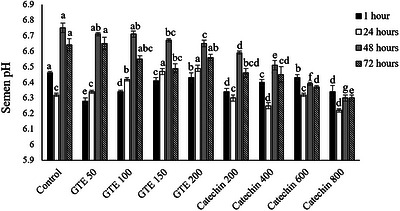
Effect of different concentrations of GTE and catechin on the semen pH during chilled semen storage in rams. Different letters above the bars in each semen storage time indicate significant differences among treatments.p< 0.05 is considered statistically significant.
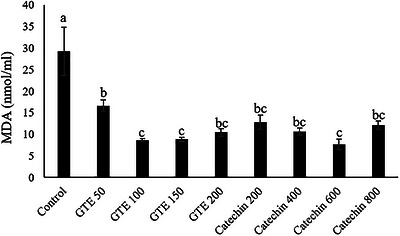
Effect of different concentrations of GTE and catechin on the semen malondialdehyde (MDA) concentration after 72 h of chilled semen storage in rams. Different letters above the bars in each semen storage time indicate significant differences among treatments.p< 0.05 is considered statistically significant.
Discussion
This study aimed to evaluate the effects of GTE and (+)‐catechin on semen quality parameters, including sperm motility, viability, plasma membrane integrity, morphology and oxidative stress, during chilled semen storage. Our findings indicate that both GTE and catechin significantly improve sperm quality in a dose‐dependent manner. These results provide insight into the potential use of these natural antioxidants in semen preservation and reproductive biotechnology.
The maintenance of sperm motility during semen storage is a critical factor for successful fertilisation, particularly in artificial insemination (AI). In our study, sperm motility improved significantly in GTE‐ and catechin‐treated groups compared to the control, with the highest motility observed at 50–100 µg/mL of GTE and 600–800 µg/mL of catechin. These results align with previous studies that reported positive effects of catechins on sperm motility. For example, Silva et al. (2019) demonstrated that GTE supplementation at 100 µg/mL improved sperm motility in goats, similar to our findings at the same concentration in rams. Also, adding GTE to human sperm freezing media at a lower concentration protected spermatozoa from the detrimental effects of cryopreservation, improving motility and DNA integrity (Alqawasmeh et al.2021). Other studies also support the beneficial effects of GTE on sperm motility in dogs and roosters (Wittayarat et al.2013; Hashemian and Mehri2018). Contrarily, Baláži et al. (2022) reported that rabbits fed with a lower dose of green tea had decreased sperm motility and progressive motility, with a tendency for decreased progressive motility in the higher dose group. These differences may be due to the varying sensitivities or responsibilities of semen to grean tea across different experiments.
In our study, catechin concentrations (200–800 µg/mL) were effective in maintaining progressive motility, which is consistent with the findings of Keramati et al. (2023), who reported that catechins improved sperm motility in diabetic rats at comparable doses. However, our study also found that higher concentrations of GTE (150 and 200 µg/mL) decreased sperm motility, suggesting that excessive doses of GTE may have detrimental effects. This finding is in agreement with Roychoudhury et al. (2017), who noted that higher concentrations of green tea catechins could disrupt sperm motility due to an imbalance in antioxidant levels. In contrast, higher concentrations of catechin (600 and 800 µg/mL) maintained progressive motility, emphasising the importance of optimising dosage when using these compounds. This finding is in agreement with the study by Boosorn et al. (2010), which showed that catechin supplementation (50 and 25 µmol/L) improved sperm motility in pigs. The discrepancy could be due to species‐specific differences in sperm sensitivity to antioxidants or variations in the concentration of GTE and catechins used.
The protective effects of GTE and catechin on sperm viability and membrane integrity are well‐documented, and our study further supports these findings. Both GTE (50–100 µg/mL) and catechin (200–800 µg/mL) significantly enhanced sperm viability and plasma membrane integrity compared to the control. These results are in line with studies by Rai et al. (2020), who found that catechins improved sperm viability and motility without causing toxicity to the male reproductive system in rats. Moreover, Mustofa et al. (2021) observed that GTE supplementation (0.1 mg/100 mL) improved sperm viability in Kacang buck semen post‐thawing, similar to the improvements in sperm viability we observed with GTE. However, in our study, higher concentrations of GTE (150 and 200 µg/mL) failed to protect sperm viability, and at 200 µg/mL, it significantly reduced plasma membrane integrity after 72 h. This suggests that GTE may have a concentration threshold beyond which its beneficial effects are diminished. In one study, black tea extract (BTE) significantly improved sperm functions such as vitality and DNA fragmentation, attributed to its antioxidant properties, though there was no significant change in sperm motility (Setumo et al.2023).
Similar to our study, Rahman et al. (2018) emphasised the importance of lower doses of polyphenols to reduce oxidative stress and improve fertility in both humans and animals. Moreover, Prastiya et al. (2023) observed that lower concentrations of GTE (0.15 mg/100 mL) enhanced sperm quality in bulls, which aligns with our findings that lower doses of GTE and catechin led to better sperm motility and membrane integrity. In contrast, Bucci et al. (2018) observed that different concentrations of EGCG did not improve the quality of frozen dog sperm after thawing.
Our results showed that the percentage of sperm abnormalities remained unaffected at 1 and 24 h, but significant improvements in sperm morphology were observed at 48 and 72 h following treatment with 100 µg/mL GTE and 600–800 µg/mL catechin. This is consistent with the findings of Kara et al. (2015), who reported that adding catechin to the breeder quail diet increased fertility and hatchability by improving sperm morphology. Similarly, Cimini et al. (2023) observed that catechins enhanced sperm fertilising ability in swine without negatively affecting sperm morphology, which aligns with our results showing reduced morphological abnormalities after prolonged storage. These findings support the notion that catechins may protect sperm structural integrity by reducing oxidative damage, as oxidative stress is known to cause sperm morphological abnormalities (Tvrda et al.2019). On the other hand, the lack of improvement in sperm morphology at early time points (1 and 24 h) is likely due to the relatively short duration of exposure to the treatments, suggesting that the protective effects of GTE and catechin become more evident after prolonged semen storage.
Oxidative stress plays a critical role in semen quality degradation, and we observed that GTE and catechin supplementation resulted in a dose‐dependent decrease in MDA levels, a marker of lipid peroxidation. This decrease in MDA supports the antioxidant effects of GTE and catechins, which is consistent with previous studies. For instance, Inanç et al. (2019) reported that catechin supplementation in bull semen reduced oxidative stress and lipid peroxidation, enhancing semen quality. Similarly, Mustofa et al. (2021) found that GTE supplementation reduced MDA levels and improved post‐thaw sperm motility in Kacang buck. Oxidative stress reduction is crucial, as elevated ROS levels are known to impair sperm function by damaging cellular membranes, DNA, and proteins (Kaltsas2023). Polyphenols might interact with components of the spermatozoa and would have decreased the lipid peroxidation induced by free radicals (Zhang et al.2020). The positive effect of GTE may also stem from its metal and vitamin contents, which play critical roles in cell health by preventing oxidative stress induced by free radicals (Rai‐nishant et al.2012). In rats treated with nonylphenols, as a suppressor of oxidative defence in living organisms, including the reproductive system, GTE consumption protected the testis structure and sperm parameters from nonylphenol toxication (Azizi and Mehranjani2019).
The positive effects of GTE and catechin on sperm motility, viability and morphology, along with their ability to reduce oxidative stress, highlight their potential as additives in semen extenders for improving semen preservation. However, our study also emphasises the importance of dose optimisation. While lower concentrations of GTE and catechin improved sperm quality, higher concentrations were detrimental, particularly with GTE. This finding suggests that the use of antioxidants in semen extenders must be carefully calibrated to avoid negative effects.
Conclusion
The findings of this study indicate that the application of different concentrations of GTE and catechin positively influenced semen quality parameters across all time points. Specifically, GTE and catechin enhanced sperm motility, viability, concentration, morphology and membrane integrity. Significant improvements in motility were observed primarily at 24 and 48 h of storage, with higher concentrations of GTE and catechin providing the best results. Viability showed substantial enhancement at moderate‐to‐high concentrations, peaking at 48 h. Sperm concentration was notably higher in treatments with higher catechin and GTE concentrations, particularly at 72 h. Morphological improvements were evident at both 48 and 72 h, especially in treatments containing 5% GTE and moderate catechin levels. Membrane integrity was most significantly improved at 1 and 24 h, with moderate GTE and catechin concentrations yielding the best outcomes. These results suggest that moderate‐to‐high concentrations of GTE and catechin effectively maintain or improve semen quality, particularly within the first 48 h of storage.
Author Contributions
Robab Nabhani: data curation, investigation, writing – original draft.Saleh Tabatabaei Vakili: methodology, formal analysis, supervision, writing – review and editing.Khalil Mirzadeh: supervision.
Ethics Statement
The authors confirm that the ethical policies of the journal, as noted on the journal's author guidelines page, have been adhered to and the appropriate ethical review committee approval has been received. The US National Research Council's guidelines for the Care and Use of Laboratory Animals were followed.
Conflicts of Interest
The authors declare no conflicts of interest.
Funding
The authors have nothing to report.
Acknowledgements
The authors gratefully acknowledged the Agricultural Sciences and Natural Resources University of Khuzestan for collaboration in conducting research.
Data Availability Statement
The data that support the findings of this study are available on request from the corresponding author.
Associated Data
Data Availability Statement
The data that support the findings of this study are available on request from the corresponding author.
References
- Agarwal, A. , and Sekhon L. H.. 2010. “The Role of Antioxidant Therapy in the Treatment of Male Infertility.” Human Fertility 13, no. 4: 217–225. 10.3109/14647273.2010.532279. doi.org/10.3109/14647273.2010.532279
- Alqawasmeh, O. A. , Zhao M., Chan C. .P., et al. 2021. “Green Tea Extract as a Cryoprotectant Additive to Preserve the Motility and DNA Integrity of Human Spermatozoa.” Asian Journal of Andrology 23: 150–156. 10.4103/aja.aja_58_20. doi.org/10.4103/aja.aja_58_20
- Amini, M. R. , Kohram H., Zare shahaneh A., Zhandi M., Sharideh H., and Nabi M. M.. 2015. “The Effects of Different Levels of Vitamin E and Vitamin C in Modified Beltsville Extender on Rooster Post‐Thawed Sperm Quality.” Cell and Tissue Banking 16, no. 4: 587–592. 10.1007/s10561-015-9506-9. doi.org/10.1007/s10561-015-9506-9
- Azizi, P. , and Mehranjani M. S.. 2019. “The Effect of Green Tea Extract on the Sperm Parameters and Histological Changes of Testis in Rats Exposed to Para‐Nonylphenol.” International Journal of Reproductive BioMedicine 17: 717–726. 10.18502/ijrm.v17i10.5290. doi.org/10.18502/ijrm.v17i10.5290
- Azubuike, U. S. , David O., Ibrahim R. P., and Sankey R. J.. 2017. “Specific Sperm Abnormalities Observed in Rams (Ovis aries) Following Cypermethrin Treatment.” Journal of Cell and Animal Biology 11, no. 1: 1–6. 10.5897/JCAB2017.0450. doi.org/10.5897/JCAB2017.0450
- Baláži, A. , Sirotkin A. V., Makovický P., Chrastinová L., Makarevich A., and Chrenek P.. 2022. “Effect of Green Tea on Weight Gain and Semen Quality of Rabbit Males.” Veterinary Science 9, no. 7: 321. 10.3390/vetsci9070321. doi.org/10.3390/vetsci9070321
- Biasibetti, R. , Tramontina A. C., Costa A. P., Dutra M. F., Quincozes‐santos A., and Nardin P.. 2013. “Green Tea (Epigallocatechin‐3‐Gallate) Reverses Oxidative Stress and Reduces Acetyl Cholinesterase Activity in a Streptozotocininduced Model of Dementia.” Behavioural Brain Research 236, no. 1: 186–193. 10.1016/j.bbr.2012.08.039. doi.org/10.1016/j.bbr.2012.08.039
- Boosorn, T. , Kongbuntad W., Narkkong N. A., and Aengwanich W.. 2010. “Effects of Catechin Addition to Extender on Sperm Quality and Lipid Peroxidation in Boar Semen.” American‐Eurasian Journal of Agricultural & Environmental Sciences 7: 283–288.https://www.researchgate.net/publication/237844593.
- Bucci, D. , Spinaci M., Yeste M., et al. 2018. “Combined Effects of Resveratrol and Epigallocatechin‐3‐Gallate on Post Thaw Boar Sperm and IVF Parameters.” Theriogenology 117: 16–25. 10.1016/j.theriogenology.2018.05.016. doi.org/10.1016/j.theriogenology.2018.05.016
- Choi, S. J. , Park S. Y., Park J. S., Park S. K., and Jung M. Y.. 2016. “Contents and Compositions of Policosanols in Green Tea (Camellia sinensis) Leaves.” Food Chemistry 204: 94–101. 10.1016/j.foodchem.2016.02.027. doi.org/10.1016/j.foodchem.2016.02.027
- Cimini, C. , Ramal‐sanchez M., Taraschi A., et al. 2023. “Catechin Versus MoS2 Nanoflakes Functionalized With Catechin: Improving the Sperm Fertilizing Ability‐An In Vitro Study in a Swine Model.” International Journal of Molecular Sciences 24: 4788. 10.3390/ijms24054788. doi.org/10.3390/ijms24054788
- Dabagh, M. , Jahangiri N., Taheri madah A., et al. 2023. “Association of Dietary Total Antioxidant Capacity, Alternative Healthy Eating Index, and Dietary Inflammatory Index With Semen Quality in Men Seeking Infertility Treatment.” Frontiers in Nutrition 10: 1284379. 10.3389/fnut.2023.1284379. doi.org/10.3389/fnut.2023.1284379
- Daghigh Kia, H. , and Vatankhah S.. 2019. “Effect of Antioxidant D‐Aspartic Acid and Thawing Rate on the Freeze‐Thawing Process of ram Semen.” Iranian Journal of Applied Animal Science 9, no. 2: 265–273.https://www.researchgate.net/publication/333532018.
- Dias, T. R. , Alves M. G., Tomás G. D., Socorro S., Silva B. M., and Oliveira P. F.. 2014. “White Tea as a Promising Antioxidant Medium Additive for Sperm Storage at Room Temperature: A Comparative Study With Green Tea.” Journal of Agricultural and Food Chemistry 62: 608–617. 10.1021/jf4049462. doi.org/10.1021/jf4049462
- Forester, S. C. , and Lambert J. D.. 2011. “Antioxidant Effects of Green Tea.” Molecular Nutrition and Food Research 55, no. 6: 844–854. 10.1002/mnfr.201000641. doi.org/10.1002/mnfr.201000641
- Ghiasi Ghalehkandi, J. 2014. “Garlic (Allium sativum) Juice Protects From Semen Oxidative Stress in Male Rats Exposed to Chromium Chloride.” Animal Reproduction 11, no. 4: 526–532.https://api.semanticscholar.org/CorpusID:35101667.
- Hashemian, S. K. , and Mehri M.. 2018. “Investigation of Preservative Effects of Different Levels of Dietary Green Tea (Camellia sinensis) Extract on Sperm Quality Parameters of Rooster in the Duration of an Entire Spermatogenesis Cycle.” Animal Science Journal 31, no. 119: 71–82. 10.22092/ASJ.2017.109540.1399. doi.org/10.22092/ASJ.2017.109540.1399
- Inanç, M. E. , çil B., yeni D., et al. 2019. “The Effect of Green Tea Extract Supplementation in Bull Semen Cryopreservation.” Kafkas Universitesi Veteriner Fakultesi Dergisi 25, no. 5: 703–708. 10.9775/kvfd.2019.21702. doi.org/10.9775/kvfd.2019.21702
- Kaltsas, A. 2023. “Oxidative Stress and Male Infertility: The Protective Role of Antioxidants.” Medicina 59, no. 10: 1769. 10.3390/medicina59101769. doi.org/10.3390/medicina59101769
- Kara, K. , Kocaoğlu güçlü B., Şentürk M., and Konca Y.. 2015. “Influence of Catechin (Flavan‐3‐ol) Addition to Breeder Quail (Coturnix coturnix japonica) Diets on Productivity, Reproductive Performance, Egg Quality and Yolk Oxidative Stability.” Journal of Applied Animal Research 44, no. 1: 436–441. 10.1080/09712119.2015.1091337. doi.org/10.1080/09712119.2015.1091337
- Keramati, R. , Najafi G., Seyrafi R., and Shalizar‐jalali A.. 2023. “The Protective Effect of catechin on Fertility in Streptozotocin‐Induced Diabetic Male Mice.” Journal of Babol University of Medical Sciences 25, no. 1: 221–232. 10.22088/jbums.25.1.221. doi.org/10.22088/jbums.25.1.221
- Khan, H. , Khan M., Qureshi M. S., et al. 2017. “Effect of Green Tea Extract (Camellia sinensis) on Fertility Indicators of Post‐Thawed Bull Spermatozoa.” Pakistan Journal of Zoology 49, no. 4: 1243–1249. 10.17582/journal.pjz/2017.49.4.1243.1249. doi.org/10.17582/journal.pjz/2017.49.4.1243.1249
- Malo, C. , Gil L., Cano R., Martinez F., and Galé I.. 2011. “Antioxidant Effect of Rosemary (Rosmarinus officinalis) on Boar Epididymal Spermatozoa During Cryopreservation.” Theriogenology 75, no. 9: 1735–1741. 10.1016/j.theriogenology.2011.01.013. doi.org/10.1016/j.theriogenology.2011.01.013
- Murokore, B. J. , California P. V., Wacoo A. P., et al. 2023. “Effect of Extraction Period on Total Phenolics, Total Flavonoids, and Antioxidant Capacity of UgandanCamellia sinensisKuntze, Black Primary Grades and Green Tea.” Journal of Food Quality 3: 1–8. 10.1155/2023/3504280. doi.org/10.1155/2023/3504280
- Mustofa, I. , Susilowati S., Wurlina W., Hernawati T., and Oktanella Y.. 2021. “Green Tea Extract Increases the Quality and Reduced DNA Mutation of Post‐Thawed Kacang buck Sperm.” Heliyon 7: e06372. 10.1016/j.heliyon.2021.e06372. doi.org/10.1016/j.heliyon.2021.e06372
- Nain, C. W. , Mignolet E., and Herent M. F., et al. 2022. “The Catechins Profile of Green Tea Extracts Affects the Antioxidant Activity and Degradation of Catechins in DHI‐rich Oil.” Antioxidants 11: 1844. 10.3390/antiox11091844. doi.org/10.3390/antiox11091844
- Opuwari, C. , and Monsees T.. 2020. “Green Tea Consumption Increases Sperm Concentration and Viability in Male Rats and is Safe for Reproductive, Liver and Kidney Health.” Scientific Reports 10: 15269. 10.1038/s41598-020-72319-6. doi.org/10.1038/s41598-020-72319-6
- Patanè, G. T. , Putaggio S., Tellone E., et al. 2023. “Catechins and Proanthocyanidins Involvement in Metabolic Syndrome.” International Journal of Molecular Sciences 24, no. 11: 9228. 10.3390/ijms24119228. doi.org/10.3390/ijms24119228
- Prastiya, R. A. , Suprayogi T. W., Debora A. E., et al. 2023. “Green Tea Extract Addition Into a Tris‐Based Egg Yolk Extender Improves Bali Bull Sperm Quality.” Animal Bioscience 36, no. 2: 209–217. 10.5713/ab.22.0184. doi.org/10.5713/ab.22.0184
- Qamar, A. Y. , Naveed M. I., Raza S., et al. 2023. “Role of Antioxidants in Fertility Preservation of Sperm—A Narrative Review.” Animal Bioscience 36, no. 3: 385–403. 10.5713/ab.22.0325. doi.org/10.5713/ab.22.0325
- Rahman, S. U. , Huang Y., Zhu L., et al. 2018. “Therapeutic Role of Green Tea Polyphenols in Improving Fertility: A Review.” Nutrients 10, no. 7: 834. 10.3390/nu10070834. doi.org/10.3390/nu10070834
- Rai, A. , Gill M., Kinra M., et al. 2020. “Assessment of Preclinical Effect of (+)‐Catechin Hydrate on Sexual Function: an in Silico and in Vivo Study.” Andrologia 52, no. 10: e13737. 10.1111/and.13737. doi.org/10.1111/and.13737
- Rai‐nishant, A. J. , Navin K., and Pankaj G.. 2012. “Green Tea: A Magical Herb With Miraculous Outcomes.” International Research Journal of Pharmacy 3, no. 5: 139–148.https://api.semanticscholar.org/CorpusID:17510215.
- Riesco, M. F. , Alvarez M., Anel‐lopez L., et al. 2021. “Multiparametric Study of Antioxidant Effect on ram Sperm Cryopreservation Field Trials to Research Bench.” Animals 11: 283. 10.3390/ani11020283. doi.org/10.3390/ani11020283
- Ros‐santaella, J. L. , and Pintus E.. 2021. “Plant Extracts as Alternative Additives for Sperm Preservation.” Antioxidants 10, no. 5: 772. 10.3390/antiox10050772. doi.org/10.3390/antiox10050772
- Roychoudhury, S. , Agarwal A., Virk G., and Cho C. L.. 2017. “Potential Role of Green Tea Catechins in the Management of Oxidative Stress‐Associated Infertility.” Reproductive BioMedicine Online 34, no. 5: 487–498. 10.1016/j.rbmo.2017.02.006. doi.org/10.1016/j.rbmo.2017.02.006
- Santos, M. V. O. , da Silva A. M., Praxedes É. A., et al. 2019. “Antioxidant Effects of the Essential Oil ofSyzygium Aromaticumon Bovine Epididymal Spermatozoa.” Andrologia 51, no. 11: e13448. 10.1111/and.13448. doi.org/10.1111/and.13448
- Setumo, M. A. , Choma S. S. R., Henkel R., and Opuwari C. S.. 2022. “Green Tea (Camellia sinensis) Aqueous Extract Improved human Spermatozoa Functions In Vitro.” Journal of Medicinal Plants for Economic Development 6, no. 1: a166. 10.4102/jomped.v6i1.166. doi.org/10.4102/jomped.v6i1.166
- Setumo, M. A. , Choma S. S. R., Henkel R., and Opuwari C. S.. 2023. “Black Tea Aqueous Extracts Improve human Sperm Functions: An In Vitro Study.” Andrologia 4323458: 1–10. 10.1155/2023/4323458. doi.org/10.1155/2023/4323458
- Silva, E. C. B. , Arruda L. C. P., Vieira J. I. T., Soares P. C., and Guerra M. M. P.. 2019. “(+)‐Catechin and (‐)‐Epigallocatechin Gallate: Are These Promising Antioxidant Therapies for Frozen Goat Semen?” Arquivo Brasileiro de Medicina Veterinária e Zootecnia 71, no. 2: 521–528. 10.1590/1678-4162-10539. doi.org/10.1590/1678-4162-10539
- Słowińska, M. , Nynca J., Cejko B. I., et al. 2013. “Total Antioxidant Capacity of Fish Seminal Plasma.” Aquaculture 400: 101–104. 10.1016/j.aquaculture.2013.03.010. doi.org/10.1016/j.aquaculture.2013.03.010
- Tvrda, E. , Straka P., Galbavy D., and Ivanic P.. 2019. “Epicatechin Provides Antioxidant Protection to Bovine Spermatozoa Subjected to Induced Oxidative Stress.” Molecules 24, no. 18: 3226. 10.3390/molecules24183226. doi.org/10.3390/molecules24183226
- Wang, Y. , Fu X., and Li H.. 2025. “Mechanisms of Oxidative Stress‐Induced Sperm Dysfunction.” Frontiers in Endocrinology 16: 1520835. 10.3389/fendo.2025.1520835. doi.org/10.3389/fendo.2025.1520835
- Wang, Y. , Zhang L., Sohail T., Kang Y., Sun X., and Li Y.. 2022. “Chlorogenic Acid Improves Quality of Chilled Ram Sperm by Mitigating Oxidative Stress.” Animal 12: 1–12. 10.3390/ani12020163. doi.org/10.3390/ani12020163
- Wittayarat, M. , Ito A., Kimora T., Namula Z., Vv L. , and Lt D.. 2013. “Effect of Green Tea Polyphenol on the Quality of Canine Semen After Long‐Term Storage at 5°C.” Reproductive Biology 13, no. 3: 251–254. 10.1016/j.repbio.2013.07.006. doi.org/10.1016/j.repbio.2013.07.006
- Zhang, Y. , Lin H., Liu C., Huang J., and Liu Z.. 2020. “A Review for Physiological Activities of EGCG and the Role in Improving Fertility in Humans/Mammals.” Biomedicine and Pharmacotherapy 127: 110186. 10.1016/j.biopha.2020.110186. doi.org/10.1016/j.biopha.2020.110186
- Zubair, M. , Ahmad M., and Jamil H.. 2014. “Review on the Screening of Semen by Hypo‐Osmotic Swelling Test.” Andrologia 47, no. 7: 744–750. 10.1111/and.12335. doi.org/10.1111/and.12335
Republished from the open web under CC-BY. Authors: Nabhani R, Vakili ST, Mirzadeh K. Read the original.