Establishing Expert Consensus on Competencies for Safe Ward-Based Postoperative Epidural Analgesia Management: Protocol for a Modified Delphi Study.
Postoperative epidural analgesia (EA) is an important analgesic strategy for selected surgical procedures. However, clinical practice and training vary across settings, and no consensus-based framework currently defines the competencies required for safe ward-based EA management. A modified Delphi study will establish expert consensus on competencies for ward-based postoperative EA management. Items derived from prior empirical work will be rated by experts across three Delphi rounds: two rounds in which experts rate the relevance of each item on a seven-point Likert scale with controlled feedback between rounds, followed by a third round in which experts rate the required competence level for included items using Miller's pyramid. The study is expected to generate consensus on essential competencies and their required level for safe ward-based postoperative EA management. The findings will inform the development of a competency-based training framework and may contribute to more consistent practice and improved patient safety.
Introduction
Postoperative epidural analgesia (EA) is an important analgesic strategy for selected surgical procedures and patient groups, requiring timely assessment, recognition of side effects, and safe management by the clinical team. In surgical ward settings, this responsibility falls primarily to nursing staff, who provide continuous bedside care throughout the postoperative period [1,2,3,4]. Despite the importance of EA, international research highlights significant variation in monitoring practices, escalation routines, clinical decision‐making, and access to structured education [4,5,6,7]. Such variability compromises consistency of care and poses potential patient safety risks.
International guidelines address safety recommendations for postoperative EA management, but vary in scope and operational detail, with limited guidance on ward‐based nursing practice and required competencies [2,8,9]. In particular, existing educational focus tends to address the technical placement and initiation of EA, with comparatively less attention to ongoing ward‐based management.
National Danish data reflect these challenges: A recent nationwide survey found considerable variation in ward nurses' management of breakthrough pain during EA, with organisational barriers, inconsistent access to formalised education and competence gaps reported across surgical wards [10]. Our scoping review similarly identified heterogeneity in the content, structure and evaluation of educational interventions for EA management [4]. A qualitative multicentre focus group study further revealed variation in knowledge, clinical reasoning and organisational support among post‐anaesthesia care unit (PACU) and surgical ward nurses, with an absence of clear responsibility allocation (unpublished data). Together, these findings underscore the need for a unified framework for safe and consistent ward‐based EA practice.
Objectives
This Delphi study aims to establish expert consensus on the core competencies to be included in a structured training programme for the safe management of postoperative EA in surgical ward settings.
Specifically, the study seeks to achieve consensus on:
The resulting consensus will inform the development of a competency‐based training framework for postoperative EA management for surgical ward nurses.
Methods
Reporting Standards
This protocol follows the DELPHISTAR reporting guidance [11], and is informed by established methodological recommendations for Delphi studies [12,13,14]. Specifically, the five key recommendations outlined by Humphrey‐Murto et al. [12] concerning method selection, questionnaire development, participant identification, consensus threshold definition, and justification of methodological modifications are addressed throughout this protocol and are discussed in the Discussion section.
Study Design
The study will use a modified Delphi design [12,15]. The process will include a preparatory pre‐Delphi phase followed by three iterative Delphi rounds. Rounds 1 and 2 focus on establishing consensus on the relevance of each item using a Likert scale with controlled feedback between rounds. Round 3 addresses the required competence level for items that have reached consensus on relevance, using Miller's pyramid [16]. A fourth round will be conducted if consensus is not achieved in Round 3 (Figure1).
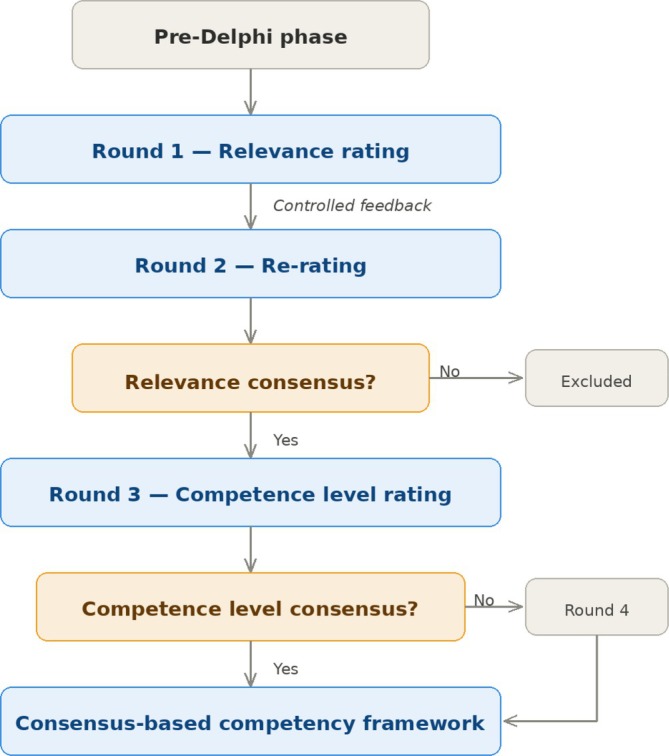
Overview of the modified Delphi study process.
Participant anonymity will be maintained throughout the Delphi process to minimise dominance bias and group conformity [12,13,14].
Participant Eligibility
In this study, ‘experts’ are defined as healthcare professionals with substantial clinical experience in postoperative EA management and/or responsibility for EA‐related education in perioperative settings. Expertise is operationalised through professional role, years of clinical experience, and domain‐specific knowledge, consistent with established Delphi guidance [13,17].
Eligible participants must meet at least one of the following criteria:
Substantial clinical experience will be interpreted in relation to both duration and depth of involvement in EA management, rather than a predefined minimum number of years. Priority will be given to participants with additional roles in education, training, or clinical leadership, such as responsibility for staff training, involvement in guideline implementation, or key roles in acute pain management teams.
Healthcare professionals unable to commit to participation in all Delphi rounds will be excluded.
Sampling and Panel Composition
A purposive sampling strategy will be used. Participants will be recruited from the orthopaedic and abdominal surgical departments that use postoperative EA and participated in a Danish national survey on postoperative EA management in 2023 [10], response rate 84%. All 61 departments represented in the survey, along with their associated anaesthesiology departments (including PACUs), will be contacted. This approach supports targeted identification of clinical environments with established experience and interest in EA care while supporting national representation.
To ensure variation in perspectives, the sample will include participants across professional groups (surgical ward nurses, PACU nurses, and anaesthesiologists), clinical settings (surgical wards and PACUs), and hospital types (e.g., university and regional hospitals). Chief nurses or nurse managers from surgical wards and PACUs, as well as heads of anaesthesiology departments, will be invited to nominate clinicians with relevant clinical expertise. Departments will be asked to nominate 1–2 nurses with current clinical experience in EA management and one anaesthesiologist with relevant expertise [12].
All nominated individuals will be screened against predefined eligibility criteria prior to inclusion. To ensure adequate representation of PACU nursing perspectives, particular attention will be given to the inclusion of PACU nurses alongside surgical ward nurses in the recruitment process.
A minimum of 30 participants is considered sufficient for a stable and information‐rich Delphi panel [14]. However, a larger panel is anticipated given the breadth of the recruitment strategy. Panel size will not be artificially restricted, as broader representation across professional groups, clinical settings, and hospital types is expected to strengthen the robustness and transferability of the consensus findings. Invitations will be distributed by email with two reminders at one‐week intervals.
Participants who do not complete Round 1 will not be invited to subsequent rounds. Attrition across rounds will be monitored and reported.
Delphi Procedure
Table1provides an overview of the data collected and outputs generated across all phases of the Delphi process.
Table: Data collection, participants, and outputs across Delphi rounds.
Pre‐Delphi Preparation and Item Development
Prior to initiating the Delphi rounds, a structured preparatory pre‐Delphi phase will be conducted to ensure content validity and clinical relevance of the initial item pool. This phase encompasses item generation, domain organisation, project group review, and pilot testing of the questionnaire.
Item Generation, Evidence Synthesis and Domain Organisation
The initial pool of Delphi items will be generated through synthesis of four complementary evidence sources:
Items will be organised into preliminary content domains to ensure comprehensive coverage of relevant competencies. In the Delphi questionnaire, items will be presented within their respective domains to support respondent orientation and contextual understanding. Within each domain, items will be presented in a fixed order. Participants will be instructed to evaluate each item independently, without regard to its domain classification. This approach balances navigability with independent item evaluation. The final structuring of competencies will be undertaken by the research team, informed by the Delphi consensus results.
Project Group (Preparatory Phase)
A project group (n= 6), comprising three nurses and three physicians with clinical and research expertise across anaesthesia, orthopaedic surgery, and Delphi methodology, will contribute to the development and refinement of the initial item pool.
The group will review the structured evidence synthesis, refine item wording, structure content domains, and identify potential overlaps or ambiguities. The group will not prioritise, rate, or exclude items or have any influence on the consensus process. Members of the project group will not participate in the Delphi rounds.
Pilot Testing of Delphi Questionnaire
A pilot phase will be conducted prior to Round 1 to assess clarity, relevance, and feasibility of the questionnaire. This will include cognitive pretesting with a small sample of healthcare professionals (n= 3–5) representing the target groups, and a technical pilot test (n= 3–5) using the full survey in REDCap to evaluate functionality, completion time, and usability.
Pilot participants will be selected to reflect the intended expert panel and will be excluded from the final Delphi panel where feasible. Minor revisions to item wording, structure, and response options will be made as needed, without altering the underlying conceptual content.
Round 1—First Consensus Rating
In Round 1, participants will rate the relevance of each predefined item for inclusion in a training programme for ward‐based EA management using a 7‐point Likert scale (1 = not at all relevant, 7 = highly relevant). Participants will be instructed to rate each item based on what they consider important for safe and effective practice, rather than based on current practice or local feasibility.
An ‘Unable to rate/Outside my expertise’ option will be available for all items. Participants will also be invited to propose new items through an open free‐text field at the end of the questionnaire. New items proposed by participants will be reviewed by the project group and, if deemed within scope, included in Round 2, consistent with established Delphi practice [13,14].
Round 2—Re‐Rating With Controlled Feedback
In Round 2, participants will be provided with controlled feedback from Round 1, including median scores and the distribution of ratings for each item. Provision of controlled feedback between rounds is a defining feature of the Delphi method, allowing participants to reconsider their ratings in light of group responses while maintaining independent judgement [13,14].
Participants will be invited to reconsider and re‐rate all items using the same rating scale as in Round 1. The same instructions will apply, including rating items based on what they consider relevant for safe and effective clinical practice, and the option to indicate ‘Unable to rate/Outside my expertise’.
Round 3—Competence Level Rating
Items reaching relevance consensus after Round 2 will be included in Round 3. Participants will be asked to rate the required competence level for each included item using Miller's pyramid of clinical competence [16], which ranges from theoretical knowledge (1 = Knows) to independent clinical performance (4 = Does). Participants will be instructed to rate the level that a surgical ward nurse should ideally achieve upon completing a training programme in postoperative EA management.
Controlled feedback from Round 2 (item inclusion list with relevance consensus data) will be provided to contextualise the rating task. An ‘Unable to rate/Outside my expertise’ option will be available for participants to elaborate on their competence level ratings where desired.
Consensus Criteria
Consensus criteria are defined separately for relevance (Rounds 1–2) and required competence level (Round 3).
Relevance consensus (Rounds 1–2) will be considered achieved when the median score is ≥ 6 and ≥ 70% of participants rate the item within the upper range (scores 6–7). A median threshold of ≥ 6 on a 7‐point scale was selected to ensure that only items with strong and broad expert endorsement are retained, consistent with established Delphi practice [13,14]. Items meeting the relevance consensus criteria after Round 2 will proceed to Round 3 for competence level rating. Items not meeting relevance consensus will be excluded from the core framework but may be reported as areas of non‐consensus. Competence level consensus (Round 3) will be defined as ≥ 70% of participants rating the item at the same level (or within one adjacent level) on Miller's pyramid. Items not reaching competence level consensus in Round 3 will be subject to a fourth round if needed.
Data Analysis
Quantitative data will be analysed using descriptive statistics. For each item and round, median scores, proportions of ratings in the upper range (scores 6–7), and response distributions will be calculated. Median scores and percentage agreement are used as the primary measures of central tendency and consensus, as these are appropriate for ordinal data and are consistent with established Delphi practice [13,14]. Stability across rounds will be assessed by comparing these measures between rounds.
Participant characteristics will be reported descriptively, including professional role, years of clinical experience in EA management, clinical setting, and hospital type, to allow assessment of panel composition and representativeness.
Qualitative comments from Round 1, including proposed new items, will be reviewed to identify ambiguities, clarify item wording, and support interpretation of quantitative findings, prior to Round 2. New items deemed within scope will be included in Round 2. Comments will be summarised narratively to describe common rationales and suggested refinements. Qualitative data will not be used to modify the underlying conceptual content of items but may inform clarification of item wording prior to Round 2.
Data Management
Survey data will be collected and stored in REDCap on secure institutional servers compliant with GDPR [18,19]. Participants will be assigned unique study IDs, and all data will be de‐identified prior to analysis.
Patient and Public Involvement
Patients and the public are not involved in this study, as it focuses on professional expertise related to clinical competence and educational design. No patient data will be collected. The final framework is expected to indirectly benefit postoperative patients through strengthened ward‐based EA safety and practice consistency.
Ethical Considerations
The study will be conducted in accordance with the principles of the Declaration of Helsinki and applicable European data protection regulations.
The study has been registered and approved in the Capital Region of Denmark's data protection system, Privacy (registration number: p‐2026‐20,629), and is registered in OSF Registries (registration number: Kmws8,https://osf.io/Kmws8). Electronic informed consent will be obtained from all participants. The Ethics Committee in the Capital Region was notified (F‐26003352) but waived full ethical approval in accordance with Danish legislation (waiver‐date: 28.02.2026).
Discussion
This protocol describes a modified Delphi study designed to establish a consensus‐based competency framework for safe and effective ward‐based management of postoperative EA. Delphi methodology is well suited for developing consensus on complex clinical and educational questions, particularly when empirical evidence is limited, or practice varies [12]. By integrating findings from prior empirical work with perspectives from anaesthesiologists, PACU nurses, and surgical ward nurses, the study aims to develop a clinically relevant and practice‐oriented framework.
A key strength of the study is the interdisciplinary composition of the expert panel, reflecting the collaborative nature of postoperative EA management. Inclusion of participants across professional groups and clinical settings is expected to enhance the relevance and applicability of the resulting framework to real‐world practice.
As with all Delphi studies, the findings will reflect expert consensus rather than empirical testing. Potential limitations include attrition between rounds and sampling bias related to recruitment from departments which previously participated in our national survey. In addition, the national context may influence transferability to other healthcare systems.
Several methodological measures have been applied to strengthen rigour and minimise bias. Participant anonymity is maintained throughout all Delphi rounds to reduce dominance bias and group conformity [13,14]. Controlled feedback between rounds supports independent judgement while allowing participants to reconsider their responses in light of group trends, a defining feature of the Delphi method that distinguishes it from simple surveys [12,14]. Predefined consensus criteria and the separation of item development from consensus rating further enhance transparency and methodological rigour.
The three‐round design and the separation of relevance from competence level assessment represent key methodological modifications to the standard Delphi design, made in accordance with the recommendations of Humphrey‐Murto et al. [12,15]. Separating these two dimensions across rounds is methodologically important: it ensures that participants can revise their relevance ratings in response to controlled group feedback before the competence level dimension is introduced, supporting genuine iterative consensus‐building on each dimension independently. Miller's pyramid was selected for Round 3 because it accommodates the full range of item types—from theoretical knowledge (Levels 1–2) to independent clinical performance (Level 4, ‘Does’), which represents the expected ceiling for a surgical ward nurse.
Author Contributions
Cornelia Charlotte Lamprecht:conceptualization, methodology, investigation, funding acquisition, visualization, writing – original draft, project administration.Søs Bohart:conceptualization, writing – review and editing.Kim Wildgaard:conceptualization, supervision, writing – review and editing.Morten Vester‐Andersen:conceptualization, supervision, writing – review and editing.Anne Mørup‐Petersen:conceptualization, supervision, writing – review and editing.Thordis Thomsen:conceptualization, supervision, writing – review and editing.
Funding
This work was supported by Novo Nordisk Fonden (NNF25OC0106884).
Disclosure
This study is registered in OSF Registries (registration number: kmws8,https://osf.io/kmws8).
Conflicts of Interest
The authors declare no conflicts of interest.
Acknowledgements
The authors acknowledge the use of Claude (Anthropic, accessed 2026) to assist with language editing and reference consistency checks during manuscript preparation. All scientific content, conclusions, and responsibility for accuracy remain solely with the authors.
Data Availability Statement
No datasets have yet been generated. Anonymised Delphi data will be made available on reasonable request following publication.
Associated Data
Data Availability Statement
No datasets have yet been generated. Anonymised Delphi data will be made available on reasonable request following publication.
References
- Elliott J. E., Fischer M., Meloche K., and Quinlan‐Colwell A., “Nursing Care of the Patient With Epidural Analgesia,” Pain Management Nursing 26, no. 2 (2025): 178–189, 10.1016/j.pmn.2024.12.009. doi.org/10.1016/j.pmn.2024.12.009
- Faculty of Pain Medicine of the Royal College of Anaesthetists , Best Practice in the Management of Epidural Analgesia in the Hospital Setting (Faculty of Pain Medicine of the Royal College of Anaesthetists, 2025),https://fpm.ac.uk/sites/fpm/files/documents/2026‐04/Management%20of%20epidural%20analgesia%202025%20‐2026%20update.pdf.
- Gustafsson U. O., Rockall T. A., Wexner S., et al., “Guidelines for Perioperative Care in Elective Colorectal Surgery: Enhanced Recovery After Surgery (ERAS) Society Recommendations 2025,” Surgery 184 (2025): 109397, 10.1016/J.SURG.2025.109397. doi.org/10.1016/J.SURG.2025.109397
- Lamprecht C. C., Vester‐Andersen M., Thomsen T., Thomsen T. E., Mørup‐Petersen A., and Wildgaard K., “Training Programmes for Healthcare Professionals in Managing Epidural Analgesia: A Scoping Review,” Acta Anaesthesiologica Scandinavica 69, no. 4 (2025): e70025, 10.1111/aas.70025. doi.org/10.1111/aas.70025
- Bird A. and Wallis M., “Nursing Knowledge and Assessment Skills in the Management of Patients Receiving Analgesia via Epidural Infusion,” Journal of Advanced Nursing 40, no. 5 (2002): 522–531, 10.1046/j.1365-2648.2002.02409.x. doi.org/10.1046/j.1365-2648.2002.02409.x
- Bird A., Wallis M., and Chaboyer W., “Registered Nurses' and Midwives' Knowledge of Epidural Analgesia,” Collegian: Journal of the Royal College of Nursing, Australia 16, no. 4 (2009): 193–200, 10.1016/j.colegn.2009.03.004. doi.org/10.1016/j.colegn.2009.03.004
- Sandie C. L. and Heindel L. J., “The Knowledge and Attitudes of Nonanesthesia Nurses Regarding Postoperative Epidural Analgesia,” AANA Journal 67, no. 5 (1999): 455–460.
- Australian and New Zealand College of Anaesthetists and Faculty of Pain Medicine, PS41(G) , Position Statement on Acute Pain Management (Australian and New Zealand College of Anaesthetists, 2023),https://www.anzca.edu.au/safety‐and‐advocacy/standards‐of‐practice/professional‐documents.
- Australian and New Zealand College of Anaesthetists, PG03(A) , Guideline for the Management of Major Regional Analgesia (Australian and New Zealand College of Anaesthetists, 2014),https://www.anzca.edu.au/safety‐and‐advocacy/standards‐of‐practice/professional‐documents.
- Thomsen T. E., Lamprecht C. C., Wildgaard K., Thomsen T., and Vester‐Andersen M., “Ward Nurses' Use of Epidural Analgesia When Treating Breakthrough Pain: A National Survey Study,” Acta Anaesthesiologica Scandinavica 70, no. 1 (2026): e70154, 10.1111/aas.70154. doi.org/10.1111/aas.70154
- Niederberger M., Schifano J., Deckert S., et al., “Delphi Studies in Social and Health Sciences‐Recommendations for an Interdisciplinary Standardized Reporting (DELPHISTAR). Results of a Delphi Study,” PLoS One 19, no. 8 (2024): e0304651, 10.1371/journal.pone.0304651. doi.org/10.1371/journal.pone.0304651
- Humphrey‐Murto S., Varpio L., Gonsalves C., and Wood T. J., “Using Consensus Group Methods Such as Delphi and Nominal Group in Medical Education Research,” Medical Teacher Electronic Version 39, no. 1 (2017): 14–19, 10.1080/0142159X.2017.1245856. doi.org/10.1080/0142159X.2017.1245856
- Jünger S., Payne S. A., Brine J., Radbruch L., and Brearley S. G., “Guidance on Conducting and REporting DElphi Studies (CREDES) in Palliative Care: Recommendations Based on a Methodological Systematic Review,” Palliative Medicine 31, no. 8 (2017): 684–706, 10.1177/0269216317690685. doi.org/10.1177/0269216317690685
- Diamond I. R., Grant R. C., Feldman B. M., et al., “Defining Consensus: A Systematic Review Recommends Methodologic Criteria for Reporting of Delphi Studies,” Journal of Clinical Epidemiology 67, no. 4 (2014): 401–409, 10.1016/j.jclinepi.2013.12.002. doi.org/10.1016/j.jclinepi.2013.12.002
- Humphrey‐Murto S., Varpio L., Wood T. J., et al., “The Use of the Delphi and Other Consensus Group Methods in Medical Education Research: A Review,” Academic Medicine 92, no. 10 (2017): 1491–1498, 10.1097/ACM.0000000000001812. doi.org/10.1097/ACM.0000000000001812
- Miller G. E., “The Assessment of Clinical Skills/Competence/Performance,” Academic Medicine 65, no. 9 Suppl (1990): S63–S67, 10.1097/00001888-199009000-00045. doi.org/10.1097/00001888-199009000-00045
- Niederberger M. and Deckert S., “Das Delphi‐Verfahren: Methodik, Varianten und Anwendungsbeispiele,” Zeitschrift für Evidenz, Fortbildung und Qualität im Gesundheitswesen 174 (2022): 11–19, 10.1016/j.zefq.2022.08.007. doi.org/10.1016/j.zefq.2022.08.007
- Harris P. A., Taylor R., Minor B. L., et al., “The REDCap Consortium: Building an International Community of Software Platform Partners,” Journal of Biomedical Informatics 95 (2019): 103208, 10.1016/j.jbi.2019.103208. doi.org/10.1016/j.jbi.2019.103208
- Harris P. A., Taylor R., Thielke R., Payne J., Gonzalez N., and Conde J. G., “Research Electronic Data Capture (REDCap) – a Metadata‐Driven Methodology and Workflow Process for Providing Translational Research Informatics Support,” Journal of Biomedical Informatics 42, no. 2 (2009): 377–381, 10.1016/j.jbi.2008.08.010. doi.org/10.1016/j.jbi.2008.08.010
Republished from the open web under CC-BY. Authors: Lamprecht CC, Bohart S, Wildgaard K, Vester-Andersen M, Mørup-Petersen A, Thomsen T. Read the original.