Feasibility and Acceptability of a Breastfeeding Support Intervention Among Mothers of Infants Under Six Months Old Discharged From Malnutrition Treatment in Kilifi County.
Malnourished infants under 6 months experience poor growth and development. A pilot study applied the WHO guideline for treatment of acute malnutrition and found that it was possible to re-establish exclusive breastfeeding during inpatient treatment. However, weight gain could not be sustained 6 weeks after discharge suggesting that follow-up breastfeeding support may be required. Our study aimed to pilot the feasibility and acceptability of a follow-up intervention among infants discharged from malnutrition treatment. A home-based post-discharge breastfeeding support intervention was developed to be delivered by breastfeeding peer supporters in a series of three home visits and three intervention phone calls over a period of 7 weeks after discharge from the hospital. The intervention was piloted among 20 mother-infant pairs providing quantitative and qualitative data from a standardized questionnaire and in-depth interviews. Data was analyzed descriptively and using thematic analysis. The median infant birth weight was 2.07 kg and > 50% of the mothers had primary education or less. The intervention was feasible with 100% reach of the target participants with a geographic spread of 25% urban and 75% rural areas. All intervention components were applied consistently, resulting in 100% adherence over a 6-month period. The intervention was accepted by mothers, perceived to be beneficial, and reported to increase breastfeeding confidence. It was adaptable, adjusting to emerging challenges, and was successfully integrated into existing health services. The pilot demonstrated high feasibility and widespread acceptance of the intervention. Its effectiveness to improve weight gain among recovering infants is being determined in a trial.
Introduction
Severe acute malnutrition (SAM)/wasting, in infants under 6 months old (U6M), is a nutritional condition characterized by weight‐for‐length (WLZ) z‐scores <−2, and/or the presence of clinical signs of bilateral pitting edema (World Health Organization2023). Globally, SAM affects millions of infants, with the highest number occurring in low‐ and middle‐income countries (LMICs). In 2021, the prevalence of SAM among u6m infants was estimated to be 24.5 million. This is a three times increase in prevalence when compared to 2011 when the estimate was at 8.5 million (Kerac et al.2021). In Kenya, the demographic health survey of 2022 reports stunting and wasting prevalence of approximately 12% and 11.9% respectively among infants under 6 months (Government of Kenya GOK2022).
Wasting in U6M infants leads to an elevated risk of childhood morbidity and mortality higher than that of wasted older children (6–59 months) (Kerac et al.2011; Grijalva‐Eternod et al.2017). The severity of malnutrition in this early infancy period influences the overall growth and development of these infants (Kerac et al.2015) underscoring the need for timely and effective interventions for preventing, identification and management (World Health Organization2023).
In 2013, the World Health Organization (WHO) released its first guidelines for the management and treatment of SAM in infants U6M. While these guidelines were updated in 2023 (World Health Organization2023), the core recommendation for management of SAM in U6M infants remains the same: emphasizing the re‐establishment of exclusive breastfeeding (EBF).
Commonly, breastfeeding is known as a promotive intervention (Ochola et al.2013; Horta et al.2015; Kimani‐Murage et al.2016; Kimani‐Murage et al.2017; Kavle et al.2019; Mituki‐Mungiria et al.2020). However, for infants who are born nutritionally vulnerable, i.e. Preterm/Low Birth Weight (LBW) and or those who develop nutritional vulnerability after birth, EBF is a life‐saving nutritional intervention crucial for their treatment, recovery, growth, and survival (Ahmed and Sands2010; Hamer et al.2022; Khatib et al.2023).
In Kenya, the Improving Breastfeeding among Malnourished Infants (IBAMI‐1) study piloted the implementation of the 2013 WHO guidelines using breastfeeding peer supporter (BFPS) and resulted in effective re‐establishment of EBF and infants attaining the recommended weight velocity among 65% of the enrolled infants after inpatient treatment (Mwangome et al.2020) However, despite the intensive inpatient nutritional rehabilitation efforts, follow‐up data revealed a critical gap in sustaining adequate nutritional recovery and growth after transitioning to their homes without any form of structured follow‐up support offered post‐discharge (Van Ryneveld et al.2020). The results highlighted an important existing gap in guideline and practice on follow‐up care of infants under 6 months discharged from malnutrition treatment indicating a need for a structured post‐discharge follow‐up support intervention for these infants.
To address this need, our research team used participatory methods involving interviews with stakeholders at national and county levels and a series of workshops with local practitioners to co‐design a home‐based post‐discharge breastfeeding support intervention (BFSI). The process of intervention development is described elsewhere (unpublished). It is the results from the piloting of the intervention evaluating its feasibility and acceptability that is the subject of this publication.
Materials and Methods
Study Design
The pilot study was conducted in Kilifi County Referral Hospital in Kenya and used a descriptive exploratory study design to assess the feasibility (applicability) and acceptability (administrable with minimum discomfort) of a home‐based post‐discharge BFSI.
Breastfeeding Support Intervention
The piloted intervention was a home‐based, individualized, face‐to‐face breastfeeding support provided by a peer supporter (BFPS) consisting of three home visits and three intervention calls over a period of 7 weeks after discharge from the hospital. Additional components included invitations of the area community health promoter (CHP), a breastfeeding partner (buddy) of the mother's choice to the home visit sessions with the aim of providing social support and linking the mother to other available community‐based psychosocial and health support systems.
Intervention Follow‐Up: 3 Calls and 3 Visits
Within 48 h after discharge, BFPS made the first intervention call (IntvCall 1) which also served as booking call 1 (BkCall 1) for the first home visit. The call aimed to assess the mother/baby's progress after discharge and plan for the first home visit (HV1). The first home visit would happen within the first week after discharge and the BFPS would be accompanied by the CHP for this visit.
The second intervention call (IntvCall 2) and booking call (BkCall 2) were made in the second week after discharge and aimed to assess the mother/baby's progress since the last visit and plan for the second home visit 2 (HV2). HV2 happened in week four post‐discharge, and here the BFPS would plan to meet with the participant's breastfeeding buddy for information sharing and building breastfeeding support around the mother.
The third intervention call (IntvCall 3) and booking call (BkCall 3) were done in the fifth‐week post‐discharge and aimed to assess the mother/baby's progress since the last visit and plan for the third home visit (HV3). HV3 was done in the seventh‐week post‐discharge and as this was the last home visit, the BFPS was accompanied by the CHP to support the transition (Figure1).
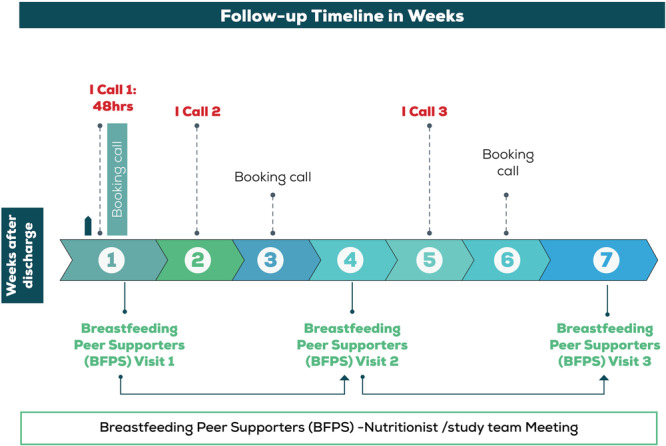
Components of the breastfeeding support intervention (BFSI).
During the home visits, the BFPS observe breastfeeding and correct positioning, attachment and suckling techniques of the infant to the breast. They also support mothers with hand expression where necessary and discuss practical strategies to continued EBF. They observe the infant and discuss danger signs while enquiring about infants' health. They also observe the mother for any signs of distress or overwhelm and their care practices such as hygiene and non‐verbal cues and may counsel the mothers where necessary.
Study Participants
Inclusion Criteria
The primary study participants were infants aged between 4 and 12 weeks and their mothers admitted to Kilifi County te Referral Hospital. Infants were eligible if they were diagnosed with low anthropometry at admission, including a WLZ < −2 or a MUAC < 11.0 cm or a weight for age (WAZ) < −2, or the presence of bilateral pitting edema. Additionally, the study required that caregivers are willing and able to breastfeed the infants and consent to participate in the study.
Intervention implementers including breastfeeding peer supporters, field staff and managers were also included.
Exclusion Criteria
Infants were excluded if they had congenital abnormalities that would obstruct breastfeeding, such as cleft palate, or had conditions that would invalidate the use of normal growth standards, such as hydrocephalus and other dysmorphic features. The pilot study opted to exclude pre‐term infants who had been hospitalized since birth and had never been discharged to go home as their mothers would not have had a home breastfeeding experience.
Sampling
A non‐probability sampling approach was used to purposively recruit the participants who met the inclusion criteria. A total of 20 dyads were enrolled in the pilot phase which was deemed sufficient, aligning with the recommendations for conducting a pilot study as a novice researcher, which suggests that 10–30 participants are adequate for gathering preliminary data (Doody and Doody2015).
Data Collection
Quantitative Data
Quantitative data was collected using a standardized questionnaire [case report form (CRFs)] administered at admission, discharge, and during the follow‐up period up to 6 months of age. The information captured in the CRFs mainly included mother and infant anthropometry and important demographic information such as age, level of education, marital status, and employment status and for infants age, gender, size at birth, place of birth and breastfeeding status. Data was sourced from both hospital child records and maternal recall. At admission, breastfeeding status was assessed by maternal recall however during admission and at discharge breastfeeding was assessed by observation and application of the WHO breastfeeding observation tool. Additional data was used to assess the feasibility aspect of the intervention for the key implementation indicators such as enrollment rates, adherence to the intervention, coverage/reach, fidelity and dropout rates.
Qualitative Data
The researcher used semi‐structured interview guides tailored to conduct in‐depth interviews with the intervention recipients and implementers. The recipients' in‐depth interview content guide was focused on getting information on mothers' experiences, feelings and their views of the intervention to assess their acceptability of the intervention. While the implementers' in‐depth interview guide focused on their experiences, expectations, challenges, enablers and changes made during the implementation of the pilot intervention. A total of 12 in‐depth interviews were conducted with mothers in the national Swahili language: seven after the first home visit and five after the last. Each interview lasted between 20 and 25 min. Most mothers who participated in the first interview also took part in the second, except for two who had lost their babies.
Additionally, three interviews averaging 30 min were held with study implementers in Swahili language, including the BFPS (female), research officer(female), and field worker(male), after piloting the intervention.
Data Management
Quantitative data was initially entered into a REDCap ((Research Electronic Data Capture) database (Harris et al.2009) and later transferred to Excel sheets, where it was cleaned to address any missing values and ensure accuracy. Data from all participants was included into the final analysis including data from infants who died before the end of the follow‐up period.
Interview recordings were transferred to a password‐protected computer for storage and then transcribed verbatim to ensure accuracy and preserve the richness of the participants' responses. Then, it was cleaned by listening to all the transcripts against the audio recordings to check on missing data and make corrections.
Data Analysis
Quantitative Analysis
Descriptive analysis was done for the quantitative data focusing on the participants' demographic characteristics such as calculating the percentage, median, and interquartile range (IQR) using Microsoft excel. The feasibility constructs proposed by (Skivington et al.2021), assessed metrics such as recruitment/enrollment, coverage/reach, adherence, fidelity and dropout rates (Table1).
Table: Constructs of acceptability and feasibility.
Qualitative Analysis
Thematic framework analysis was conducted following Braun and Clarke's six‐phase guide (Braun and Clarke2023). This involved several steps: first, reading and re‐reading the transcripts to become thoroughly familiar with the data; next, generating initial codes to identify significant features within the data; then, searching for patterns among the codes to identify potential themes; reviewing the identified themes to ensure they accurately represented the data; defining and naming the themes, and finally interpretation and writing up the findings. Our interpretation of the themes identified were informed by the theoretical framework of acceptability (Sekhon et al.2017). This framework consists of seven constructs: affective attitude, burden, ethicality, intervention coherence, opportunity costs, perceived effectiveness, and self‐efficacy(Sekhon et al.2017) summarized in Table1.
Ethical Considerations
The study was approved ‐ by the KEMRI Scientific and Ethics Research Unit (KEMRI/SERU/CGMR‐C/238/4326) and licenced by The National Commission for Science, Technology and Innovation (NACOSTI/P/23/24178). The participants were provided with detailed information about the study, and their consent was obtained before participation. The data collected was kept confidential and was used solely for this research.
Results
Participants Characteristics
The study involved 20 mother‐infant pairs.
The median age of the mothers at the birth of their first child was 22 years (IQR 19.75, 26 years), median weight, height and MUAC were 54.95 kg (IQR: 51.69, 67.70 kg), 152.1 cm (IQR: 149.6, 155.0 cm), and 280.0 mm (IQR: 240.5, 297.5 mm) respectively (Table2).
Table: Maternal characteristics.
The median admission weight, length, MUAC and head circumference for infants were 2.295 kg (IQR: 1.87, 3.19 kg), 46.45 cm (IQR: 43.02, 51.42 cm), 86.0 mm (IQR: 74.0, 97.0 mm) and 34.25 cm (IQR: 32.55, 36.98 cm respectively (Table3).
Table: Infant characteristics.
Feasibility Outcomes
As indicated earlier, feasibility was assessed using the framework approach proposed by (Husain et al.2024) and (Skivington et al.2021). Our results on feasibility are presented for each construct including reach, coverage, adherence, fidelity and intervention adaptability.
Reach, Coverage and Adherence
The pilot study achieved 100% enrollment of its target participants within the stipulated time frame and accomplished a geographical spread of 25% and 75% in urban and rural areas respectively. All intervention components for the mothers in the pilot activities were completed on time, achieving a 100% adherence rate and a 0% dropout rate.
Fidelity
The BFPS implemented the intervention components successfully, achieving 100% fidelity for Intervention Call 1, 95% for Call 2, and 80% for Call 3. In Home Visits, fidelity was 100% for Visit 1, 95% for Visit 2, and 85% for Visit 3. Strong family support engagement was noted, with 90% of mothers choosing a breastfeeding buddy, and 80% of those buddies being present during Home Visit 2. CHPs were linked to households at 100%, with 100% presence during Home Visit 1% and 80% during Visit 3.
Intervention Adaptability
Continuous adjustments were made based on real‐time feedback and emerging challenges, during the intervention implementation.
Infants' Recruitment
Initially, preterm infants who had never been discharged home since birth would be recruited into the study as soon as they became eligible, however during piloting an adjustment was made to only recruit infants presenting from home to maximize on the home experience.
Booking Calls for Home Visits
The few mothers who were not reachable on the phone were contacted via their spouses' contacts which had been provided as secondary contacts.
Transportation
Originally, the peer supporters were to use public transport to visit the households to maintain “peer‐ness” however, during the piloting this could not be arranged due to organization policies. Hence for the pilot phase, peer supporters used organization vehicles.
Buddy Selection
Most mothers selected their husbands as breastfeeding buddies but many of them were unavailable during home visits. This was perceived to be a misunderstanding in the communication regarding the breastfeeding buddy component of the intervention. This finding led to a change in strategy on the timing and packaging of the breastfeeding buddy information. It was agreed to integrate the information of selection of buddies during hospitalization.
Mothers' Relocation
After the hospital discharge, some mothers opted to stay in relatives' homes instead of going back to their own homes. This was unexpected and it disrupted the home‐based follow‐up activities. An adjustment was made in the data capturing tools to allow for follow‐up of mothers as they relocated to new “homes.” For example, fresh mappings of homes were done for every new relocation.
Infants Readmission
In cases where infants were readmitted back to the hospital, home intervention follow‐up would be temporarily frozen and later resumed upon discharge ensuring continuous home‐based support and follow up.
Intervention Integration to Maternal and Child Health Services
The involvement of community health extension workers (CHEWs1) helped to connect the CHPs with BFPS thus playing a significant role in integrating the intervention into the community health system.
Acceptability Outcomes
Informed by constructs from the theory of acceptability framework (Table1) (Sekhon et al.2017) we identified six themes that indicated the overall acceptability of the intervention among the mothers. These themes are discussed in turn below.
Mothers' Expectations of Intervention
Most mothers assumed the primary goal of the BFPS home visits was to discuss breastfeeding practices. However, a few expected additional support, such as financial aid or food donations, if they were deemed nutritionally vulnerable.
BFPS Provided Useful Breastfeeding Information and Other Support
Interviews showed that peer supporters were a valuable resource for breastfeeding advice. Mothers successfully applied much of the guidance, such as proper breastfeeding positions and milk storage practices. However, some struggled with milk expression and felt overwhelmed by caregiving demands, making it challenging to follow feeding plans aimed at improving milk production.
Predominant Positive Feelings About the BFPS
From the interviews, mothers felt comfortable communicating and interacting with the BFPS over the phone and in person. These interactions made it easier for them to discuss any challenges and get clarification as illustrated in the quote below:
Increased Confidence in Breastfeeding
Most mothers reported that they understood the advice from the BFPS and increased self‐confidence in breastfeeding their infants. Several mothers felt they were confident enough to educate other mothers who were unaware of the recommended breastfeeding practice. For example, one mother noted:
However, one mother in the home visit two interviews felt that it was difficult for her to grasp all the information because she was advised on multiple issues during the home visits.
The Intervention Components Were Deemed Appropriate and Complementary to Each Another
From the interviews, the timing and duration of the calls and home visits were well‐suited to the mothers' routines. The home visits were reported to fit the mothers' schedules, except in one instance, where one mother found the timing of a home visit inconvenient. The BFPS had arrived very early in the morning before the mother had had breakfast. When the BFPS requested her to demonstrate how she was expressing milk, the mother felt uncomfortable and believed she couldn't produce any milk at that time.
Proposed Recommendations by Mothers
Mothers suggested several improvements to the intervention i.e. proposing the inclusion of questions about bed net use, family planning advice and provision of written materials for breastfeeding advice as illustrated below.
Mothers also suggested that the intervention be extended to other homes and that village‐wide meetings be organized to educate more mothers on breastfeeding practices. This suggestion was linked to the mothers' perspectives about how beneficial they found the intervention to be.
Discussion
The post‐discharge BFSI pilot study was found to be feasible by the implementers and acceptable by the recipient mothers of infants. The pilot study achieved successful recruitment and enrollment, thus being a good indicator of success of the laid‐out study procedures. Early success in recruitment, enrollment and retention of study participants reflects potential success in future recruitment when similar mechanisms are maintained (Walters et al.2017). From our study, the successful recruitment observed indicates the success of the laid‐out procedures and boosts the confidence of similar replication in the main trial. The success in recruitment is not only a feasibility indicator but also an indicator of acceptability in the sense that it is associated with the perceived importance and benefit of the study by the participant (Bower et al.2009).
Our findings agree with findings of a cluster randomized trial pilot study in rural India where complete participant inclusion through community efforts enhanced the intervention reach (Pérez et al.2020). Our pilot study reached participants from both rural and urban areas which is a good measure of implementation coverage, supported by Clifford et al (Nkyekyer et al.2021) and Goodrich et al (Ashcraft et al.2024). If similar strategies are used there is promising replicability of the findings in the main trial. However, it is yet to be seen whether the plan for BFPS to use public transport to follow up at home will attain similar coverage.
The intervention demonstrated a high level of adherence to its components, reflecting high level of feasibility. Supported by Rempel, Rempel, and Moore (2017) and Rempel, Rempel et al. (2017), adherence to intervention components achieves better outcomes by maintaining a similar implementation plan. However, despite the observed level of adherence, infant death or mother's out‐migration to non‐study geographic zones may affect adherence levels in the main trial which intends to follow‐up infants up to 12 months of age.
The intervention can be practically and easily implemented as demonstrated by the fidelity findings. The success of replicating similar implementation fidelity in the main trial is supported by a conceptual framework (Carroll et al.2007), that emphasizes the importance of maintaining high fidelity for the success of intervention implementation.
The pilot intervention encountered some challenges during its implementation phase. The pilot, however, consistently adapted to challenges adjusting throughout the process. For instance, a few mothers who were not reachable on phone, were later contacted via their spouses' contacts which had been provided as secondary contacts.
Our study findings were in line with the findings from other studies (Eldridge et al.2017) which indicate that successful interventions are those that can adapt to local needs. Furthermore, flexibility and adaptability are essential in community‐based breastfeeding support programs to address unexpected challenges and improve outcomes.
The pilot study demonstrated significant potential for the intervention to be integrated into the existing maternal and child health services within the healthcare system. As revealed by the results, the CHPs played a crucial role in providing ongoing community support and ensuring the sustainability of breastfeeding even after the study was completed. Other studies have yielded similar results, indicating that involving CHPs in health interventions significantly enhances sustainability and ensures continuity over time (Perry et al.2014; Kok et al.2015; Vaughan et al.2015). This is because CHPs are at the base of the health system and are best suited to bridge the gap between the health care system and the community.
On acceptability, all mothers expected the intervention to provide support on breastfeeding, showing their understanding of the intervention's purpose. According to (Sekhon et al.2017), the mothers' expectations aligned well with the Intervention Coherence construct suggesting that the intervention was well‐understood. Acri et al (Acri et al.2015) argue that well‐understood interventions are likely to be well‐received, an outcome supported by the findings from our study. Though some mothers anticipated other forms of support, this is a normal observation as it is expected that there are varied expectations for individuals participating in any intervention (Rollins et al.2016).
Mothers found the intervention to be effective, reporting that they gained valuable knowledge on breastfeeding, which they successfully applied to improve their practices. However, some mothers also mentioned that household chores added to their demands, making it challenging to implement all the knowledge they had acquired. Despite these challenges, our findings indicate that the intervention was highly acceptable to the mothers, as evidenced by their positive reception of the advice and their commitment to follow it. Several studies (McFadden et al.2017; Clarke et al.2020), have demonstrated that positive responses of the participants towards the intervention are indicative of a high level of acceptability of an intervention. This alignment suggests that the designed intervention was highly valued and received widespread recognition based on the perceived and demonstrated benefits.
There were high levels of breastfeeding confidence observed among the mothers which indicated a high level of self‐efficacy obtained through their participation in the intervention. The knowledge received from the BFPS was reportedly eye‐opening to the mothers with several of them wishing they had the information before having their other children.
The significance of self‐efficacy in the effectiveness of breastfeeding interventions is supported by others who proposed that interventions focusing on enhancing mothers' confidence yield positive results and are well‐received. Similarly, (Otsuka et al.2014), concluded that mothers who have faith in their ability to breastfeed and receive consistent support demonstrate high acceptance levels.
Most mothers widely praised their interactions with the BFPS, demonstrating a positive feeling about the BFPS support and the intervention. This indicates that the continuous follow‐up and support by the BFPS improved their interactions with the mothers, leading to increased positive feelings towards them and the intervention. This finding is consistent with (McFadden et al.2017), who emphasized the importance of ongoing follow‐up support in improving the acceptability of interventions and fostering positive attitudes towards the intervention. Others have also confirmed that regular interaction increases confidence and builds trust, leading to higher satisfaction, and acceptance of an intervention.
BFPS tackled most tasks, leaving mothers with simple routines and techniques to follow, such as proper breastfeeding positioning. Most mothers reported to have received the intervention well, as it required minimal effort from them to follow the easy and straightforward routines. This finding is in line with other studies indicating that when mothers are provided with clear and easy‐to‐follow practices and instructions that demand minimal effort, they are more likely to comply with and accept the intervention.
Limitations
We acknowledge that the findings are from a pilot study with a small sample size and hence generalizability is limited. The pilot failed to utilize public transportation for the BFPS due to the organization policy that necessitated the use of organization vehicles even though the study team will use public vehicles in the main trial. The acceptability and feasibility of this approach to use public transport may need to be assessed. Use of public transport for the peer supporters helps to maintain their peer‐ness during follow‐up visits which is fundamental to gaining trust and openness from the mother.
Recommendations
For the main trial, it is essential to incorporate additional questions on intervention calls, including family planning topics during home visits and provide written information and communication (IEC) materials containing breastfeeding information.
Conclusion
From our findings, we can ascertain that the BFSI intervention is feasible and acceptable among mother‐infant pairs, allowing for the main trial to progress. Enhancing peer‐ness of the supporters, for example by using public transport during follow‐up visits will further improve acceptability of the intervention. Recommendations from the mothers for example on additional topics informed trial training curriculum for the BFPS. Findings from the main trial will provide evidence for effectiveness of a structured post discharge follow‐up strategy for infants recovering from malnutrition.
Author Contributions
M.M. and C.J. conceptualized the study and applied for funding. M.M., C.J. and F.M. developed the intervention and implemented the pilot study. M.M., F.M. and N.K. supported J.U. in analysis and write up of the data. All authors read and approved the final manuscript.
Conflicts of Interest
The authors declare no conflicts of interest.
Acknowledgements
We acknowledge Sofia Saha, Kahindi Charo and Grace Dena for their support with data collection. The study is funded by the Wellcome Trust International Intermediate Fellowship funding to Dr Martha Mwangome on grant reference number 221997/Z/20/Z.
Data Availability Statement
The data that support the findings of this study are available from the corresponding author upon reasonable request.
Associated Data
Data Availability Statement
The data that support the findings of this study are available from the corresponding author upon reasonable request.
References
- Acri, M. , Frank S., Olin S. S., et al. 2015. “Examining the Feasibility and Acceptability of a Screening and Outreach Model Developed for a Peer Workforce.” Journal of Child and Family Studies 24, no. 2: 341–350. doi.org/10.1007/s10826-013-9841-z
- Ahmed, A. H. , and Sands L. P.. 2010. “Effect of Pre‐ and Postdischarge Interventions on Breastfeeding Outcomes and Weight Gain Among Premature Infants.” Journal of Obstetric, Gynecologic & Neonatal Nursing 39, no. 1: 53–63. doi.org/10.1111/j.1552-6909.2009.01088.x
- Ashcraft, L. E. , Goodrich D. E., Hero J., et al. 2024. “A Systematic Review of Experimentally Tested Implementation Strategies Across Health and Human Service Settings: Evidence From 2010‐2022.” Implementation Science 19, no. 1: 43. doi.org/10.1186/s13012-024-01369-5
- Bower, P. , Wallace P., Ward E., et al. 2009. “Improving Recruitment to Health Research in Primary Care.” Family Practice 26, no. 5: 391–397. doi.org/10.1093/fampra/cmp037
- Braun, V. , and Clarke V.. 2023. “Toward Good Practice in Thematic Analysis: Avoiding Common Problems and Be(com)ing a Knowing Researcher.” International Journal of Transgender Health 24, no. 1: 1–6. doi.org/10.1080/26895269.2022.2129597
- Carroll, C. , Patterson M., Wood S., Booth A., Rick J., and Balain S.. 2007. “A Conceptual Framework for Implementation Fidelity.” Implementation Science 2: 40. doi.org/10.1186/1748-5908-2-40
- Clarke, J. L. , Ingram J., Johnson D., et al. 2020. “The Aba Intervention for Improving Breastfeeding Initiation and Continuation: Feasibility Study Results.” Maternal & Child Nutrition 16, no. 1: e12907. doi.org/10.1111/mcn.12907
- Doody, O. , and Doody C. M.. 2015. “Conducting a Pilot Study: Case Study of a Novice Researcher.” British Journal of Nursing 24, no. 21: 1074–1078. doi.org/10.12968/bjon.2015.24.21.1074
- Eldridge, J. D. , Hartnett J. O., Lee F. F., Sekhobo J. P., and Edmunds L. S.. 2017. “Implementing a WIC‐Based Intervention to Promote Exclusive Breastfeeding: Challenges, Facilitators, and Adaptive Strategies.” Journal of Nutrition Education and Behaviour 49, no. 7 Suppl 2: S177–S185.e1. doi.org/10.1016/j.jneb.2017.04.005
- Government of Kenya (GOK) . 2022. “Kenya Demographic and Health Survey 2022.”https://www.dhsprogram.com/publications/publication-FR380-DHS-Final-Reports.cfm.
- Grijalva‐Eternod, C. S. , Kerac M., McGrath M., et al. 2017. “Admission Profile and Discharge Outcomes for Infants Aged Less Than 6 Months Admitted to Inpatient Therapeutic Care in 10 Countries. A Secondary Data Analysis.” Maternal & Child Nutrition 13, no. 3: e12345. 10.1111/mcn.12345. doi.org/10.1111/mcn.12345
- Hamer, D. H. , Solomon H., Das G., et al. 2022. “Importance of Breastfeeding and Complementary Feeding for Management and Prevention of Childhood Diarrhoea in Low‐ and Middle‐Income Countries.” Journal of Global Health 12: 10011. doi.org/10.7189/jogh.12.10011
- Harris, P. A. , Taylor R., Thielke R., Payne J., Gonzalez N., and Conde J. G.. 2009. “Research Electronic Data Capture (REDCap)‐‐A Metadata‐Driven Methodology and Workflow Process for Providing Translational Research Informatics Support.” Journal of Biomedical Informatics 42, no. 2: 377–381. doi.org/10.1016/j.jbi.2008.08.010
- Horta, B. L. , Loret de Mola C., and Victora C. G.. 2015. “Long‐Term Consequences of Breastfeeding on Cholesterol, Obesity, Systolic Blood Pressure and Type 2 Diabetes: A Systematic Review and Meta‐Analysis.” Acta Paediatrica 104, no. 467: 30–37. doi.org/10.1111/apa.13133
- Husain, M. O. , Hawke L. D., Lu Y., et al. 2024. “A Mixed‐Methods Study to Evaluate the Feasibility and Preliminary Efficacy of Delivering the Optimal Health Program (OHP) for Youth at Clinical High Risk (CHR) for Psychosis: A Study Protocol.” PLoS One 19, no. 7: e0306968. doi.org/10.1371/journal.pone.0306968
- Kavle, J. A. , Ahoya B., Kiige L., et al. 2019. “Baby‐Friendly Community Initiative‐From National Guidelines to Implementation: A Multisectoral Platform for Improving Infant and Young Child Feeding Practices and Integrated Health Services.” Supplement, Maternal & Child Nutrition 15 Suppl 1, no. Suppl 1: e12747. doi.org/10.1111/mcn.12747
- Kerac, M. , Blencowe H., Grijalva‐Eternod C., et al. 2011. “Prevalence of Wasting Among Under 6‐Month‐Old Infants in Developing Countries and Implications of New Case Definitions Using Who Growth Standards: A Secondary Data Analysis.” Archives of Disease in Childhood 96, no. 11: 1008–1013. doi.org/10.1136/adc.2010.191882
- Kerac, M. , James P. T., McGrath M. G., Brennan E., Opondo C., and Frison S.. 2021. “Infant malnutrition in Low‐ and Middle‐Income Countries: Assessment and Prevalence of Small and Nutritionally At‐Risk Infants Aged Under 6 Months in 54 Demographic & Health Survey datasets.” medRxiv: 2021.2012.2023.21268306.
- Kerac, M. , Mwangome M., McGrath M., Haider R., and Berkley J. A.. 2015. “Management of Acute Malnutrition in Infants Aged Under 6 Months (MAMI): Current Issues and Future Directions in Policy and Research.” Supplement, Food and Nutrition Bulletin 36, no. 1 Suppl: S30–S34. doi.org/10.1177/15648265150361S105
- Khatib, M. N. , Gaidhane A., Upadhyay S., et al. 2023. “Interventions for Promoting and Optimizing Breastfeeding Practices: An Overview of Systematic Review.” Frontiers in Public Health 11: 984876. doi.org/10.3389/fpubh.2023.984876
- Kimani‐Murage, E. W. , Griffiths P. L., Wekesah F. M., et al. 2017. “Effectiveness of Home‐Based Nutritional Counselling and Support on Exclusive Breastfeeding in Urban Poor Settings in Nairobi: A Cluster Randomized Controlled Trial.” Globalization and Health 13, no. 1: 90. doi.org/10.1186/s12992-017-0314-9
- Kimani‐Murage, E. W. , Norris S. A., Mutua M. K., et al. 2016. “Potential Effectiveness of Community Health Strategy to Promote Exclusive Breastfeeding in Urban Poor Settings in Nairobi, Kenya: A Quasi‐Experimental Study.” Journal of Developmental Origins of Health and Disease 7, no. 2: 172–184. doi.org/10.1017/S2040174415007941
- Kok, M. C. , Dieleman M., Taegtmeyer M., et al. 2015. “Which Intervention Design Factors Influence Performance of Community Health Workers in Low‐ and Middle‐Income Countries? A Systematic Review.” Health Policy and Planning 30, no. 9: 1207–1227. doi.org/10.1093/heapol/czu126
- McFadden, A. , Gavine A., Renfrew M. J., et al. 2017. “Support for Healthy Breastfeeding Mothers With Healthy Term Babies.” Cochrane Database of Systematic Reviews 2, no. 2: CD001141. doi.org/10.1002/14651858.CD001141.pub5
- Mituki‐Mungiria, D. , Tuitoek P., Varpolatai A., Ngotho D., and Kimani‐Murage E.. 2020. “Effectiveness of Community Health Workers in Improving Early Initiation and Exclusive Breastfeeding Rates in a Low‐Resource Setting: A Cluster‐Randomized Longitudinal Study.” Food Science & Nutrition 8, no. 6: 2719–2727. doi.org/10.1002/fsn3.1559
- Mwangome, M. , Murunga S., Kahindi J., et al. 2020. “Individualized Breastfeeding Support for Acutely Ill, Malnourished Infants under 6 Months Old.” Maternal & Child Nutrition 16, no. 1: e12868. doi.org/10.1111/mcn.12868
- Nkyekyer, J. , Clifford S. A., Mensah F. K., Wang Y., Chiu L., and Wake M.. 2021. “Maximizing Participant Engagement, Participation, and Retention in Cohort Studies Using Digital Methods: Rapid Review to Inform the Next Generation of Very Large Birth Cohorts.” Journal of Medical Internet Research 23, no. 5: e23499. doi.org/10.2196/23499
- Ochola, S. A. , Labadarios D., and Nduati R. W.. 2013. “Impact of Counselling on Exclusive Breast‐Feeding Practices in a Poor Urban Setting in Kenya: A Randomized Controlled Trial.” Public Health Nutrition 16, no. 10: 1732–1740. doi.org/10.1017/S1368980012004405
- Otsuka, K. , Taguri M., Dennis C. L., et al. 2014. “Effectiveness of a Breastfeeding Self‐Efficacy Intervention: Do Hospital Practices Make a Difference?” Maternal and Child Health Journal 18, no. 1: 296–306. doi.org/10.1007/s10995-013-1265-2
- Pérez, M. C. , Chandra D., Koné G., et al. 2020. “Implementation Fidelity and Acceptability of An Intervention to Improve Vaccination Uptake and Child Health in Rural India: A Mixed Methods Evaluation of a Pilot Cluster Randomized Controlled Trial.” Implementation Science Communications 1: 88. doi.org/10.1186/s43058-020-00077-7
- Perry, H. B. , Zulliger R., and Rogers M. M.. 2014. “Community Health Workers in Low‐, Middle‐, and High‐Income Countries: An Overview of Their History, Recent Evolution, and Current Effectiveness.” Annual Review of Public Health 35: 399–421. doi.org/10.1146/annurev-publhealth-032013-182354
- Rempel, L. A. , Rempel J. K., Khuc T. N., and Vui L. T.. 2017. “Influence of Father‐Infant Relationship on Infant Development: A Father‐Involvement Intervention in Vietnam.” Developmental Psychology 53, no. 10: 1844–1858. doi.org/10.1037/dev0000390
- Rempel, L. A. , Rempel J. K., and Moore K. C. J.. 2017. “Relationships Between Types of Father Breastfeeding Support and Breastfeeding Outcomes.” Maternal & Child Nutrition 13, no. 3: e12337. doi.org/10.1111/mcn.12337
- Rollins, N. C. , Bhandari N., Hajeebhoy N., et al. 2016. “Why Invest, and What It Will Take to Improve Breastfeeding Practices?” Lancet 387, no. 10017: 491–504. doi.org/10.1016/S0140-6736(15)01044-2
- Van Ryneveld, M. , Mwangome M., Kahindi J., and Jones C.. 2020. “Mothers' Experiences of Exclusive Breastfeeding in a Postdischarge Home Setting.” Maternal & Child Nutrition 16, no. 4: e13016. doi.org/10.1111/mcn.13016
- Sekhon, M. , Cartwright M., and Francis J. J.. 2017. “Acceptability of Healthcare Interventions: An Overview of Reviews and Development of a Theoretical Framework.” BMC Health Services Research 17, no. 1: 88. doi.org/10.1186/s12913-017-2031-8
- Skivington, K. , Matthews L., Simpson S. A., et al. 2021. “A New Framework for Developing and Evaluating Complex Interventions: Update of Medical Research Council Guidance.” BMJ 374: n2061. doi.org/10.1136/bmj.n2061
- Vaughan, K. , Kok M. C., Witter S., and Dieleman M.. 2015. “Costs and Cost‐Effectiveness of Community Health Workers: Evidence From a Literature Review.” Human Resources for Health 13: 71. doi.org/10.1186/s12960-015-0070-y
- Walters, S. J. , Bonacho Dos Anjos Henriques‐Cadby I., Bortolami O., et al. 2017. “Recruitment and Retention of Participants in Randomised Controlled Trials: A Review of Trials Funded and Published by the United Kingdom Health Technology Assessment Programme.” BMJ Open 7, no. 3: e015276. doi.org/10.1136/bmjopen-2016-015276
- World Health Organization . 2023. WHO Guideline on the Prevention and Management of Wasting and Nutritional Oedema (Acute Malnutrition) in Infants and Children Under 5 Years. Geneva, World Health Organization.
Republished from the open web under CC-BY. Authors: Unda J, Munene F, Kagwanja N, Jones C, Mwangome M. Read the original.