FuelGuard AI:An AI-Driven Unified Framework for Intelligent Fuel and LPG Allocation During Emergencies and Supply Shortages
Abstract. Fuel and LPG are essential resources for transportation, households, healthcare, agriculture, and other critical services. During emergencies, supply shortages, and sudden demand fluctuations, conventional distribution systems may face challenges in forecasting demand, managing limited resources, and ensuring fair and secure access. This paper presents FuelGuard AI, an intelligent digital framework developed to support fuel and LPG allocation through centralized monitoring, quota management, priority-based allocation, demand analysis, and secure transaction verification. The implemented prototype integrates citizen and station-operator interfaces with a secure QR-based authentication mechanism using short-lived cryptographic tokens, enabling authorized operators to verify allocation requests before dispensing fuel. The system also maintains transaction records and supports server-side quota deduction to improve traceability and prevent unauthorized or duplicate allocations. In addition, the framework provides a foundation for AI-assisted demand forecasting, shortage detection, and adaptive allocation during critical situations. The proposed system aims to improve transparency, security, resource utilization, and fairness while complementing existing fuel and LPG distribution infrastructure.
1.Introduction
Fuel and LPG are essential energy resources that support transportation, households, healthcare, agriculture, industries, and emergency services. Their continuous availability is important for the functioning of modern society. However, during natural disasters, supply shortages, sudden demand increases, and other critical situations, fuel and LPG distribution systems can experience significant pressure. Managing limited resources while maintaining fair, secure, and transparent access becomes a major challenge.
Existing fuel and LPG distribution systems increasingly use digital technologies for activities such as booking, authentication, payment, inventory management, and delivery. However, these functions may remain distributed across different operational processes, making centralized monitoring, quota management, secure verification, and adaptive resource allocation difficult during critical situations.
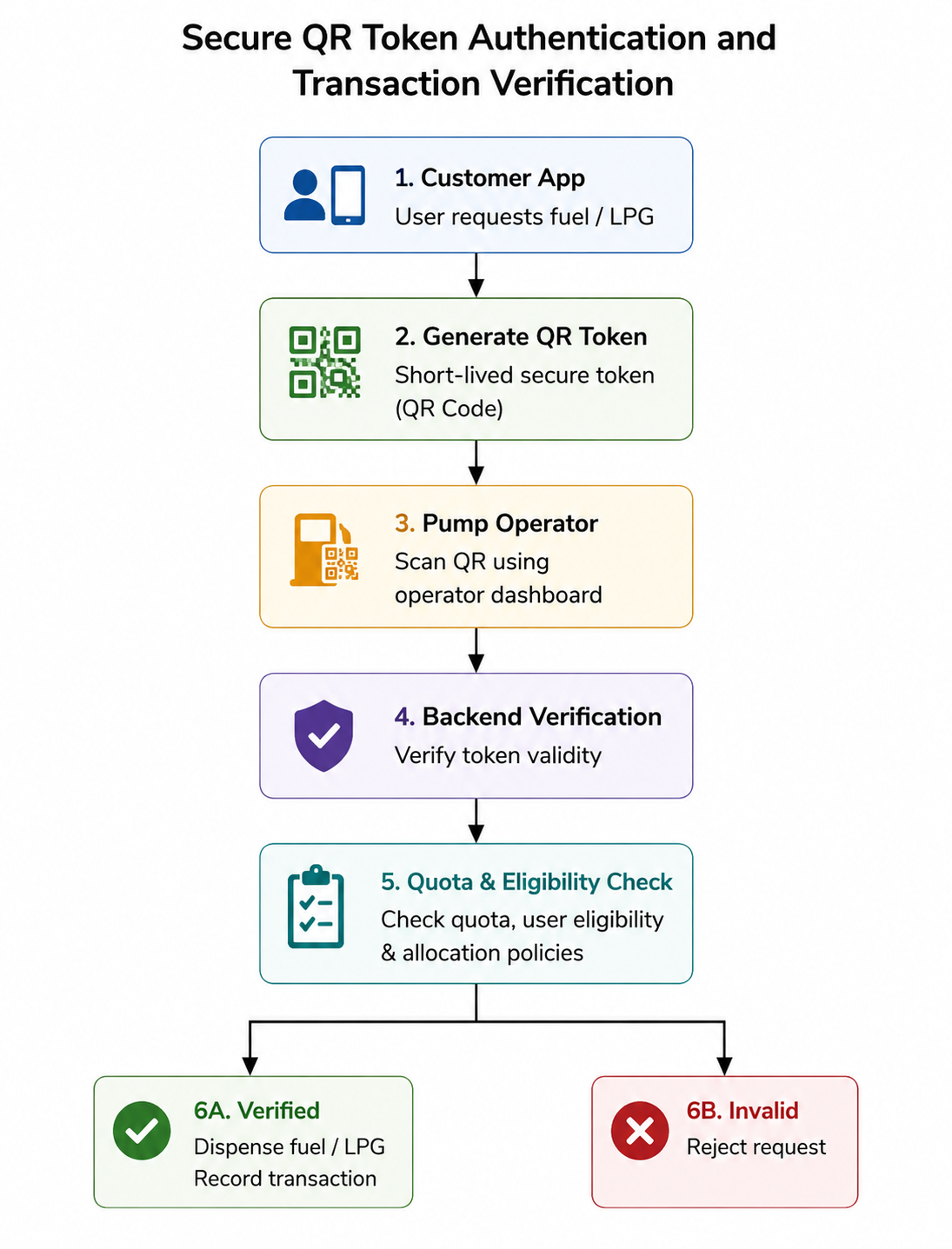
To address these challenges, this paper presents FuelGuard AI, an intelligent digital platform designed to support secure and controlled fuel and LPG resource management. The implemented prototype provides citizen and station-operator interfaces, quota management, fuel inventory monitoring, transaction recording, and secure QR-based verification. A short-lived cryptographic token is generated for an authorized allocation request and encoded into a QR code. The pump operator can scan the QR code using a camera-based scanner, verify the request through the backend, and process the authorized fuel allocation[2], [3].
The system also incorporates server-side quota deduction and one-time token validation to reduce unauthorized or duplicate fuel dispensing. This creates a traceable connection between the citizen allocation request, operator verification, fuel quantity, and resulting transaction. The framework is designed to complement existing fuel and LPG distribution infrastructure rather than replace it.
In addition to secure allocation, FuelGuard AI provides a foundation for intelligent demand analysis, shortage detection, priority-based allocation, and centralized monitoring. During critical situations, these capabilities can assist authorities and distribution organizations in making informed decisions regarding available resources and allocation priorities.
The primary objective of FuelGuard AI is therefore to provide a secure, transparent, traceable, and intelligent approach to fuel and LPG resource management, with particular emphasis on preventing misuse, improving quota control, supporting fair allocation, and maintaining reliable transaction records during normal and emergency operating conditions.
2.Problem Statement and Objectives
2.1 Problem Statement
During emergencies, supply shortages, and sudden increases in fuel and LPG demand, conventional distribution systems may face difficulties in maintaining adequate supply, controlling individual quotas, preventing unauthorized or duplicate allocations, and ensuring fair access to limited resources. Existing digital services provide useful functions such as booking, authentication, and delivery management, but these functions may be distributed across separate operational processes. This can make it difficult to maintain centralized visibility of inventory, quotas, allocation requests, and completed transactions during critical situations.
A further challenge is the secure verification of fuel allocation requests at the dispensing point. Manual verification or the use of exposed authentication information can increase the possibility of unauthorized access, repeated usage, and allocation errors. Therefore, there is a need for a unified system that combines quota management, secure digital verification, transaction traceability, inventory awareness, and controlled resource allocation.
FuelGuard AI addresses this problem by providing a centralized digital framework that connects customers, pump operators, and administrators through controlled allocation and verification workflows.
2.2 Objectives
The main objectives of FuelGuard AI are:
- To provide secure fuel and LPG quota management for controlling resource allocation according to defined limits.
- To implement secure QR-based verification using short-lived cryptographic tokens for authorized fuel allocation requests.
- To enable pump operators to verify customer allocations through a camera-based QR scanning mechanism before dispensing fuel.
- To prevent duplicate and unauthorized allocations through token expiration, one-time-use validation, and backend verification.
- To maintain traceable transaction records containing allocation, verification, quantity, station, and transaction information.
- To support inventory-aware allocation by considering available fuel/LPG resources and existing reservations or quotas.
- To support priority-based allocation during critical situations, allowing essential services to receive higher priority according to predefined policies.
- To provide centralized monitoring for customers, pump operators, and administrators to improve transparency and operational control.
- To provide a foundation for intelligent demand analysis and shortage detection using historical transaction and supply information.
3.Proposed FuelGuard AI Framework
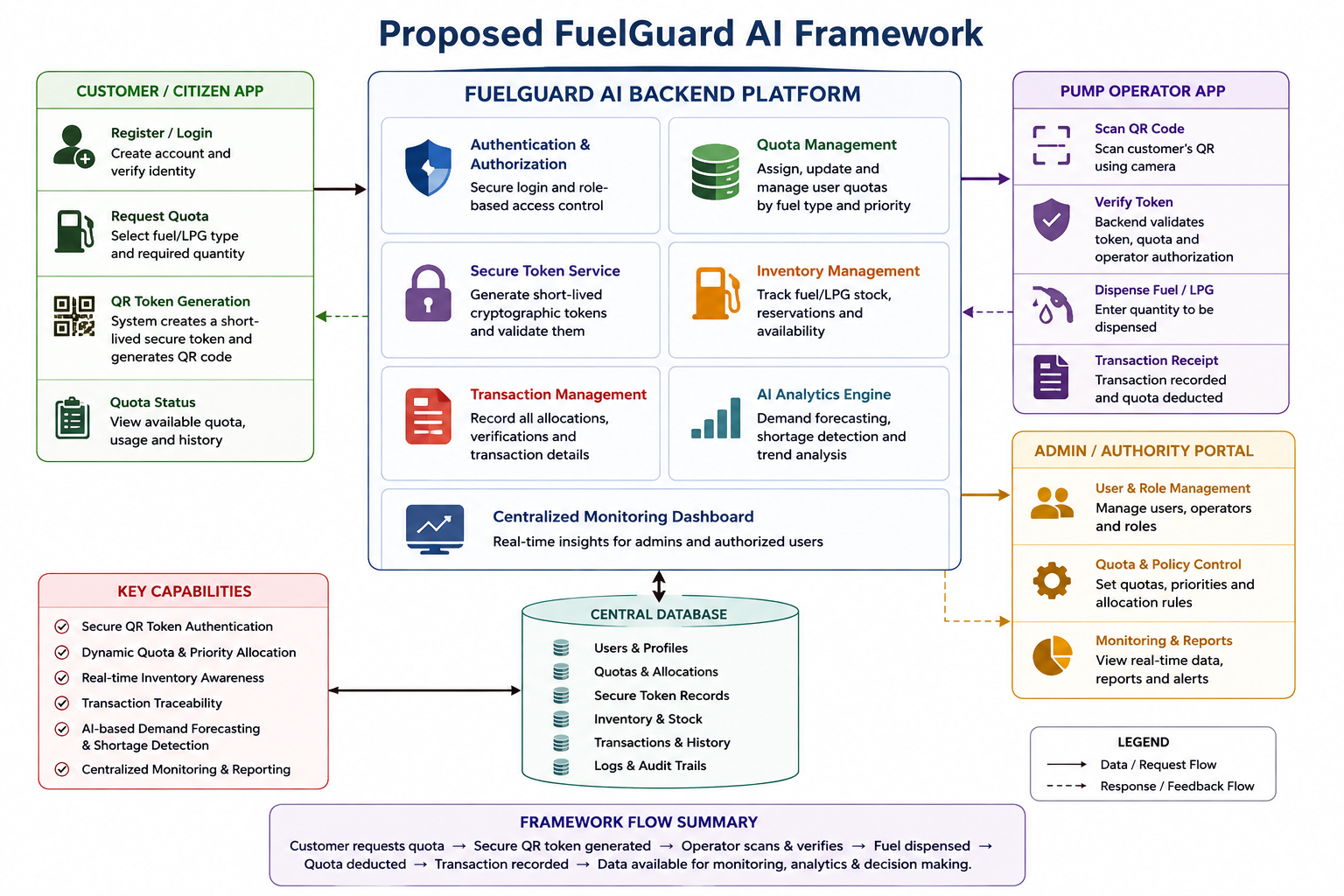
FuelGuard AI is designed as a unified digital framework for managing fuel and LPG resources during normal operations, supply shortages, and emergency situations. The framework connects customers, fuel station operators, LPG distributors, and authorized administrators through a centralized platform.
The proposed framework consists of several interconnected components. Quota Management controls the amount of fuel or LPG that can be allocated to an individual customer or service. Inventory Management maintains information about available fuel, LPG cylinders, reservations, and allocation status. Priority-Based Allocation enables predefined priority categories, such as emergency services and critical operations, to receive appropriate resource allocation during shortages.
A key component of the framework is Secure QR Authentication. When a customer is authorized for a fuel allocation, the system generates a short-lived cryptographic token and represents it as a QR code. The pump operator scans the QR code using the station interface. The backend verifies the token, checks its validity and usage status, and retrieves the authorized quota before allowing the transaction to proceed.
The framework also maintains transaction records for each completed allocation. These records provide information about the allocated resource, quantity, customer or service, station, timestamp, verification status, and transaction state. This improves traceability and provides an auditable history of resource distribution.
For emergency situations, FuelGuard AI provides a foundation for demand analysis, shortage detection, and adaptive allocation. Available stock can be compared with current or predicted demand to identify potential shortages. Allocation policies can then consider quota limits, resource availability, demand, and priority levels.
The overall framework therefore integrates:
- Customer and service management
- Fuel and LPG inventory management
- Quota management
- Secure QR-based authentication
- Pump operator verification
- Priority-based allocation
- Transaction management
- Centralized monitoring
- Demand and shortage analysis
This unified approach is intended to improve the security, transparency, traceability, and efficiency of fuel and LPG distribution while complementing existing distribution infrastructure [4].
4.System Architecture and Network
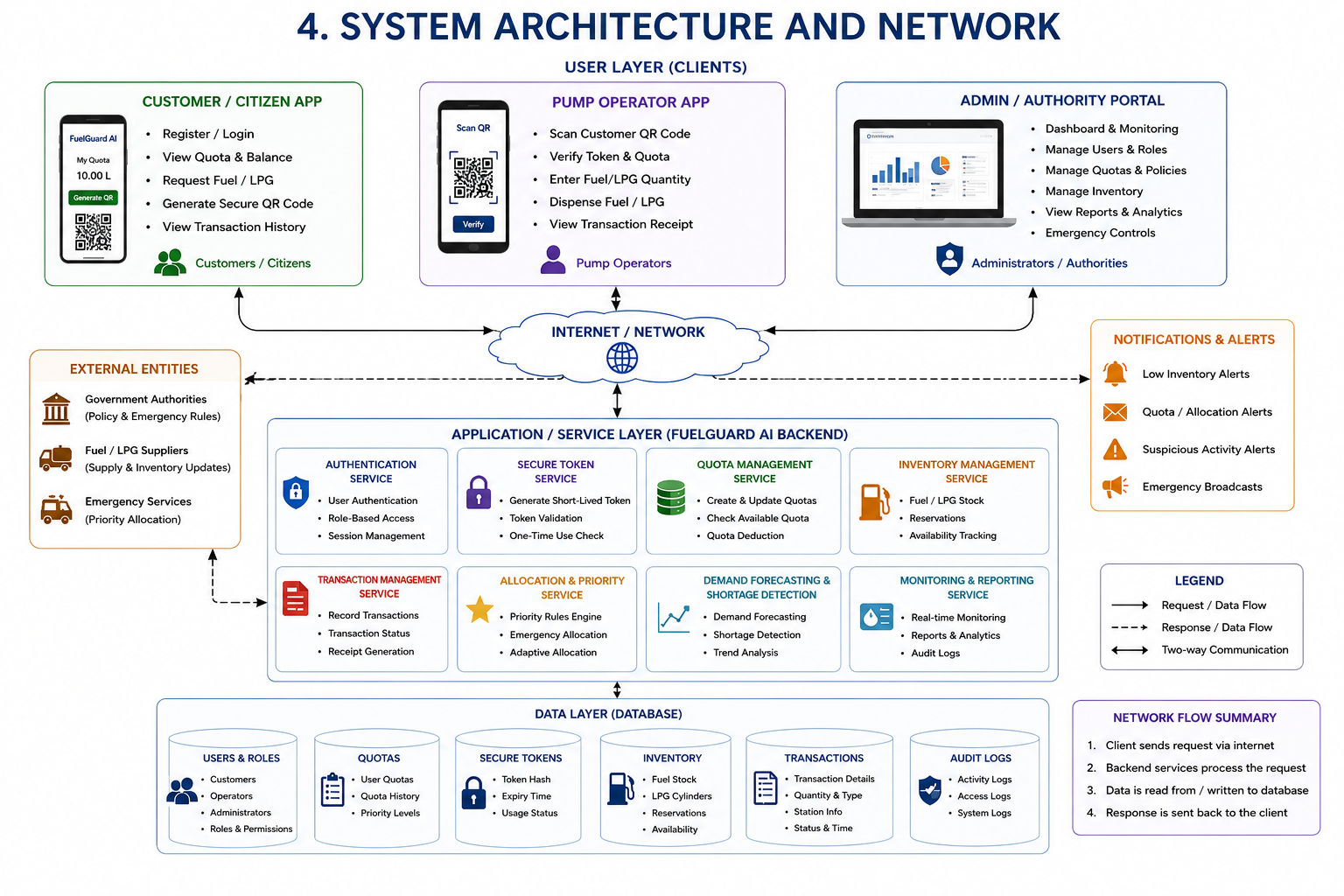
FuelGuard AI follows a centralized client-server architecture in which customers, fuel station operators, LPG distributors, and authorized administrators interact with a common backend platform. The architecture provides a unified environment for quota management, secure authentication, inventory management, transaction processing, and monitoring.
The client layer consists of interfaces used by customers, pump operators, and administrators. Customers can request or view their allocated fuel quota and generate a secure QR code for authorized dispensing. Pump operators use the station interface to scan and verify customer QR codes before dispensing fuel. Administrators can access operational information, monitor transactions, and manage allocation policies.
The application and service layer acts as the central processing layer of FuelGuard AI. It handles authentication, role-based authorization, quota validation, secure token verification, inventory operations, transaction processing, and monitoring. Requests received from the different clients are validated before the corresponding operation is performed.
The data layer maintains operational information including user profiles, quotas, secure token records, inventory information, and transaction history. Centralized data management allows authorized users to access consistent and up-to-date information while maintaining traceability of fuel allocation activities[6].
The network connects the different participants through secure communication with the central backend. Information exchanged through the network includes fuel and LPG availability, customer quota information, allocation requests, transaction records, emergency priorities, and distribution status. Under normal conditions, the system can follow standard allocation policies, while emergency or shortage conditions can be handled using updated quotas and predefined priority rules.
Role-based access control ensures that users can access only the functions appropriate to their responsibilities. For example, customers interact with their quota information, pump operators perform verification and dispensing operations, and administrators manage operational and monitoring functions.
The centralized architecture enables FuelGuard AI to provide secure information sharing, centralized monitoring, controlled resource allocation, and traceable transactions across participating entities
5.AI-Based Demand Forecasting and Shortage Detection
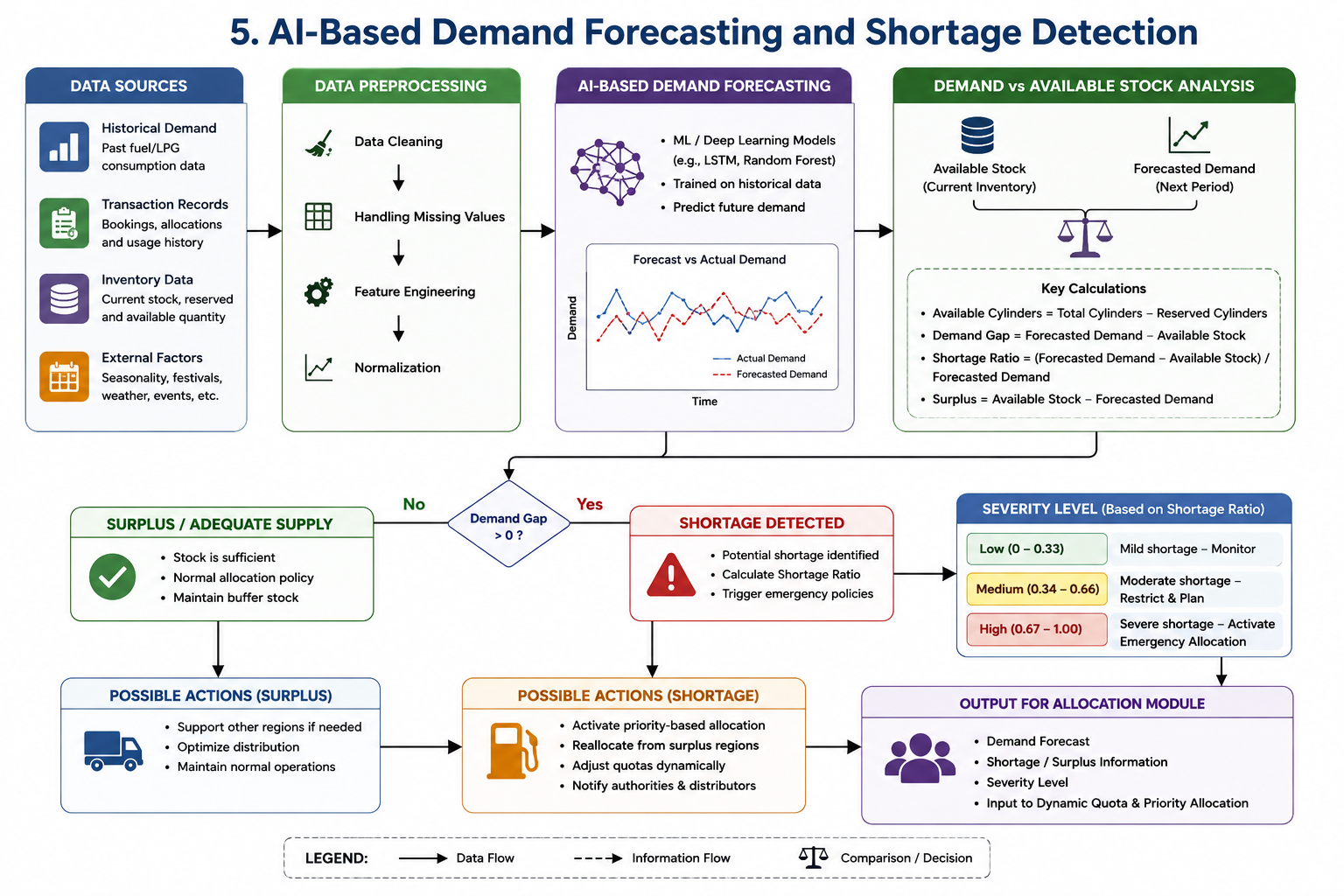
FuelGuard AI incorporates demand forecasting and shortage detection to support proactive management of fuel and LPG resources during sudden demand fluctuations and supply constraints. The framework considers historical demand, current inventory, allocation activity, and expected demand to estimate future resource requirements.
The forecasting component can be used to identify regions or stations where expected demand may exceed available stock. A positive demand gap indicates a potential shortage and allows the system to identify areas that may require additional supply before the shortage becomes critical [1], [4].
For LPG distribution, the framework considers available cylinders, confirmed bookings, and predicted demand. Available cylinders can be calculated as:
Available Cylinders = Total Cylinders − Reserved Cylinders
When predicted demand exceeds available cylinders, existing bookings and essential requirements can be prioritized while future allocations are adjusted according to availability.
FuelGuard AI further calculates a shortage ratio to estimate the severity of a supply shortage:
Shortage Ratio = (Predicted Demand − Available Stock) / Predicted Demand
A higher shortage ratio indicates greater pressure on the available supply and can be used to support the activation of emergency allocation policies.
The framework can also compare expected demand and available stock across regions. A region with surplus resources can potentially support a region experiencing a shortage, subject to operational and policy constraints. The surplus is represented as:
Surplus = Available Stock − Expected Demand
A positive value represents a surplus, whereas a negative value indicates a potential shortage.
This forecasting and shortage-detection mechanism enables FuelGuard AI to move from reactive allocation toward proactive, data-driven resource management. The resulting demand and shortage information can subsequently be used by the quota and priority allocation mechanisms to support fair distribution during normal and emergency conditions.
6.Dynamic Quota and Priority-Based Allocation
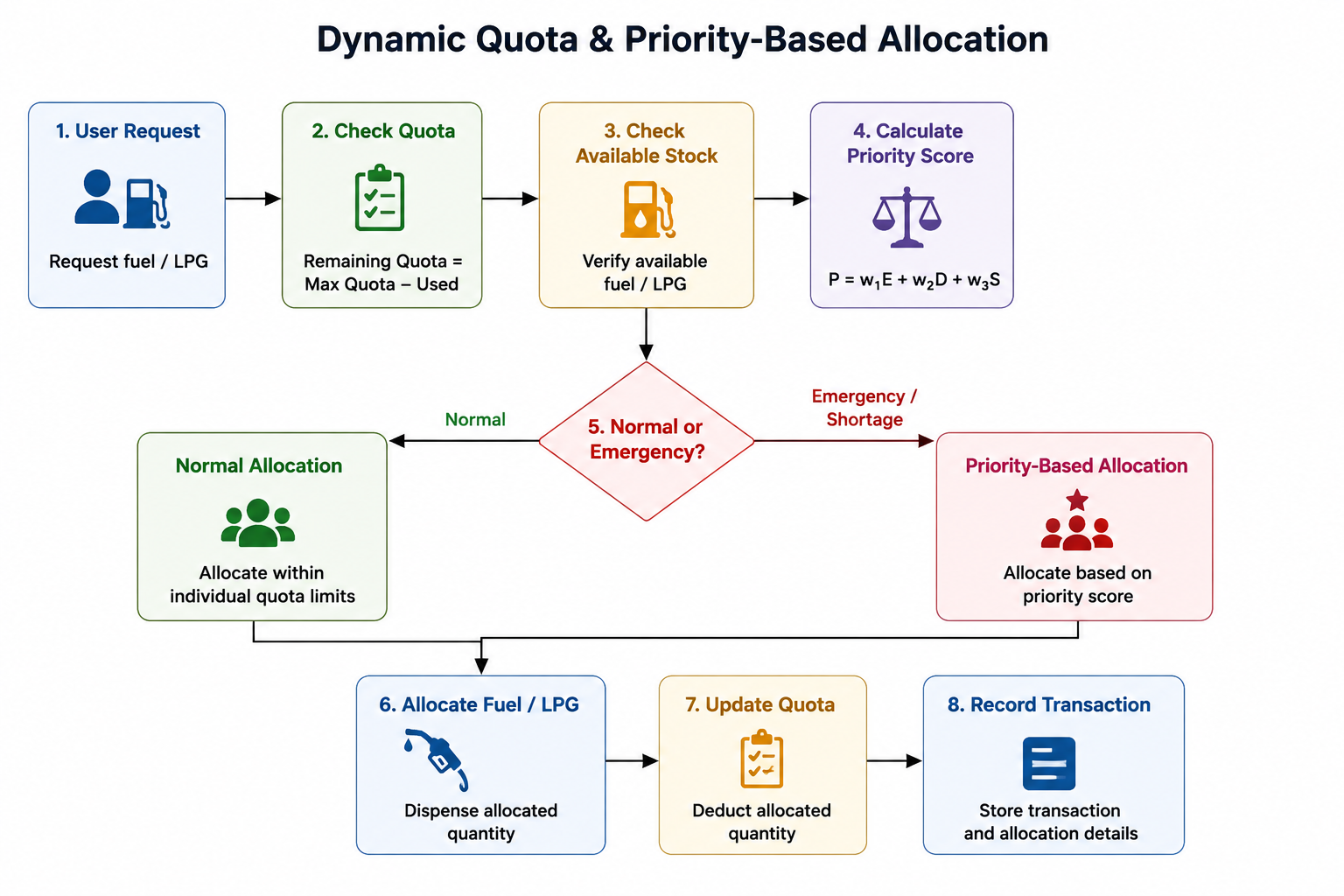
FuelGuard AI uses dynamic quota management and priority-based allocation to distribute limited fuel and LPG resources in a controlled and fair manner. Under normal conditions, users receive resources according to their permitted allocation limits. During emergencies or shortages, the allocation policy can be adapted according to demand, available stock, and the priority of the requesting service.
For normal consumers, the remaining quota is calculated as:
Remaining Quota = Maximum Quota − Quantity Used
This prevents users from receiving resources beyond their permitted allocation.
During emergency situations, FuelGuard AI assigns priority according to predefined factors. Essential services such as ambulances, hospitals, fire services, and other emergency operations can receive higher priority than general consumers. The priority score is represented as:
P = w₁E + w₂D + w₃S
where E represents emergency or service priority, D represents demand level, S represents stock availability, and the weights are predefined according to the allocation policy.
When available resources are insufficient to satisfy total demand, the system can distribute resources proportionally according to priority scores:
Allocationᵢ = (Priority Scoreᵢ / Σ Priority Scores) × Available Stock
This provides a systematic mechanism for distributing limited resources instead of applying the same allocation to every request.
For LPG distribution, available cylinders are calculated by subtracting reserved cylinders from the total available cylinders. When predicted demand exceeds availability, existing bookings and essential requirements can be prioritized while future allocations are adjusted [5], [6], [7].
The final allocation decision combines quota, demand, priority, and stock availability rather than depending on a single factor. This allows FuelGuard AI to maintain fairness during normal conditions while supporting controlled priority-based allocation during emergencies.
7.Secure QR Token Authentication and Transaction Verification
FuelGuard AI uses secure QR-based token authentication to verify fuel and LPG allocation requests at the pump operator terminal. A user generates a temporary QR code containing a short-lived authentication token. The pump operator scans the QR code using the operator dashboard, and the backend verifies the token before allowing the transaction to proceed.
The verification process checks the validity of the token, user eligibility, available quota, and applicable allocation policies. Only a successfully verified request is allowed to proceed to fuel or LPG dispensing. This provides a secure and traceable mechanism for transaction authorization.
The system also records important transaction information such as the transaction ID, user identification, fuel or LPG type, allocated quantity, location, timestamp, quota, verification status, allocation priority, and transaction status. This creates an auditable record of resource distribution.
8.Real-Time Monitoring and Transaction Management
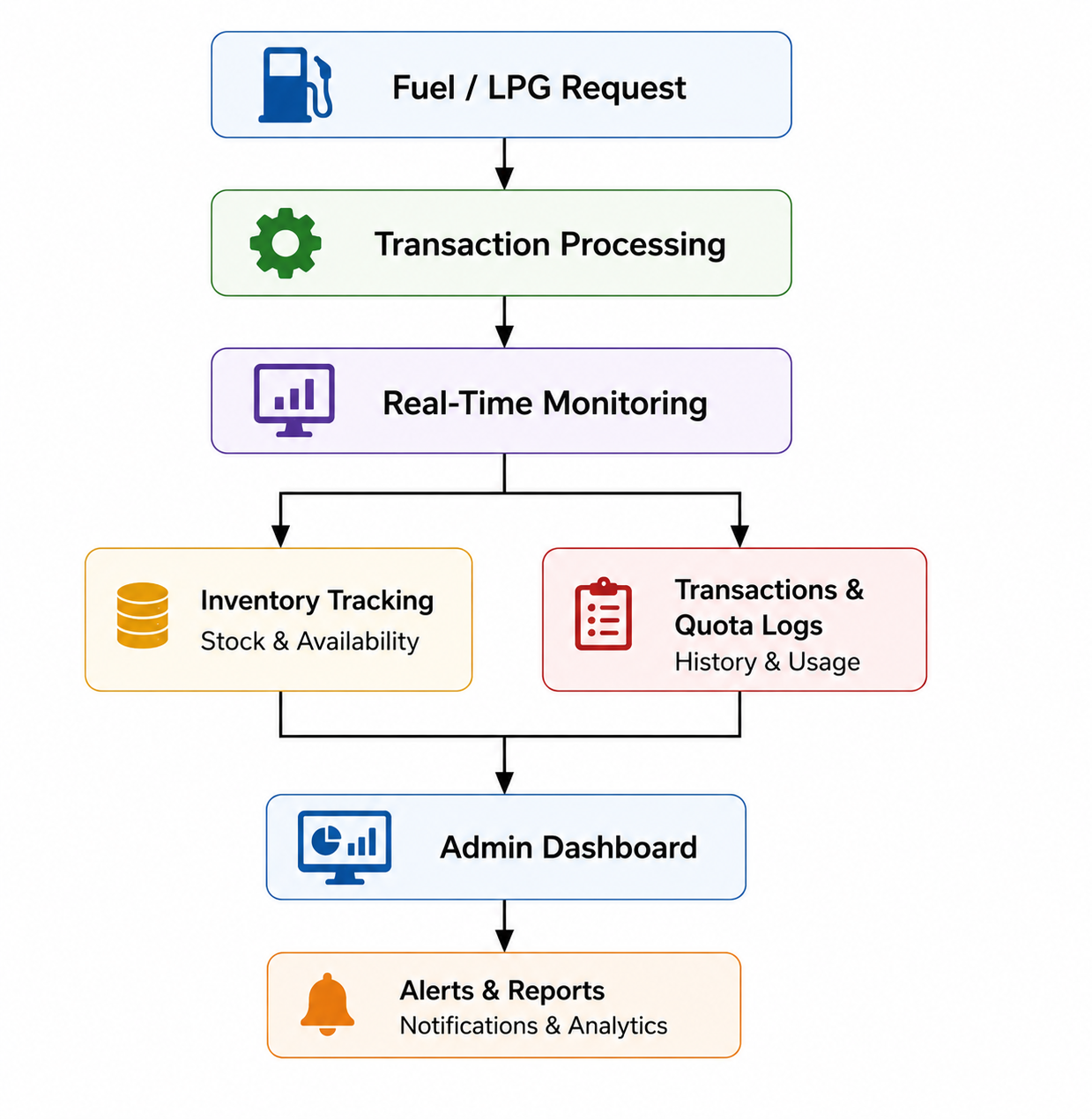
FuelGuard AI provides centralized real-time monitoring of fuel and LPG distribution activities. The system records each transaction with details such as user identification, fuel type, quantity, timestamp, verification status, and transaction status. This enables administrators and authorized operators to track resource usage and distribution activities.
The monitoring module can also support inventory tracking, quota usage, transaction history, and alerts for unusual activities or supply shortages. During emergency conditions, these monitoring capabilities help authorities make timely allocation and resource-management decisions.
9.Privacy, Security and Data Management
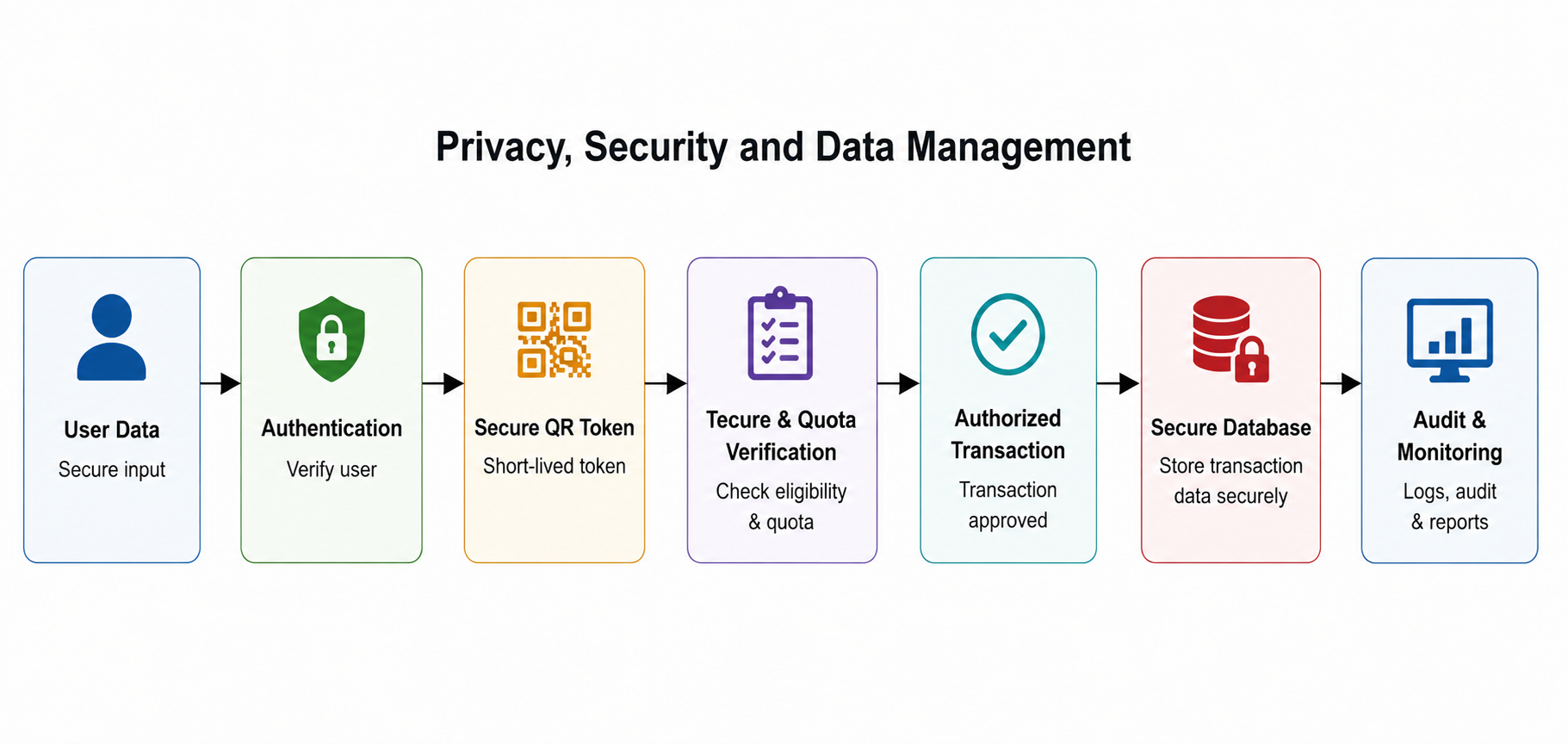
FuelGuard AI incorporates security mechanisms to protect user authentication and fuel allocation transactions. The system uses secure, short-lived QR tokens for transaction verification, reducing the risk of unauthorized or repeated use. User eligibility and quota information are verified before a transaction is approved.
Transaction records are maintained with relevant information such as user identification, allocated quantity, verification status, timestamp, and transaction status. These records provide traceability and support auditing of fuel and LPG distribution activities.
10.Implementation and Prototype
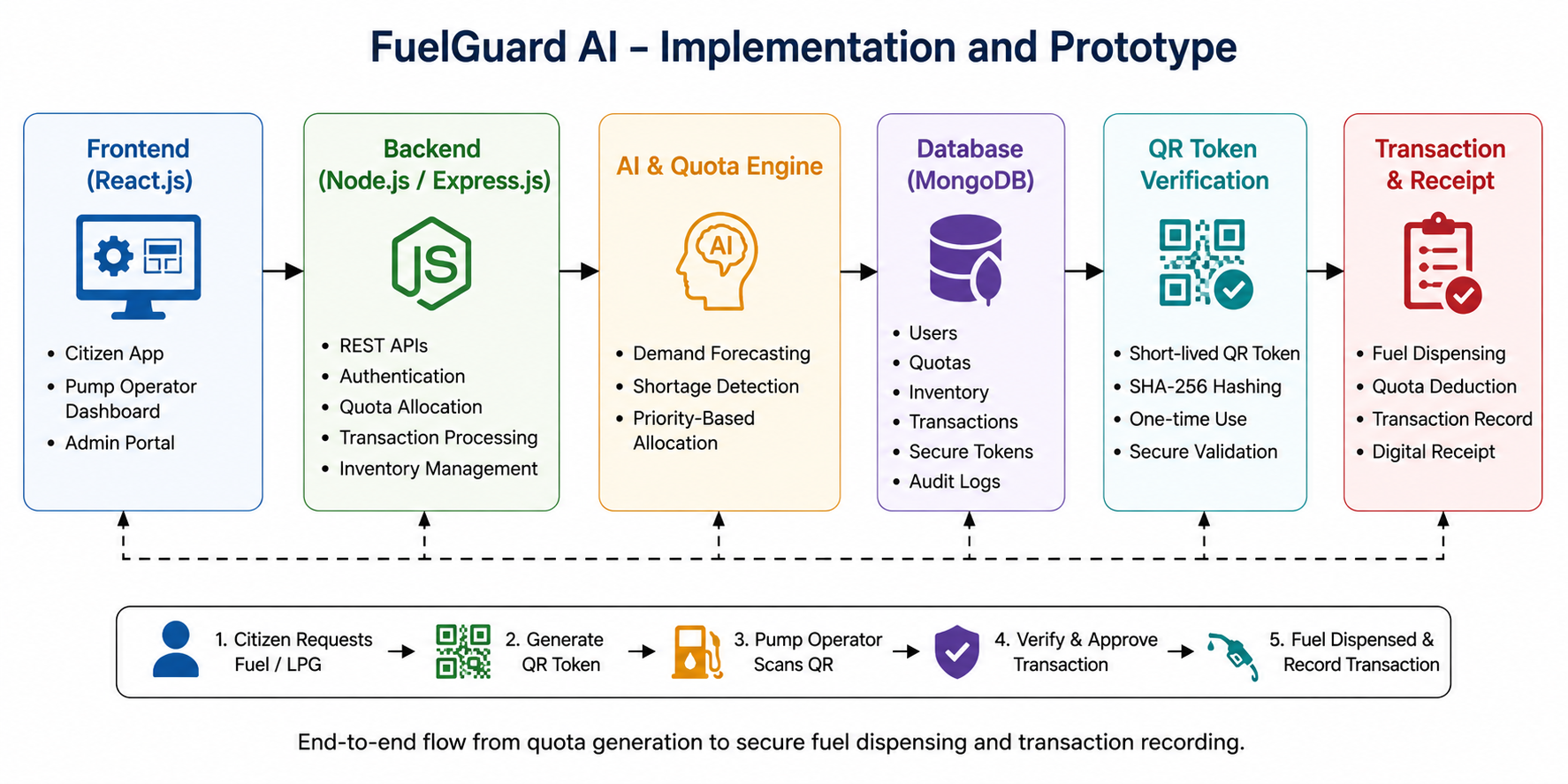
FuelGuard AI was implemented as a web-based prototype consisting of a citizen application, pump operator dashboard, and administrator portal. The system follows a client–server architecture in which the frontend communicates with backend services through REST APIs.
The frontend was developed using React.js, providing responsive interfaces for fuel requests, quota management, QR-code generation, pump operations, and administrative monitoring. The backend was implemented using Node.js and Express.js, responsible for authentication, quota allocation, transaction processing, inventory management, and communication between system components.
MongoDB was used as the primary database for storing user profiles, quota records, inventory information, transactions, and audit logs. The AI component supports demand forecasting and shortage detection using historical consumption and inventory-related data.
For secure fuel authorization, the prototype generates short-lived QR tokens for approved fuel quotas. The pump operator scans the customer's QR code using a camera-based scanner. The token is verified by the backend before the requested quantity is dispensed. Tokens are stored as SHA-256 hashes and are protected against expiration and repeated use. After successful verification and dispensing, the corresponding quota is automatically deducted and the transaction is recorded.
The prototype was tested through production builds and backend integration tests. The implementation successfully demonstrated the complete workflow from quota generation and QR authentication to fuel dispensing, quota deduction, and transaction recording. This prototype provides the foundation for further deployment with real fuel-station systems and connected dispensing infrastructure.
11.Results and Discussion
The FuelGuard AI prototype was evaluated to determine whether the proposed framework can support secure quota management, demand monitoring, and controlled fuel distribution. The prototype successfully demonstrated the integration of citizen requests, quota allocation, QR-based authentication, transaction processing, and inventory monitoring.
The secure QR authentication mechanism generated short-lived tokens and enabled the pump operator to verify an authorized fuel request before dispensing. Token expiration and one-time-use protection were implemented to reduce the possibility of unauthorized reuse. Successful verification resulted in quota deduction and transaction recording.
The AI-based components provide a foundation for identifying consumption trends, forecasting demand, and detecting potential shortages. By combining demand information with inventory and quota data, the system can assist authorities in making informed allocation decisions during periods of limited supply.
The prototype also demonstrated real-time monitoring through separate dashboards for citizens, pump operators, and administrators. These interfaces provide visibility into quotas, fuel inventory, transactions, and alerts. Overall, the results indicate that FuelGuard AI can integrate AI-based forecasting, dynamic quota allocation, secure authentication, and real-time monitoring into a unified fuel-management framework.
12.Conclusion and Future Work
12.1 Conclusion
FuelGuard AI proposes an AI-driven framework for intelligent and secure fuel and LPG resource management during emergencies, supply shortages, and sudden demand fluctuations. The system integrates demand forecasting, dynamic quota management, priority-based allocation, secure QR token authentication, inventory monitoring, and centralized transaction management.
The proposed framework enables transparent and controlled distribution of limited fuel resources by considering user quotas, available stock, predicted demand, and priority requirements. The secure QR-based verification mechanism provides an additional layer of protection against unauthorized and repeated transactions. The prototype demonstrates the feasibility of integrating these functions into a unified digital platform.
Overall, FuelGuard AI can support efficient, transparent, and data-driven fuel and LPG distribution while complementing existing fuel station and supply infrastructure.
12.2 Future Work
Future development can focus on:
- Improving the accuracy of AI-based demand forecasting using larger real-world datasets.
- Integrating live fuel-station and LPG inventory data.
- Developing advanced regional redistribution algorithms.
- Integrating government and emergency-service priority policies.
- Extending the system to multiple regions and fuel stations.
- Conducting large-scale real-world testing to measure allocation efficiency and prediction accuracy.
- Adding mobile notifications for quota, shortage, and emergency alerts.
References
[1] A. S. Al-Sumaiti et al., “Artificial Intelligence for Water–Energy Nexus Demand Forecasting: A Review,” International Journal of Low-Carbon Technologies, vol. 17, pp. 730–744, 2022.
[2] Hindustan Petroleum Corporation Limited, “HP Anytime – LPG Refill Booking and Delivery Services,” HPCL.
[3] Indian Oil Corporation Limited, “LPG Services and Digital Booking,” IndianOil.
[4] A. Roozbeh Nia, A. Awasthi, and N. Bhuiyan, “Industry 4.0 and Demand Forecasting of the Energy Supply Chain: A Literature Review,” Computers & Industrial Engineering, vol. 154, Art. no. 107128, 2021.
[5] W. Wang, J. Fan, W. Zhu, Y. Cai, Y. Yang, X. Zhang, Y. Yao, and X. Chang, “When Demand Uncertainty Occurs in Emergency Supplies Allocation: A Robust DRL Approach,” Applied Sciences, vol. 16, no. 2, Art. no. 581, 2026.
[6] L. Mei, Y. Chenjing, and S. Sha, “AI-Driven Emergency Logistics Network Deployment in Dynamic Environments,” Scientific Reports, vol. 16, Art. no. 11596, 2026.
[7] J. Zheng, Y. Zhao, Y. Li, J. Li, and Q. Wang, “Dynamic Emergency Resource Allocation via Graph Attention Networks and Hierarchical Reinforcement Learning,” Information Processing & Management, vol. 63, no. 6, Art. no. 104777, 2026.