Health, Social and Recidivism Outcomes Among People Who Have Been Incarcerated in New South Wales, Australia: Study Protocol and Cohort Profile for the Prison Outcomes STudy (POST).
Introduction We have been funded to examine post-incarceration health and social outcomes for all people incarcerated in New South Wales, Australia, 2000-2022; assess treatment and services for drug dependence and serious mental illness; and project the impact of expanding intervention coverage. We will use a linked cohort, the Prison Outcomes STudy (POST), which we also describe. Methods The POST cohort was established using linked administrative data for all adults (≥ 18 years) admitted to full-time custody in New South Wales, 2000-2022. Custody records were probabilistically linked to 18 health, justice and mortality datasets. We report baseline sociodemographic and custody characteristics and the frequency of key post-release events. Results 200,486 adults, 15% women (n = 30,698), were incarcerated, with 2,282,367 person-years of follow-up and 11% (257,545 person-years) of follow-up spent in custody. First Nations people comprised 27% of the cohort. Half (48%) of the cohort (n = 95,563) had at least one contact with community mental health services, and 27% (n = 54,100) had received alcohol and other drug treatment. POST will provide population-wide evidence on health and social outcomes after custody, including the effects of treatment for drug dependence and serious mental illness. We will compare across subgroups and the outcomes of post-release service engagement. Mathematical modelling will test the impact of expanding access to care in prison and post-release on outcomes in the community. Discussion and conclusions POST will inform policy and service responses across justice, health and community settings to reduce harms among people who experience incarceration.
Introduction
The global prison population size has increased by 27% since 2000 [1]; over 30 million people are released from prison globally each year [2]. Australian governments spend 422 per prisoner per day) [3]. In 2024, there were over 70,000 prison releases in Australia [4], a 36% increase since 2000 [5].
One of the intended goals of incarceration is to punish people for breaking the law, alongside deterrence, rehabilitation and community protection. The population of incarcerated people does, however, include people who are especially susceptible to hardship. This includes First Nations people (in Australia, Aboriginal and Torres Strait Islander people), who comprise 31% of the incarcerated population [6,7,8] (compared to 3.2% of the general population [9]); people who use illicit drugs (> 70% of the prison population) [10,11,12]; people with serious mental illness (15% of the prison population compared to 1% of the general population) [13,14,15,16]; and women, a growing minority of people in prison (7%) who often come from disadvantaged backgrounds (including domestic violence, childhood trauma and social deprivation).
The negative outcomes associated with incarceration are immense and long‐lasting [17], with increased risks of suicide, fatal drug overdose, communicable and non‐communicable disease, serious mental illness and socio‐economic disadvantage [13,14,15,16]. High reincarceration rates [18] result in re‐exposure to the adverse health and social impacts of prison [19], causing repeated harm to individuals, families and community [20,21,22,23].
Our data linkage study comprises all people incarcerated in New South Wales (NSW) since 2000, linked with 18 state and national administrative datasets. Our National Health and Medical Research Council (NHMRC)‐funded project, which leverages these data, will generate crucial population‐level data on risk of adverse health and social outcomes following release from prison; evaluate the effectiveness of interventions for serious mental illness and drug dependence in reducing adverse outcomes; and model the population‐level impact of increasing coverage of care in prison and linkage to effective interventions post‐release. Despite advances in the management of serious mental illness and drug dependence, significant gaps persist in delivering treatment to people leaving prison. Opioid agonist treatment (OAT; methadone or buprenorphine) for opioid dependence is classified as a World Health Organization essential medicine [24]. Community evidence shows OAT reduces multiple adverse outcomes, including overdose and suicide [25,26]. We have demonstrated the population‐wide beneficial impacts of OAT among people in NSW [27,28,29]. However, there is limited evidence on the uptake and effectiveness of OAT following release from incarceration, including newly introduced long‐acting injectable buprenorphine formulations. Available evidence suggests that maintaining OAT in the community after release is associated with higher rates of primary healthcare contact [30] and lower rates of ambulance contact [31]. Similarly, evidence for the uptake and impact of interventions for methamphetamine dependence post‐release is almost non‐existent [32,34,35]. Interventions for serious mental illness, for example, antipsychotic medication, may reduce suicidality, mortality and crime among people with serious mental illness [32,34,35], but there is limited research on the extent and impact of linkage to care post‐release among people who have been incarcerated.
This NHMRC‐funded project has three aims:Characterise and quantify adverse health and social outcomes among people released from prison (including mental health, overdose, recidivism and mortality). We will also examine variation in risks among key subpopulations that are rarely studied using other research designs because of the more limited sample sizes that are typically obtained from studies that do not capture the entire population.Assess the extent and impact of interventions targeting opioid and methamphetamine dependence and serious mental illness on adverse health and social outcomes.Use mathematical modelling to assess the potential impact of scaling up mental health and drug dependence interventions on reducing adverse outcomes following release from prison.
Methods
Ethics Statement
Ethics approvals include NSW Population and Health Services Ethics Committee (No: 2022/ETH00289, including a waiver of consent), Australian Institute of Health and Welfare (No: EO2022/5/1371), Corrections Health (No: 2021.61), Aboriginal Health and Medical Research Council Ethics Committee (No: 1999/22) and UNSW Sydney Human Research Ethics Committee (No: iRECS6272).
Cohort Description
This is a population‐based retrospective cohort study of all adults (≥ 18+ years) with a record of incarceration in NSW between 1 January 2000 and 31 December 2021, recorded in the NSW Bureau of Crime Statistics and Research's Reoffending Database (ROD).
ROD is an internally linked dataset of finalised legal actions within the NSW Criminal Justice System, including all finalised court appearances in the Children's, Local, District and Supreme Courts of NSW since 1994 and all adult episodes of full‐time incarceration to custody since 2000, which have been supplied to the Bureau of Crime Statistics and Research by Corrective Services NSW from their electronic Offender Integrated Management System. The internal matching process between court and custody data within the ROD database has been previously validated and has a specificity of 99.9% and a sensitivity of 93.8% [25]. We have previously used this database in successful data linkage projects [26].
Data for cohort members were linked to 18 state and national datasets to provide content data on health service utilisation, disease notifications, alcohol and other drug treatment, mental health treatment, social services and mortality, in addition to reoffending content data contained in ROD (see Figure1and Table1). Please see AppendixAfor details of coding for several key datasets (TablesA1,A2,A3,A4,A5,A6).
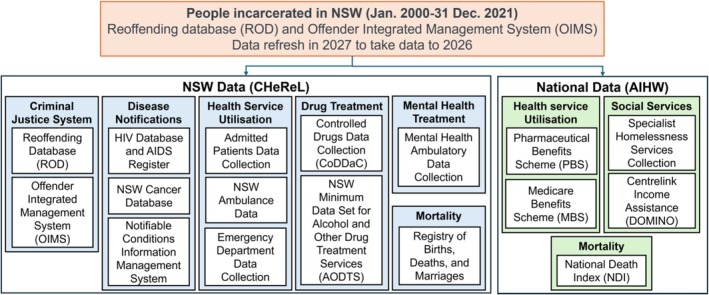
Datasets linked in POST, including date ranges of available data. Abbreviations: AIHW, Australian Institute of Health and Welfare; NSW, New South Wales.
Table: Contents of datasets linked to the POST cohort.
Data Linkage and Data Security
Data linkage was conducted by the Centre for Health Record Linkage for NSW datasets and the Australian Institute of Health and Welfare data integration unit for National datasets. Data were linked probabilistically, in accordance with standard models [37]. Personal identifying data used for the purposes of data linkage remain with the data linkage authorities and were not made available to study investigators. Linked content data, identified only by a Person‐Project‐Number, are stored in and accessed via the Secure Unified Research Environment, a high‐security data environment approved by all data custodians and ethics committees. Access to project data is limited to approved and named researchers who are conducting analyses and who have the approval of the principal investigator and all ethics committees. The method of reporting for research outputs will ensure that individual participants cannot be identified. To ensure that results relating to Aboriginal and Torres Strait Islander peoples are reported in a culturally appropriate manner, all study outputs are reviewed by an Aboriginal Reference Group.
Data Cleaning
Prior to any analyses, all received data were cleaned, including logic checks, correction of obvious typographical errors, identification of missing data and data entry errors. Where variables are recorded across datasets, comparison of these will be used to determine ‘correct’ values. For example, Indigenous status is known to be poorly recorded in many health datasets [38]; we have elected to code an individual as Aboriginal and/or Torres Strait Islander if they were identified as such in any of the included datasets.
Cohort Characteristics
Between 2000 and 2021, 200,486 individuals were incarcerated at least once in NSW (30,698 women and 166,238 men). The number of people who entered the cohort, the number leaving incarceration and the number currently incarcerated each year are presented, by sex, in Figure2(see also TableA7for all data). There was a consistently higher number of men than women experiencing their first adult incarceration during the study period or any incarceration each year, and a similar number of releases from incarceration each year as there were entrances to incarceration. Cohort members spent a total of 257,545 person‐years in incarceration, out of a total of 2,282,367 person‐years of observation (Table2).
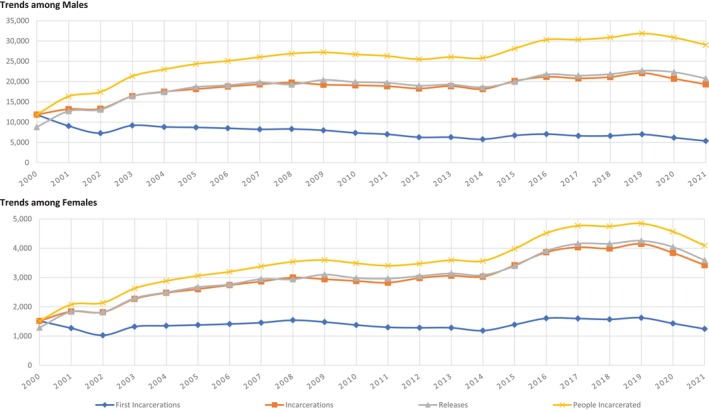
Annual trends in cohort experiencing first incarceration, incarcerated at least once, and released from custody, by sex (2000–2021).Note:Total number of men (n= 166,238) and women (30,698); Blue = first incarceration during the cohort period (counted once); Orange = individuals incarcerated at least once per year (max once/year); Grey = individuals released from custody per year (max once/year); Yellow = individuals held in custody at any point in the year (counted once/year).
Table: Characteristics of the POST cohort.
Tables2and3present descriptive characteristics of the cohort. At cohort entry, the median age was 30 years; 26% were identified as being Aboriginal and/or Torres Strait Islander (cf. comprising around 3.2% of the general Australian population). Most people were living in major cities at the time of incarceration (65%); 25% came from the two most economically disadvantaged areas (which contain 20% of the general population).
Table: POST cohort drug and alcohol treatment and other health service contacts.
Approximately half of the cohort (53.5%) were incarcerated for periods on remand only (i.e., were not incarcerated following a custodial sentence); 26.7% had one episode of incarceration following sentencing, and 19.9% had more than one. Men in the cohort had higher proportions of sentenced episodes: 27.7% had one, and 21.0% had more than one, compared with 20.9% and 13.5% among women in the cohort. The median number of incarcerations during follow‐up was 2 (interquartile range [IQR]: 1, 4); most incarcerations (including remand) were for short durations (median 4 days [IQR: 1, 104 days]). The median number of proven criminal charges during the observation period was 11 (IQR: 5, 24); 71% of the cohort had at least one violent offence conviction, and 4 in 10 had at least one drug offence or property offence.
Levels of HIV notifications were very low in the cohort (0.34%); just over one in eight people in the cohort received a notification of hepatitis C infection at some point (13.8%). One in 10 received a notification of a sexually transmitted infection at some point (10.6%). Using data from the NSW Registry of Births, Deaths and Marriages, 6.8% of the cohort died during follow‐up (13,394 people; Table2).
Table3presents information on some health service use of the cohort (recorded at any time in each of the datasets). Opioid agonist treatment (methadone or buprenorphine) was accessed at some point by 15.01% of the cohort (with slightly higher levels among women). One in 10 had ever accessed community drug treatment for amphetamine use (10.7%; 17.0% among women, 9.9% among men).
The majority (81%) had at least one emergency department visit, and most (60%) had an ambulance callout. Ambulance callouts for suspected overdoses had occurred for 23.2% of women and 12.82% of men. Outpatient mental health treatment had been accessed by almost half of the cohort (47.7%).
Hospital stays for substance use disorders were coded as one of the reasons for hospital stays for a substantial minority (e.g., 22.0% for alcohol use disorders; 13.8% for stimulant use disorders and 10.6% for opioid use disorders). Almost 1 in 10 had experienced a hospital stay for psychosis (9.4%) or self‐harm (9.5%). Almost 1% (0.95%) had ever had a hospital stay related to endocarditis, and 13.6% for a skin or soft tissue infection.
Results
Aim 1: Quantify Adverse Health and Social Events Post‐Release
We will quantify rates of adverse health and social events (Table3) among people released from incarceration for the study follow‐up time (or until reincarceration or death) and at different time periods (1‐, 3‐, 6‐, 12‐, and 24‐month post‐release), with confidence intervals derived from a Poisson or negative binomial distribution as appropriate. We will test for differences in outcomes among specific subgroups (Table4), including individuals with histories of serious mental illness, opioid dependence, methamphetamine dependence, women and First Nations people.
Table: Health and social outcomes, and subgroup operationalisation.
Using extended survival and generalised linear regression models, we will calculate effect estimates (e.g., hazard ratios, odds ratios and incidence rate ratios) to assess heterogeneity between population subgroups descriptively, by constructing models within each subgroup, and formally through hypothesis testing of interaction terms. Analyses will be stratified by duration of incarceration, consider each adverse outcome separately and be adjusted for relevant confounders (Table4shows examples). We will also investigate the effect of repeat incarceration episodes by using methods that incorporate multiple observations per person (e.g., generalised linear mixed models and generalised estimating equations). The generalised estimating equation approach will account for the correlated nature of repeated measurements among individuals; logistic models will be used to calculate the odds of an outcome; Poisson models will calculate the rates (the negative binomial distribution will be considered in the presence of overdispersion). Cox regression models will be utilised to calculate the median time to health and social outcomes from release from incarceration. Measures of association will be estimated using a competing risk model (e.g., Fine–Grey model) when competing risks are present, such as when death occurs that is not the outcome of interest, for example, when estimating the time to suicide and death occurred due to other circumstances. Adjustments will be made using the same confounders as for the generalised estimating equation approach. Weighted Schoenfeld residuals will be used to examine the assumption of proportional hazards. Subgroup analyses will focus on individuals with histories of opioid/methamphetamine dependence or serious mental illness; we will examine potential differences in outcomes for women and First Nations people and consider other subpopulations such as those who have experienced homelessness. These data critically inform Aims 2 and 3.
Far smaller studies than ours, with much shorter follow‐up [39], have had sufficient power to show associations between sex and mental disorders when examining overdose and mortality (rarest outcomes). We will have sufficient power for all subpopulations: to detect a 25% difference in mortality between males and females (the smallest subgroup), 12 months post‐release would require ≈ 17,923 females and ≈ 118,292 males (female mortality rate of 0.008; male rate of 0.0102; 80% power; 5% significance; 6.6 ratio of males/females) [15]. Power to examine differences among First Nations people will be higher [40].
Aim 2: Assess the Effect of Interventions to Reduce Adverse Health and Social Events Among Select Subpopulations
Aim 2 analyses will assess the impact of interventions on the risk of adverse health and social outcomes. We will examine interventions provided to people released from prison with a history of opioid dependence, methamphetamine dependence or serious mental illness. We will test for variation in exposure and treatment effects between women and men, and between Aboriginal and Torres Strait Islander peoples and non‐Indigenous people. Interventions for opioid dependence include methadone, buprenorphine and long‐acting injectable buprenorphine; interventions for methamphetamine dependence will include counselling, support, case management and residential rehabilitation. Interventions for serious mental illness will include visits with a psychologist, psychiatrist or mental health outpatient, and relevant medications such as antipsychotics. Periods in and out of treatment will be estimated.
The overall objective of the NHMRC‐funded study is to assess the impact of interventions on the risk of adverse health and social outcomes immediately upon leaving incarceration. We will examine interventions provided to three subpopulations—people with opioid dependence, methamphetamine dependence and SMI (Table5). For people with a history of each disorder, we will investigate the time taken to obtain disorder‐specific treatment in the community, censoring at the end of follow‐up, death or reincarceration. We will test for variations in exposure and treatment effects between women and men, and between First Nations and non‐First Nations people, using similar approaches described in Aim 1.
Table: Operationalisation of services being considered, and potential covariate operationalisation.
Aim 3: Modelling the Population‐Level Impact of Scaling Up Interventions Post‐Release
We will use mathematical modelling to project the population‐level impacts of scaling up mental health, opioid and methamphetamine dependence interventions post‐release. We will assess the impact achieved by past intervention provision and estimate the potential reductions in adverse outcomes (see Table4) that could be achieved by scaling up linkage to care upon release. Impact will be measured, overall and by sex and First Nations status, and at the intersection of sex and First Nations status, in terms of the number of adverse events averted (e.g., drug‐related deaths and suicide) and the relative reduction in incidence of adverse outcomes.
Leveraging our experience with dynamic modelling of OAT's impact on mortality [25,44], we will develop an individual‐based model of the cohort subpopulations with opioid dependence to estimate the population‐level impact of post‐release OAT. The models will simulate the trajectory of health, treatment, and social outcomes of each individual within the cohort. Using cohort data, individuals will be assigned characteristics such as age, sex, First Nations status and other key covariates identified in Aim 1. Upon release, individuals will receive each intervention with probabilities informed by cohort data, which can differ based on their characteristics and over time.
Informed by Aims 1 and 2, individuals will experience adverse health and social outcomes with probabilities that are dependent on their characteristics, intervention exposure and time since prison release, including any interactions (e.g., differential exposure and/or effectiveness of interventions by First Nations status or sex). The model will be used to estimate the impact of interventions over 2000–2021 by comparing baseline model simulations with counterfactual scenarios in which interventions are not delivered, similar to our previous modelling for all people with opioid dependence [25,44]. Impact will be measured in terms of adverse events averted (e.g., drug‐related deaths and suicide) and the relative reduction in incidence of adverse outcomes. Analyses will also estimate the differential impact of these interventions for First Nations people and women, resulting from differential baseline risks of adverse events and uptake and/or effectiveness of OAT.
Analyses of cohort data will identify trends in the number of people with opioid dependence who are incarcerated for the first time and their characteristics. Projecting forward, the model will then be used to estimate the impact of different scenarios which scale up specific post‐release interventions, informed by our advisory groups. Analyses will identify which intervention scenarios maximise impact for the overall population, and among First Nations people and women.
In a similar way, we will develop individual‐based models of the cohort subpopulations with methamphetamine dependence and SMI to evaluate the impact of post‐release interventions and of scaling‐up interventions targeted to these subpopulations going forward, if we generate evidence of effectiveness for specific interventions. If interventions for SMI and methamphetamine dependence show no/limited effectiveness in Aim 2, we will conduct scenario analyses that model interventions with different effectiveness on outcomes based on consultations with the Community Advisory Group, First Nations Reference Group (FNRG), other external stakeholders and international evidence [45]. Combining sub‐models for opioids, methamphetamine and SMI, we will then develop an overall model of the entire cohort population updated to 2000–2024 data and incorporating results from Aim 2.4. We will compare the incidence rate ratio of adverse outcomes by sex and First Nations status with and without the scale‐up.
Relevance for Consumers and Community
We address many government priorities. This project is aligned with the National Mental Health and Suicide Prevention Plan (Priority 3: Coordinating treatment and supports for people with severe and complex mental illness; Priority 4—improving First Nations mental health and suicide prevention) and the Australian Government'sNational Drug Strategy 2017–2026, where priority populations are people in contact with the criminal justice system and First Nations people. It also aligns with theNational Agreement on Closing the Gap Plan[45], with targets on reducing incarceration and suicide among First Nations people.
The project will be informed by the insights of individuals with lived experience of incarceration through the FNRG and the Community Advisory Group, as well as community partners. Guidance from advocacy groups for people who experience incarceration, the FNRG for our project, and other key stakeholders have shaped the core research questions and informed the project's analyses for women and First Nations people. We will continue to co‐design the project with advisory groups using a structured framework to continuously improve our research questions, critique methodologies, interpret findings and guide effective dissemination.
Data Resource Access
To protect privacy and confidentiality, approval for the linkage of health data in NSW is provided under strict conditions for the storage, retention and use of the data. The current approval permits storage of the data at one site, the University of New South Wales, Sydney, for up to 7 years following the date of publication of results. Data may only be supplied for analysis within Australia.
We encourage interested parties to contact us to discuss potential secondary data analyses, noting that legislation requires that the data can only be stored and analysed within NSW. Virtual Private Network and other virtual access are not permitted under current approvals. Requests for data access can be submitted to Professor Louisa Degenhardt (l.degenhardt@unsw.edu.au) and will be reviewed by the POST investigator team. Potential collaborators will be required to gain approval for data access and specific secondary analyses from the NSW Population and Health Services Research Ethics Committee. Collaborators proposing to examine research questions relating specifically to Aboriginal peoples will also be required to seek approval from the Aboriginal Health and Medical Research Council.
Discussion
Although studies have documented the elevated risk of communicable diseases and mortality in prisoners post‐release [46], most health and social outcomes remain under‐researched [47], and there is a lack of population‐wide research on health and social outcomes post‐release from incarceration. Individuals with serious mental illness or drug dependence, women and First Nations people face unique challenges and health disparities that are not adequately addressed by general population studies [7,48,49,50]. Despite this, research on these subpopulations among people who are incarcerated is limited: evidence to drive change and improve outcomes is critically needed.
Policymakers and those working with people who are incarcerated are acutely aware of the risks faced by people released from incarceration, but strong population evidence on interventions to reduce these risks is lacking. We have shown that the impacts of mental health and drug dependence treatment after release from incarceration are neither well studied nor understood [27]. For example, only two studies have examined the impact of opioid agonist treatment (OAT, methadone or buprenorphine, classified as World Health Organization essential medicines [24]) delivered during incarceration on mortality post‐release [28], and only one of those examined linkage to OAT provided post‐release [28,29]. A long‐acting injectable buprenorphine formulation (delivered weekly/monthly) for the treatment of opioid dependence, found to be effective in the community [51,52], has recently been introduced and rapidly scaled up in prisons in Australia [53], but there has been no evaluation of potential differences in outcomes for people released from incarceration on this new buprenorphine formulation compared to methadone. This is important because there is evidence to suggest that people may prefer methadone to buprenorphine (but are given limited choice of OAT medication during incarceration, and are typically required to receive long‐acting injecting buprenorphine [53]), and therefore may be more likely to cease buprenorphine after leaving prison. This would potentially increase risks of the adverse outcomes that are known to be highly elevated for opioid dependent people post‐release, particularly mortality [54].
There has been no evaluation of the impact of either methamphetamine dependence or serious mental illness treatment provided to people released from incarceration in Australia. Additionally, no study has examined potential subpopulation differences of post‐release interventions for mental health and drug dependence [25]. And importantly, no studies have considered comorbidity between drug dependence and serious mental illness in terms of impact on outcomes post‐release and the impact of interventions to dually treat these disorders.
Our study will fill these gaps using real‐world data. Our study will use a population‐wide linked cohort to quantify the risk of post‐release harms, including Amon key subpopulation, and assess the effectiveness of interventions following release from prison. It will be the first to jointly examine how serious mental illness and drug dependence contribute to these outcomes. Findings will underpin mathematical modelling, which will identify where improved linkage to care post‐release can yield the greatest benefits. These findings will inform policy and practice across justice, health, and community sectors. This work will quantify outcomes and generate evidence around critical points for intervention to reduce health and social harms among people released from incarceration, informing Justice Health, Corrective Services and community agencies. It will also answer policy‐relevant questions about the impact of improving the transition from incarceration to community care; and additionally, the benefits of increasing programmes that divert people from incarceration.
Strengths and Weaknesses
A key strength of this study is the use of the NSW ROD as a sampling frame, capturing all people in NSW who have been incarcerated on any given day since 2000, eliminating coverage error. As individuals in the cohort have data linked from multiple longitudinal health and social data collections, POST serves as a growing resource for a range of study designs and research questions relating to incarceration, as well as to related interventions and policies.
As these data collections are primarily collected for administrative purposes, the data are limited to those variables that are routinely collected. We have notification data on HIV and HCV infection, for example, but this will underestimate true prevalence if not all people who have been incarcerated have been tested. Data on indicators of so cial determinants of health are available, such as homelessness and socio‐economic status—the latter of which is inferred indirectly by applying the Socio‐Economic Indexes for Areas to the postcode listed for each participant [37]. Another limitation concerns our limited capacity to examine health services delivered during incarceration: many services, such as prescribed medicines and general medical services, are not contained within the routine datasets collected for community‐delivered healthcare (PBS and Medicare Benefits Scheme, specifically), limiting our capacity to assess exposure to some health interventions during incarceration (TablesA1,A2,A3,A4,A5,A6,A7).
Despite these limitations, the size and duration of the cohort will permit analyses of rare adverse outcomes and changes over time. We have linked multiple health and criminal justice datasets that provide a rich set of covariates for inclusion in predictive models. These data will enable detailed exploration of trajectories that account for individual and treatment setting variables and how these may influence outcomes. We expect findings from these analyses to inform clinical guidelines for care during incarceration and post‐release.
Author Contributions
L.D. and T.S. led the writing of the paper. T.S. led and supervised analyses of the POST cohort study that feature in this manuscript. All authors made substantial contributions to the critical review, editing and revision of the manuscript. All authors approved the final version of the manuscript.
Funding
This work was supported by the Australian NHMRC through a program grant (the ASCEND program: Advancing the health of people who use drugs: hepatitis C and drug dependence [ASCEND], the National Drug and Alcohol Research Centre), an NHMRC Clinical Trials and Cohort study grant (#2041832; the Prison Outcomes Study [POST]) and leveraging an NIH project grant (R01 DA144740, R01 DA059822). L.D. is supported by an NHMRC Investigator Award Level 3 (#2016825). The National Drug and Alcohol Research Centre is supported by funding from the Australian Government Department of Health under the Drug and Alcohol Program. M.H. and P.V. acknowledge support from NIHR HPRU in Behavioural Science and Evaluation and NIHR Programme Grant EPIToPe. P.V. and J.S. acknowledge support from the Wellcome Trust (WT 220866/Z/20/Z and 226619/Z/22/Z).
Conflicts of Interest
In the past 3 years, G.D. has received research grants from Gilead, AbbVie and Merck. The authors declare no conflicts of interest.
References
- H. FairandR. Walmsley, World Prison Population List(ICPR, 2024).
- UNODC, Prevention of Spread of HIV Amongst Vulnerable Groups in South Asia(United Nations Office on Drugs and Crime, 2008).
- Australian Government Productivity Commission, Report on Government Services 2024(Australian Government Productivity Commission, 2024).
- ABS, Corrective Services, Australia, March Quarter 2024(Australian Bureau of Statistics, 2024), .
- ABS, Prisoners in Australia 2023(Australian Bureau of Statistics, 2024), .
- M. F. Doyle, F. Al‐Ansari, S. Kaye, M. Williams, K. Conigrave, andJ. Bowman, “Alcohol and Other Drug Use Before Custody Among Aboriginal and Non‐Aboriginal People in New South Wales, Australia, ”Australian and New Zealand Journal of Public Health47, no. 3(2023): 100052. doi.org/10.1016/j.anzjph.2023.100052
- M. Doyle, L. Maher, S. Graham, H. Wand, andJ. Iversen, “Hepatitis C Virus Prevalence and Associated Risk Factors Among Indigenous Australians Who Inject Drugs, ”Australian and New Zealand Journal of Public Health42, no. 1(2018): 52–56. doi.org/10.1111/1753-6405.12741
- D. Weatherburn, M. Doyle, T. Weatherall, andJ. Wang, “Towards an Understanding of Indigenous Arrest, ”Trends and Issues in Crime and Criminal Justice694(2024): 1–22.
- Australian Bureau of Statistics, Census of Population and Housing—Counts of Aboriginal and Torres Strait Islander Australians(Australian Bureau of Statistics, 2022).
- S. Fazel, A. J. Hayes, K. Bartellas, M. Clerici, andR. Trestman, “Mental Health of Prisoners: Prevalence, Adverse Outcomes, and Interventions, ”Lancet Psychiatry3, no. 9(2016): 871–881. doi.org/10.1016/S2215-0366(16)30142-0
- C. C. Browne, D. Korobanova, N. Yee, et al. , “The Prevalence of Self‐Reported Mental Illness Among Those Imprisoned in New South Wales Across Three Health Surveys, From 2001 to 2015, ”Australian and New Zealand Journal of Psychiatry57, no. 4(2023): 550–561. doi.org/10.1177/00048674221104411
- N. Yee, C. Browne, P. Chemjong, D. Korobanova, andK. Dean, “The Full Spectrum of Clinical Stages of Psychosis at Prison Entry: Prevalence and Concurrent Validity of Symptom Screening, ”Social Psychiatry and Psychiatric Epidemiology60(2025): 363–373, . doi.org/10.1007/s00127-024-02733-y
- M. Hobbs, K. Krazlan, S. Ridout, Q. Mai, M. Knuiman, andR. Chapman, Mortality and Morbidity in Prisoners After Release From Prison in Western Australia 1995‐2003. AIC Research and Public Policy Series, vol. 71(Australian Institute of Criminology, 2006).
- K. Dolan, A. L. Wirtz, B. Moazen, et al. , “Global Burden of HIV, Viral Hepatitis, and Tuberculosis in Prisoners and Detainees, ”Lancet388, no. 10049(2016): 1089–1102. doi.org/10.1016/S0140-6736(16)30466-4
- Australian Institute of Health and Welfare, The Health of People in Australia's Prisons 2022(AIHW, 2023).
- S. Fazel, I. A. Yoon, andA. J. Hayes, “Substance Use Disorders in Prisoners: An Updated Systematic Review and Meta‐Regression Analysis in Recently Incarcerated Men and Women, ”Addiction112, no. 10(2017): 1725–1739. doi.org/10.1111/add.13877
- Penal Reform International, Global Prison Trends 2020(Penal Reform International and Thailand Institute of Justice, 2020).
- C. C. Browne, D. Korobanova, N. Yee, et al. , “Factors Associated With Postrelease Healthcare and Justice Contact Among Prison Entrants in New South Wales, ”International Journal of Forensic Mental Health24, no. 2(2025): 143–154.
- A. Pisani, Long‐Term Re‐Offending Rates of Adults and Young People in NSW(NSW Bureau of Crime Statistics and Research, 2022).
- N. R. Jones, M. Hickman, S. Nielsen, et al. , “The Impact of Opioid Agonist Treatment on Fatal and Non‐Fatal Drug Overdose Among People With a History of Opioid Dependence in NSW, Australia, 2001–2018: Findings From the OATS Retrospective Linkage Study, ”Drug and Alcohol Dependence236(2022): 109464. doi.org/10.1016/j.drugalcdep.2022.109464
- P. Padmanathan, H. Forbes, M. T. Redaniel, et al. , “Self‐Harm and Suicide During and After Opioid Agonist Treatment Among Primary Care Patients in England: A Cohort Study, ”Lancet Psychiatry9, no. 2(2022): 151–159. doi.org/10.1016/S2215-0366(21)00392-8
- S. Colledge‐Frisby, N. Jones, L. Degenhardt, et al. , “Incidence of Suicide and Self‐Harm Among People With Opioid Use Disorder and the Impact of Opioid Agonist Treatment: A Retrospective Data Linkage Study, ”Drug and Alcohol Dependence246(2023): 109851, . doi.org/10.1016/j.drugalcdep.2023.109851
- T. Santo, Jr. , B. Clark, M. Hickman, et al. , “Association of Opioid Agonist Treatment With All‐Cause Mortality and Specific Causes of Death Among People With Opioid Dependence: A Systematic Review and Meta‐Analysis, ”JAMA Psychiatry78, no. 9(2021): 979–993. doi.org/10.1001/jamapsychiatry.2021.0976
- World Health Organization, WHO Essential Medicines Library(World Health Organization). accessed April 29, 2026, .
- A. Chaillon, C. Bharat, J. Stone, et al. , “Modeling the Population‐Level Impact of Opioid Agonist Treatment on Mortality Among People Accessing Treatment Between 2001 and 2020 in New South Wales, Australia, ”Addiction117, no. 5(2022): 1338–1352. doi.org/10.1111/add.15736
- T. Santo, Jr. , Quantifying the Impact of Opioid Agonist Treatment on Suicide Mortality in New South Wales, Australia: A Population‐Level Analysis From 2001 to 2020. (Oral Presentation)(College on Problems of Drug Dependence (CPDD), 2024).
- C. MacDonald, G. Macpherson, O. Leppan, et al. , “Interventions to Reduce Harms Related to Drug Use among People Who Experience Incarceration: Systematic Review and Meta‐Analysis, ”The Lancet. Public Health9, no. 9(2024): e684–e699, . doi.org/10.1016/S2468-2667(24)00160-9
- L. Degenhardt, S. Larney, J. Kimber, et al. , “The Impact of Opioid Substitution Therapy on Mortality Post‐Release From Prison: Retrospective Data Linkage Study, ”Addiction109, no. 8(2014): 1306–1317. doi.org/10.1111/add.12536
- J. Marsden, G. Stillwell, H. Jones, et al. , “Does Exposure to Opioid Substitution Treatment in Prison Reduce the Risk of Death After Release? A National Prospective Observational Study in England, ”Addiction112, no. 8(2017): 1408–1418. doi.org/10.1111/add.13779
- M. Curtis, A. L. Wilkinson, P. Dietze, et al. , “Is Use of Opioid Agonist Treatment Associated With Broader Primary Healthcare Use Among Men With Recent Injecting Drug Use Histories Following Release From Prison? A Prospective Cohort Study, ”Harm Reduction Journal20, no. 1(2023): 42. doi.org/10.1186/s12954-023-00773-2
- M. Curtis, A. L. Wilkinson, P. Dietze, et al. , “Prospective Study of Retention in Opioid Agonist Treatment and Contact With Emergency Healthcare Following Release From Prisons in Victoria, Australia, ”Emergency Medicine Journal40, no. 5(2023): 347–354. doi.org/10.1136/emermed-2022-212755
- Z. Chang, P. Lichtenstein, N. Långström, H. Larsson, andS. Fazel, “Association Between Prescription of Major Psychotropic Medications and Violent Reoffending After Prison Release, ”JAMA316, no. 17(2016): 1798–1807. doi.org/10.1001/jama.2016.15380
- S. Colledge‐Frisby, N. Jones, S. Larney, et al. , “The Impact of Opioid Agonist Treatment on Hospitalisations for Injecting‐Related Diseases Among an Opioid Dependent Population: A Retrospective Data Linkage Study, ”Drug and Alcohol Dependence236(2022): 109494. doi.org/10.1016/j.drugalcdep.2022.109494
- H. Y. Meltzer, L. Alphs, A. I. Green, et al. , “Clozapine Treatment for Suicidality in Schizophrenia: International Suicide Prevention Trial (InterSePT), ”Archives of General Psychiatry60, no. 1(2003): 82–91. doi.org/10.1001/archpsyc.60.1.82
- J. M. Vermeulen, G. van Rooijen, M. P. van de Kerkhof, A. L. Sutterland, C. U. Correll, andL. de Haan, “Clozapine and Long‐Term Mortality Risk in Patients With Schizophrenia: A Systematic Review and Meta‐Analysis of Studies Lasting 1. 1–12. 5 Years, ”Schizophrenia Bulletin45, no. 2(2019): 315–329. doi.org/10.1093/schbul/sby052
- N. R. Jones, M. Shanahan, T. Dobbins, et al. , “Reductions in Emergency Department Presentations Associated With Opioid Agonist Treatment Vary by Geographic Location: A Retrospective Study in New South Wales, Australia, ”Drug and Alcohol Review38, no. 6(2019): 690–698. doi.org/10.1111/dar.12976
- Australian Bureau of Statistics, Socio‐Economic Indexes for Areas (SEIFA)(Australian Bureau of Statistics, 2016).
- D. A. Randall, S. Lujic, A. H. Leyland, andL. R. Jorm, “Statistical Methods to Enhance Reporting of Aboriginal Australians in Routine Hospital Records Using Data Linkage Affect Estimates of Health Disparities, ”Australian and New Zealand Journal of Public Health37(2013): 442–449. doi.org/10.1111/1753-6405.12114
- A. BuktenandM. R. Stavseth, “Estimated Effects of Opioid Agonist Treatment in Prison on All‐Cause Mortality and Overdose Mortality in People Released From Prison in Norway: A Prospective Analysis of Data From the Norwegian Prison Release Study (nPRIS), ”Lancet Public Health9, no. 7(2024): e421–e431. doi.org/10.1016/S2468-2667(24)00098-7
- Bureau of Crime Statistics and Research, “New South Wales Custody Statistics: Quarterly Update June 2024, ”2024
- S. Colledge‐Frisby, N. Jones, S. Larney, et al. , “The Impact of Opioid Agonist Treatment on Hospitalisations for Injecting‐Related Diseases Among an Opioid Dependent Population: A Retrospective Data Linkage Study, ”Drug and Alcohol Dependence236(2022): 109494. doi.org/10.1016/j.drugalcdep.2022.109494
- A. Havard, N. Jones, C. Bharat, et al. , “Mortality During and After Specialist Alcohol and Other Drug Treatment: Variation in Rates According to Principal Drug of Concern and Treatment Modality, ”Drug and Alcohol Review42, no. 6(2023): 1461–1471. doi.org/10.1111/dar.13669
- N. Z. Chowdhury, H. Wand, O. Albalawi, et al. , “Mental Health Service Contact Following Release From Prison or Hospital Discharge in Those With Psychosis, ”Frontiers in Psychiatry13(2022): 1034917. doi.org/10.3389/fpsyt.2022.1034917
- J. Stone, L. Degenhardt, J. Grebely, et al. , “Modelling the Intervention Effect of Opioid Agonist Treatment on Multiple Mortality Outcomes in People Who Inject Drugs: A Three‐Setting Analysis, ”Lancet Psychiatry8, no. 4(2021): 301–309. doi.org/10.1016/S2215-0366(20)30538-1
- Partnership Agreement on Closing the Gap, “National Agreement on Closing the Gap, ”2020
- R. Borschmann, R. Borschmann, C. Keen, et al. , “Rates and Causes of Death After Release From Incarceration Among 1 471 526 People in Eight High‐Income and Middle‐Income Countries: An Individual Participant Data Meta‐Analysis, ”Lancet403, no. 10438(2024): 1779–1788. doi.org/10.1016/S0140-6736(24)00344-1
- C. Lennox, B. Angell, andK. Dean, “Mind the Gap! Criminal Justice and Health Transitions for Those With Severe Mental Illness, ”Front. Psychiatry(2023): 1143370, . doi.org/10.3389/fpsyt.2023.1143370
- D. Weatherburn, O. Albalawi, N. Chowdhury, et al. , “Does Mental Health Treatment Reduce Recidivism Among Offenders With a Psychotic Illness?, ”Journal of Criminology54, no. 2(2021): 239–258.
- K. Dean, C. Browne, andN. Dean, “Stigma Discrimination Experiences Amongst Those With Mental Illness in Contact With the Criminal Justice System, Rapid Review Report for the National Mental Health Commission, ”2022
- K. Dean, G. Lyons, A. Johnson, andE. McEntyre, “First Nations Peoples in the Forensic Mental Health System in New South Wales: Characteristics and Rates of Criminal Charges Post‐Release, ”Australian & New Zealand Journal of Psychiatry57, no. 6(2023): 904–913. doi.org/10.1177/00048674231151594
- M. R. Lofwall, S. L. Walsh, E. V. Nunes, et al. , “Weekly and Monthly Subcutaneous Buprenorphine Depot Formulations vs Daily Sublingual Buprenorphine With Naloxone for Treatment of Opioid Use Disorder: A Randomized Clinical Trial, ”JAMA Internal Medicine6(2018): 764–773. doi.org/10.1001/jamainternmed.2018.1052
- N. Lintzeris, A. J. Dunlop, P. S. Haber, et al. , “Patient‐Reported Outcomes of Treatment of Opioid Dependence With Weekly and Monthly Subcutaneous Depot vs Daily Sublingual Buprenorphine: A Randomized Clinical Trial, ”JAMA Network Open4, no. 5(2021): e219041. doi.org/10.1001/jamanetworkopen.2021.9041
- C. Bharat, K. Chidwick, N. Gisev, M. Farrell, R. Ali, andL. Degenhardt, “Trends in Use of Medicines for Opioid Agonist Treatment in Australia, 2013‐2022, ”International Journal on Drug Policy123(2024): 104255. doi.org/10.1016/j.drugpo.2023.104255
- L. Degenhardt, J. Grebely, J. Stone, et al. , “Global Patterns of Opioid Use and Dependence: Harms to Populations, Interventions, and Future Action, ”Lancet394, no. 10208(2019): 1560–1579. doi.org/10.1016/S0140-6736(19)32229-9
- L. Degenhardt, N. Gisev, J. Trevena, et al. , “Engagement with the criminal justice system among opioid‐dependent people: a retrospective cohort study, ”Addiction108, no. 12(2013): 2152–2165. doi.org/10.1111/add.12324
Republished from the open web under CC-BY. Authors: Degenhardt L, Farrell M, Doyle M, Stone J, Bharat C, Hickman M, Martinello M, Weatherburn D, Dean K, Coyte J, Macdonald C, Harrod ME, Grant L, Larman G, Vickerman P, McGrath C, Thompson P, Churchill A, Dore G, Santo T. Read the original.