Immediate Effects of Delayed Auditory Feedback on Stuttering: A Systematic Review and Meta-Analysis of Literature Published 2000-2024.
Purpose This systematic review and meta-analysis evaluated the fluency- enhancing effect of DAF alone in individuals with developmental stuttering. Methods Following PRISMA 2020 guidelines, we searched multiple databases for studies published between 2000 and 2024. Eligible studies examined DAF conditions applied to speech tasks with stuttering-related outcomes. Meta-analyses were conducted using a random-effects model, with subgroup analyses by disfluency type, delay time, speech task, stuttering severity, and participant age. Results Of the 194 records screened, eight studies involving a total of 98 participants in total met the inclusion criteria, and five studies involving 61 participants were eligible for quantitative synthesis. Each study included 8-20 participants ranging from school-age children to adults. Most participants were male, and stuttering severity ranged from mild to severe. DAF conditions were evaluated using oral reading and spontaneous speech/monologue tasks. Meta-analysis revealed no significant overall benefit of DAF compared with normal auditory feedback (NAF; mean difference = -1.46, 95% CI [-4.83, 1.91]). Conclusion DAF alone does not consistently reduce disfluencies; however, specific populations and conditions may derive greater benefits from it. Larger, well-controlled studies are needed to clarify its therapeutic potential and clinical applications. What this paper adds What is already known on this subject Delayed auditory feedback (DAF) has been reported to improve fluency in people who stutter and is used in several assistive devices. However, its independent effect remains unclear because DAF is often combined with other altered auditory feedback conditions. What this study adds to existing knowledge This systematic review and meta-analysis evaluated the exclusive effect of DAF on stuttering. The results indicate that DAF alone does not consistently reduce disfluency compared with NAF, although certain conditions (e.g., shorter delays or reading tasks) may show greater benefits. What are the potential or actual clinical implications of this work? Clinicians should interpret the fluency-enhancing effects of DAF cautiously when used alone. Further well-controlled studies are needed to determine which individuals and speech contexts may benefit most from DAF-based interventions.
Introduction
Developmental stuttering is a speech fluency disorder characterized by repetitions, prolongations, and blocks, typically occurring at the beginning of utterances (Guitar2025). A defining feature of stuttering is its variability across time and situations (Constantino et al.2016; Ortiz‐Alvarez and Arenas2025; Tichenor and Yaruss2021). One well‐documented factor influencing disfluency is altered auditory feedback with a delay, known as delayed auditory feedback (DAF; Andrade and Juste2011; Howell2004; Lee1950; Naylor1953; Lincoln et al.2006). DAF has also been examined in intervention studies (Baxter et al.2015; Johnson et al.2023) using devices such as SpeechEasy, Pocket Speech Lab, SmallTalk, Fluency Enhancer, Digital Speech Aid, Edinburgh Masker, and in‐ear fluency devices (e.g., Armson and Kiefte2008; Baxter et al.2015; Foundas et al.2013; Pollard et al.2009). Many of these devices combine DAF with frequency‐altered feedback (FAF).
The mechanisms underlying disfluency reduction with DAF remain debated (Chon et al.2021; Foundas et al.2013; Howell2004; Kalinowski and Saltuklaroglu2003; Lincoln et al.2006). A widely accepted explanation is that DAF induces a reduction in speech rate or prolonged speech (Daliri et al.2025), particularly at longer delays (Ryan and Ryan1995; Ryan and Van Kirk1974). According to the EXPLAN theory, even short delays may slow down speech by preventing overly rapid production when cognitive–linguistic planning lags behind motor execution (Howell2004; Howell and Au‐Yeung2002). Altered auditory feedback may therefore provide additional time for speech planning to prevent or correct errors. At shorter delays, DAF may also function as a secondary speech signal, similar to choral speech (Kalinowski and Dayalu2002; Saltuklaroglu et al.2009). This mechanism is thought to support the integration of speech production and perception through the mirror neuron system, although less effectively than true choral speech (Saltuklaroglu et al.2009). Other studies have examined kinematic or acoustic variability under DAF compared with NAF (Chon et al.2021; Daliri et al.2025). Although many theories emphasize reduced speech rate as the primary factor, fluency enhancement is also observed during fast speech under short‐delay DAF (50–75 ms), suggesting that slower speech is not always necessary (Kalinowski et al.1993; Kalinowski and Stuart1996). These findings indicate that the fluency‐enhancing effects of DAF are multidimensional and may relate to subtypes of stuttering, for example, those associated with central auditory processing (Foundas et al.2013; Picoloto et al.2017).
Despite reports suggesting that DAF benefits individuals who stutter, its effectiveness remains debated (Andrade and Juste2011; Fiorin et al.2021; Foundas et al.2013). Some studies have failed to replicate fluency‐enhancing effects (Alqhazo and Alkhamaiseh2025; Chon et al.2021). Variability in DAF outcomes has been linked to factors such as stuttering severity (Fiorin et al.2021; Foundas et al.2013; Sparks et al.2002; Unger et al.2012), delay time (Goldiamond1965; Kalinowski and Stuart1996; Lincoln et al.2006), and speech task type (Armson et al.2006; Armson and Stuart1998; Foundas et al.2013; Lincoln et al.2006). However, the combined influence of these factors has not been systematically examined. A further complication is that DAF is often implemented together with FAF (Andrade and Juste2011; Lincoln et al.2006), making it difficult to isolate the effect of DAF alone. Consequently, previous findings have been inconsistent. To address this gap, the present systematic review and meta‐analysis evaluated the effect of DAF alone on reducing stuttering disfluency. The review was restricted to studies published from 2000 onward because, at the time the review was designed, we expected to identify a sufficient number of studies for synthesis. Furthermore, earlier studies may have demonstrated greater methodological variability (Andrade and Juste2011).
Methods
Literature Search Strategy
Following the Preferred Reporting Items for Systematic Reviews and Meta‐Analyses (PRISMA) 2020 guidelines (Page et al.2021), a multi‐database search was conducted in Web of Science, PubMed, PsycINFO, and Education Resources Information Center (ERIC). The search, completed on 19 October 2024, targeted studies published between 2000 and 2024 using the terms ‘stutter’ OR ‘stamm*’ AND ‘delay* ‘auditory feedback’ OR ‘DAF.’ A manual search of the reference lists of previous reviews (Andrade and Juste2011; Lincoln et al.2006) and additional sources (i.e., Google Scholar) was also conducted to identify potentially eligible articles. Search results were exported to EndNote X9.3.3 (Windows), and duplicates were manually removed.
Inclusion and Exclusion Criteria
Studies were eligible if they (a) included individuals with developmental stuttering, (b) applied a speech task under DAF, and (c) measured speech disfluencies (stuttering‐like disfluencies [SLD], other disfluencies [OD], or total disfluencies). Exclusion criteria were as follows: (a) conference papers, reviews, commentaries, or dissertations; (b) non‐developmental stuttering samples; (c) absence of DAF speech tasks; (d) no disfluency outcomes reported; (e) combined fluency‐enhancing conditions (e.g., DAF with FAF or masking); (f) sample size < 5; and (g) non‐English articles.
Study Selection
Article selection followed a two‐stage PRISMA 2020 screening process. In Stage 1, titles and abstracts were screened against the eligibility criteria. Articles of uncertain relevance proceeded to Stage 2, where full texts were reviewed. Two authors (OI, TY) independently evaluated each article, and Cohen's kappa (κ) was calculated to assess inter‐rater reliability. Disagreements were resolved through discussion.
Data Extraction
Data were extracted for the following dimensions: study information (author, year of publication), participants (sample size, age, gender, inclusion criteria, stuttering severity), procedures (speech task, delay time, control condition, independent variables), and outcomes (main findings, and statistical values such as means and standard deviations [SD] of disfluencies). One author (DI) charted data from the included studies, and all authors subsequently reviewed the extracted data. Any discrepancies were resolved through discussion.
Quality Assessment
Study quality was assessed using the index developed by Andrade and Juste (2011). One point was awarded for each of the following: the use of blinding or inter‐rater agreement, inclusion of a control group, quantitative data analysis, statistical testing, and a longitudinal design. Scores ranged from 0 (lowest quality) to 5 (highest). Two authors (OI, TY) independently rated the studies, resolving disagreements with a third author (DI).
Data Analysis and Statistical Analysis
Eligible studies were analyzed using a random‐effects model to estimate weighted mean differences and 95% confidence intervals (CIs) between DAF and NAF. Studies missing key data (e.g., means, SDs, sample sizes) were excluded from the meta‐analysis. If multiple comparable DAF conditions (e.g., delay times of 50 ms, and 100 ms) were tested, each was coded separately. When estimating weighted mean difference and 95% CI at the study level, means and SD were combined into a single group in accordance with the Cochrane Handbook (Higgins et al.2024) to avoid duplication. Statistical analyses and visualizations were conducted with Review Manager 5.4.1 (The Cochrane Collaboration2020).
Heterogeneity was assessed using Cochrane's Q and I2statistics (Higgins et al.2003). Given that Cochrane's Q has limited sensitivity in small samples, I2was also used to estimate the percentage of variance attributable to actual differences. Subgroup analyses compared outcomes by disfluency type (SLD vs. OD), delay time, speech task, stuttering severity, and participant age. Publication bias was examined using a funnel plot and statistical tests conducted in R 4.0.4 (R Core Team2021).
Results
Article Search Process
The article selection process is shown in Figure1. A database search yielded 194 citations. After removing duplicates, 104 articles remained for Stage 1 screening. Of these, 63 were excluded based on eligibility criteria with κ = 0.66 (substantial interrater agreement; Landis and Koch1977). Disagreements were resolved through discussion. In the full‐text screening, a total of 33 articles of 41 articles were excluded, resulting in a kappa of 0.50 (moderate agreement). Owing to insufficient reliability, a third author (DI) reviewed all remaining articles and resolved any disagreements through consensus discussion between all authors. A list of the excluded studies and the reasons for their exclusion is provided in thesupplementary table. Although a manual literature search was conducted, none of the identified articles met the inclusion criteria. Therefore, a total of eight studies involving 98 participants were included.
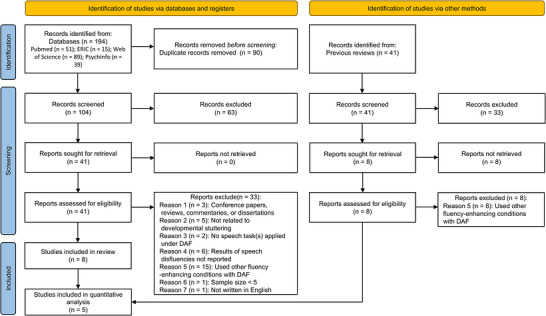
PRISMA 2020 flow diagram.
Summary of the Included Articles
Participant information is summarized in Table1. Sample sizes ranged from 8 to 20, with ages spanning school‐age children to adults in their 50s. Most participants were men, and most articles confirmed no presence of hearing, speech, or language problems. Some studies specified prior stuttering therapy, a diagnosis of developmental stuttering, or minimum severity thresholds (e.g., greater than 3%–5% SLD). Reported severity ranged from mild (Ishida et al.2021) to severe (Van Borsel et al.2003), with some samples spanning mild to severe cases (Fiorin et al.2021; Stuart and Kalinowski2004). It should be noted that these severity levels were assessed using different scales, that is, SSI, SSI‐3, Illinois Clinician Stuttering Severity Scale, or Scale for Rating severity of stuttering. Consequently, cross‐study comparisons of stuttering severity should be interpreted with caution because different severity scales were used.
Table: Summary of participants’ information in each study.
Study characteristics are summarized in Table2. Tasks included reading and spontaneous or monologue speech. DAF delays ranged from 50 ms (Antipova et al.2008) to 250 ms (Chon et al.2021). Several studies tested multiple delays (Antipova et al.2008; Saltuklaroglu et al.2009; Van Borsel et al.2003) and combined DAF with other altered feedback conditions such as FAF (Antipova et al.2008; Fiorin et al.2021; Saltuklaroglu et al.2009). Except for one longitudinal pre–post study (Van Borsel et al.2003), all designs were cross‐sectional. Outcomes included SLD, OD, or total disfluencies.
Table: Summary of study overview in each study.
Main Comparisons Between DAF and NAF
Main comparisons between DAF and NAF are presented in Table3. Five studies conducted statistical analyses to evaluate the effects of DAF relative to NAF. Results were inconsistent: three studies reported decreased disfluencies under DAF (Antipova et al.2008; Saltuklaroglu et al.2009; Stuart and Kalinowski2004), whereas Ishida et al. (2021) reported increased disfluencies, and others reported mixed findings. Fiorin et al. (2021) observed reduced SLD only in participants with severe stuttering. Among studies focusing on disfluency type, one reported reduced SLD with DAF (Picoloto et al.2017), one reported the reverse (Chon et al.2021), and one found severity‐dependent effects (Fiorin et al.2021). For OD, one study found a reduction (Fiorin et al.2021), whereas two reported no effect (Chon et al.2021; Picoloto et al.2017). The only pre–post study (Van Borsel et al.2003) reported disfluency reduction under DAF across tasks before therapy; however, the effects diminished post‐therapy, persisting only in the reading task.
Table: Main comparison of DAF and NAF conditions.
Meta‐Analysis of the DAF Effect
Of the eight articles initially included, three (Antipova et al.2008; Ishida et al.2021; Van Borsel et al.2003) were excluded because key descriptive statistics could not be extracted. Therefore, five studies involving a total of 61 participants contributed ten outcomes to the meta‐analysis. Three studies compared disfluency types (Chon et al.2021; Fiorin et al.2021; Picoloto et al.2017), one examined delay times (Saltuklaroglu et al.2009), and two assessed stuttering severity (Fiorin et al.2021; Stuart and Kalinowski2004). Studies with multiple groups were combined into single pairwise comparisons, and results were synthesized in a forest plot (Figure2). The pooled mean difference between DAF and NAF was not significant (–1.46 [95% CI: –4.83, 1.91]). One study favored DAF (Saltuklaroglu et al.2009), whereas Chon et al. (2021) favored NAF; indicating greater disfluency under DAF. The remaining studies reported nonsignificant results (Fiorin et al.2021; Picoloto et al.2017; Stuart and Kalinowski2004). Heterogeneity was high (χ2= 15.99,p= 0.003), warranting subgroup analyses. Publication bias (AppendixA) was assessed using statistical tests of rank correlation (Begg's test:p= 1.00) and regression (Egger's test:p= 0.281); however, the findings were inconclusive because of the small number of studies.

Forest plot of all outcomes.
Subgroup results for disfluency type, delay time, speech task, stuttering severity, and participant age are presented in AppendicesB–F. These analyses should be considered exploratory and hypothesis‐generating because several subgroups included only a small number of studies. For example, the reading subgroup included only two studies (Saltuklaroglu et al.2009; Stuart and Kalinowski2004), limiting the reliability of comparisons across speech tasks. The high heterogeneity observed across subgroups (χ2= 6.47–31.67,p< 0.001–0.17) may reflect small sample sizes and potential confounding factors.
Quality Assessment
The quality assessment results are presented in Table4. Most studies scored one point each for masking (described blind assessment or inter‐rater reliability), quantitative analysis, and confirmation of significance. None of the studies included a control group (score = 0). Only one study (Van Borsel et al.2003) used a longitudinal design, earning a point in this category; thus, most of the included studies were cross‐sectional. One study (Stuart and Kalinowski2004) received the lowest quality assessment score (1 point), corresponding to the 12.5th percentile of the quality scores reported by Andrade and Juste (2011). However, excluding this study did not alter the overall effect estimate (mean difference = –1.46, 95% CI [–4.83, 1.91]). Therefore, all eligible studies were retained in the meta‐analysis.
Table: Quality assessment of studies.
Discussion
Overall DAF Effect
This meta‐analysis synthesized evidence comparing disfluencies under DAF and NAF conditions, focusing on the exclusive effect of DAF. Findings showed no significant overall DAF effect. While numerous studies have examined the effects of altered auditory feedback on speech disfluencies in people who stutter (Andrade and Juste2011; Lincoln et al.2006), few investigated DAF alone. In fact, during full‐text screening, approximately half of the excluded studies (15/33) were eliminated because DAF was combined with other fluency‐enhancing conditions. Previous systematic reviews reported the utility of DAF in intervention studies (Baxter et al.2015; Johnson et al.2023), but most combined DAF with FAF (Andrade and Juste2011; Antipova et al.2008; Hudock and Kalinowski2014; Lincoln et al.2006; Lincoln et al.2010; Ratyńska et al.2012; Ritto et al.2016; Stuart et al.2004; Stuart and Kalinowski2004; Unger et al.2012). The present findings suggest that DAF alone may have limited effectiveness, consistent with recent research reporting no significant benefit (Alqhazo and Alkhamaiseh2025). However, this does not preclude a potential DAF effect, as variability may exist across studies, as suggested by our subgroup analyses. These results underscore the need for further research to clarify DAF mechanisms and control for confounding factors.
Factors Related to the DAF Effect
Subgroup analyses revealed high heterogeneity and small sample sizes; thus, results must be interpreted with caution. Three factors repeatedly highlighted in prior research—delay time, stuttering severity, and speech task—are discussed below.
Delay Time
In the present meta‐analysis, delay times ranged from 50 ms (Antipova et al.2008) to 250 ms (Chon et al.2021). Some studies have suggested that shorter delays (<100 ms) may reduce disfluencies, whereas longer delays (>200 ms) have been associated with mixed or sometimes adverse effects (Chon et al.2021; Ishida et al.2021). However, these observations are based on a small number of studies with differing methodologies and should therefore be interpreted cautiously. Early studies often employed longer initial delays (200–250 ms; Goldiamond1965; Lincoln et al.2006; Ryan and Van Kirk1974), which were gradually reduced as fluency was maintained (Goldiamond1965). Recent research frequently applies shorter delays (50–100 ms;; Alqhazo and Alkhamaiseh2025; Antipova et al.2008; Kalinowski et al.1993; Lincoln et al.2006; Stuart and Kalinowski2004; Stuart et al.2003). Kalinowski et al. (1996) suggested a minimum delay of 50 ms for maximum fluency benefit. Longer delays may induce speech rate reduction or prolonged speech, but this is not always necessary (Kalinowski et al.1993, 1996; Stuart et al.2003). In contrast, shorter delays appear to stabilize speech motor patterns (Chon et al.2021). Increased linguistic complexity, such as longer utterances or greater phonological and syntactic demands, also elevates kinematic variability (Kleinow and Smith2000; MacPherson and Smith2013; Smith et al.2010; Usler and Walsh2018), which can trigger stuttering (Alqhazo and Al‐Dennawi2018; Buhr and Zebrowski2009; Coalson et al.2012). From a motor control perspective (Civier et al.2010; Max et al.2004), shorter delays may better stabilize motor patterns and support fluency.
Stuttering Severity
The present meta‐analysis did not find a significant difference in the effect of DAF according to stuttering severity. However, this finding should be interpreted cautiously based on the limited number of studies available for analysis. Several prior studies suggest greater benefits for individuals with severe stuttering (Foundas et al.2013; Sparks et al.2002; Unger et al.2012). For example, Sparks et al. (2002) reported DAF effects only in severe cases, and Ishida et al. (2021) observed adverse effects in mild cases. In Fiorin et al. (2021), the data included in the meta‐analysis were limited to OD because insufficient descriptive statistics for SLD; nevertheless, they reported significant reductions in SLD among individuals with severe stuttering. In studies combining DAF and FAF, greater benefits were again observed in severe cases (Foundas et al.2013; Unger et al.2012). However, there are concerns regarding few benefits for individuals with mild stuttering. Previous studies suggested that mild stuttering may be subject to a floor effect (Antipova et al.2008; Unger et al.2012), where already low baseline disfluency leaves little room for further reduction. Overall, further research with larger samples is required to determine whether stuttering severity moderates the effects of DAF.
Speech Task
Most studies used oral reading or spontaneous speech/monologue tasks, with only one including conversation (Van Borsel et al.2003). Reading tasks were common in earlier research (Howell et al.1999; Kalinowski et al.1993, 1996; Lincoln et al.2006; Stuart et al.1997), whereas recent studies often use spontaneous speech or monologue (Antipova et al.2008; Chon et al.2021; Fiorin et al.2021; Hudock and Kalinowski2014; Lincoln et al.2006; Picoloto et al.2017; Ratyńska et al.2012; Ritto et al.2016; Stuart et al.2004). In the present meta‐analysis, the reading‐task subgroup appeared to exhibit a larger DAF effect than the spontaneous speech subgroup, although this observation should be interpreted with caution because of the limited number of included studies and small sample sizes. Consistent with this tentative pattern, previous studies have reported that altered auditory feedback effects tend to be weaker for spontaneous speech than for reading tasks (Foundas et al.2013; Lincoln et al.2006). Studies using reading tasks consistently report reductions, whereas spontaneous speech tends to show limited effects (Armson and Stuart1998; Armson et al.2006; Foundas et al.2013). While spontaneous speech involves greater linguistic complexity, including word selection and sentence formulation, Foundas et al. (2013) suggested that reading tasks may allow individuals to allocate more cognitive resources to feedback monitoring, thereby enhancing fluency. Although studies published before 2000 were not included in the present review, reading tasks were frequently used in earlier research. Reviewing and synthesizing findings from these earlier studies may help clarify whether task‐related differences in DAF effects are robust.
Limitations and Future Implications
This meta‐analysis focused on studies published since 2000. Given the small number of eligible studies and the frequent use of combined DAF and FAF in clinical contexts, earlier studies may still inform interpretation, though their contribution could remain limited due to methodological variability (Andrade and Juste2011). To better clarify DAF mechanisms and obtain more reliable effect estimates, future studies should isolate DAF, incorporate subgroup analyses, and account for possible stuttering subtypes such as auditory processing disorders (Picoloto et al.2017) and neuroanatomical abnormalities. In addition, the generalizability of the findings may be limited because this review relied exclusively on English‐language literature; consequently, relevant studies published in other languages may not have been captured. Furthermore, the review protocol was not registered in advance. Future updates of this meta‐analysis should include prospective protocol registration to enhance transparency and methodological rigor.
Several statistical and methodological limitations should be considered when interpreting the present findings. First, the number of studies included in the meta‐analysis was small, which restricts the reliability of several supplementary analyses. The subgroup analyses should therefore be interpreted as exploratory, because several subgroups consisted of only two studies. Second, the assessment of publication bias should also be interpreted cautiously. Although Begg's and Egger's tests did not indicate clear publication bias, these tests have very low statistical power when only a small number of studies are available. Overall, few number of eligible studies could limit the interpretation of the present meta‐analysis and highlights the need for additional research on the effects of DAF. Third, risk of bias was not formally assessed using established tools such as the Risk of Bias in Non‐randomised Studies of Interventions (ROBINS‐I; Sterne et al.2016). Instead, study quality was evaluated using criteria proposed in a previous systematic review of stuttering and DAF (Andrade and Juste2011). Some items in this framework had limited discriminative value. For example, all included studies received a score of 0 on the control‐group criterion (Table4). Although the inclusion of a control group is important in intervention studies because it helps reduce the influence of confounding factors unrelated to the intervention itself, most intervention studies in this area involved SpeechEasy, which combines DAF and FAF and was therefore excluded from the present review. Consequently, the control‐group criterion contributed little to the assessment of study quality among the studies included in this review.
Future research should also emphasize methodological consistency, including control groups, blinding, task replication, and device calibration (Andrade and Juste2011). Lincoln et al. (2006) highlighted the importance of conversational speech sampling to generalize findings beyond clinical and laboratory contexts. Yet, none of the studies in our meta‐analysis investigated conversational tasks after Lincoln's publication, despite later DAF+FAF studies (e.g., SpeechEasy) including such tasks (Armson and Stuart1998; Armson et al.2006; Foundas et al.2013; Hudock and Kalinowski2014; Lincoln et al.2010; O'Donnell et al.2008; Pollard et al.2009; Ritto et al.2016). Although spontaneous speech is challenging to control due to confounding variables, further research on DAF in conversational contexts remains essential.
Interactions between factors also merit attention. For instance, optimal delay time may depend on the speech task. Antipova et al. (2008) found that longer delays produced greater benefits for spontaneous speech or monologue than for reading. During spontaneous speech, controlling speech rate appears essential; the stronger the DAF‐induced slowing effect, the greater the potential improvement in fluency. Further validation of these interactions would be instrumental in taking advantage of the individualize DAF effect for stuttering.
Conclusion
This meta‐analysis is the first to systematically evaluate the exclusive effect of DAF on stuttering. The results indicate that DAF alone does not significantly reduce disfluency. The included studies involved sample sizes ranging from 8 to 20 participants, with ages spanning from school‐age children to adults. Most participants were male, and stuttering severity ranged from mild to severe. DAF was evaluated using oral reading and spontaneous speech/monologue tasks. The findings also highlight the heterogeneous nature of DAF effects and underscore the need for studies with sufficient sample size and better‐controlled design to clarify its therapeutic potential.
Funding
This work was supported by the University of Tsukuba Basic Research Support Program Type S.
Conflicts of Interest
The authors declare no conflicts of interest.
Data Availability Statement
The data that support the findings of this study are available from the corresponding author upon reasonable request.
Associated Data
Data Availability Statement
The data that support the findings of this study are available from the corresponding author upon reasonable request.
References
- (*Represent Included Articles in Our Systematic Review).
- Alqhazo, M. , and Al‐Dennawi S.. 2018. “The Linguistic Aspects of the Speech of Jordanian Children Who Stutter.” International Journal of Pediatric Otorhinolaryngology 109: 174–179. 10.1016/j.ijporl.2018.04.003. doi.org/10.1016/j.ijporl.2018.04.003
- Alqhazo, M. , and Alkhamaiseh Z.. 2025. “Effect of Delayed Auditory Feedback on Stuttering‐Like Disfluencies.” International Journal of Language and Communication Disorders 60, no. 2: e70007. 10.1111/1460-6984.70007. doi.org/10.1111/1460-6984.70007
- Andrade, C. R. F. , and Juste F. S.. 2011. “Systematic Review of Delayed Auditory Feedback Effectiveness for Stuttering Reduction.” Jornal da Sociedade Brasileira de Fonoaudiologia 23, no. 2: 187–191. 10.1590/S2179-64912011000200018. doi.org/10.1590/S2179-64912011000200018
-
- Antipova, E. A. , Purdy S. C., Blakeley M., and Williams S.. 2008. “Effects of Altered Auditory Feedback(AAF) on Stuttering Frequency During Monologue Speech Production.” Journal of Fluency Disorders 33, no. 4: 274–290. 10.1016/j.jfludis.2008.09.002. doi.org/10.1016/j.jfludis.2008.09.002
- Armson, J. , and Kiefte M.. 2008. “The Effect of SpeechEasy on Stuttering Frequency, Speech Rate, and Speech Naturalness.” Journal of Fluency Disorders 33, no. 2: 120–134. 10.1016/j.jfludis.2008.04.002. doi.org/10.1016/j.jfludis.2008.04.002
- Armson, J. , Kiefte M., Mason J., and De Croos D.. 2006. “The Effect of SpeechEasy on Stuttering Frequency in Laboratory Conditions.” Journal of Fluency Disorders 31, no. 2: 137–152. 10.1016/j.jfludis.2006.04.004. doi.org/10.1016/j.jfludis.2006.04.004
- Armson, J. , and Stuart A.. 1998. “Effect of Extended Exposure to Frequency‐Altered Feedback on Stuttering During Reading and Monologue.” Journal of Speech, Language, and Hearing Research 41, no. 3: 479–490. 10.1044/jslhr.4103.479. doi.org/10.1044/jslhr.4103.479
- Baxter, S. , Johnson M., Blank L., et al. 2015. “The State of the Art in Non‐Pharmacological Interventions for Developmental Stuttering. Part 1: A Systematic Review of Effectiveness.” International Journal of Language and Communication Disorders 50, no. 5: 676–718. 10.1111/1460-6984.12171. doi.org/10.1111/1460-6984.12171
- Buhr, A. , and Zebrowski P.. 2009. “Sentence Position and Syntactic Complexity of Stuttering in Early Childhood: A Longitudinal Study.” Journal of Fluency Disorders 34, no. 3: 155–172. 10.1016/j.jfludis.2009.08.001. doi.org/10.1016/j.jfludis.2009.08.001
-
- Chon, H. , Jackson E. S., Kraft S. J., Ambrose N. G., and Loucks T. M.. 2021. “Deficit or Difference? Effects of Altered Auditory Feedback on Speech Fluency and Kinematic Variability in Adults Who Stutter.” Journal of Speech, Language, and Hearing Research 64, no. 7: 2539–2556. 10.1044/2021_JSLHR-20-00606. doi.org/10.1044/2021_JSLHR-20-00606
- Civier, O. , Tasko S. M., and Guenther F. H.. 2010. “Overreliance on Auditory Feedback May Lead to Sound/Syllable Repetitions: Simulations of Stuttering and Fluency‐Inducing Conditions With a Neural Model of Speech Production.” Journal of Fluency Disorders 35, no. 3: 246–279. 10.1016/j.jfludis.2010.05.002. doi.org/10.1016/j.jfludis.2010.05.002
- Coalson, G. A. , Byrd C. T., and Davis B. L.. 2012. “The Influence of Phonetic Complexity on Stuttered Speech.” Clinical Linguistics and Phonetics 26, no. 7: 646–659. 10.3109/02699206.2012.682696. doi.org/10.3109/02699206.2012.682696
- Constantino, C. D. , Leslie P., Quesal R. W., and Yaruss J. S.. 2016. “A Preliminary Investigation of Daily Variability of Stuttering in Adults.” Journal of Communication Disorders 60: 39–50. 10.1016/j.jcomdis.2016.02.001. doi.org/10.1016/j.jcomdis.2016.02.001
- Daliri, A. , Honda S., and Max L.. 2025. “Delayed Auditory Feedback Increases Speech Production Variability in Typically Fluent Adults but has the Opposite Effect in Stuttering Adults.” Frontiers in Human Neuroscience 19: 1628114. 10.3389/fnhum.2025.1628114. doi.org/10.3389/fnhum.2025.1628114
-
- Fiorin, M. , Marconato E., Palharini T. A., et al. 2021. “Impact of Auditory Feedback Alterations in Individuals With Stuttering.” Brazilian Journal of Otorhinolaryngology 87, no. 3: 247–254. 10.1016/j.bjorl.2019.08.005. doi.org/10.1016/j.bjorl.2019.08.005
- Foundas, A. L. , Mock J. R., Corey D. M., Golob E. J., and Conture E. G.. 2013. “The SpeechEasy Device in Stuttering and Nonstuttering Adults: Fluency Effects While Speaking and Reading.” Brain and Language 126, no. 2: 141–150. 10.1016/j.bandl.2013.04.004. doi.org/10.1016/j.bandl.2013.04.004
- Goldiamond, I. 1965. “Stuttering and Fluency as Manipulatable Operant Response Classes.” In Research in Behavior Modification, edited by Krasner L. and Ullman L., 358–363. Holt, Rinehart & Winston.
- Guitar, B. 2025. Stuttering: An Integrated Approach to Its Nature and Treatment, 6th ed. Wolters Kluwer Health.
- Higgins, J. P. T. , Li T., and Deeks J. J.. 2024. “Chapter 6. Choosing Effect Measures and Computing Estimates of Effect.” In Cochrane Handbook for Systematic Reviews of Interventions (version 6.5), edited by Higgins J. P. T., Thomas J., Chandler J., et al., Cochrane. Retrieved fromhttps://www.cochrane.org/authors/handbooks‐and‐manuals/handbook/current/chapter‐06.
- Higgins, J. P. T. , Thompson S. G., Deeks J. J., and Altman D. G.. 2003. “Measuring Inconsistency in Meta‐Analyses.” BMJ 327, no. 7414: 557–560. 10.1136/bmj.327.7414.557. doi.org/10.1136/bmj.327.7414.557
- Howell, P. 2004. “Effects of Delayed Auditory Feedback and Frequency‐Shifted Feedback on Speech Control and Some Potentials for Future Development of Prosthetic Aids for Stammering.” Stammering Research: An On‐Line Journal Published by the British Stammering Association 1, no. 1: 31–46.
- Howell, P. , and Au‐Yeung J.. 2002. “The EXPLAN Theory of Fluency Control Applied to the Diagnosis of Stuttering.” In Clinical Linguistics: Theory and Applications in Speech Pathology and Therapy, edited by Fava E., 75–94. John Benjamins Publishing Company. 10.1075/cilt.227.08how. doi.org/10.1075/cilt.227.08how
- Howell, P. , Sackin S., and Williams R.. 1999. “Differential Effects of Frequencyshifted Feedback Between Child and Adult Stutterers.” Journal of Fluency Disorders 24, no. 2: 127–136. 10.1016/S0094-730X(98)00021-7. doi.org/10.1016/S0094-730X(98)00021-7
- Hudock, D. , and Kalinowski J.. 2014. “Stuttering Inhibition via Altered Auditory Feedback During Scripted Telephone Conversations.” International Journal of Language and Communication Disorders 49, no. 1: 139–147. 10.1111/1460-6984.12053. doi.org/10.1111/1460-6984.12053
-
- Ishida, O. , Iimura D., and Miyamoto S.. 2021. “Influence of Attention Capture on Disfluent Speech Under Delayed Auditory Feedback Among Adults Who Stutter.” Acoustical Science and Technology 42, no. 2: 113–115. 10.1250/ast.42.113. doi.org/10.1250/ast.42.113
- Johnson, W. , Darley F. L., and Spriesterbach D. C.. 1963. “Diagnostic Methods in Speech Pathology.” New York, Harper & Low.
- Johnson, G. , Onslow M., Horton S., and Kefalianos E.. 2023. “Reduced Stuttering for School‐Age Children: A Systematic Review.” Journal of Fluency Disorders 78: 106015. 10.1016/j.jfludis.2023.106015. doi.org/10.1016/j.jfludis.2023.106015
- Kalinowski, J. , Armson J., Roland‐Mieszkowski M., Stuart A., and Gracco V. L.. 1993. “Effects of Alterations in Auditory Feedback and Speech Rate on Stuttering Frequency.” Language and Speech 36, no. 1: 1–16. 10.1177/002383099303600101. doi.org/10.1177/002383099303600101
- Kalinowski, J. , and Dayalu V. N.. 2002. “A Common Element in the Immediate Inducement of Effortless, Natural‐Sounding, Fluent Speech in People Who Stutter: ‘The Second Speech Signal’.” Medical Hypotheses 58, no. 1: 61–66. 10.1054/mehy.2001.1451. doi.org/10.1054/mehy.2001.1451
- Kalinowski, J. , and Saltuklaroglu T.. 2003. “Speaking With a Mirror: Engagement of Mirror Neurons via Choral Speech and its Derivatives Induces Stuttering Inhibition.” Medical Hypotheses 60, no. 4: 538–543. 10.1016/S0306-9877(03)00004-5. doi.org/10.1016/S0306-9877(03)00004-5
- Kalinowski, J. , and Stuart A.. 1996. “Stuttering Amelioration at Various Auditory Feedback Delays and Speech Rates.” European Journal of Disorders of Communication 31, no. 3: 259–269. 10.3109/13682829609033157. doi.org/10.3109/13682829609033157
- Kleinow, J. , and Smith A.. 2000. “Influences of Length and Syntactic Complexity on the Speech Motor Stability of the Fluent Speech of Adults Who Stutter.” Journal of Speech, Language, and Hearing Research 43, no. 2: 548–559. 10.1044/jslhr.4302.548. doi.org/10.1044/jslhr.4302.548
- Landis, J. R. , and Koch G. G.. 1977. “An Application of Hierarchical Kappa‐Type Statistics in the Assessment of Majority Agreement Among Multiple Observers.” Biometrics 33, no. 2: 363–374. 10.2307/2529786. doi.org/10.2307/2529786
- Lee, B. S. 1950. “Effects of Delayed Speech Feedback.” Journal of the Acoustical Society of America 22, no. 6: 824–826. 10.1121/1.1906696. doi.org/10.1121/1.1906696
- Lincoln, M. , Packman A., and Onslow M.. 2006. “Altered Auditory Feedback and the Treatment of Stuttering: A Review.” Journal of Fluency Disorders 31, no. 2: 71–89. 10.1016/j.jfludis.2006.04.001. doi.org/10.1016/j.jfludis.2006.04.001
- Lincoln, M. , Packman A., Onslow M., and Jones M.. 2010. “An Experimental Investigation of the Effect of Altered Auditory Feedback on the Conversational Speech of Adults Who Stutter.” Journal of Speech, Language, and Hearing Research 53, no. 5: 1122–1131. 10.1044/1092-4388(2009/07-0266)/07-0266). doi.org/10.1044/1092-4388(2009/07-0266)/07-0266))
- MacPherson, M. K. , and Smith A.. 2013. “Influences of Sentence Length and Syntactic Complexity on the Speech Motor Control of Children Who Stutter.” Journal of Speech, Language, and Hearing Research 56, no. 1: 89–102. 10.1044/1092-4388(2012/11-0184). doi.org/10.1044/1092-4388(2012/11-0184)
- Max, L. , Guenther F. H., Gracco V. L., Ghosh S. S., and Wallace M. E.. 2004. “Unstable or Insufficiently Activated Internal Models and Feedback‐Biased Motor Control as Sources of Dysfluency: A Theoretical Model of Stuttering.” Contemporary Issues in Communication Science and Disorders 31: 105–122. 10.1044/cicsd_31_S_105. doi.org/10.1044/cicsd_31_S_105
- Naylor, R. V. 1953. “A Comparative Study of Methods of Estimating the Severity of Stuttering.” Journal of Speech and Hearing Disorders 18, no. 1: 30–37. 10.1044/jshd.1801.30. doi.org/10.1044/jshd.1801.30
- O'Donnell, J. J. , Armson J., and Kiefte M.. 2008. “The Effectiveness of SpeechEasy During Situations of Daily Living.” Journal of Fluency Disorders 33, no. 2: 99–119. 10.1016/j.jfludis.2008.02.001. doi.org/10.1016/j.jfludis.2008.02.001
- Ortiz‐Alvarez, A. , and Arenas R.. 2025. “A Phenomenological Exploration of the Contextual Variability of Stuttering.” Journal of Fluency Disorders 84: 106120. 10.1016/j.jfludis.2025.106120. doi.org/10.1016/j.jfludis.2025.106120
- Page, M. J. , Moher D., Bossuyt P. M., et al. 2021. “PRISMA 2020 Explanation and Elaboration: Updated Guidance and Exemplars for Reporting Systematic Reviews.” BMJ 372: n160. 10.1136/bmj.n160. doi.org/10.1136/bmj.n160
-
- Picoloto, L. A. , Cardoso A. C. V., Cerqueira A. V., and Oliveira C. M. C.. 2017. “Effect of Delayed Auditory Feedback on Stuttering With and Without Central Auditory Processing Disorders.” CoDAS 29, no. 6: e20170038. 10.1590/2317-1782/201720170038. doi.org/10.1590/2317-1782/201720170038
- Pollard, R. , Ellis J. B., Finan D., and Ramig P. R.. 2009. “Effects of the SpeechEasy on Objective and Perceived Aspects of Stuttering: A 6‐Month, Phase I Clinical Trial in Naturalistic Environments.” Journal of Fluency Disorders 34, no. 1: 1–23. 10.1044/1092-4388(2008/07-020. [doi.org/10.1044/1092-4388(2008/07-020](https://doi.org/10.1044/1092-4388(2008/07-020)
- R. Core Team . 2021. R: A Language and Environment for Statistical Computing . Vienna, Austria: R Foundation for Statistical Computing.https://www.r‐project.org/.
- Ratyńska, J. , Szkiełkowska A., Markowska R., Kurkowski M., Mularzuk M., and Skarżyński H.. 2012. “Immediate Speech Fluency Improvement After Application of the Digital Speech Aid in Stuttering Patients.” Medical Science Monitor 18, no. 1: CR9–CR12. 10.12659/MSM.882191. doi.org/10.12659/MSM.882191
- Riley, G. D. 1972. “A Stuttering Severity Instrument for Children and Adults.” Journal of Speech and Hearing Disorders 37, no. 3: 314–322. 10.1044/jshd.3703.314. doi.org/10.1044/jshd.3703.314
- Riley, G. D. 1994. Stuttering Severity Instrument for Young Children (SSI‐3), 3rd ed. Pro‐Ed.
- Ritto, A. P. , Juste F. S., Stuart A., Kalinowski J., and de Andrade C. R. F.. 2016. “Randomized Clinical Trial: The Use of SpeechEasy® in Stuttering Treatment.” International Journal of Language and Communication Disorders 51, no. 6: 769–774. 10.1111/1460-6984.12237. doi.org/10.1111/1460-6984.12237
- Ryan, B. P. , and Van Kirk B.. 1974. “The Establishment, Transfer, and Maintenance of Fluent Speech in 50 Stutterers Using Delayed Auditory Feedback and Operant Procedures.” Journal of Speech and Hearing Disorders 39, no. 1: 3–10. 10.1044/jshd.3901.03. doi.org/10.1044/jshd.3901.03
- Ryan, B. P. , and Van Kirk Ryan B.. 1995. “Programmed Stuttering Treatment for Children: Comparison of Two Establishment Programs Through Transfer, Maintenance, and Follow‐Up.” Journal of Speech, and Hearing Research 38, no. 1: 61–75. 10.1044/jshr.3801.6. doi.org/10.1044/jshr.3801.6
-
- Saltuklaroglu, T. , Kalinowski J., Robbins M., Crawcour S., and Bowers A.. 2009. “Comparisons of Stuttering Frequency During and After Speech Initiation in Unaltered Feedback, Altered Auditory Feedback, and Choral Speech Conditions.” International Journal of Language and Communication Disorders 44, no. 6: 1000–1017. 10.1080/13682820802546951. doi.org/10.1080/13682820802546951
- Smith, A. , Sadagopan N., Walsh B., and Weber‐Fox C.. 2010. “Increasing Phonological Complexity Reveals Heightened Instability in Inter‐Articulatory Coordination in Adults Who Stutter.” Journal of Fluency Disorders 35, no. 1: 1–18. 10.1016/j.jfludis.2009.12.001. doi.org/10.1016/j.jfludis.2009.12.001
- Sparks, G. , Grant D. E., Millay K., Walker‐Batson D., and Hynan L. S.. 2002. “The Effect of Fast Speech Rate on Stuttering Frequency During Delayed Auditory Feedback.” Journal of Fluency Disorders 27, no. 3: 187–201. 10.1016/S0094-730X(02)00128-6. doi.org/10.1016/S0094-730X(02)00128-6
- Sterne, J. A. , Hernán M. A., Reeves B. C., et al. 2016. “ROBINS‐I: A Tool for Assessing Risk of Bias in Non‐Randomised Studies of Interventions.” BMJ 355: i4919. 10.1136/bmj.i4919. doi.org/10.1136/bmj.i4919
-
- Stuart, A. , and Kalinowski J.. 2004. “The Perception of Speech Naturalness of Post‐Therapeutic and Altered Auditory Feedback Speech of Adults With Mild and Severe Stuttering.” Folia Phoniatrica et Logopaedica 56, no. 6: 347–357. 10.1159/000081082. doi.org/10.1159/000081082
- Stuart, A. , Kalinowski J., and Rastatter M. P.. 1997. “Effect of Monaural and Binaural Altered Auditory Feedback on Stuttering Frequency.” Journal of the Acoustical Society of America 101, no. 6: 3806–3809. 10.1121/1.418387. doi.org/10.1121/1.418387
- Stuart, A. , Kalinowski J., Rastatter M. P., Saltuklaroglu T., and Dayalu V.. 2004. “Investigations of the Impact of Altered Auditory Feedback in‐the‐Ear Devices on the Speech of People Who Stutter: Initial Fitting and 4‐Month Follow‐Up.” International Journal of Language and Communication Disorders 39, no. 1: 93–113. 10.1080/13682820310001616976. doi.org/10.1080/13682820310001616976
- Stuart, A. , Xia S., Jiang Y., Jiang T., Kalinowski J., and Rastatter M. P.. 2003. “Self‐Contained in‐the‐Ear Device to Deliver Altered Auditory Feedback: Applications for Stuttering.” Annals of Biomedical Engineering 31, no. 2: 233–237. 10.1114/1.1541014. doi.org/10.1114/1.1541014
- The Cochrane Collaboration . 2020. Review Manager (RevMan) (version 5.4.1) (Computer Software). Nordic Cochrane Centre.
- Tichenor, S. E. , and Yaruss J. S.. 2021. “Variability of Stuttering: Behavior and Impact.” American Journal of Speech‐Language Pathology 30, no. 1: 75–88. 10.1044/2020_AJSLP-20-00112. doi.org/10.1044/2020_AJSLP-20-00112
- Unger, J. P. , Glück C. W., and Cholewa J.. 2012. “Immediate Effects of AAFdevices on the Characteristics of Stuttering: A Clinical Analysis.” Journal of Fluency Disorders 37, no. 2: 122–134. 10.1016/j.jfludis.2012.02.001. doi.org/10.1016/j.jfludis.2012.02.001
- Usler, E. R. , and Walsh B.. 2018. “The Effects of Syntactic Complexity and Sentence Length on the Speech Motor Control of School‐Age Children Who Stutter.” Journal of Speech, Language, and Hearing Research 61, no. 9: 2157–2167. 10.1044/2018_JSLHR-S-17-0435. doi.org/10.1044/2018_JSLHR-S-17-0435
-
- Van Borsel, J. , Reunes G., and Van den Bergh N.. 2003. “Delayed Auditory Feedback in the Treatment of Stuttering: Clients as Consumers.” International Journal of Language and Communication Disorders 38, no. 2: 119–129. 10.1080/1368282021000042902. doi.org/10.1080/1368282021000042902
- Yairi, E. , and Ambrose N. G.. 2005. Early Childhood Stuttering: For Clinicians by Clinicians. Pro‐Ed.
Republished from the open web under CC-BY. Authors: Iimura D, Yamamoto T, Ishida O. Read the original.