Outcomes of Liver Transplant Versus Partial Hepatectomy for Perihilar Cholangiocarcinoma Patients Requiring Arterial Reconstruction.
Background and aims Liver resection (LR) and orthotopic liver transplantation (OLT) are therapeutic options for locally advanced perihilar cholangiocarcinoma (pCCA) requiring hepatic artery reconstruction (HAR). This study aimed to compare short- and long-term outcomes of LR and OLT. Outcomes were major vascular complications, 90-day mortality, overall survival (OS) and recurrence-free survival (RFS). Methods A cohort of patients undergoing LR with HAR from 10 Western centres was compared with an OLT cohort comprising patients who received or did not receive neoadjuvant chemoradiotherapy (NACR). Results 109 patients, 60 LR and 49 OLT (22 OLT no-NACR and 27 OLT NACR) were included. LR patients were older and had fewer Bismuth type 4 tumours (38.3% vs. 69.4%, p = 0.009). Positive margins (49.2% vs. 6.5%, p Conclusions LR and OLT for locally advanced pCCA had similar rates of major complications and post-operative mortality, but NACR was associated with increased vascular complications. Survival was difficult to compare in the groups due to their heterogeneity, but OLT, especially with NACR, seems to give better results than LR.
Introduction
If technically possible, complete resection remains the best therapeutic option for patients with perihilar cholangiocarcinoma (pCCA), with a 5‐year overall survival (OS) between 30% and 50% [1,2,3,4]. Only a minority of patients (20%) are eligible for surgery [5,6,7], because most patients have metastatic or locally advanced disease at diagnosis or are too frail to undergo major surgery.
One of the main reasons for defining a pCCA as locally advanced is the involvement of the portal vein or hepatic artery in the future liver remnants. Vascular resection and reconstruction (VR) during liver resection (LR) can increase the number of patients eligible for surgery; however, its use is still debated [8,9]. Hepatic artery reconstruction (HAR) has been associated with a large increase in postoperative morbidity and mortality in several studies [8,10]. Other studies, however, found that the benefit of LR in OS justified the increased risk of complications after HAR [11,12,13].
Orthotopic liver transplantation (OLT) has been proposed to achieve the most radical resection of locally advanced pCCA. The Mayo Clinic protocol involves neoadjuvant chemoradiation (NACR) [14]. This protocol applies strict patient selection criteria that are met by only about 4% of all patients with pCCA [14,15]. In a retrospective cohort of 237 patients transplanted for pCCA from 1992 to 2019, Azad et al. reported a 5 year intention‐to‐treat OS of 68%; in their cohort 84 (35%) patients had de novo pCCA, 153 (65%) had PSC‐associated pCCA and OS was significantly longer for the second group (58% vs. 74%) [16]. NACR, especially the radiation component, has been associated with a high risk of vascular complications such as hepatic artery thrombosis or haemorrhage, with rates as high as 23% [17,18]. A comparison of VR outcomes between patients with locally advanced pCCA undergoing LR and OLT preceded or not preceded by NACR is lacking in the literature and has been previously advocated [11].
This study aimed to compare LR and OLT (with or without NACR) for patients with locally advanced pCCA in terms of major and vascular complications, 90‐day mortality, OS, and recurrence‐free survival (RFS) in patients with locally advanced pCCA.
Patients and Methods
Study Design
This observational cohort study included retrospectively collected data from two separate collaborative study groups. Data from patients undergoing surgical exploration at 25 European and American centres for proven or suspected pCCA during any time span not preceding the year 2000 were included in a collaborative retrospective, standardized, and de‐identified database of the Perihilar Cholangiocarcinoma Collaboration Group. The participating centres in this study provided additional information on VR and vascular complications. Only patients with histologically proven pCCA in surgical specimens were included. HAR was the focus of the comparison given that this is a reconstruction with a higher risk of complications. Therefore, only patients who underwent HAR with or without associated portal vein reconstruction (PVR) were included. Patients undergoing bile duct resection without partial hepatectomy, those not undergoing VR, and those undergoing PVR only were excluded [19].
Data for the OLT cohort were obtained from an international, multicentre, retrospective database of consecutive patients who underwent OLT for locally advanced pCCA unsuitable for LR between April 2011 and July 2020 [20]. Patients were selected for OLT based on strict Mayo Clinic selection criteria [21]. The population of the aforementioned study was divided into a Dutch cohort of patients who did not receive NACR (OLT no‐NACR group), and a French cohort of patients who received NACR (OLT‐NACR group), and a subgroup analysis comparing LR with OLT with or without NACR was conducted. According to the Central Committee on Research Involving Human Subjects, no written consent has been obtained from the patients as there is no patient‐identifiable data included.
The endpoints of this study were major and vascular complications, 90‐day mortality, OS, and RFS.
Definitions
The work‐up and management of patients, as well as postoperative management and follow‐up, differed across centres and during the inclusion period, according to the protocols of each institution. The criteria for defining unrespectability, diagnostic criteria, and selection criteria in the OLT cohort have been previously described [20]. Patients in the LR cohort were defined as locally advanced because of the requirement for hepatic artery reconstruction of the remnant liver. Involvement could pertain to the main hepatic artery, as well as the unilateral hepatic artery to the remnant liver.
Tumours were classified according to the Bismuth‐Corlette classification [22]. Liver resections were defined according to the Brisbane terminology [23]; negative resection margins were defined as tumour‐free margins in all resection planes in the pathology report. HAR was defined as any resection of the left, right, or main hepatic artery to the future liver remnant followed by reconstruction due to vascular involvement. All complications registered during initial hospitalization or within 90 days after surgery were reported and classified according to the Clavien‐Dindo classification [24]. Vascular complications were recorded for both LR and OLT, and included thrombosis, post‐operative haemorrhage, pseudoaneurysm, and stenosis. Major vascular complications were defined as Clavien–Dindo grade > 3a. The definitions and grading for post‐hepatectomy liver failure (PHLF) and bile leak proposed by the International Study Group of Liver Surgery (ISGLS) were used [25,26]. Only grades B and C were considered clinically relevant. Other biliary complications analysed included biliary stenosis, necrosis, and cholangitis. OS was defined as the time between surgery and death or the last follow‐up, whereas RFS was defined as the time between surgery and the first radiological or pathological evidence of recurrence.
Statistical Analysis
Categorical data were presented as frequencies and percentages and compared using Pearson's χ squared test or Fisher's exact test, when appropriate. Continuous variables are presented as median and interquartile range (IQR) and compared using the Mann–Whitney U test. Logistic regression was used to identify independent risk factors for vascular complications. OS and RFS were analysed using Kaplan–Meier curves and compared between the groups using the log‐rank test. Cox regression analysis was performed to investigate the prognostic factors for RFS and OS. Factors with ap< 0.20 at univariate analysis were included in multivariate analysis with backwards stepwise selection, both for logistic and Cox regression analysis. Patients from the transplant cohort with no malignancy in the resected liver and no malignancy in the pre‐transplant histological examination were excluded from the survival analyses. For all analyses, two‐sidedp‐values < 0.05 were considered significant. All analyses were performed, and all figures were produced using SPSS (software version 28, IBM, US).
Results
A total of 10 out of 25 centres provided the additional data required for this study, representing 1241 patients undergoing LR for pCCA. Subsequent exclusion was required for 103 patients (8.3%) who had a final pathological diagnosis other than pCCA and 84 patients (6.8%) who underwent bile duct resection without partial hepatectomy. Of the remaining 1054 patients, 795 (75.4%) did not undergo VR and 199 (18.9%) underwent PVR only. The final LR cohort consisted of 60 patients with locally advanced pCCA who underwent HAR, including 42 (70%) who underwent combined PVR and HAR (Figure1). The OLT cohort consisted of 49 patients: 27 (55.1%) in the NACR group and 22 (44.9%) in the no‐NACR group. The study population consisted of 109 patients.
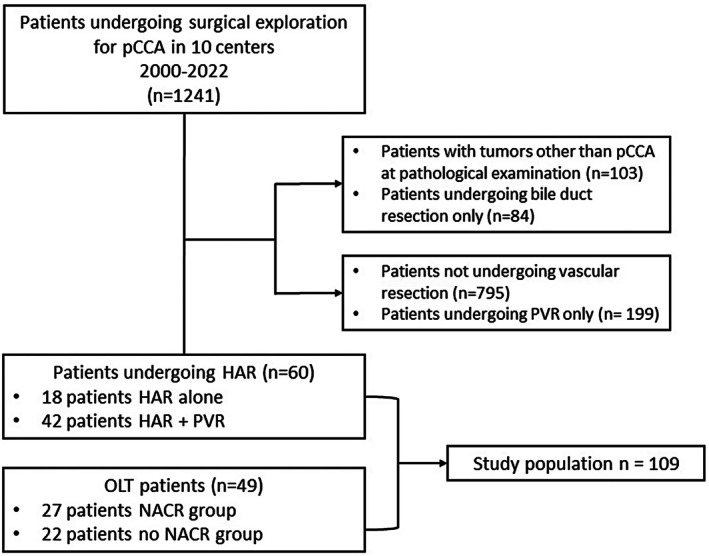
Flowchart showing the selection of the study population.
Patients, Operative and Pathological Characteristics
Patients undergoing LR were older than those undergoing OLT (66 vs. 54,p< 0.001) and suffered less from Primary Sclerosing Cholangitis (PSC) (1.7% vs. 28.6%,p< 0.001) (Table1). Tumours in the LR group were less frequently Bismuth Type 4 than in the OLT group (38.3% vs. 69.4%,p= 0.009), but this was less evident when comparing LR with OLT no‐NACR (63.6%,p= 0.24). Additional pancreatoduodenectomy was performed in none of the patients (0%) in the LR group and in 4 (8.2%) patients in the OLT group (p= 0.027). No differences were found in median tumour diameter in the pathological report (2.9 vs. 2.6 cm,p= 0.94) or in the proportion of patients with tumours larger than 3 cm (32.7% for LR and 28.6% for OLT,p= 0.65). Positive lymph nodes were reported in 54.2% of the LR patients and 32.4% of the OLT patients (p= 0.058). Finally, a positive margin (R1 resection) was more frequent in LR patients than in OLT patients (49.2% vs. 6.5%,p< 0.001), for both OLT no NACR (10.5%,p= 0.003) and NACR (3.7%,p< 0.001) patients.
Table: Demographic, operative and pathological characteristics of the study population, divided into three groups: Liver resection (LR), orthotopic liver transplantation (OLT) not preceded by neo chemoradiotherapy (NACR) and preceded by NACR (OLT no NACR and OLT NACR respectively).
Postoperative Complications
No differences were found between LR and OLT (with or without NACR) in major (40% vs. 46.9%,p= 0.56) or vascular complications (23.0% vs. 28.6%,p= 0.66) (Table2). Postoperative mortality within 90 days was also comparable between the two groups (15% vs. 10.2%,p= 0.57). PHLF was more frequent in LR patients than in OLT patients (20% vs. 0%,p< 0.001), whereas a difference in severe biliary complications could not be demonstrated against patients undergoing OLT with NACR (16.7% vs. 25.9%,p= 0.38); on the other hand, patients undergoing OLT with no NACR had a higher incidence of biliary complications (16.7% vs. 40.9%,p= 0.036). However, severe biliary complications were less common when comparing LR to OLT no‐NACR (16.7% vs. 40.9%,p= 0.036). NACR was the only independent prognostic factor for the occurrence of vascular complications in the study population (OR 2.63, 95% CI 1.03–6.70,p= 0.043; Table3). NACR patients had more frequent vascular complications (40.7% vs. 20.7%,p= 0.046) and hepatic artery complications (33.3% vs. 14.6%,p= 0.048) than non‐NACR patients (Table4).
Table: Postoperative course of the study population, divided into three groups: Liver resection (LR), orthotopic liver transplantation (OLT) not preceded by neo adjuvant chemo‐radiotherapy (NACR) and preceded by NACR (OLT no NACR and OLT NACR respectively).
Table: Logistic regression analysis for vascular complications.
Table: Postoperative course of the study population divided based on preoperative neo adjuvant chemo‐radiotherapy (NACR).
A multivariate analysis for 90‐day mortality was also conducted: age (OR 1.08, 95% CI 1.01–1.17,p= 0.027) and vascular complications (OR 9.60, 95% CI 2.16–42.60,p= 0.003) were independent risk factors, while preoperative biliary drainage was an independent protective factor (OR 0.15, 95% CI 0.03–0.73,p= 0.019) (TableS1).
Survival Analysis
No difference in the median OS after LR versus OLT was observed (24 vs. 40 months,p= 0.13). OS at 3‐year was 41% for LR versus 56% for OLT (log‐rankp= 0.20; Figure2A). No differences were found when comparing LR with OLT no NACR (3‐ and 5‐years OS 61% and 43%, respectively;p= 0.14) and LR with OLT NACR (3‐ and 5‐years OS 52% and 42%, respectively;p= 0.36; Figure2B). BMI (HR 2.81, 95% CI 1.13–7.02,p= 0.026) and nodal involvement (HR 2.56, 95% CI 1.24–5.31,p= 0.011) were independent poor prognostic factors for OS (Table5). The median RFS after LR was lower than that after OLT (19 vs. 38 months,p= 0.031; Figure2C); OLT NACR showed the best RFS that was significantly higher than that of LR (3‐ and 5‐years RFS 61% vs. 25% and 53% vs. 20%, respectively,p= 0.034), but not higher than OLT no NACR RFS (3‐ and 5‐years RFS 50% and 34%, respectively,p= 0.45, Figure2D). Independent poor prognostic factors for RFS included positive resection margin (HR 2.64, 95% CI 1.18–5.91) and perineural invasion (HR 3.64, 95% CI 1.09–12.16,p= 0.035) (Table6). Post recurrence OS did not differ between the two groups (LR 7 months, IQR 3–38 vs. OLT 11 months, IQR 3–14,p= 0.53); data on post recurrence management was not available for enough patients to conduct a proper analysis.
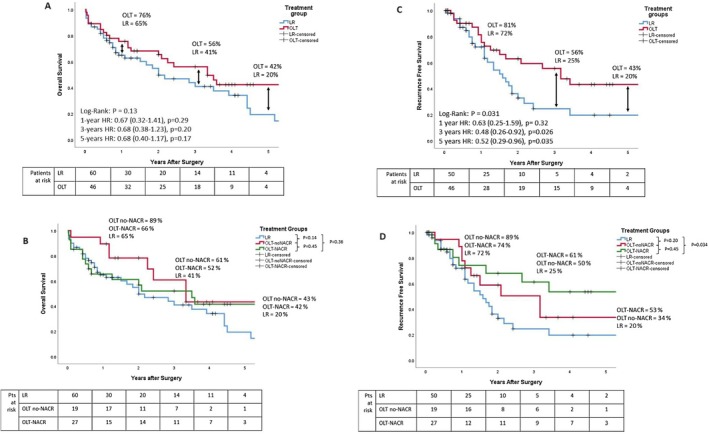
Overall survival of the study population. (A) LR vs. OLT (B) LR vs. OLT no NACR vs. OLT NACR. Recurrence free survival, (C) LR vs. OLT (D) LR vs. OLT no NACR vs. OLT NACR. In Figure2Bthe Log rank test for OS never gave a statistically significant result (LR vs. OLT no NACRp= 0.14, LR vs. OLT NACRp= 0.36, OLT no NACR vs. NACR p = 0.45), while in Figure2Dthe test for RFS gave a significant difference for LR compared to OLT with NACR (p= 0.034), but not for the other comparisons (LR vs. OLT no NACRp= 0.20, OLT NACR vs. OLT no NACRp= 0.45).
Table: Cox regression analysis for overall survival.
Table: Cox regression analysis for recurrence free survival in the study population.
Discussion
In this multicentre observational cohort study, no difference was observed in postoperative major and vascular complications and 90‐day mortality between patients with locally advanced pCCA undergoing LR with HAR or OLT with or without NACR. PHLF was more common after LR, and severe biliary complications were the most frequent after OLT without NACR. NACR was the only poor prognostic factor for the occurrence of vascular complications (OR, 2.56; 95% CI 1.24–5.31,p= 0.011). OLT was associated with a significantly better RFS, although a statistically significant difference in OS could not be demonstrated. BMI ≥ 30 and positive nodal status were independent poor prognostic factors for OS. Positive margins and perineural invasion were independent poor prognostic factors for RFS.
To our knowledge, the present study is the first comparison of LR and OLT, with a focus on vascular complications, in patients with locally advanced pCCA requiring HAR. Several studies have compared the LR for pCCA with and without VR. In their recent single‐centre series of 303 pCCA patients undergoing LR with VR (venous or arterial) vs. 484 patients without VR, Mizuno et al. reported a comparable incidence of severe complications (50% vs. 48%, respectively,p= 0.71); in contrast, VR patients showed higher 90‐day mortality (3.6% vs. 1.2%,p= 0.04), portal vein complications (4.6% vs. 1%,p= 0.011), and hepatic artery complications (8.2% vs. 2%,p< 0.001) [11]. Kuriyama et al. found no differences in major complications (37.5% vs. 53.4%,p= 0.21) and 90‐day mortality (4.2% vs. 3.4%,p= 0.12) between 48 VR patients and 58 non‐VR patients. Both studies showed that in expert centres, VR is feasible and can offer a chance for long‐term OS in patients with locally advanced pCCA [27]. Breuer et al. suggested that OLT should have a lower risk of major complications and postoperative mortality [28].
Our study could not demonstrate a difference between LR and OLT when comparing the risks of major complications, vascular complications, and postoperative mortality within 90 days. The comparable incidence of vascular complications may come as a surprise; however, NACR was a poor independent prognostic factor for vascular complications, with an OR of 2.63. This result is consistent with the available literature that identifies in NACR the probable cause of increased vascular complications after OLT for pCCA [29,30,31]. Tan et al. compared 74 patients with OLT and pCCA who received NACR and 173 who underwent transplantation for other causes. They found that vascular complications were more common in OLT for pCCA; in particular, hepatic artery complications increased after OLT for pCCA (24.3% vs. 11.6%,p= 0.012) [29].
The incidence of major complications was comparable between the LR and OLT groups (40% vs. 46.9%,p= 0.56). This relatively small incidence of major complications, as compared with a benchmark value of ≤ 70% [32], may be due to the fact that among LR patients left hemi‐hepatectomy was the most common type of resection. Left hemi‐hepatectomy is associated with lower morbidity compared to right‐sided resection because of the larger future liver remnant and therefore reduced risk of liver failure [33,34,35]. Nonetheless, moderate‐to‐severe PHLF was seen in 20% of the patients, whereas it was completely absent in the transplanted patients. On the other hand, it is interesting to see how biliary complications were significantly more frequent in OLT without NACR compared to LR, while no difference was found when comparing OLT NACR and LR. Although no available study identified NACR as an independent risk or protective factor for biliary complications, it can be speculated that NACR, especially radiotherapy, may “harden” the recipient bile duct, making the anastomosis easier and less prone to reject and mismatch of the duct [36,37].
Moving onto the pathologist bench, a positive margin was obtained in 49.2% of LR patients and only 6.5% of OLT patients, indicating that OLT may be a more radical therapeutic option for patients with locally advanced pCCA, which may explain the significant difference in RFS reported in our paper (43% for OLT vs. 20% for LR at 5 years,p= 0.035), a result that almost equals the benchmark value for RFS set by Breuer et al. in their recent paper (≥ 43.8% at 5 years) [28].
A recent meta‐analysis by Cambridge et al. reported 65.1% 5 years OS for OLT with NACR in pCCA patients [38]. The results reported in our paper are worse (42% 5‐year OS for OLT patients): this can be due to many factors, first of all the high proportion of nodal positive patients in the OLT group (34%, 36.8% in patients transplanted without NACR, 27.8% in patients after NACR); another puzzling result is the lack of positive effect on OS of OLT compared to LR, even after stratifying for NACR: the reason is again multifactorial, starting from the small sample size and many heterogeneities in the distribution of prognostic factors between groups, but again the very similar distribution of N1 between groups surely played a role in it, and this is at the very least a reminder of how “biology is queen” and we should be very careful in allocating patients to the proper treatment based on the better or worse biology of the disease [39]; nevertheless, the curves for OS diverge, especially after the 2nd year, and median OS is quite different (24 vs. 40 months), even without statistical significance, hinting at a possible positive effect of OLT in more controlled conditions. Keeping in mind these limitations, it's also interesting to notice that OLT seems to grant a positive effect on RFS and when stratifying for preoperative treatment the OLT NACR group showed longer RFS than LR (p= 0.034), a fact that is not true for OLT alone (p= 0.20). This result is difficult to interpret and may hint both at a positive effect on survival given by NACR, but also at a selection of biologically “more favourable” candidates among the OLT candidates; further studies are warranted to better investigate this aspect. Unfortunately, the effect of post recurrence management on OS was impossible to investigate due to the lack of data for most patients, even if post‐recurrence OS did not differ significantly between LR and OLT.
It has been postulated that radiotherapy is responsible for the vascular complications in patients undergoing OLT with NACR [17,18]. In our cohort NACR was associated with an increased risk of vascular complications that were in turn associated with increased 90‐day mortality. It remains unclear how this side effect is comparable to the potential benefit of radiotherapy using the Mayo protocol, given how our data seem to suggest that NACR potentially reduced the oncological futility but at the cost of indirectly increasing surgical futility. Future studies should consider neoadjuvant regimens that use systemic chemotherapy without RT. This could decrease the risk of vascular complications associated with radiation without sacrificing the potential benefits of a neoadjuvant approach. A definitive claim for superiority or inferiority of OLT on LR, and of NACR or no NACR, however could be made only after a randomized controlled trial: a first attempt was made by the TRANSPHIL trial (clinicaltrials.gov;NCT02232932), that was unfortunately closed prematurely due to failure of recruitment; more recently, a new multicentric randomized study called LITALHICA trial (NCT06125769) was promoted by the university of Padua in Italy [40], and its results are eagerly awaited.
This study had several limitations that must be considered when interpreting the results. First, given the rarity of the disease and the infrequent use of OLT and LR with VR in patients with pCCA, the study population was small, resulting in inadequate power to rule out clinically relevant differences in the outcomes. Second, the LR and OLT groups differed at baseline; because of the limited sample size, we could not control for potential confounders, and because of the retrospective study design, we cannot rule out any unknown remaining confounders; in particular, OLT patients were younger and presented more frequently with pCCA associated with PSC, that is usually associated with better prognosis [38,41], but, on the other hand, presented more frequently with Bismuth type IV tumours. Moreover, as it was easy to predict, OLT patients achieved a much higher percentage of R0 resection. All these factors must be considered especially in interpreting the results of the survival analysis, that de facto compares two very heterogeneous groups. However, given the circumstances and the limited available literature on this topic, the current results are as good as possible. Third, patients treated with NACR have a pre‐transplant interval in which selection bias occurs because patients with disease progression or clinical deterioration drop out. Finally, the heterogeneity of the two groups made the survival analysis flawed and its results are difficult to interpret. In particular, RFS was longer for OLT NACR patients, but OS was not statistically different, and the lack of post recurrence management data means we cannot evaluate its effect on these results.
All limitations considered, we believe this study confirms how the risk of complications and mortality resides not in the technique used to treat locally advanced pCCA (OLT or LR), but in other factors, of which NACR seems to be the most important. On the other hand, however, NACR seems to have a positive impact on recurrence‐free survival, while the technique of choice had a limited effect given the great negative impact of biological negative prognostic factors like N1. In the end, our findings, provided that patients are treated in high‐volume, highly experienced HPB and liver transplantation centres, urge to carefully select patients that could benefit from OLT, to preferably perform NACR remembering the increased risk of vascular complications, and to always consider radical intent surgery in those patients in which R0 may be obtained with a vascular resection and reconstruction, as coherent with our previous findings [19,20].
In conclusion, LR and OLT for locally advanced pCCA had similar rates of major complications and post‐operative mortality, but NACR was associated with increased vascular complications. Survival was difficult to compare in the groups due to their heterogeneity, but OLT, especially with NACR, seems to give better results than LR.
Author Contributions
E.P., F.J.H.H. and B.G.K. were responsible for conceptualization of the paper, analysis and first draft of the paper. E.P., P.B.O., B.G.K. and A.R. coordinated data collection for the resection group. R.J.P., R.A. and F.J.H.H. coordinated data collection for liver transplantation. All authors participated in writing and revising the final version of the paper.
Funding
The authors have nothing to report.
Ethics Statement
According to the Central Committee on Research Involving Human Subjects, this type of study, using de‐identified data, does not require approval from an ethics committee.
Conflicts of Interest
The authors declare no conflicts of interest.
Acknowledgements
Perihilar Cholangiocarcinoma Collaboration Group: (PubMed citable collaborative authorship) Aldrighetti L., Bechstein W. O., de Boer M. A., Büttner S., Capobianco I., Charco R., Franken L. C., Gilg S., Gomez‐Gavara C., Guglielmi A., van Gulik T. M., Heil J., Jansson H., Kazemier G., Lodge P., Marino R., Nadalin S., Nguyen T. A., Prasad R.
Poletto E., Olthof P. B., Ruzzenente A., et al., “Outcomes of Liver Transplant Versus Partial Hepatectomy for Perihilar Cholangiocarcinoma Patients Requiring Arterial Reconstruction,” Liver International 46, no. 7 (2026): e70729, 10.1111/liv.70729.
Contributor Information
Robert J. Porte, Email: r.j.porte@erasmusmc.nl.
Frederik J. H. Hoogwater, Email: f.j.h.hoogwater@umcg.nl.
Bas Groot Koerkamp, Email: bas.grootkoerkamp@erasmus.nl.
the Perihilar Cholangiocarcinoma Collaboration Group:
L. Aldrighetti,W. O. Bechstein,M. A. de Boer,S. Büttner,I. Capobianco,R. Charco,L. C. Franken,S. Gilg,C. Gomez‐Gavara,A. Guglielmi,T. M. van Gulik,J. Heil,H. Jansson,G. Kazemier,P. Lodge,R. Marino,S. Nadalin,T. A. Nguyen, andR. Prasad
Data Availability Statement
Data were obtained from the Perihilar Cholangiocarcinoma Collaboration Group and from a collaboration between three Dutch and five French transplant centres. The data are available from the corresponding author upon request.
Associated Data
Data Availability Statement
Data were obtained from the Perihilar Cholangiocarcinoma Collaboration Group and from a collaboration between three Dutch and five French transplant centres. The data are available from the corresponding author upon request.
References
- Nagino M., Ebata T., Yokoyama Y., et al., “Evolution of Surgical Treatment for Perihilar Cholangiocarcinoma: A Single‐Center 34‐Year Review of 574 Consecutive Resections,” Annals of Surgery 258 (2013): 129–140, 10.1097/SLA.0b013e3182708b57. doi.org/10.1097/SLA.0b013e3182708b57
- Ruzzenente A., Bagante F., Olthof P. B., et al., “Surgery for Bismuth‐Corlette Type 4 Perihilar Cholangiocarcinoma: Results From a Western Multicenter Collaborative Group,” Annals of Surgical Oncology 28 (2021): 7719–7729, 10.1245/s10434-021-09905-z. doi.org/10.1245/s10434-021-09905-z
- De Bellis M., Mastrosimini M. G., Conci S., et al., “The Prognostic Role of True Radical Resection in Perihilar Cholangiocarcinoma After Improved Evaluation of Radial Margin Status,” Cancers 14 (2022): 6126, 10.3390/cancers14246126. doi.org/10.3390/cancers14246126
- Groot Koerkamp B., Wiggers J. K., Gonen M., et al., “Survival After Resection of Perihilar Cholangiocarcinoma‐Development and External Validation of a Prognostic Nomogram,” Annals of Oncology 27 (2016): 753, 10.1093/annonc/mdw063. doi.org/10.1093/annonc/mdw063
- Lauterio A., De Carlis R., Centonze L., et al., “Current Surgical Management of Peri‐Hilar and Intra‐Hepatic Cholangiocarcinoma,” Cancers 13 (2021): 3657, 10.3390/cancers13153657. doi.org/10.3390/cancers13153657
- Banales J. M., Cardinale V., Carpino G., et al., “Expert Consensus Document: Cholangiocarcinoma: Current Knowledge and Future Perspectives Consensus Statement From the European Network for the Study of Cholangiocarcinoma (ENS‐CCA),” Nature Reviews. Gastroenterology & Hepatology 13 (2016): 261–280, 10.1038/nrgastro.2016.51. doi.org/10.1038/nrgastro.2016.51
- van Keulen A.‐M., Franssen S., van der Geest L. G., et al., “Nationwide Treatment and Outcomes of Perihilar Cholangiocarcinoma,” Liver International 41 (2021): 1945–1953, 10.1111/liv.14856. doi.org/10.1111/liv.14856
- Serrablo A., Serrablo L., Alikhanov R., and Tejedor L., “Vascular Resection in Perihilar Cholangiocarcinoma,” Cancers 13 (2021): 5278, 10.3390/cancers13215278. doi.org/10.3390/cancers13215278
- Miyazaki M., Kato A., Ito H., et al., “Combined Vascular Resection in Operative Resection for Hilar Cholangiocarcinoma: Does It Work or Not?,” Surgery 141 (2007): 581–588, 10.1016/j.surg.2006.09.016. doi.org/10.1016/j.surg.2006.09.016
- Hewitt D. B., Brown Z. J., and Pawlik T. M., “Current Perspectives on the Surgical Management of Perihilar Cholangiocarcinoma,” Cancers 14 (2022): 2208, 10.3390/cancers14092208. doi.org/10.3390/cancers14092208
- Mizuno T., Ebata T., Yokoyama Y., et al., “Combined Vascular Resection for Locally Advanced Perihilar Cholangiocarcinoma,” Annals of Surgery 275 (2022): 382–390, 10.1097/SLA.0000000000004322. doi.org/10.1097/SLA.0000000000004322
- van Vugt J. L. A., Gaspersz M. P., Coelen R. J. S., et al., “The Prognostic Value of Portal Vein and Hepatic Artery Involvement in Patients With Perihilar Cholangiocarcinoma,” HPB 20 (2018): 83–92, 10.1016/j.hpb.2017.08.025. doi.org/10.1016/j.hpb.2017.08.025
- Song Y., Zhang Y., Zhen Z., and Huang Z., “Effects of Portal Vein Resection and Hepatic Artery Resection on Long‐Term Survival in Klatskin Tumor: A Meta‐Analysis,” World Journal of Surgical Oncology 20 (2022): 230, 10.1186/s12957-022-02692-1. doi.org/10.1186/s12957-022-02692-1
- Rea D. J., Heimbach J. K., Rosen C. B., et al., “Liver Transplantation With Neoadjuvant Chemoradiation Is More Effective Than Resection for Hilar Cholangiocarcinoma,” Annals of Surgery 242 (2005): 451–458, 10.1097/01.sla.0000179678.13285.fa. doi.org/10.1097/01.sla.0000179678.13285.fa
- Vugts J. J. A., Gaspersz M. P., Roos E., et al., “Eligibility for Liver Transplantation in Patients With Perihilar Cholangiocarcinoma,” Annals of Surgical Oncology 28 (2021): 1483–1492, 10.1245/s10434-020-09001-8. doi.org/10.1245/s10434-020-09001-8
- Azad A. I., Rosen C. B., Taner T., Heimbach J. K., and Gores G. J., “Selected Patients With Unresectable Perihilar Cholangiocarcinoma (pCCA) Derive Long‐Term Benefit From Liver Transplantation,” Cancers 12 (2020): 3157, 10.3390/cancers12113157. doi.org/10.3390/cancers12113157
- Darwish Murad S., Kim W. R., Harnois D. M., et al., “Efficacy of Neoadjuvant Chemoradiation, Followed by Liver Transplantation, for Perihilar Cholangiocarcinoma at 12 US Centers,” Gastroenterology 143 (2012): 88–98.e3, 10.1053/j.gastro.2012.04.008. doi.org/10.1053/j.gastro.2012.04.008
- Duignan S., Maguire D., Ravichand C. S., et al., “Neoadjuvant Chemoradiotherapy Followed by Liver Transplantation for Unresectable Cholangiocarcinoma: A Single‐Centre National Experience,” HPB 16 (2014): 91–98, 10.1111/hpb.12082. doi.org/10.1111/hpb.12082
- Poletto E., Olthof P. B., Hoogwater F. J. H., et al., “Operative and Oncological Outcomes of Vascular Resection and Reconstruction for Perihilar Cholangiocarcinoma,” Annals of Surgical Oncology 32 (2025): 9597–9607, 10.1245/s10434-025-18137-4. doi.org/10.1245/s10434-025-18137-4
- Hoogwater F. J. H., Kuipers H., de Meijer V. E., et al., “Role of Neoadjuvant Chemoradiotherapy in Liver Transplantation for Unresectable Perihilar Cholangiocarcinoma: Multicentre, Retrospective Cohort Study,” BJS Open 7, no. 2 (2023), 10.1093/bjsopen/zrad025. doi.org/10.1093/bjsopen/zrad025
- Heimbach J. K., Haddock M. G., Alberts S. R., et al., “Transplantation for Hilar Cholangiocarcinoma,” Liver Transplantation 10 (2004): S65–S68, 10.1002/lt.20266. doi.org/10.1002/lt.20266
- Bismuth H., Nakache R., and Diamond T., “Management Strategies in Resection for Hilar Cholangiocarcinoma,” Annals of Surgery 215 (1992): 31–38, 10.1097/00000658-199201000-00005. doi.org/10.1097/00000658-199201000-00005
- Strasberg S. M. and Phillips C., “Use and Dissemination of the Brisbane 2000 Nomenclature of Liver Anatomy and Resections,” Annals of Surgery 257 (2013): 377–382, 10.1097/SLA.0b013e31825a01f6. doi.org/10.1097/SLA.0b013e31825a01f6
- Dindo D., Demartines N., and Clavien P.‐A., “Classification of Surgical Complications: A New Proposal With Evaluation in a Cohort of 6336 Patients and Results of a Survey,” Annals of Surgery 240 (2004): 205–213, 10.1097/01.sla.0000133083.54934.ae. doi.org/10.1097/01.sla.0000133083.54934.ae
- Rahbari N. N., Garden O. J., Padbury R., et al., “Posthepatectomy Liver Failure: A Definition and Grading by the International Study Group of Liver Surgery (ISGLS),” Surgery 149 (2011): 713–724, 10.1016/j.surg.2010.10.001. doi.org/10.1016/j.surg.2010.10.001
- Koch M., Garden O. J., Padbury R., et al., “Bile Leakage After Hepatobiliary and Pancreatic Surgery: A Definition and Grading of Severity by the International Study Group of Liver Surgery,” Surgery 149 (2011): 680–688, 10.1016/j.surg.2010.12.002. doi.org/10.1016/j.surg.2010.12.002
- Kuriyama N., Komatsubara H., Nakagawa Y., et al., “Impact of Combined Vascular Resection and Reconstruction in Patients With Advanced Perihilar Cholangiocarcinoma,” Journal of Gastrointestinal Surgery: Official Journal of the Society for Surgery of the Alimentary Tract 25 (2021): 3108–3118, 10.1007/s11605-021-05004-2. doi.org/10.1007/s11605-021-05004-2
- Breuer E., Mueller M., Doyle M. B., et al., “Liver Transplantation as a New Standard of Care in Patients With Perihilar Cholangiocarcinoma? Results From an International Benchmark Study,” Annals of Surgery 276 (2022): 846–853. doi.org/10.1097/SLA.0000000000005641
- Tan E. K., Rosen C. B., Heimbach J. K., Gores G. J., Zamora‐Valdes D., and Taner T., “Living Donor Liver Transplantation for Perihilar Cholangiocarcinoma: Outcomes and Complications,” Journal of the American College of Surgeons 231 (2020): 98–110, 10.1016/j.jamcollsurg.2019.12.037. doi.org/10.1016/j.jamcollsurg.2019.12.037
- Mantel H. T. J., Rosen C. B., Heimbach J. K., et al., “Vascular Complications After Orthotopic Liver Transplantation After Neoadjuvant Therapy for Hilar Cholangiocarcinoma,” Liver Transplantation 13 (2007): 1372–1381, 10.1002/lt.21107. doi.org/10.1002/lt.21107
- Gores G. J., Darwish Murad S., Heimbach J. K., and Rosen C. B., “Liver Transplantation for Perihilar Cholangiocarcinoma,” Digestive Diseases 31 (2013): 126–129, 10.1159/000347207. doi.org/10.1159/000347207
- Mueller M., Breuer E., Mizuno T., et al., “Perihilar Cholangiocarcinoma ‐ Novel Benchmark Values for Surgical and Oncological Outcomes From 24 Expert Centers,” Annals of Surgery 274 (2021): 780–788, 10.1097/SLA.0000000000005103. doi.org/10.1097/SLA.0000000000005103
- Olthof P. B., Wiggers J. K., Groot Koerkamp B., et al., “Postoperative Liver Failure Risk Score: Identifying Patients With Resectable Perihilar Cholangiocarcinoma Who Can Benefit From Portal Vein Embolization,” Journal of the American College of Surgeons 225 (2017): 387–394, 10.1016/j.jamcollsurg.2017.06.007. doi.org/10.1016/j.jamcollsurg.2017.06.007
- Wu W., Cheng Q., Chen J., Chen D., Feng X., and Wu J., “Left‐Side vs. Right‐Side Hepatectomy for Hilar Cholangiocarcinoma: A Meta‐Analysis,” World Journal of Surgical Oncology 19 (2021): 107, 10.1186/s12957-021-02213-6. doi.org/10.1186/s12957-021-02213-6
- Olthof P. B., Erdmann J. I., Alikhanov R., et al., “Higher Postoperative Mortality and Inferior Survival After Right‐Sided Liver Resection for Perihilar Cholangiocarcinoma: Left‐Sided Resection Is Preferred When Possible,” Annals of Surgical Oncology 31 (2024): 4405–4412, 10.1245/s10434-024-15115-0. doi.org/10.1245/s10434-024-15115-0
- Esser H., de Jong I. E. M., Roos F. M., et al., “Consensus Classification of Biliary Complications After Liver Transplantation: Guidelines From the BileducTx Meeting,” British Journal of Surgery 112, no. 5 (2025), 10.1093/bjs/znae321. doi.org/10.1093/bjs/znae321
- Seehofer D., Eurich D., Veltzke‐Schlieker W., and Neuhaus P., “Biliary Complications After Liver Transplantation: Old Problems and New Challenges,” American Journal of Transplantation 13 (2013): 253–265, 10.1111/ajt.12034. doi.org/10.1111/ajt.12034
- Cambridge W. A., Fairfield C., Powell J. J., et al., “Meta‐Analysis and Meta‐Regression of Survival After Liver Transplantation for Unresectable Perihilar Cholangiocarcinoma,” Annals of Surgery 273 (2021): 240–250, 10.1097/SLA.0000000000003801. doi.org/10.1097/SLA.0000000000003801
- Mantel H. T. J., Westerkamp A. C., Adam R., et al., “Strict Selection Alone of Patients Undergoing Liver Transplantation for Hilar Cholangiocarcinoma Is Associated With Improved Survival,” PLoS One 11 (2016): e0156127, 10.1371/journal.pone.0156127. doi.org/10.1371/journal.pone.0156127
- Gringeri E., Furlanetto A., Billato I., et al., “The Italian Experience on Liver Transplantation for Unresectable Peri‐Hilar Cholangiocarcinoma: A National Survey and Future Perspectives,” Updates in Surgery 76 (2024): 2505–2513, 10.1007/s13304-024-01889-1. doi.org/10.1007/s13304-024-01889-1
- Saffioti F. and Mavroeidis V. K., “Review of Incidence and Outcomes of Treatment of Cholangiocarcinoma in Patients With Primary Sclerosing Cholangitis,” World Journal of Gastrointestinal Oncology 13 (2021): 1336–1366, 10.4251/wjgo.v13.i10.1336. doi.org/10.4251/wjgo.v13.i10.1336
Republished from the open web under CC-BY. Authors: Poletto E, Olthof PB, Ruzzenente A, Adam JP, Alwayn IPJ, Boleslawski E, de Boer MT, Chebaro A, Chiche L, Dopazo C, Dubbeld J, Erdmann JI, Hakeem A, Coenraad MJ, Kuipers H, Mabrut JY, Maulat C, Maithel SK, de Meijer VE, Mohkam K, Murad SD, Muscari F, Rolinger J, Polak WG, Rayar M, Ratti F, Robin F, Schnitzbauer AA, Sparrelid E, Van Vilsteren FGI, Porte RJ, Hoogwater FJH, Groot Koerkamp B, Perihilar Cholangiocarcinoma Collaboration Group. Read the original.