Patients with chronic kidney disease stage 3b: do general practitioners and nephrologists follow KDIGO guidelines?
Background Appropriate referral and management of patients with chronic kidney disease (CKD) from primary care to nephrologists are essential to prevent disease progression and complications. Objectives To describe the demographic and follow-up characteristics of patients with CKD stage 3b at the time of nephrology referral, the medical care offered by general practitioners, and the initial care provided by nephrologists in the Brazilian Unified Health System (SUS). Methods This retrospective cohort study included all patients with CKD stage 3b on the waiting list for nephrology consultation between January 2018 and January 2020 in a large city in southern Brazil. Sociodemographic data, comorbidities, and adherence to follow-up recommendations based on the 2021 Kidney Disease: Improving Global Outcomes (KDIGO) guidelines were analyzed. Laboratory test requests and results were compared between the periods of general practitioner care and the period following nephrology consultation. Results A total of 211 patients (mean age 74 ± 12 years) were included; 76.0% were hypertensive and 46.9% had diabetes. Approximately half had an adequate number of primary care appointments. Laboratory monitoring was suboptimal in both primary and specialized care. Before nephrology consultation, hemoglobin and urinalysis were available for 32.2% and 19.4% of patients, respectively. After consultation, hemoglobin and potassium results were documented in 68.3% and 58.8% of patients, respectively. Conclusion Although patients with CKD stage 3b were regularly followed, low adherence to KDIGO testing recommendations raises concerns about the adequacy of care. Strengthening communication and guideline implementation between primary care and nephrology services is crucial to improve CKD management within the SUS.
Introduction
Chronic kidney disease (CKD) has a global prevalence of 13.4%, and its incidence has been increasing1. Associated with significant morbidity and mortality, CKD has a substantial impact on the healthcare system, especially when patients reach advanced stages and require renal replacement therapy (RRT)2,3,4,5,6,7. Treatment before this stage focuses on controlling underlying diseases, slowing disease progression, and preparing for RRT8,9. Over the last few decades, increased attention has been placed on public health strategies to improve the care of patients with CKD. The principles of care have been compiled by Kidney Disease: Improving Global Outcomes (KDIGO), which serves as a global reference9.
Current KDIGO guidelines suggest that patients with stages 1–3 of CKD should be treated in primary care, while patients with CKD stages 4 and 5 should be referred for specialist care9. However, complications resulting from the loss of renal function can be present at stage 3b, necessitating therapeutic measures to manage these complications and slow disease progression even at this early stage8,9,10,11,12. General practitioners often experience doubts and anxieties regarding CKD management, leading to inadequate nephrology referrals and suboptimal patient care13,14,15,16. A well-organized and operational regulatory health system may address these issues17. The Brazilian Public Health System (SUS) provides universal healthcare access to the population, including care for patients with CKD prior to dialysis and all types of RRT (hemodialysis, peritoneal dialysis, and kidney transplantation). For patients with CKD stages 4 and 5, the system recommends referral to a nephrologist and multiprofessional care. For those with CKD stages 1–3, multidisciplinary matrix support is suggested, enabling the general practitioner to provide combined care with a nephrologist through teleconsultations conducted by telephone or e-mail18,19. However, implementing such a complex system is challenging in settings with large patient populations19.
Given the complexity of caring for patients with stage 3 CKD, it is important to evaluate whether general practitioners are aware of and adhere to the KDIGO recommendations for managing CKD9. This study aimed to evaluate whether general practitioners and nephrologists adhered to the KDIGO guidelines for managing patients with CKD stage 3b by assessing the number of appointments, laboratory test requests, and renin–angiotensin–aldosterone system blocker (RAASi) prescriptions.
Methods
Study Design
This was a retrospective cohort study of a convenience sample of patients with CKD stage 3b referred for nephrology care in a universal public healthcare system (SUS).
Participants and Study Location
We studied patients with CKD stage 3b referred for nephrology care in the city of Belo Horizonte (Minas Gerais, Brazil) between January 2018 and January 2020. The city, as the state capital, provided specialized healthcare for a population of 2,521,564 inhabitants at the time of the study (IBGE)20. Data were collected from the regulatory system’s electronic records (referral data) and from electronic medical records (clinical and laboratory data) at the time of referral and for up to five years thereafter. The first available laboratory test in the electronic medical records was extracted both from the referral period and during nephrology care for up to five years. RAASi prescriptions were collected once, before nephrology care. The number of medical appointments per year before the nephrologist’s consultation was also recorded.
Patients were eligible if they were at CKD stage 3b [estimated glomerular filtration rate (eGFR) of 30–44 mL/min/1.73 m2using the CKD-EPI (Chronic Kidney Disease Epidemiology Collaboration) equation] when registered for nephrology consultation in the regulatory system and if they were seen by a nephrologist at least twice during the five years of the study. Exclusion criteria were: i) patients misclassified as stage 3b at the time of referral; ii) patients who were not followed in the accessible SUS electronic record system; iii) patients who were already under nephrology care but were mislabeled as first appointments; iv) those who died or started dialysis before their nephrology appointment; and v) patients excluded from the waiting list by the regulatory system because they changed stage while on the list or due to advanced age with decreased eGFR but without CKD complications (Figure 1).
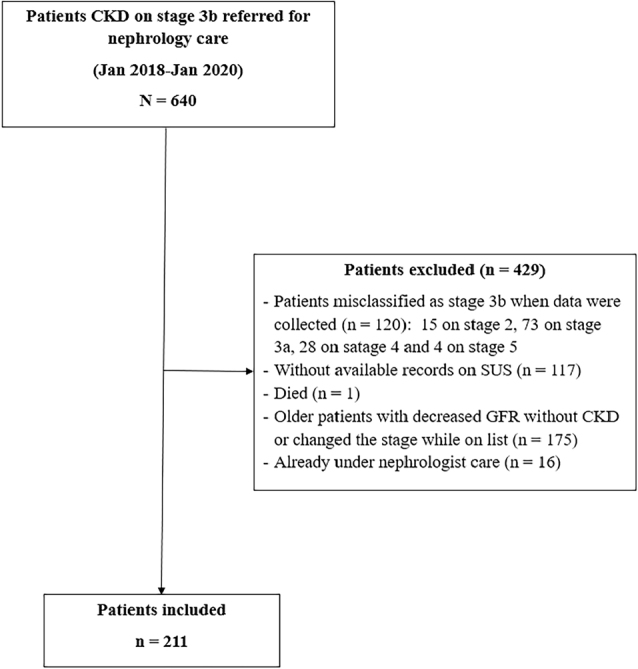
Study sample, inclusion, and exclusion criteria. SUS: Brazilian Public Health System.
Patients with CKD stage 3b were referred to the nephrology department in Belo Horizonte, MG, between January 2018 and January 2020. This study was approved by the Research Ethics Committees of the Faculty of Medical Sciences (CAAE 52619621.2.0000.5134) and the Municipal Health Secretariat of Belo Horizonte (CAAE 52619621.2.3001.5140) and was conducted in accordance with the Declaration of Helsinki. As the study was based on electronic records, the requirement for informed consent was waived.
Variables and Data Collection
We assessed sociodemographic variables, including sex (male or female), age (years), level of education (years of schooling), self-declared ethnicity (yellow, white, mixed, and black), and comorbidities (diabetes mellitus and hypertension). We also collected laboratory data related to comorbidities, including LDL and HDL (mg/dL), uric acid (mg/dL), and sodium (mEq/L).
Renal function was assessed by eGFR, using the CKD-EPI equation, and by predictive variables for severity, such as the urine albumin-to-creatinine ratio (UACR, mg/g of creatinine). Laboratory tests (potassium levels in mEq/L), organic involvement secondary to loss of renal function [bone disease—parathyroid hormone (PTH) in pg/mL, calcium and phosphorus levels in mg/dL], and anemia [hemoglobin (Hb) in g/dL and the nutritional parameter albumin in g/dL] were also considered.
Adherence to KDIGO clinical guidelines9,21was assessed by checking the frequency of medical consultations: two to three times annually if UACR was below 30 mg/g and three times annually if UACR was above 30 mg/g22. For laboratory tests, we evaluated the results available in laboratory or medical records. These results were considered adequate if found as follows: potassium, creatinine, UACR, and routine urinalysis, expected twice a year; Hb, PTH, and albumin, expected annually; and vitamin D, assessed at baseline23,24. This assessment was performed before and after nephrology consultation. Lipid, uric acid, and sodium profiles were also collected from medical and laboratory records, when available at least once. The prescription of RAASi was verified in the prescription section of the medical record at the time of referral.
Regulation of Access to Nephrological Care
In Belo Horizonte, the capital of the third-largest state in Brazil, located in the Southeast region, more than thirteen thousand patients were referred by primary care to a nephrologist and placed on the waiting list in 2018. Access to a specialist occurs exclusively upon a primary care request, and all appointments are regulated and offered by a central regulation office. Following the regulatory protocols, patients with CKD stages 4 and 5, with massive proteinuria and a single kidney with nephrolithiasis, were seen by a nephrologist within 15 days of referral, representing approximately 10% of total referrals. The remaining patients were placed on a waiting list. Five nephrologists reviewed each case on this list, checking information from the referral request, medical records, and laboratory records, and found that 50% lacked the minimum data required to justify a nephrology appointment; these cases were placed on hold, and primary care was asked to complete the requisitions before the patient could be returned to the list. Twenty-two cases were outside the protocol and were removed from the system, with documentation informing the reason for this action. In total, 22% (2719 patients) remained on the waiting list for nephrology consultation, half of whom were in CKD stage 3b.
Although these patients were not considered to be under nephrologist care according to the guidelines, given that matrix support was not fully implemented in the city, the regulatory protocol determined that they should be under nephrological assistance—in this case, on the waiting list. Given the complexity of caring for patients with stage 3 CKD, it is important to evaluate whether general practitioners are aware of and follow KDIGO recommendations for managing CKD9. This is especially crucial due to the potential for significant and rapid declines in renal function and the high number of referrals requesting specialized assistance at this stage22,25.
Statistical Analysis
Statistical analysis was performed using the Statistics and Data Science program Stata, version 17.0, with an α level of 0.05. Categorical variables were presented as absolute and relative frequencies. Continuous variables were described as means, standard deviations (SD), medians, and interquartile ranges, depending on the results of the Shapiro-Wilk test for normality. Differences between demographic variables were assessed using a binomial test for bimodal variables or a goodness-of-fit test for ordinal variables. The difference between pre- and post-nephrology examinations was determined by Fisher’s exact test for categorical variables or the Wilcoxon signed-rank test, considering the small sample size and non-normal distribution. The availability of laboratory test results before and after nephrology consultation was compared using risk ratios (RR), reported with 95% confidence intervals, considering the pre-nephrology group as the reference. Renal function was evaluated over the years using linear mixed models, with time as a numerical variable and participants as a random factor. Statistical significance was set at p < 0.05.
Results
Sociodemographic and Clinical Characteristics
A total of 211 eligible patients with a mean age of 74.0 ± 12 years were included, of whom 81.0% were older than 65 years (Figure 1). Most participants self-reported as non-Black, had a low level of education, and were overweight or obese (Table 1). Among the participants, 49.3% had diabetes mellitus, and 76.0% had hypertension. The average time to the nephrology consultation was 20 ± 4 months, ranging from 11 to 28 months.
Table: Sociodemographic and clinical characteristics of 211 patients with chronic kidney disease stage 3b
Kdigo Adherence
Adherence to at least two medical consultations per year for this stage of CKD was achieved in 55.5% of patients receiving general practitioner care and in 49.3% of those followed up by a nephrologist. At the first consultation with the nephrologist, only 64.5% of patients underwent a creatinine testing, and only three had proteinuria results. Urinalysis was rarely available, being documented in only 19.4% (41) of patients before nephrological care and in 49.3% (104) after nephrology consultation (RR 1.59;1.37-1.84) (Table 2). Albuminuria data, assessed by UACR, were requested in only 1.4% (3) of initial consultations, increasing in subsequent years from 3.3% in the first year to 20.9% over five years of nephrology follow-up. Among diabetic patients, 71.1% (73) had glycated hemoglobin results.
Table: Availability of laboratory test results for 211 patients with chronic kidney disease stage 3b before and after nephrology consultation
Renal function, measured using serum creatinine levels, was reported in 136 (64.5%) patients at the time of request. Regarding records per year, this parameter was observed in 31 (14.7%) patients in 2018, 118 (55.9%) in 2019, and 82 (38.9%) in 2020. These data were collected overall, including subjects who had already undergone a nephrology consultation and others who were still awaiting consultation between 2018 and 2020. Renal function assessments were also performed in 124 (58.8%) and 45 (21.3%) individuals under nephrologist care in 2021 and 2022, respectively (Table 3).
Table: Evolution of glomerular filtration rate, calculated from creatinine using the ckd-epi equation, from referral to the nephrologist until 2022
Albuminuria assessments, such as UACR or routine urine tests, were rarely requested, even among the 76% of patients with hypertension and the 49.3% with diabetes mellitus. Although UACR > 300 mg/g was observed in some patients, the highest incidence occurred in 2020, with only 11 (25%) results available (Figure 2).
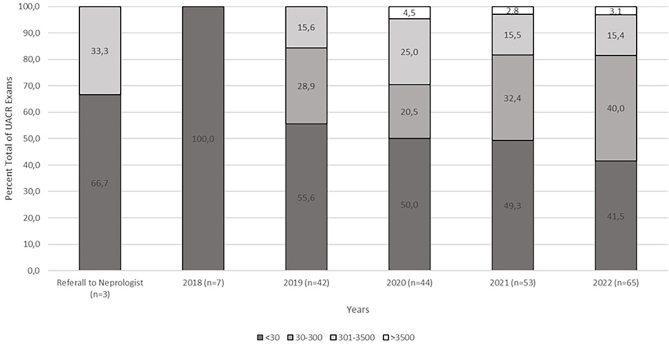
Albuminuria levels measured by the UACR (mg/g of creatinine) at referral and after nephrology care.
Eighty percent of the participants were receiving RAASi therapy, 48.3% were using angiotensin receptor blockers, and 31.7% were taking angiotensin-converting enzyme inhibitors (Table 1).
The proportion of patients with available laboratory results for calcium, phosphorus, albumin, vitamin D, parathyroid hormone (PTH), uric acid, lipid profile, and sodium, tests recommended by clinical guidelines for patients with stage 3b disease, ranged from 5% to 32% prior to the nephrology consultation (Table 2). After nephrology care, these tests were requested and available for 25–50% of patients, except for hemoglobin and potassium, which were available for 68% and 58.8%, respectively (Table 2).
Complications Resulting from Loss of Renal Function
The mean levels and the percentage of tests outside the optimal values defined by the guidelines did not differ between pre- and post-nephrology care (Table 4). Serum potassium levels were higher than 5 mEq/L in 30% of patients in both groups (highest value of 6.5 mEq/L), even though few examinations were requested. Anemia, defined as Hb < 12 g/dL, was observed in 43.6% and 36.1% of patients pre- and post-nephrology care, respectively (Table 4). Anemia with an indication for therapeutic intervention (Hb < 10 g/dL) was less frequent (7.4% and 4.9% in patients pre- and post-nephrology care, respectively).
Table: Laboratory test results for the 211 patients with chronic kidney disease stage 3b before and after nephrology consultation
Renal Function Decline
The linear mixed model demonstrated that no significant decline in renal function was observed, as measured by eGFR, during the pre-nephrology care period. However, renal function declined after the initiation of nephrology care, with reductions at 4 (3.25 mL/min) and at 5 years (15.49 mL/min) after referral (Table 3).
Discussion
Our results indicate that general practitioners infrequently adhere to KDIGO guidelines for the referral of patients to a nephrologist or for the adequate follow-up of recommended laboratory tests. Nevertheless, these professionals play an important role in the comprehensive management of chronic kidney disease. Their contribution extends beyond the early detection and monitoring of renal impairment, encompassing the prevention of hospitalizations and the coordination of multidisciplinary care. Previous studies have demonstrated that general practitioner involvement can reduce the risk of hospitalization, even during challenging periods such as the COVID-19 pandemic26,27,28.
The average time to the first nephrology appointment was 20 months, and most of the patients were seen 2–3 times per year, in line with the guidelines, either before or after nephrology care. Notably, there were no differences between pre- and post-nephrology care in the frequency of CKD complications, such as anemia, hyperkalemia, and hypocalcemia. However, a decline in eGFR was observed when comparing the last two years with baseline data.
In patients with CKD, the anticipated GFR loss is reported to be between 0.3 and 1 mL/min/year8,24,29,30, which aligns with our findings in the first three years of follow-up. Nevertheless, we observed an accelerated decline in renal function in the last four and five years, exceeding the 5 mL/min/year threshold suggested by KDIGO. It remains unclear whether the observed decline in renal function was related to a reduced frequency of routine medical appointments, limited access to laboratory testing, or the direct or indirect effects of SARS-CoV-2 infection. However, given the retrospective design of this study, it was not possible to control for potential confounding factors or to establish a causal relationship between the pandemic and the observed decline in renal function. This limitation should be acknowledged and considered when interpreting these findings1,31.
The Chronic Kidney Disease Outcomes and Practice Patterns Study (CKDopps)32evaluated pre-dialysis patients under nephrology care in various countries, including 888 patients from Brazil; however, only 31 were in stage 3b. Our study, in contrast, focused on patients initially managed in primary care, highlighting current gaps in nonspecialized care for this population. Notably, the CKDopps cohort was 10 years younger than our study population, even though we included only patients with CKD stage 3b.
We observed a concerning lack of availability of laboratory test results for patients with CKD under general practitioner or nephrologist care. Less than 25% of tests recommended by the guidelines were available in our study, similar to that reported in the CKDopps32, where albuminuria results were available for less than half of the study population. It remains unclear whether this is due to physicians’ unawareness of the guidelines or a failure by participants to complete the requested tests.
Comorbidities such as diabetes and hypertension are prevalent in this patient population and require adequate control and follow-up33,34. Even UACR, a routine examination, was rarely available for our study participants. The prevalence of hypertension in patients with CKD stage 3b was consistent with previous reports35,36. Anemia, defined as Hb < 12 g/dL, was also prevalent despite nephrology care. However, in Brazil, the treatment of anemia in patients with CKD using erythropoietin and iron supplementation is provided by the SUS only when the Hb level is lower than 10 g/dL36, which corresponded to less than 10% of patients before and after nephrology care.
This observational study is the first to track patients with CKD stage 3b managed in primary care. We included all eligible patients on the waitlist at the time of the study. Additionally, the integrated SUS system provides a unique opportunity to understand multiple aspects of care for these patients within the public healthcare network (e.g., access to consultations and laboratory test results). However, as a retrospective study, the quality and completeness of data extracted from electronic medical records may have affected the consistency of the analyses and the robustness of the conclusions. The limited availability of laboratory data highlights a major challenge in ensuring adequate patient follow-up. It remains uncertain whether these tests were not requested by healthcare providers or were not completed by patients, which warrants further investigation. Furthermore, because the study relied on a convenience sample restricted to a single city, the findings may not be generalizable to other Brazilian regions that differ in healthcare structure, resource distribution, and population characteristics. Despite these limitations, the study accurately portrays real-world CKD management in primary care and emphasizes persistent barriers related to adherence to clinical guidelines and coordination across healthcare levels. The results help identify gaps that may guide strategies to enhance clinical practice and healthcare management for CKD patients.
Conclusion
Although patients with CKD stage 3b were seen frequently by their physicians, the lack of laboratory tests, as recommended by the KDIGO, raises concerns about the adequacy of care provided. Conversely, no significant decline in renal function was observed in the first two years, which corresponded to the median time to nephrology consultation. However, insufficient monitoring of key complications, such as albuminuria, anemia, and mineral and bone disorders, indicates that the absence of a decline in eGFR alone cannot be interpreted as evidence of clinical safety during this waiting period. Future research should investigate the impact of delayed nephrology consultation on the progression of CKD and its complications within the primary care system, particularly in the context of nephrological matrix support. Additionally, efforts should focus on improving the implementation of clinical guidelines and understanding the barriers to their adherence. These findings highlight the need for continuous professional education and structured matrix support within the SUS to enhance the quality of care for patients with CKD stage 3b.
References
- LvJCZhangLXPrevalence and disease burden of chronic kidney disease. Adv Exp Med Biol20191165315 doi.org/10.1007/978-981-13-8871-2_1
- GaitondeDYCookDLRiveraIMChronic kidney disease: detection and Evaluation. Am Fam Physician2017961277683
- NwankwoEBelloAKEl NahasAMChronic kidney disease: stemming the global tide. Am J Kidney Dis20054512018 doi.org/10.1053/j.ajkd.2004.09.005
- RoubicekCBrunetPHuiartLThirionXLeonettiFDussolBTiming of nephrology referral: influence on mortality and morbidity. Am J Kidney Dis20003613541 doi.org/10.1053/ajkd.2000.8241
- McLaughlinKMannsBCulletonBDonaldsonCTaubKAn economic evaluation of early versus late referral of patients with progressive renal insufficiency. Am J Kidney Dis200138511228 doi.org/10.1053/ajkd.2001.28619
- XieYBoweBMokdadAHXianHYanYLiTAnalysis of the Global Burden of Disease study highlights the global, regional, and national trends of chronic kidney disease epidemiology from 1990 to 2016. Kidney Int201894356781 doi.org/10.1016/j.kint.2018.04.011
- BikbovBPurcellCALeveyASSmithMAbdoliAAbebeMthe GBD Chronic Kidney Disease Collaboration. Global, regional, and national burden of chronic kidney disease, 1990-2017: a systematic analysis for the Global Burden of Disease Study 2017. Lancet20203951022570933 doi.org/10.1016/S0140-6736(20)30045-3
- BaekSDBaekCHKimJSKimSMKimJHKimSBDoes stage III chronic kidney disease always progress to endstage renal disease? A ten-year follow-up study. Scand J Urol Nephrol20124632328 doi.org/10.3109/00365599.2011.649045
- StevensPEAhmedSBCarreroJJFosterBFrancisAHallRKthe Kidney Disease: Improving Global Outcomes (KDIGO) CKD Work Group. KDIGO 2024 Clinical Practice Guideline for the Evaluation and Management of Chronic Kidney Disease. Kidney Int20241054SS117314 doi.org/10.1016/j.kint.2023.10.018
- InkerLAAstorBCFoxCHIsakovaTLashJPPeraltaCAKDOQI US Commentary on the 2012 KDIGO Clinical Practice Guideline for the Evaluation and Management of CKD. Am J Kidney Dis201463571335 doi.org/10.1053/j.ajkd.2014.01.416
- DelatorreTRomãoEAMattosATRFerreiraJBBManagement of chronic kidney disease: perspectives of Brazilian primary care physicians. Prim Health Care Res Dev202122e8 doi.org/10.1017/S1463423621000074
- Brasil. Ministério da Saúde. Secretaria de Atenção à Saúde. Departamento de Atenção Especializada e Temática. Diretrizes Clínicas para o Cuidado ao paciente com Doença Renal Crônica – DRC no Sistema Único de Saúde [Internet]BrasíliaMinistério da Saúde2014[cited 2023 July 20]Available from:
- WrightJGlenisterKMThwaitesRTerryDThe importance of adequate referrals for chronic kidney disease. Aust J Gen Pract2018471–25862 doi.org/10.31128/AFP-08-17-4302
- SmartNATitusTTOutcomes of early versus late nephrology referral in chronic kidney disease: a systematic review. Am J Med20111241110731080e2 doi.org/10.1016/j.amjmed.2011.04.026
- KumarSJeganathanJAmrutheshTiming of nephrology referral: influence on mortality and morbidity in chronic kidney disease. Nephrourol Mon20124357881 doi.org/10.5812/numonthly.2232
- GreerRCLiuYCavanaughKDiamantidisCJEstrellaMMSperatiCJthe Kidney Disease: Improving Global Outcomes (KDIGO) CKD Work Group. Primary care physicians’ perceived barriers to nephrology referral and co-management of patients with CKD: a qualitative study. J Gen Intern Med2019347122835 doi.org/10.1007/s11606-019-04975-y
- PintoLFSoranzDScarduaMTSilvaIMAmbulatory municipal regulation of the Unified Health System services in Rio de Janeiro: advances, limitations and challenges. Cien Saude Colet2017224125767 doi.org/10.1590/1413-81232017224.26422016
- Brasil. Ministério da Saúde. Secretaria de Atenção à Saúde. Departamento de Atenção Especializada e Temática. Diretrizes Clínicas para o Cuidado ao paciente com Doença Renal Crônica – DRC no Sistema Único de Saúde. BrasíliaMinistério da Saúde2014
- Brasil. Ministério da Saúde. Portaria No 1. 675, de 7 de junho de 2018. Critérios para a organização e funcionamento do cuidado da pessoa com doença renal crônica (DRC) no âmbito do Sistema Único de Saúde (SUS)Diário Oficial da UniãoBrasília2018
- Instituto Brasileiro de Geografia e Estatística [Internet]. Rio de JaneiroIBGE2020[cited 2023 July 11]Available from:
- Kidney Disease: Improving Global Outcomes (KDIGO). Clinical Practice Guideline for the Evaluation and Management of Chronic Kidney Disease. Kidney Int Suppl2012311138
- BaekSDBaekCHKimJSKimSMKimJHKimSBDoes stage III chronic kidney disease always progress to endstage renal disease?A ten-year follow-up studyScand J Urol Nephrol20124632328 doi.org/10.3109/00365599.2011.649045
- Kidney Disease: Improving Global Outcomes (KDIGO). KDIGO 2017 Clinical Practice Guideline Update for the Diagnosis, Evaluation, Prevention, and Treatment of Chronic Kidney Disease–Mineral and Bone Disorder (CKD-MBD). The Kidney Disease: Improving Global OutcomesKidney Int Suppl [Internet]. 2017[cited 2023 July 11]71159Disponível em:
- McMurrayJJVParfreyPSAdamsonJWAljamaPBernsJSBohliusJKDIGO Clinical Practice Guideline for Anemia in Chronic Kidney Disease. Kidney Int Suppl20122279335
- SmartNADiebergGLadhaniMTitusTEarly referral to specialist nephrology services for preventing the progression to end-stage kidney disease. Cochrane Database Syst Rev20146CD007333 doi.org/10.1002/14651858.CD007333.pub2
- AokiTSugiyamaYMutaiRMatsushimaMImpact of primary care attributes on hospitalization during the COVID-19 pandemic: a nationwide prospective cohort study in Japan. Ann Fam Med20232112732 doi.org/10.1370/afm.2894
- WiebeNKlarenbachSWAllanGMMannsBJPelletierRJamesMTthe Alberta Kidney Disease Network. Potentially preventable hospitalization as a complication of CKD: a cohort study. Am J Kidney Dis20146422308 doi.org/10.1053/j.ajkd.2014.03.012
- MurakamiMAokiTSugiyamaYSasakiSNishiwakiHYazawaMAssociation between primary care physician–nephrologist collaboration and clinical outcomes in patients with stage 5 chronic kidney disease: a JOINTKD cohort study. J Nephrol2025385138594 doi.org/10.1007/s40620-025-02299-1
- HalbesmaNKuikenDSBrantsmaAHBakkerSJLWetzelsJFMDe ZeeuwDMacroalbuminuria Is a Better Risk Marker than Low Estimated GFR to Identify Individuals at Risk for Accelerated GFR Loss in Population Screening. J Am Soc Nephrol2006179258290 doi.org/10.1681/ASN.2005121352
- ImaiEHorioMYamagataKIsekiKHaraSUraNSlower decline of glomerular filtration rate in the Japanese general population: a longitudinal 10-year followup study. Hypertens Res200831343341 doi.org/10.1291/hypres.31.433
- AleneziFKAlmeshariMAMahidaRBangashMNThickettDRPatelJMIncidence and risk factors of acute kidney injury in COVID-19 patients with and without acute respiratory distress syndrome (ARDS) during the first wave of COVID-19: a systematic review and Meta-Analysis. Ren Fail2021431162133 doi.org/10.1080/0886022X.2021.2011747
- StengelBMuenzDTuCSpeyerEAlencar de PinhoNCombeCthe CKDopps investigators. Adherence to the kidney disease: improving global outcomes CKD guideline in nephrology practice across countries. Kidney Int Rep20216243748 doi.org/10.1016/j.ekir.2020.11.039
- CheungAKChangTICushmanWCFurthSLHouFFIxJHthe Kidney Disease: Improving Global Outcomes (KDIGO) Blood Pressure Work Group. KDIGO 2021 Clinical Practice Guideline for the Management of Blood Pressure in Chronic Kidney Disease. Kidney Int2021993S187 doi.org/10.1016/j.kint.2020.11.003
- de BoerIHCaramoriMLChanJCNHeerspinkHJLHurstCKhuntiKthe Kidney Disease: Improving Global Outcomes (KDIGO) Diabetes Work Group. KDIGO 2020 Clinical Practice Guideline for Diabetes Management in Chronic Kidney Disease. Kidney Int2020984S1115 doi.org/10.1016/j.kint.2020.06.019
- PraxedesJNDiretrizes sobre Hipertensão Arterial e uso de anti-hipertensivos na Doença Renal Crônica. Braz. J. Nephrol [Internet]2004[cited 2023 June 23]263, suppl. 1449Available from:
- Brasil. Ministério da Saúde. Protocolos clinicos e diretrizes terapeuticas: anemia na doença renal crônicaBrasíliaMinistério da Saúde2017
Republished from the open web under CC-BY. Authors: Macedo JG, Almeida AM, Sanders-Pinheiro H, Fabreti-Oliveira RA. Read the original.