Population Pharmacokinetics and Pharmacodynamics of Paracetamol in Malaysian Patients With Plasmodium knowlesi Malaria.
Paracetamol may improve renal function in patients with severe Plasmodium knowlesi malaria, particularly in those with acute kidney injury and hemolysis, via inhibition of cell-free hemoglobin mediated oxidative kidney damage. We developed a population pharmacokinetic/pharmacodynamic (PK/PD) model to assess effects of paracetamol on creatinine, hepatotoxicity, fever clearance, and parasite clearance among Malaysian patients with predominantly non-severe knowlesi malaria using data from the PACKNOW trial (Clinical Trials Registration: NCT03056391). A total of 372 patients were included in the PK/PD analyses (paracetamol: n = 183, control: n = 189). Paracetamol PK was described using a prior PK model published in patients with falciparum malaria. The PK/PD demonstrated that higher paracetamol exposures were associated with a faster decline in both creatinine and fever clearance time, supporting its renoprotective and antipyretic effects. Increased paracetamol exposure was not associated with hepatotoxicity or serious adverse events, despite a weak positive association with liver transaminases over time. No significant relationship was observed between paracetamol exposure and parasite clearance. Overall, these findings highlight an exposure-response relationship for paracetamol and a decline in creatinine, supporting its use as a renoprotective drug in treating Plasmodium knowlesi malaria.
Introduction
Acute kidney injury (AKI) among patients with severe falciparum and knowlesi malaria is a frequent complication and is associated with mortality [1,2,3,4,5]. Among children with severe falciparum malaria, AKI has been associated with long‐term neurocognitive deficits [6,7], behavioral problems [8], and chronic kidney disease [6]. Current management strategies have been limited primarily to restrictive fluid therapy, nephrotoxin avoidance and treatment of progressive AKI with renal replacement therapy (RRT); therefore, preventing AKI is essential to reducing morbidity and mortality. Use of paracetamol for this purpose has been limited.
The pathophysiology of malaria‐associated AKI involves oxidative tissue damage mediated by plasma cell‐free hemoglobin (CFH) released during the inherent intravascular hemolysis related toPlasmodiumspecies infection [9,10,11]. After CFH intraerythrocytic release, ferrous and ferric hemoglobin deplete haptoglobin and hemopexin, resulting in ferric heme oxidization to ferryl heme and globin radicals that trigger lipid peroxidation and kidney damage [10,12,13,14,15]. Paracetamol has been demonstrated to disrupt this cascade by reducing ferryl heme levels and inhibiting the formation of harmful globin radicals [16]. Paracetamol was shown to mitigate myoglobin‐related renal toxicity in a pre‐clinical model [16], and to lower the risk of AKI requiring RRT in a retrospective study of adults with rhabdomyolysis [17]. A randomized controlled trial (RCT) of paracetamol in adults with sepsis and elevated CFH showed a reduction in oxidative stress and improved renal function [18]. Furthermore, an RCT of paracetamol in Bangladeshi adults with moderate and severe falciparum malaria found that paracetamol improved kidney function and reduced the risk of developing AKI; this renoprotective effect was most pronounced in patients with elevated plasma CFH [19]. The pharmacokinetic/pharmacodynamic (PK/PD) analysis of paracetamol in the Bangladesh study showed that a higher paracetamol exposure increased the probability of an improvement in creatinine over the first 72 h.
In a large RCT of Malaysian patients with predominantly uncomplicatedPlasmodium knowlesimalaria, regular paracetamol dosing was not associated with renoprotection among the entire study cohort [20]. However, among the pre‐specified subgroups of severe malaria, and those with AKI and hemolysis, regularly dosed paracetamol was associated with a greater proportional reduction in creatinine at 72 h. The current analysis describes the PK of paracetamol in Malaysian patients withPlasmodium knowlesiand assesses the PD effects of paracetamol on creatinine, hepatotoxicity, fever clearance, and parasite clearance.
Methods
Study Design and Patients
This PK/PD analysis was pre‐specified within the PACKNOW trial [20,21] (Effect of Regularly Dosed Paracetamol vs. No Paracetamol on Renal Function inPlasmodium knowlesiMalaria), a two‐arm, open‐label, randomized controlled study undertaken at one tertiary and three district hospitals in Sabah, Malaysia. Hospitalized patients aged ≥ 5 years with microscopy‐confirmedPlasmodium knowlesimalaria, who had recent fever, were within 18 h of initiating antimalarial therapy, and provided written informed consent, were enrolled. Patients who were pregnant, had a contraindication or allergy to paracetamol, known cirrhosis, consumed more than six standard alcoholic drinks per day, or lacked PCR‐confirmedPlasmodium knowlesimonoinfection were excluded. Patients fulfilling WHO research criteria for severe knowlesi malaria were classified as severe malaria [22], and the remainder as non‐severe malaria. Patients were randomized (1:1 ratio) to receive either paracetamol 1 g orally every 6 h for 72 h or no paracetamol, together with standard antimalarial treatment. AKI was classified using the Kidney Disease: Improving Global Outcomes (KDIGO) criteria [23], excluding urine output criteria. Serial clinical, biochemical, parasitological, and safety assessments were performed. Plasma paracetamol concentrations were measured using intensive or sparse sampling strategies. The intensive schedule included pre‐dose and post‐dose samples at 0.5, 1.5, 2.5, and 4 h after the first dose, with additional samples every 6 h for 72 h and at 72.5, 73.5, 74.5, 76, 78, and 84 h. The sparse schedule consisted of samples collected at enrollment and every 6 h for 72 h. The samples were quantified using validated LC–MS/MS methods [24], full details of the study procedures are provided in the Supplementary FilesS1. The study was approved by the Malaysian Research Ethics Committee (NMRR‐16‐356‐29088) and the Ethics Committee of Menzies School of Health Research (2016‐2544), with recognition from the Australian Departments of Defense and Veterans' Affairs Human Research Ethics Committee (142‐19). The trial was registered atClinicalTrials.gov(NCT03056391).
Population Pharmacokinetic Modeling of Paracetamol
The population PK properties of paracetamol was evaluated using a nonlinear mixed‐effects modeling approach (NONMEM, version 7.4, Icon Development Solution, Ellicott City, MD). Most plasma samples (81.4%) were collected as trough concentrations. This resulted in substantial variability in observed paracetamol concentrations in this study, potentially causing model misspecification and model instability using a standard modeling approach. The PRIOR subroutine ($PRIOR NWPRI) in NONMEM was implemented by using information from a previously published model to stabilize the estimation of the PK parameters of paracetamol. Three candidate prior models were identified from the literature based on their structural similarity to the expected pharmacokinetic behavior of paracetamol in the target population [25,26,27]. The suitability of each candidate model was evaluated by applying each prior model to the current dataset with all parameters fixed to their reported estimates without re‐estimation (MAXEVAL = 0) using the following assessments: objective function value (OFV) comparison, visualization of theη‐distributions for parameters with inter‐individual variability, and external visual predictive checks (VPCs). The selected prior model was a PK study of paracetamol in patients withPlasmodium falciparummalaria [25], consisting of a two‐compartment disposition model with first‐order absorption describing the oral administration. This model demonstrated the lowest OFV, the most appropriate eta distributions with acceptable shrinkage, and external VPC performance that most adequately reflected the variability in the current population. Subsequently, three prior implementation approaches were evaluated, that is, informative prior on bothθandω, informative prior onθwith non‐informative prior onω, and informative prior onθwithωestimated freely from the current data. Details on the prior model evaluation are provided in the Supplementary FilesS2. The first‐order conditional estimation method with eta‐epsilon interaction (FOCE‐I) was used throughout model development. Model evaluations and diagnostics were carried out using the R‐package Xpose version 4.0, Perl‐speaks‐NONMEM version 4.8.0, and Pirana version 2.9.9 [28,29,30]. OFV were assumed to beχ2distributed and a drop of 3.84, 6.63 and 10.83 were deemed significant on a significance level of 0.05, 0.01 and 0.001, respectively. A total of 2.0% of paracetamol concentrations that measured below the lower limit of quantification (LLOQ) were omitted. For patients with measurable pre‐study concentrations, the compartment initialization method [31], in which the observed concentration at enrollment was used to initialize the amount of paracetamol in the central compartment, was implemented to handle the missing dose record prior to study enrollment. PK parameters were assumed to be log‐normally distributed, and inter‐individual variability (IIV) was implemented with an exponential function as shown in Equation (1).
whereθidenotes the individual parameter estimate,θdenotes the population mean parameter estimate, andηθ,idenotes the IIV with zero mean and varianceω2. Inter‐occasion variability (IOV), was also implemented with an exponential function as shown in Equation (2) to investigate the between days random variability, that is, day 0, day 1, day 2, and day 3, which was evaluated on the relative bioavailability parameter.
whereκi,θdenotes the IOV of the PK parameter with zero mean and varianceω2at thejth occasion. The residual unexplained variability was assumed to be additive on a logarithmic scale. Additionally, a time‐dependent effect was evaluated for both the relative bioavailability and apparent elimination clearance of paracetamol to describe the reduction in observed peak concentrations at the last dose compared to the first dose (46% reduction; range: 12%–96%) despite constant dosing, which standard time‐invariant models failed to adequately describe. Exponential functions with a plateau constraint were evaluated as these naturally incorporate physiologically meaningful limits. The function used to describe the decrease in relative bioavailability over time is shown in Equation (3).
wherekdenotes the rate of bioavailability decrease over time,tdenotes time in hours,Ft= 0denotes relative bioavailability at time zero (1 fixed) andFMINdenotes the minimum relative bioavailability.
The function used to assess the time effect on the increase in apparent elimination clearance over time is shown in Equation (4).
wherekdenotes the rate of apparent elimination clearance increase over time, CLt= 0denotes apparent elimination clearance at time zero,tdenotes time in hours, and CLMAXdenotes the maximum apparent elimination clearance.
The effect of body weight on PK parameters was evaluated using an allometric function as shown in Equation (5).
whereBWidenotes individual body weight andBWmediandenotes median body weight of the study population and n was set to be equal to 0.75 and 1 for all clearance parameters and volume of distribution parameters, respectively. Physiologically relevant demographic covariates, including age, sex, baseline parasitemia, hemoglobin, hematocrit, aspartate aminotransferase, alanine aminotransferase (ALT), and severe malaria were investigated using a stepwise covariate approach (pvalues of < 0.05 and < 0.01 for forward inclusion and backward elimination, respectively). Model diagnostics, including goodness‐of‐fit plots and prediction‐corrected visual predictive checks [32] (n= 1000), were used to assess the descriptive and predictive performance of the model, respectively. The uncertainty and robustness of the PK parameters estimated from the final model were assessed using bootstrapping (n= 1000).
Population Pharmacokinetic/Pharmacodynamic Modeling of Paracetamol
For the PK/PD analysis of paracetamol, the individual PK parameters derived from the developed PK model of paracetamol were used to generate individual concentration‐time profiles, which were then linked to the PD parameters of interest. In the current analysis, the PD parameters that were evaluated include creatinine, fever clearance time, ALT, and parasite clearance. Model diagnostics and parameter uncertainty were evaluated in the same manner as described above for the PK model.
Effect of Paracetamol on Creatinine
Model structure for percentage change in creatinine from baseline was based on visual inspection and physiological plausibility. Creatinine profiles showed a rapid initial decline followed by a plateau over 72 h. Both linear and exponential plateau models were evaluated to describe the natural change of creatinine from baseline, as shown in Equations (6) and (7), respectively.
where∆Creatininedenotes percentage change of creatinine from baseline, BaseCRdenotes the∆Creatinineat time 0 (fixed to zero), SlopeCRdenotes the linear slope of percentage change of creatinine over time,κdenotes the rate constant of creatinine reduction,tdenotes time in hours, and Plateau denotes the maximum percentage change of creatinine from baseline. The effect of paracetamol was then evaluated on the model that best described the natural change of creatinine, including treatment arm, AUC0‐72H, and paracetamol concentration. For effect of paracetamol concentration, both linear andEMAXfunctions, with either additive or proportional effects, were evaluated on the parameters describing the percentage change of creatinine over time (i.e., SlopeCR,κ, and Plateau). The linear andEMAXconcentration‐effect models were described using Equations (8) and (9), respectively.
where EFF denotes the concentration‐effect of paracetamol,SlopeCPdenotes the slope of concentration‐effect relationship,EMAXdenotes the maximum effect, EC50denotes paracetamol concentration at which effect is 50% of theEMAX, andCPdenotes paracetamol plasma drug concentration. Physiologically plausible covariates including, KDIGO stage at enrollment, severe malaria, cell‐free hemoglobin ≥ 77,600 ng/mL, and patient developed acute kidney injury after enrollment were evaluated using stepwise covariate approach.
Effect of Paracetamol on Fever and Parasite Clearance Time
Fever clearance time was analyzed using a parametric time‐to‐event modeling approach. Two endpoints were assessed: fever clearance time A (FCT‐A; time to first temperature < 37.5°C) and fever clearance time B (FCT‐B; time to temperature < 37.5°C and remain there for 24 h). Data from the paracetamol and control groups were modeled simultaneously in NONMEM using Laplacian estimation. Exponential, Gompertz, Weibull, and log‐logistic hazard functions were evaluated, and the best‐fitting model was selected. Paracetamol effects were evaluated on the hazard function as described previously, using treatment arm, AUC0‐72H, and plasma concentrations, with linear andEMAXrelationships explored. Additional covariates including severe malaria and cell‐free hemoglobin ≥ 77,600 ng/mL were also evaluated using a stepwise covariate approach. Full model details are provided in the Supplementary FilesS3.
In addition, parasite clearance was explored following a previous analysis [20] that showed slightly increased parasite clearance parameters in the paracetamol group. Associations between parasite clearance parameters (slope half‐life, PC50–PC99) and paracetamol exposure (CMAX, AUC0‐72H) were evaluated using linear regression in GraphPad Prism.
Effect of Paracetamol on Liver Function
The measurements of ALT were transformed to their natural logarithms. The log‐linear function as shown in Equation (10) was used to describe the baseline change in ALT level over time, starting from admission until day 7 (0–168 h).
where ln(ALT) denotes the natural logarithm of ALT level, Baseln(ALT)denotes the baseline natural logarithm ALT level at time 0, Slopeln(ALT)denotes the linear slope of ln(ALT) change over time, and t denotes time in hours. Paracetamol effects were evaluated on the slope of ln(ALT) change as described previously, using treatment arm, AUC0‐72H, and plasma concentrations, with linear andEMAXrelationships explored. Additional covariates including baseline serum creatinine, baseline ALT level, age, body weight, KDIGO stage at enrollment, severe malaria, cell‐free hemoglobin ≥ 77,600 ng/mL, and sex were evaluated on both baseline and slope of the log‐linear function using a stepwise covariate approach.
Results
A total of 372 patients from the PACKNOW study (paracetamol:n= 183, control:n= 189) were included in the PK/PD analyses (Table1). Five patients who had undergone RRT and one patient who had incomplete data were excluded from the PK/PD analysis (FigureS1). The study cohort included 28 (7.5%) patients with WHO‐defined severe malaria on research criteria, in addition to 106 (28.5%) with AKI (defined as KDIGO stage 0–3) [23].
Table: Demographics and baseline characteristics of patients by treatment group.
Population Pharmacokinetics of Paracetamol
A total of 2435 paracetamol plasma samples from 183 patients were analyzed, comprising 453 (18.6%) intensive and 1982 (81.4%) sparse samples. Incorporating prior information from a previously published model inPlasmodium falciparumpatients [25], using an informative prior onθwhile allowingωto be estimated freely from the current dataset, helped stabilize parameter estimation and resulted in the best model fit. Paracetamol PK were best described by a two‐compartment model with first‐order absorption and elimination. Inter‐occasion variability on relative bioavailability accounted for differences between dosing occasions (p< 0.001). Bioavailability decreased significantly over time (p< 0.001), reaching a minimum relative bioavailability of 0.220 (95% CI: 0.145–0.301), with a decline half‐life of 10.2 h (95% CI: 6.70–16.6). The impact of body weight on clearance and volume of distribution parameters was described by an allometric function, where an increase in body weight led to higher paracetamol clearance and volume of distribution. Increasing age was associated with slower absorption, with the absorption rate constant decreasing by 1.9% per year (95% CI: 1.6–2.0;p< 0.01). The population PK parameter estimates were robust, with relative standard errors below 30% (Table2), except for IIV on absorption rate constant (48.7%) and on the apparent volume of distribution of peripheral compartment (39.0%). The goodness‐of‐fit plots and the visual predictive check for the final model demonstrated good descriptive and predictive performance (Figure1).
Table: Population pharmacokinetic parameters of paracetamol in Malaysian patients withP. knowlesimalaria.
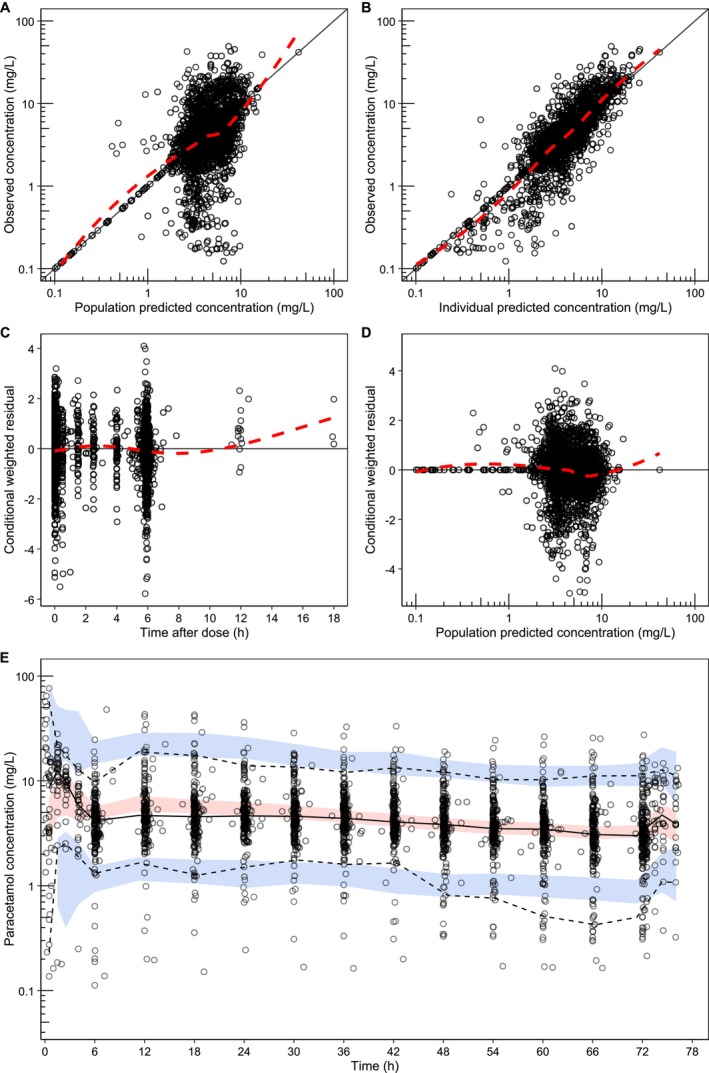
Goodness‐of‐fit plots and prediction‐corrected visual predictive check of the final population pharmacokinetic model of paracetamol inPlasmodium knowlesipatients. Observed concentrations versus population predictions (A), observed concentrations versus individually predicted concentrations (B), conditionally weighted residuals vs. time after dose (C), and conditionally weighted residuals versus population predictions (D). The open circles represent the observed concentrations. The solid black lines represent the line of identity or zero‐line, and the dashed red lines represent a local polynomial regression fitting of all data (trend lines). Prediction‐corrected visual predictive check (n= 1000) of the final population pharmacokinetic model of paracetamol (E). The open circles represent the observed paracetamol concentrations. The solid black line represents the 50th percentile of the observations, and dashed black lines represent the 5th and 95th percentiles of the observations. The shaded areas represent the 95% confidence intervals of each simulated percentile.
Population Pharmacokinetics/Pharmacodynamics of Paracetamol
Effect of Paracetamol on Creatinine
A total of 2365 creatinine measurements from 372 patients in the paracetamol (n= 183) and control (n= 189) groups were analyzed. Samples were collected at enrolment (baseline) and every 12 h up to 72 h after commencement of paracetamol administration. The percentage change from baseline creatinine was calculated for each patient at each time point and included in the PK/PD analysis. The data were best described by a model incorporating an exponential decay with a plateau function to represent the percentage change from baseline. Higher paracetamol exposure was associated with a faster creatinine reduction rate (p< 0.01). The reduction rate increased by 25.4% (95% CI: 15.5–28.8) for every 10‐fold increase in paracetamol AUC0‐72H, with a mean reduction rate constant of 0.0477 h−1(95% CI: 0.0386–0.0502). The mean maximal reduction (plateau) in creatinine was estimated at 9.9% (95% CI: 7.9–11.2) below baseline. The severity of AKI at enrollment, based on ordinal KDIGO staging of 0 to 3, significantly influenced the maximal proportional change in creatinine plateau (p< 0.001), with greater improvements observed in patients with higher KDIGO stages at enrollment.
Subset analyses of severe and non‐severePlasmodium knowlesimalaria showed a similar trend, with paracetamol exposure increasing the rate of creatinine reduction in both groups. For each 10‐fold increase in paracetamol AUC0‐72H, the reduction rate increased by 26.1% (95% CI: 8.2–44.0;p< 0.01) in non‐severe malaria and by 23.2% (95% CI: −30.3 to 64.9;p> 0.05) in severe malaria. The corresponding mean rate constants were 0.0507 (95% CI: 0.0394–0.0620) and 0.0349 (95% CI: 0.00230–0.0686), respectively. The lack of statistical significance in the severe malaria group may be due to the smaller sample size in this cohort. The parameter estimates from the final PK/PD model describing the percentage change from baseline of creatinine for the entire cohort were robust, with relative standard errors below 30% (Table3). The goodness‐of‐fit plots and the visual predictive check for the final model demonstrated good descriptive and predictive performance (Figure2).
Table: Parameter estimates from the population pharmacokinetic/pharmacodynamic parameters describing the percentage change from baseline of serum creatinine.
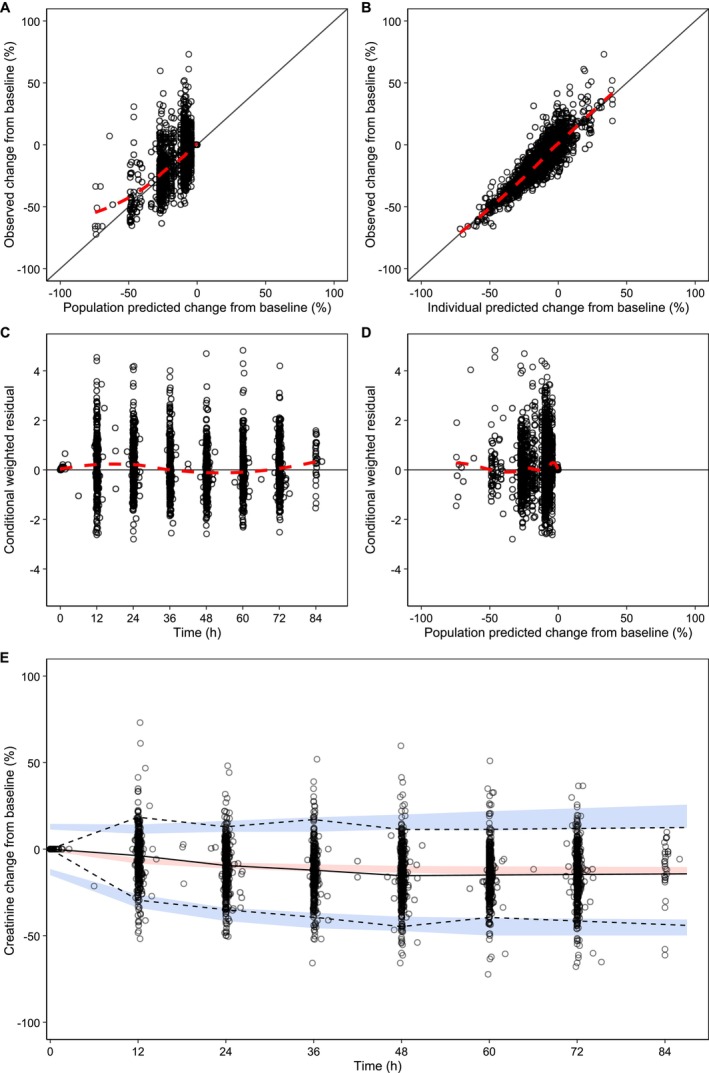
Goodness‐of‐fit plots and visual predictive check of the final PK/PD model for paracetamol effect on creatinine. Observed creatinine change from baseline versus population prediction (A), observed creatinine change from baseline versus individual prediction (B), conditionally weighted residuals versus time (C), and conditionally weighted residuals versus population prediction (D). The open circles represent the observed creatinine change from baseline. The solid black lines represent the line of identity or zero‐line, and the dashed red lines represent a local polynomial regression fitting of all data (trend lines). Visual predictive check (n= 1000) of the final PK/PD model for paracetamol effect on creatinine (E). The open circles represent the observed creatinine change from baseline. The solid black line represents the 50th percentile of the observations, and the dashed black lines represent the 5th and 95th percentiles of the observations. The shaded areas represent the 95% confidence intervals of each simulated percentile.
Effect of Paracetamol on Fever and Parasite Clearance Time
In the PACKNOW trial, the median FCT‐B was significantly shorter in the paracetamol arm compared to the control arm [20]. In this PK/PD analysis, we further evaluated the effect of paracetamol exposure on fever clearance time using the time‐to‐event model. Among patients included in the PK/PD analysis, 195 patients had a temperature of ≥ 37.5°C at enrollment. One patient in the control arm with missing data was excluded, leaving 194 patients (102 in paracetamol and 92 in the control group) for analysis.
For both FCT‐A and FCT‐B, a log‐logistic hazard model best described the data, and was further improved by incorporating paracetamol exposure (AUC0‐72H) as a linear covariate on the hazard function (p< 0.01). For FCT‐A, higher paracetamol exposure was associated with an approximately 15.8% (95% CI: 4.0–28.0) faster rate of fever clearance per 100 mg·h/L increase in AUC0‐72H. For FCT‐B, a similar association was observed, with an approximately 12.6% (95% CI: 2.0–25.0) faster rate of sustained fever clearance per 100 mg·h/L increase in AUC0‐72H. Parameter estimates from the time‐to‐event models were robust, with relative standard errors below 30%, except for the paracetamol exposure effects on FCT‐A (45.7%) and FCT‐B (50.0%) (TableS1). The visual predictive checks demonstrated that the models adequately described and predicted the observed fever clearance profiles (FigureS2).
Linear regression of paracetamol exposure (CMAXand AUC0‐72H) against parasite clearance parameters (slope half‐life, PC50–PC99) showed no significant associations (p> 0.05; FigureS3).
Effect of Paracetamol on Liver Function
A total of 372 patients in the paracetamol (n= 183) and control (n= 189) groups were included in this analysis. Changes in ALT levels, used as a biomarker of hepatotoxicity, were evaluated over 0–168 h and were best described by a log‐linear model. Incorporating paracetamol exposure (AUC0‐72H) as a covariate on the slope of ALT change significantly improved the model (p< 0.001). Stepwise covariate analysis identified age (p< 0.01), baseline ALT (p< 0.001), and body weight (p< 0.001) as additional significant covariates compared with the model that included the impact of paracetamol exposure.
Age and baseline ALT were inversely associated with the slope of ALT change, whereas body weight was positively associated with baseline ALT. In the final model, paracetamol exposure increased the ALT slope by 0.3% (95% CI: 0.2–0.5) per 1 mg·h/L increase in AUC0‐72H. Each additional year of age reduced the slope by 1.1% (95% CI: 0.3–2.0), and each 1 U/L increase in baseline ALT reduced the slope by 1.2% (95% CI: 0.8–1.7). Baseline ALT increased by 0.4% (95% CI: 0.2–0.5) for every 1 kg increase in body weight. From this model, although increases in paracetamol exposure were associated with increases in ALT, within the observed AUC0‐72Hrange in the study population receiving paracetamol every 6 h for 72 h, none of the individual predicted ALT values at any time point exceeded three times their baseline (range: −0.965 to 1.71). The parameter estimates from the final model were robust, with relative standard errors below 30% for all parameters, except for the effect of age on the slope (36.1%) (Table4). The goodness‐of‐fit plots and the visual predictive checks demonstrated a good descriptive and predictive performance of the model (Figure3).
Table: Parameter estimates from the population pharmacokinetic/pharmacodynamic parameters describing the alanine aminotransferase change over time.
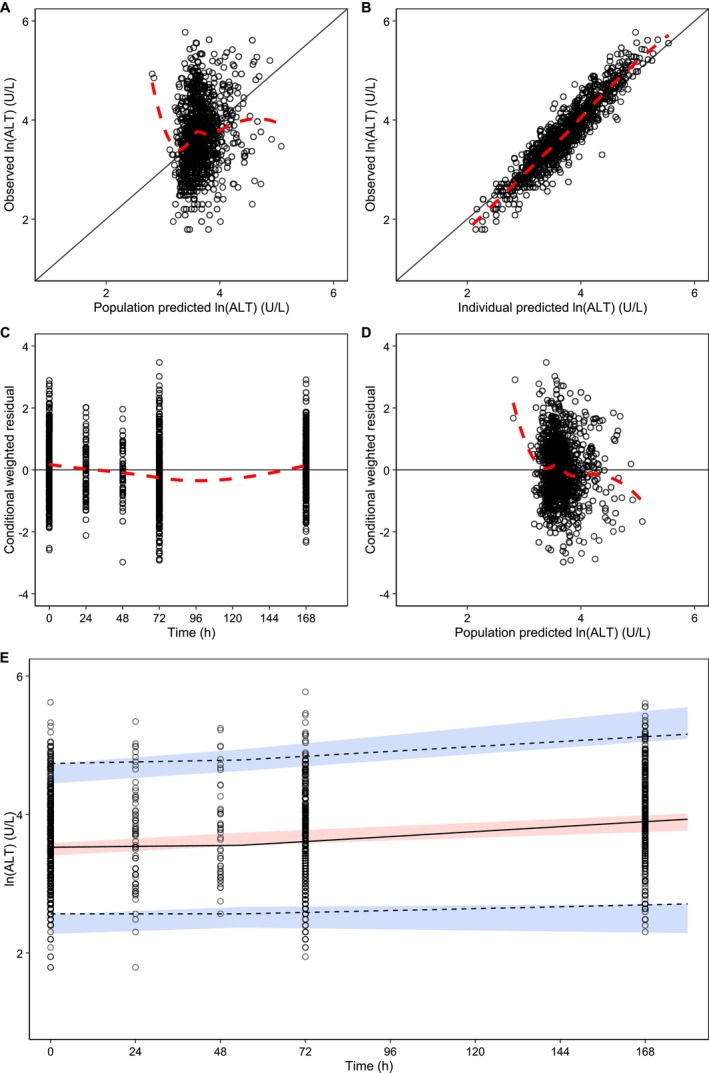
Goodness‐of‐fit plots and visual predictive check of PK/PD model for paracetamol effect on alanine aminotransferase (ALT). Observed ln (ALT) versus population prediction (A), observed ln (ALT) versus individual prediction (B), conditionally weighted residuals versus time (C), and conditionally weighted residuals versus population prediction (D). The open circles represent the observed ln (ALT). The solid black lines represent the line of identity or zero‐line, and the dashed red lines represent a local polynomial regression fitting of all data (trend lines). Visual predictive (n= 1000) of the final PK/PD model for paracetamol effect on ALT (E). The open circles represent the observed ln (ALT). The solid black line represents the 50th percentile of the observations, and the dashed black lines represent the 5th and 95th percentiles of the observations. The shaded areas represent the 95% confidence intervals of each simulated percentile. ln, natural logarithm.
Discussion
In this study, we described the population PK/PD of paracetamol in Malaysian patients withPlasmodium knowlesimalaria, utilizing data from the PACKNOW clinical trial [20] to evaluate the impact of paracetamol exposure on renal, hepatic, and fever outcomes. The PK/PD model for creatinine showed that higher paracetamol exposure significantly accelerated the decline in creatinine following treatment, supporting the renoprotective effects of paracetamol observed in PACKNOW. Importantly, in the PACKNOW study, a renoprotective effect was demonstrated in subgroups of patients with severe knowlesi malaria, and with AKI and hemolysis, but not in the overall cohort. However, our PK/PD paracetamol findings extend these observations by suggesting potential benefit even in patients with uncomplicatedPlasmodium knowlesimalaria, who comprised the majority of patients in this analysis. These results are also consistent with our previous study inPlasmodium falciparummalaria, where higher paracetamol exposure (AUC0‐72H) was associated with improved renal outcomes [19]. Together, these data provide evidence for an exposure‐dependent renoprotective effect of paracetamol in malaria.
In addition to improving renal function, higher paracetamol exposure was also associated with faster fever clearance times, confirming the antipyretic effect of paracetamol in patients withPlasmodium knowlesimalaria. These findings are consistent with previous studies inPlasmodium falciparummalaria [19,20,33,34,35,36] and support current WHO recommendations for paracetamol use as an antipyretic [37]. Concerns raised by earlier studies about a lack of antipyretic benefit may reflect underdosing, infrequent body temperature assessments, or sub‐therapeutic paracetamol concentrations, as drug levels were not measured in those analyses [38,39].
Paracetamol exposure was also associated with elevations in ALT. Our model identified that higher paracetamol exposure increased the slope of ALT rise over time, while age and baseline ALT attenuated this effect. These relationships are consistent with findings from larger observational studies [40]. Importantly, although an elevation in predicted ALT was observed with higher paracetamol exposure, for all participants, these values were well below Hy's law criteria for hepatotoxicity, based on an elevation three times greater than the measured baseline, and no significant differences in adverse events were noted between the treatment and control groups. Together with safety data from a previous study in falciparum malaria [19], these findings support the tolerability of standard‐dose paracetamol in malaria.
In this study, a PK/PD analysis of paracetamol demonstrated no significant relationship between paracetamol exposure and parasite clearance time. This finding aligns with previous PK/PD of paracetamol and randomized trial data in falciparum and knowlesi malaria [19,20,25,41]. Although earlier studies, including a Cochrane review and a trial in African children, reported inconclusive or conflicting results regarding parasite clearance time [38,42], the current analysis supports that while paracetamol provides renoprotective and antipyretic benefits, it does not influence parasite clearance dynamics.
The PK analysis of paracetamol in this study demonstrated that the exposure to paracetamol declined over time, despite continued dosing. The current data are insufficient to differentiate whether the time dependency is attributable to changes in relative bioavailability or elimination clearance of the drug, as both similarly affect paracetamol exposure. In our model, implementing the time effect on bioavailability provided a better fit and was therefore retained. The decline in paracetamol exposure over time may be related to altered drug metabolism during acute malaria infection. Paracetamol is primarily metabolized via glucuronidation and sulfation, with a minor oxidative pathway generating toxic metabolite N‐acetyl‐p‐benzoquinone imine (NAPQI) [43]. In malaria, glucuronidation has been shown to decrease, potentially due to reduced availability of UDP‐glucuronic acid during acute illness [44,45]. Animal studies have also demonstrated downregulation of UGT, SULT, and CYP enzyme expression during peak parasitemia, with recovery thereafter [46]. Although these mechanistic findings align with our observations, this study did not directly assess paracetamol metabolism to determine whether reduced metabolism contributed to the decline in paracetamol exposure over time. A pooled analysis of PK studies of paracetamol in malaria patients, incorporating metabolite measurements, could help elucidate the mechanisms underlying this phenomenon.
In conclusion, this PK/PD analysis of paracetamol demonstrates clear exposure–response relationships between paracetamol and clinical outcomes inPlasmodium knowlesimalaria. Higher exposure was associated with improved renal function and faster fever clearance, while also linked to modest increases in ALT without evidence of hepatotoxicity. These findings support the renoprotective and antipyretic effects of paracetamol in malaria and support a wider uptake of its use for these purposes in severe malaria.
Author Contributions
Thanaporn Wattanakul, Richard M. Hoglund, and Katherine Plewes wrote the manuscript. Daniel J. Cooper, Katherine Plewes, Matthew J. Grigg, Giri S. Rajahram, Timothy William, Arjen M. Dondorp, Michael D. Edstein, Geoffrey W. Birrell, Nicholas M. Anstey, and Bridget E. Barber designed and performed the research. Thanaporn Wattanakul, Richard M. Hoglund, and Joel Tarning analyzed the data. All authors revised and approved the final manuscript.
Funding
This work was supported by Ministry of Health, Malaysia (grant number BP00500420 and grant number BP00500/117/1002 to Giri S. Rajahram); the US NIH (5R01_AI160457‐02 to Giri S. Rajahram and Matthew J. Grigg); the Australian National Health and Medical Research Council (grants 1037304, 1132975, and 1045156 and fellowships to Nicholas M. Anstey, 1042072, 1135820; Bridget E. Barber, 1088738; and Matthew J. Grigg 2017436); the Australian Centre of Research Excellence in Malaria Elimination (ACREME); and the Wellcome Trust (grant 220211). The authors used AI assistance for language editing and improving the readability of this manuscript. This research was funded in part, by the Wellcome Trust [315982/Z/24/Z]. For the purpose of Open Access, the author has applied a CC BY public copyright license to any Author Accepted Manuscript version arising from this submission.
Disclosure
Disclaimer: The views expressed here are those of the authors and do not necessarily reflect the official policy or position of the Australian Defense Force, Joint Health Command, or any extant Australian Defense Force policy.
Conflicts of Interest
The authors declare no conflicts of interest.
References
- A. M. Dondorp, S. J. Lee, M. A. Faiz, et al. , “The Relationship Between Age and the Manifestations of and Mortality Associated With Severe Malaria, ”Clinical Infectious Diseases: An Official Publication of the Infectious Diseases Society of America47(2008): 151–157. doi.org/10.1086/589287
- L. von Seidlein, R. Olaosebikan, I. C. Hendriksen, et al. , “Predicting the Clinical Outcome of Severe Falciparum Malaria in African Children: Findings From a Large Randomized Trial, ”Clinical Infectious Diseases: An Official Publication of the Infectious Diseases Society of America54(2012): 1080–1090. doi.org/10.1093/cid/cis034
- G. S. Rajahram, D. J. Cooper, T. William, M. J. Grigg, N. M. Anstey, andB. E. Barber, “Deaths From Plasmodium Knowlesi Malaria: Case Series and Systematic Review, ”Clinical Infectious Diseases: An Official Publication of the Infectious Diseases Society of America69(2019): 1703–1711. doi.org/10.1093/cid/ciz011
- A. L. Conroy, M. Hawkes, R. E. Elphinstone, et al. , “Acute Kidney Injury Is Common in Pediatric Severe Malaria and Is Associated With Increased Mortality, ”Open Forum Infectious Diseases3(2016): ofw046. doi.org/10.1093/ofid/ofw046
- M. J. Grigg, T. William, B. E. Barber, et al. , “Age‐Related Clinical Spectrum of Plasmodium Knowlesi Malaria and Predictors of Severity, ”Clinical Infectious Diseases: An Official Publication of the Infectious Diseases Society of America67(2018): 350–359. doi.org/10.1093/cid/ciy065
- A. L. Conroy, R. O. Opoka, P. Bangirana, et al. , “Acute Kidney Injury Is Associated With Impaired Cognition and Chronic Kidney Disease in a Prospective Cohort of Children With Severe Malaria, ”BMC Medicine17(2019): 98. doi.org/10.1186/s12916-019-1332-7
- B. J. Ouma, J. M. Ssenkusu, E. Shabani, et al. , “Endothelial Activation, Acute Kidney Injury, and Cognitive Impairment in Pediatric Severe Malaria, ”Critical Care Medicine48(2020): e734–e743. doi.org/10.1097/CCM.0000000000004469
- M. R. Hickson, A. L. Conroy, P. Bangirana, et al. , “Acute Kidney Injury in Ugandan Children With Severe Malaria Is Associated With Long‐Term Behavioral Problems, ”PLoS One14(2019): e0226405. doi.org/10.1371/journal.pone.0226405
- K. Plewes, H. W. F. Kingston, A. Ghose, et al. , “Cell‐Free Hemoglobin Mediated Oxidative Stress Is Associated With Acute Kidney Injury and Renal Replacement Therapy in Severe Falciparum Malaria: An Observational Study, ”BMC Infectious Diseases17(2017): 313. doi.org/10.1186/s12879-017-2373-1
- R. E. Elphinstone, A. L. Conroy, M. Hawkes, et al. , “Alterations in Systemic Extracellular Heme and Hemopexin Are Associated With Adverse Clinical Outcomes in Ugandan Children With Severe Malaria, ”Journal of Infectious Diseases214(2016): 1268–1275. doi.org/10.1093/infdis/jiw357
- B. E. Barber, M. J. Grigg, K. A. Piera, et al. , “Intravascular Haemolysis in Severe Plasmodium Knowlesi Malaria: Association With Endothelial Activation, Microvascular Dysfunction, and Acute Kidney Injury, ”Emerging Microbes & Infections7(2018): 106. doi.org/10.1038/s41426-018-0105-2
- B. J. ReederandM. T. Wilson, “Hemoglobin and Myoglobin Associated Oxidative Stress: From Molecular Mechanisms to Disease States, ”Current Medicinal Chemistry12(2005): 2741–2751. doi.org/10.2174/092986705774463021
- R. E. Elphinstone, F. Riley, T. Lin, et al. , “Dysregulation of the Haem‐Haemopexin Axis Is Associated With Severe Malaria in a Case‐Control Study of Ugandan Children, ”Malaria Journal14(2015): 511. doi.org/10.1186/s12936-015-1028-1
- N. M. Anstey, M. Y. Hassanali, J. Mlalasi, D. Manyenga, andE. D. Mwaikambo, “Elevated Levels of Methaemoglobin in Tanzanian Children With Severe and Uncomplicated Malaria, ”Transactions of the Royal Society of Tropical Medicine and Hygiene90(1996): 147–151. doi.org/10.1016/s0035-9203(96)90118-2
- J. B. Weinberg, T. W. Yeo, J. P. Mukemba, et al. , “Dimethylarginines: Endogenous Inhibitors of Nitric Oxide Synthesis in Children With Falciparum Malaria, ”Journal of Infectious Diseases210(2014): 913–922. doi.org/10.1093/infdis/jiu156
- O. Boutaud, K. P. Moore, B. J. Reeder, et al. , “Acetaminophen Inhibits Hemoprotein‐Catalyzed Lipid Peroxidation and Attenuates Rhabdomyolysis‐Induced Renal Failure, ”Proceedings of the National Academy of Sciences of the United States of America107(2010): 2699–2704. doi.org/10.1073/pnas.0910174107
- M. DesgrouasandT. Boulain, “Paracetamol Use and Lowered Risk of Acute Kidney Injury in Patients With Rhabdomyolysis, ”Journal of Nephrology34(2021): 1725–1735. doi.org/10.1007/s40620-020-00950-7
- D. R. Janz, J. A. Bastarache, T. W. Rice, et al. , “Randomized, Placebo‐Controlled Trial of Acetaminophen for the Reduction of Oxidative Injury in Severe Sepsis: The Acetaminophen for the Reduction of Oxidative Injury in Severe Sepsis Trial, ”Critical Care Medicine43(2015): 534–541. doi.org/10.1097/CCM.0000000000000718
- K. Plewes, H. W. F. Kingston, A. Ghose, et al. , “Acetaminophen as a Renoprotective Adjunctive Treatment in Patients With Severe and Moderately Severe Falciparum Malaria: A Randomized, Controlled, Open‐Label Trial, ”Clinical Infectious Diseases: An Official Publication of the Infectious Diseases Society of America67(2018): 991–999. doi.org/10.1093/cid/ciy213
- D. J. Cooper, M. J. Grigg, K. Plewes, et al. , “The Effect of Regularly Dosed Acetaminophen vs no Acetaminophen on Renal Function in Plasmodium Knowlesi Malaria (PACKNOW): A Randomized, Controlled Trial, ”Clinical Infectious Diseases: An Official Publication of the Infectious Diseases Society of America75(2022): 1379–1388. doi.org/10.1093/cid/ciac152
- D. J. Cooper, K. Plewes, M. J. Grigg, et al. , “The Effect of Regularly Dosed Paracetamol Versus no Paracetamol on Renal Function in Plasmodium Knowlesi Malaria (PACKNOW): Study Protocol for a Randomised Controlled Trial, ”Trials19(2018): 250. doi.org/10.1186/s13063-018-2600-0
- Severe Malaria, ”Tropical Medicine & International Health19(2014): 7–131. doi.org/10.1111/tmi.12313_2
- Kidney Disease: Improving Global Outcomes (KDIGO) Acute Kidney Injury Work Group, “KDIGO Clinical Practice Guideline for Acute Kidney Injury, ”Kidney International2(2012): 1–138.
- R. K. Kam, M. H. Chan, H. T. Wong, et al. , “Quantitation of Paracetamol by Liquid Chromatography‐Mass Spectrometry in Human Plasma in Support of Clinical Trial, ”Future Science OA4(2018): FSO331. doi.org/10.4155/fsoa-2018-0039
- T. Wattanakul, P. Teerapong, K. Plewes, et al. , “Pharmacokinetic Properties of Intramuscular Versus Oral Syrup Paracetamol in Plasmodium Falciparum Malaria, ”Malaria Journal15(2016): 244. doi.org/10.1186/s12936-016-1283-9
- E. K. LangeskovandK. Kristensen, “Population Pharmacokinetic of Paracetamol and Atorvastatin With Co‐Administration of Semaglutide, ”Pharmacology Research & Perspectives10(2022): e00962. doi.org/10.1002/prp2.962
- S. Jiang, K. Madrasi, T. Samant, et al. , “Population Pharmacokinetic Modeling of Acetaminophen Protein Adducts in Adults and Children, ”Journal of Clinical Pharmacology60(2020): 595–604. doi.org/10.1002/jcph.1555
- E. N. JonssonandM. O. Karlsson, “Xpose–An S‐PLUS Based Population Pharmacokinetic/Pharmacodynamic Model Building Aid for NONMEM, ”Computer Methods and Programs in Biomedicine58(1999): 51–64. doi.org/10.1016/s0169-2607(98)00067-4
- L. Lindbom, J. Ribbing, andE. N. Jonsson, “Perl‐Speaks‐NONMEM (PsN)–a Perl Module for NONMEM Related Programming, ”Computer Methods and Programs in Biomedicine75(2004): 85–94. doi.org/10.1016/j.cmpb.2003.11.003
- R. J. Keizer, M. van Benten, J. H. Beijnen, J. H. Schellens, andA. D. Huitema, “Pirana and PCluster: A Modeling Environment and Cluster Infrastructure for NONMEM, ”Computer Methods and Programs in Biomedicine101(2011): 72–79. doi.org/10.1016/j.cmpb.2010.04.018
- Y. WangandX. Liu, “Handling Missing Dosing History in Population Pharmacokinetic Modeling: An Extension to MDM Method, ”CPT: Pharmacometrics & Systems Pharmacology8(2019): 39–49. doi.org/10.1002/psp4.12374
- M. Bergstrand, A. C. Hooker, J. E. Wallin, andM. O. Karlsson, “Prediction‐Corrected Visual Predictive Checks for Diagnosing Nonlinear Mixed‐Effects Models, ”AAPS Journal13(2011): 143–151. doi.org/10.1208/s12248-011-9255-z
- S. Krishna, W. Supanaranond, S. Pukrittayakamee, et al. , “Fever in Uncomplicated Plasmodium Falciparum Infection: Effects of Quinine and Paracetamol, ”Transactions of the Royal Society of Tropical Medicine and Hygiene89(1995): 197–199. doi.org/10.1016/0035-9203(95)90494-8
- S. Krishna, S. Pukrittayakamee, W. Supanaranond, et al. , “Fever in Uncomplicated Plasmodium Falciparum Malaria: Randomized Double‐ ‘blind’ Comparison of Ibuprofen and Paracetamol Treatment, ”Transactions of the Royal Society of Tropical Medicine and Hygiene89(1995): 507–509. doi.org/10.1016/0035-9203(95)90087-x
- P. WilairatanaandS. Looareesuwan, “Antipyretic Efficacy of Indomethacin and Acetaminophen in Uncomplicated Falciparum Malaria, ”Annals of Tropical Medicine and Parasitology88(1994): 359–363. doi.org/10.1080/00034983.1994.11812877
- C. Luxemburger, M. van Vugt, T. Slight, et al. , “Early Vomiting of Mefloquine in Children With Malaria Is Not Modified by the Timing of Antipyretic Treatment, ”Transactions of the Royal Society of Tropical Medicine and Hygiene92(1998): 562–563. doi.org/10.1016/s0035-9203(98)90916-6
- World Health Organization, “WHO Guidelines for Malaria, 16 October 2023, ” (2023).
- C. H. Brandts, M. Ndjave, W. Graninger, andP. G. Kremsner, “Effect of Paracetamol on Parasite Clearance Time in Plasmodium Falciparum Malaria, ”Lancet350(1997): 704–709. doi.org/10.1016/S0140-6736(97)02255-1
- P. E. Kofoed, J. Ursing, A. Rodrigues, andL. Rombo, “Paracetamol Versus Placebo in Treatment of Non‐Severe Malaria in Children in Guinea‐Bissau: A Randomized Controlled Trial, ”Malaria Journal10(2011): 148. doi.org/10.1186/1475-2875-10-148
- M. Claus, C. Antoni, andB. Hofmann, “Factors Associated With Elevated Alanine Aminotransferase in Employees of a German Chemical Company: Results of a Large Cross‐Sectional Study, ”BMC Gastroenterology21(2021): 25. doi.org/10.1186/s12876-021-01601-2
- G. L. Birbeck, K. B. Seydel, S. Mwanza, et al. , “Acetaminophen and Ibuprofen in Pediatric Central Nervous System Malaria: A Randomized Clinical Trial, ”JAMA Neurology81(2024): 857–865. doi.org/10.1001/jamaneurol.2024.1677
- M. M. Meremikwu, C. C. Odigwe, B. Akudo Nwagbara, andE. E. Udoh, “Antipyretic Measures for Treating Fever in Malaria, ”Cochrane Database of Systematic Reviews2012(2012): CD002151. doi.org/10.1002/14651858.CD002151.pub2
- L. L. Mazaleuskaya, K. Sangkuhl, C. F. Thorn, G. A. FitzGerald, R. B. Altman, andT. E. Klein, “PharmGKB Summary: Pathways of Acetaminophen Metabolism at the Therapeutic Versus Toxic Doses, ”Pharmacogenetics and Genomics25(2015): 416–426. doi.org/10.1097/FPC.0000000000000150
- R. T. Murdoch, H. Ghabrial, G. W. Mihaly, D. J. Morgan, andR. A. Smallwood, “Malaria Infection Impairs Glucuronidation and Biliary Excretion by the Isolated Perfused Rat Liver, ”Xenobiotica; the Fate of Foreign Compounds in Biological Systems21(1991): 1571–1582. doi.org/10.3109/00498259109044406
- S. Ismail, G. O. Kokwaro, D. J. Back, andG. Edwards, “Effect of Malaria Infection on the Pharmacokinetics of Paracetamol in Rat, ”Xenobiotica; the Fate of Foreign Compounds in Biological Systems24(1994): 527–533. doi.org/10.3109/00498259409043255
- S. M. Mimche, C. M. Lee, K. H. Liu, et al. , “A Non‐Lethal Malarial Infection Results in Reduced Drug Metabolizing Enzyme Expression and Drug Clearance in Mice, ”Malaria Journal18(2019): 234. doi.org/10.1186/s12936-019-2860-5
Republished from the open web under CC-BY. Authors: Wattanakul T, Cooper DJ, Plewes K, Grigg MJ, Rajahram GS, William T, Dondorp AM, Edstein MD, Birrell GW, Anstey NM, Hoglund RM, Barber BE, Tarning J. Read the original.