Practical Enantioselective Approach to 3-Amino-2-Hydroxy Acids and Application to the Synthesis of Natural Products.
A practical approach to optically active erythro 3-amino-2-hydroxy acids has been developed and applied to the enantioselective synthesis of 3-phenylisoserine and naturally occurring 3-amino-2-hydroxy-6-methylheptanoic acid (AHMHA), a nonproteinogenic amino acid found in the marine cyclic oligopeptide perthamide C. The proposed synthetic methodology requires the enantioselective Sharpless syn-dihydroxylation of (E)-α,β-unsaturated esters followed by regioselective and stereoselective Mitsunobu azidation on the β-hydroxy group. Subsequent azide hydrogenation and ester hydrolysis provide the desired erythro 3-amino-2-hydroxy acids in high enantiopurity and overall yield. The proposed approach to AHMHA was more efficient and direct compared to the one previously reported in the literature. The absolute configuration of the diol precursor of AHMHA was assigned by ECD analysis of its biphenyl dioxolane, thereby also confirming the absolute configuration of the natural AHMHA.
Introduction
The interest in natural products chemistry is particularly motivated by their chemical diversity and the significant opportunity to discover novel molecules for the development of new classes of pharmaceuticals. The structural elucidation of natural products often requires their total synthesis. Therefore, the discovery of new synthetic approaches to gain access to structural motifs particularly widespread in natural products and bioactive drugs is of paramount importance in organic chemistry. An interesting example is constituted by chiral 3‐amino‐2‐hydroxy acids, which represent a valuable class of compounds due to their unique structural features and broad range of biological and synthetic applications. These molecules also serve as key intermediates for the synthesis of natural products, pharmaceuticals, and peptidomimetics, and they often exhibit significant biological activity on their own. In fact, the chiral 3‐amino‐2‐hydroxy acid moiety is quite common in natural products having therapeutical applications, like peptidomimetic protease inhibitors microginin [1], bestatin [2,3], and amastatin [4,5], antibacterial edeine [6], and antitumor agent paclitaxel (Taxol) [7]. Moreover, the presence of a hydroxyl and an amino stereogenic functionality adjacent to each other makes them versatile building blocks for the design of novel bioactive molecules and catalysts. For these reasons, the development of efficient and stereoselective synthetic routes to 3‐amino‐2‐hydroxy acids remains an important challenge in modern organic chemistry. Several approaches have been reported for the diastereoselective and enantioselective synthesis of such moieties, including chiral pool [8,9], asymmetric aldol reactions [10], epoxide opening [11], Sharpless asymmetric dihydroxylation (ad) [12] and asymmetric aminohydroxylation (AA) reactions [13]. However, a general and versatile synthetic methodology for obtaining enantiopure chiral 3‐amino‐2‐hydroxy acids is still lacking. In this work, we describe a stereoselective method for the synthesis of chiral 3‐amino‐2‐hydroxy acids and its application to the stereoselective synthesis of natural or pharmaceutically valuable products. Our approach is based on the introduction of the two adjacent stereocenters through a Sharplessad [14] of (E)‐α,β‐unsaturated esters1followed by a Mitsunobu regioselective and stereoselective azidation on the β hydroxy group [15] to provide, after azido group reduction, the targeterythro3‐amino‐2‐hydroxy ester4, eventually hydrolyzed to the 3‐amino‐2‐hydroxy acid5(Scheme1). Such procedure has been applied to the synthesis of (2R,3R)‐3‐phenylisoserine (5a), a valuable intermediate for the pharmaceutical industry and epimer of the Taxol side chain, and to (2R,3R)‐3‐amino‐2‐hydroxy‐6‐methylheptanoic acid (AHMHA) (5b), a nonproteinogenic amino acid found in the marine product perthamide C.
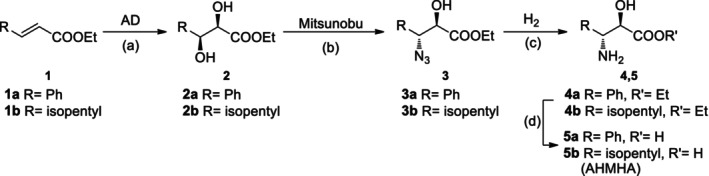
General synthetic approach toerythro3‐amino‐2‐hydroxy ester. Reagents and conditions: (a) AD‐mix‐α,t‐BuOH/H2O, MeSO4NH2, 0°C; (b) Me3SiN3, PPh3, DIAD, THF, 0°C to rt; (c) H2, Pd/C, EtOH, rt, (d) LiOH 2 M, THF, reflux.
Materials and Methods
General Experimental Procedures
1H (400 MHz) and13C (100 MHz) NMR spectra were recorded using a Varian INOVA 400 spectrometer. GC/MS spectra were obtained using an HP 6890 gas chromatograph equipped with an HP‐5975 mass spectrometric detector. HPLC chromatography was carried out with a Shimadzu Nexera LC‐40D quaternary pump equipped with SPD‐M40 PDA detector. Optical rotations were measured at room temperature using a Jasco DIP‐370 polarimeter. Absorption and ECD spectra of compound2bwere recorded at room temperature using a JASCO J815 spectropolarimeter with a 0.1 mm cell. During the measurements, the instrument was thoroughly purged with nitrogen. Analytical TLC was carried on silica gel 60 Macherey–Nagel sheets. The spots were visualized by exposing the plates to UV radiation (254 nm) and/or by spraying them with a potassium permanganate solution. Column chromatography was performed using silica gel (Merck, Kieselgel 60, 60–230 mesh). THF was freshly distilled before use over sodium benzophenone ketyl under nitrogen atmosphere. Other analytical‐grade solvents and commercially available reagents were used without further purification. Biphenyl dimethyl acetal8was synthesized starting from 2,2′‐bridged biphenyl ketone, following the procedure reported in the literature [16].
Synthetic Procedures
(2R,3S)‐3,4‐Dihydroxy‐4‐phenylpropanoate Ethyl Ester (2a)
In a mixture oftert‐butanol and water (1:1v/v; 90 mL),ad‐mix‐α (11.5 g) and methanesulfonamide (790 mg; 8.3 mmol) were sequentially added. The solution was vigorously stirred for 10 min at room temperature. Subsequently, the mixture was cooled to 0°C using an ice bath, ethyl cinnamate (1a) (1.5 g, 1.45 mL, 8.5 mmol) was added dropwise, and the mixture left stirring at 0°C for 19 h. The reaction was then quenched by addition of sodium metabisulfite stirring for 30 min and extracted three times with ethyl acetate. The combined organic phases were washed with brine and dried over anhydrous sodium sulfate. The solvent was evaporated under reduced pressure, and the crude product was purified by silica gel chromatography (n‐hexane:ethyl acetate 1:1) yielding2aas a white solid with 88% yield. m.p. = 72°C–74°C; [α]20D= +4.7 (c= 1.00 in ethanol) (Lit [17] for enantiomer (2S,3R) [α]20D= −4.1 [c= 1.45 in ethanol]). Daicel Chiralcel OJ column, λ = 220 nm, n‐hexane:i‐PrOH = 90:10; flow 0.5 mL/min; ee > 98%, first enantiomer eluted (2R,3S)‐2a. MS (EI):m/z210 (M+, 1), 119 (12), 107 (68), 104 (100), 91 (30), 79 (64), 76 (85), 51 (14), 31 (5);1H‐NMR (400 MHz, CDCl3, δ): 7.29–7.40 (m, 5H), 4.99 (dd, J = 6.9, 3.2 Hz, 1H), 4.34 (dd, J = 5.9, 3.2 Hz, 1H), 4.25 (q, J = 7.2 Hz, 2H), 3.24 (d, J = 6.4 Hz, 1H), 2.92 (d, J = 7.2 Hz, 1H),1.26 (t, J = 7.2 Hz, 3H).13C‐NMR (100 MHz, CDCl3, δ): 172.9, 140.1, 128.6, 128.2, 126.4, 74.8, 74.4, 63.3, 14.2.
(2R,3R)‐3‐Azido‐2‐hydroxy‐3‐phenylpropanoate Ethyl Ester (3a)
To a solution of the diol2a(100 mg; 0.48 mmol) and triphenylphosphine (164 mg; 0.63 mmol) (both thoroughly dried for 4 h under high vacuum) in 9 mL of anhydrous THF, diisopropyl azodicarboxylate (DIAD) (142 μL; 0.72 mmol) was added at 0°C, cooling with an ice bath. After stirring the reaction mixture for 3 h under an inert atmosphere, trimethylsilyl azide (CH3SiN3) (130 μL; 0.97 mmol) was added. The resulting solution was stirred for additional 3 h at 0°C and then allowed to warm to room temperature for 48 h. Subsequently, the solvent was removed under reduced pressure, and the residue was dissolved in THF (1.5 mL) and treated with a 1.0 M solution of tetrabutylammonium fluoride in THF (TBAF, 1.3 mL) and water (64 μL). The mixture was stirred at room temperature for 19 h until the disappearance of the intermediate silazide was observed. After evaporating the solvent at reduced pressure, the crude reaction mixture was dissolved in the minimal amount of dichloromethane and purified by silica gel chromatography (petroleum ether:ethyl acetate 1:1). The product3awas obtained as a colorless oil in 40% yield. [α]20D= −43.3 (c= 1.00 in ethanol).1H‐NMR (40 0 MHz, CDCl3, δ): 7.32–7.37 (m, 5H), 4.87 (d, J = 3.6 Hz, 1H), 4.51 (d, J = 3.2 Hz, 1H), 4.16 (q, J = 7.2 Hz, 2H), 2.91 (bs, 1H), 1.18 (t, J = 7.2 Hz, 3H).13C‐NMR (100 MHz, CDCl3, δ): 171.3, 134.4, 128.9, 128.6, 127.8, 73.7, 67.2, 62.2, 14.0.
(2R,3R)‐3‐Amino‐2‐hydroxy‐3‐phenylpropanoate Ethyl Ester (4a)
The ester3a(33 mg, 0.14 mmol) was dissolved in anhydrous ethanol (2 mL), and then a suspension of 10% palladium on carbon (Pd/C, 20 mg) was added for approximately 24 h under a hydrogen atmosphere. The reaction was stopped by filtering the mixture through a celite plug and washing it with ethanol. Excess solvent was removed by evaporation under reduced pressure, yielding product4aas a colorless oil with 79% yield. [α]20D= −24.5 (c= 0.98 in ethanol).1H‐NMR (400 MHz, CDCl3, δ): 7.26–7.35 (m, 5H), 4.46 (d, J = 3.9 Hz, 1H), 4.32 (d, J = 3.2 Hz, 1H), 4.09 (q, J = 7.0, 2H), 2.61 (bs, 3H), 1.17 (t, J = 7.1, 3H).13C‐NMR (100 MHz, CDCl3, δ): 172.5, 140.3, 128.3, 127.8, 127.0, 74.7, 61.5, 58.2, 14.0.
(2R,3R)‐3‐Amino‐2‐hydroxy‐3‐phenylpropanoic Acid (5a)
The amino hydroxy ester4a(0.11 mmol) was dissolved in THF (2 mL), and 150 μL of a 2.0 M aqueous LiOH solution was added. The reaction mixture was heated at reflux overnight. After completion, the solvent was removed under reduced pressure and the residue was dissolved in distilled water (2 mL). The resulting solution was neutralized by the addition of sodium dihydrogen phosphate dihydrate (NaH2PO4·2H2O, as needed) and extracted three times with ethyl acetate. The aqueous layer, containing the desired amino acid, was concentrated, and the resulting solid was treated with methanol, filtered, and dried under reduced pressure to afford compound5aas a white solid in 60% yield. [α]20D= +22.3 (c= 1.00 in methanol) [Lit [18]. [α]20D= +3.6 (c= 0.5 in 6 M HCl)].1H‐NMR (400 MHz, CD3OD, δ): 7.46–7.48 (m, 2H), 7.34–7.36 (m, 2H), 4.54 (d, J = 4.4 Hz, 1H), 4.35 (d, J = 4.4 Hz, 1H), 3.29 (s, 2H).13C‐NMR (100 MHz, CD3OD, δ): 174.4, 133.6, 128.6, 128.2, 128.1, 71.7, 58.6.
4‐Methylpentanal (7)
Pyridinium chlorochromate (PCC, Corey's reagent) (6.34 g; 29.4 mmol; 2.0 eq), sodium acetate (241.0 mg; 2.94 mmol; 0.2 eq), and neutral aluminum oxide (Al2O3) (3.2 g) were mixed in anhydrous dichloromethane (60 mL) under a nitrogen atmosphere. The solution was cooled to 0°C using an ice bath, and 4‐methylpentanol (6) (1.82 mL; 1.5 g; 14.7 mmol) was added. The resulting reaction mixture was stirred at room temperature for 1.5 h. The brown colored solution was filtered through a silica gel column using only dichloromethane as the eluent. The separated product, highly volatile, was concentrated at 25°C–30°C under controlled pressure (800 mmHg), resulting in a colorless oil obtained with quantitative yield. MS (EI):m/z100 (M+, 1), 72 (15), 57 (100), 56 (92), 43 (56), 41 (60).1H‐NMR (400 MHz, CDCl3, δ): 9.77 (s, 1H), 2.42 (t, J = 7.6 Hz, 2H), 1.49–1.63 (m, 3H), 0.91 (d, J = 6.4 Hz, 6H).13C‐NMR (100 MHz, CDCl3, δ): 180.0, 33.6, 32.2, 27.2, 22.4, 23.3.
Ethyl 6‐Methylhept‐2‐enoate (1b)
The aldehyde (6) and triethyl phosphonoacetate (TEPA) (3.20 mL; 1.1 eq) were added to a solution of LiOH (387 mg; 1.1 eq) in anhydrous THF (16.0 mL) under a nitrogen atmosphere. The resulting mixture was stirred at room temperature for 24 h. Once the reaction was deemed complete, it was quenched with distilled water (10 mL). The mixture was extracted three times with ethyl acetate. The combined organic phases were dried over sodium sulfate (Na2SO4) and concentrated at 40°C under reduced pressure (below 150 mmHg). The ester was purified using a silica gel chromatography column with a mixture of petroleum ether/ethyl acetate (96:4), resulting in the product with a quantitative yield. MS (EI):m/z170 (M+, 1), 125 (64), 115 (100), 101 (89), 73 (65), 55 (78), 41 (37);1H‐NMR (400 MHz, CDCl3, δ): 6.97 (dt, J = 15.6, 7.2 Hz, 1H), 5.81 (d, J = 15.6 Hz, 1H), 4.18 (q, J = 7.6 Hz, 2H), 2.20 (q, J = 7.2 Hz, 2H), 1.52–160 (m, 1H), 1.34 (q, J = 7.6 Hz, 2H), 1.29 (t, J = 7.6 Hz, 3H), 0.89 (d, J = 6.8 Hz, 6H).13C‐NMR (100 MHz, CDCl3, δ): 166.7, 149.6, 121.0, 60.0, 37.0, 30.0, 27.4, 22.3, 14.2.
(2R,3S)‐2,3‐Dihydroxy‐6‐methylheptanoate Ethyl Ester (2b)
In a mixture oftert‐butanol and water (1:1 v/v; 164 mL),ad‐mix‐α (21.6 g; 3.12 mmol) and methanesulfonamide (MeSO2NH2) (1.48 g; 0.22 mmol) were sequentially added. The solution was vigorously stirred for 10 min at room temperature. Subsequently, the mixture was cooled to 0°C using an ice bath, and the olefinic ethyl ester1b(2.805 g; 16 mmol) was added dropwise. After 19 h, the reaction was quenched by adding equimolar sodium metabisulfite (Na2S2O5) to the mixture and stirring for about 30 min. At the end of this time, the reaction mixture was extracted three times with ethyl acetate. The combined organic phases were washed with brine and then dried over sodium sulfate. The solvent was evaporated under reduced pressure, and the crude product was purified by silica gel chromatography (petroleum ether: ethyl acetate 4:1). The pure diol appears as a colorless oil, obtained with 68% yield. [α]20D= −13.1 (c= 1.07 in ethanol); MS (EI):m/z104 (100), 83 (11), 76 (76), 55 (13), 43 (13) 41 (15).1H‐NMR (400 MHz, CDCl3, δ): 4.29 (q, J = 7.2 Hz, 2H), 4.08 (dd, J = 5.2, 2.0 Hz, 1H), 3.82–3.88 (m, 1H), 3.11 (d, J = 5.2 Hz, 1H), 1.96 (bd, J = 8.8 Hz, 1H), 1.52–1.64 (m, 3H), 1.35–1.42 (m, 1H), 1.31 (t, J = 7.2 Hz, 3H), 1.19–1.29 (m, 1H), 0.91 (d, J = 6.8 Hz, 6H).13C‐NMR (100 MHz, CDCl3, δ): 173.8, 73.1, 72.9, 62.1, 34.8, 31.6, 28.0, 22.6, 22.5, 14.1.
(2R,3R)‐3‐Azido‐2‐hydroxy‐6‐methylheptanoate Ethyl Ester (3b)
To a solution of the diol (200 mg; 0.98 mmol) and triphenylphosphine (Ph3P) (340 mg; 1.27 mmol) (both thoroughly dried for 4 h under high vacuum) in 18 mL of anhydrous THF, diisopropyl azodicarboxylate (DIAD) (295 μL; 1.5 mmol) was added at 0°C, cooling with an ice bath. After stirring the reaction mixture for 3 h under an inert atmosphere, trimethylsilyl azide (CH3SiN3) (318 μL; 1.95 mmol) was added. The resulting solution was stirred for additional 3 h at 0°C and then allowed to warm to room temperature for 5 days. Subsequently, the solvent was evaporated under reduced pressure, and the residue was dissolved in THF (3 mL) and treated with tetrabutylammonium fluoride (TBAF) (2.6 mL) and water (134 μL). The mixture was stirred at room temperature overnight until the disappearance of the intermediate silazide was observed. After evaporating the solvent at reduced pressure, the crude reaction mixture was dissolved in the minimal amount of dichloromethane (CH2Cl2) and purified by silica gel chromatography (petroleum ether: ethyl acetate 4:1). The pure product appears as an oily and colorless material and was obtained with 77% yield. [α]20D= +31.3 (c= 1.04 in ethanol); MS (EI):m/z104 (22), 76 (59), 72 (20), 56 (31), 43 (100), 41 (35).1H‐NMR (400 MHz, CDCl3, δ): 4.24–4.33 (m, 3H), 3.50 (dt, J = 10.4, 3.6 Hz, 1H), 3.18 (d, J = 5.6, 1H), 1.64–1.74 (m, 1H), 1.44–1.60 (m, 2H), 1.35–1.41 (m, 1H), 1.31 (t, J = 6.8 Hz, 1H), 1.21–1.29 (m, 1H), 0.90 (d, J = 6.0 Hz, 3H), 0.89 (d, J = 6.0 Hz, 3H).13C‐NMR (100 MHz, CDCl3, δ): 172.2, 73.4, 64.9, 62.4, 35.4, 27.8, 27.0, 22.6, 22.2, 14.1.
(2R,3R)‐3‐Amino‐2‐hydroxy‐6‐methylheptanoate Ethyl Ester (4b)
The ester3b(0.44 mmol) was dissolved in anhydrous ethanol, and then a suspension of 10% palladium on carbon (Pd/C) was added for approximately 24 h under a hydrogen atmosphere. The reaction was stopped by filtering the mixture through a celite plug and washing it with ethanol. Excess solvent was removed by evaporation under reduced pressure, yielding the desired product as a colorless oil with a 90% yield. [α]20D= +24.4 (c= 1.13 in ethanol);1H‐NMR (400 MHz, CDCl3, δ): 4.23–4.28 (m, 2H), 4.12–4.18 (m, 1H), 3.00 (m, 1H), 2.21 (bs, 3H), 1.46–1.57 (m, 1H), 1.33–1.38 (m, 2H), 1.30 (t, J = 6.4 Hz, 3H), 1.10–1.22 (m, 2H), 0.88 (d, J = 6.4 Hz, 3H), 0.86 (d, J = 6.4 Hz, 3H).13C‐NMR (100 MHz, CDCl3, δ): 173.3, 74.2, 61.4, 54.6, 35.5, 30.1, 28.0, 22.6, 22.3, 14.2.
(2R,3R)‐3‐Amino‐2‐hydroxy‐6‐methylheptanoic acid (AHMHA) (5b)
The amino hydroxy ester4b(0.25 mmol) was dissolved in THF (3 mL), and 400 μL of a 2.0 M aqueous LiOH solution were added. The reaction mixture was heated at reflux for 3 h. After completion, the solvent was removed under reduced pressure and the residue was dissolved in distilled water (7 mL). The resulting solution was neutralized by the addition of sodium dihydrogen phosphate dihydrate (NaH2PO4·2H2O, as needed) and extracted three times with ethyl acetate. The aqueous layer, containing the desired amino acid, was concentrated, and the resulting solid was treated with methanol, filtered, and dried under reduced pressure to afford AHMHA as a white solid in 62% yield. [α]20D=+14.5 (c= 1.08 in methanol);1H‐NMR (400 MHz, CD3OD, δ): 4.10 (bd, J = 3.6 Hz,1H), 3.37–3.42 (m, 1H), 1.51–1.65 (m, 3H), 1.23–1.34 (m, 2H), 0.90 (d, J = 6.4 Hz, 3H), 0.89 (d, J = 6.4 Hz, 3H).13C‐NMR (100 MHz, CD3OD, δ): 176.6, 72.2, 55.8, 35.6, 29.2, 27.0, 22.9, 22.5.
Biphenyl Boronate2c
Under an inert atmosphere, diol2b(0.36 mmol) was dissolved in anhydrous chloroform (5 mL). Subsequently, 4‐biphenylboronic acid (0.44 mmol) and activated 4 Å molecular sieves were added, and the mixture was stirred at room temperature overnight. The mixture was then filtered to remove the molecular sieves, and the solvent was evaporated. The resulting crude product was purified by column chromatography, eluting with chloroform alone, affording the pure boronate2cas a colorless liquid in 90% yield. (R,R)‐Whelk‐O1 and (S,S)‐Whelk‐O1 columns (250 mm × 4.6 mm, 5 μm); λ = 260 nm; hexane:i‐PrOH = 99:1 (v/v); flow 0.8 mL/min; ee 97.5%. The (2R,3S)‐2cenantiomer eluted first using (R,R)‐Whelk‐O1 and second using (S,S)‐Whelk‐O1.1H‐NMR (400 MHz, CDCl3, δ): 7.97 (d, J = 8.00 Hz, 2H), 7.67 (d, J = 4.8 Hz, 2H), 7.65 (d, J = 4.2 Hz, 2H), 7.47 (t, J = 7.4 Hz, 2H), 7.38 (t, J = 7.4 Hz, 1H), 4.63 (d, J = 6.2 Hz, 1H), 4.55 (q, J = 6.2 Hz, 1H), 4.30 (q, J = 7.0, 2H), 1.82 (q, J = 7.5 Hz, 6H), 1.61–1.71 (m, 1H), 1.44–1.53 (m, 1H), 1.34 (t, J = 7.0 Hz, 3H), 1.30–1.42 (m, 1H), 0.96 (d, J = 6.4 Hz, 6H).13C‐NMR (100 MHz, CDCl3, δ): 171.0, 144.3, 140.8, 135.6, 128.8, 127.7, 127.3, 126.6, 81.3, 80.0, 61.6, 34.5, 33.6, 27.8, 22.6, 22.5, 14.2.
Biphenyldioxolane2d
The biphenyl acetal8(100 mg, 0.40 mmol) was dissolved in anhydrous CHCl3(5 mL) under a nitrogen atmosphere. Subsequently, the diol2b(0.40 mmol, 1equiv.) was added to the mixture along with traces ofp‐toluenesulfonic acid and previously activated 4 Å molecular sieves. The mixture was stirred at room temperature for 24 h. After filtration, evaporation of the solvent, and column chromatography the dioxolanes2dwas obtained in 45% yield. Its CD and UV spectra were recorded in ACN between 190 and 330 nm. MS (EI):m/z394.2 (M+,91), 208.1 (22), 180.1 (65), 179.1 (100), 178.1 (47), 166.0 (13), 165.0 (60), 95.1 (10).1H‐NMR (400 MHz, CDCl3, δ): 7.41 (t, J = 7.0 Hz, 2H), 7.32 (t, J = 7.3 Hz, 2H), 7.31 (d, J = 4.0 Hz, 4H), 4.25 (m, 7H), 3.57 (m, 1H), 1.80 (m, 3H), 1.35 (m, 5H), 0.92 (d, J = 6.5 Hz, 6H).13C‐NMR (100 MHz, CDCl3, δ): 167.1, 140.2, 136.2, 129.3, 127.3, 122.8, 79.8, 75.6, 59.7, 44.9, 36.6, 27.8, 25.6, 23.1, 14.1.
Results and Discussion
Synthesis of 3‐Amino‐2‐hydroxy Acids
At first, the approach was tested on the synthesis of optically active 3‐phenylisoserine5a(Scheme1), submitting ethyl cinnamate (1a) toadwithad‐mix‐α reagent and methanesulfonamide in a 1:1 tert‐butanol/water mixture, providing the diol (2R,3S)‐diol2ain 80% yield and 98% ee after column chromatography. Diol2awas then submitted to a Mitsunobu reaction with trimethylsilylazide (Me3SiN3) as a nucleophile [19] to yielderythro(2R,3R) azide3a. Notably, the Mitsunobu reaction was completely regioselective and stereoselective, allowing the substitution of only the β‐hydroxy group with the amino functionality having inverted configuration and thus allowing achieving the desired 3‐amino‐2‐hydroxy ester with the wanted relative and absolute configuration. The regioselective and stereoselective Mitsunobu substitution ofsyn‐2,3‐dihydroxy esters with hydrazoic acid has been previously described by Ko [15] and applied to the synthesis of statine. This author postulated that in 2,3‐dihydroxy esters the electron‐withdrawing effect of the ester moiety makes the α‐hydroxyl group more acidic and less nucleophilic than the β‐hydroxyl. Therefore, in non‐basic Mitsunobu conditions where hydroxyls are not deprotonated, the more nucleophilic β‐hydroxyl group reacts with the electrophilic phosphonium adduct of DIad(or DEAD), eventually giving rise to nucleophilic substitution. The (2R,3R)‐amino hydroxy ester4awas then obtained by reducing (2R,3R)‐azide3ain the presence of hydrogen and palladium on carbon [20]. The subsequent hydrolysis of4awith LiOH in a THF/water mixture provided (2R,3R)‐3‐phenylisoserine5ain 20% overall yield. Similarly, the enantiomers of2a‐5acould be obtained by the use of AD‐mix‐β reagent mixture in the AD step.
Subsequently, this approach was applied to the synthesis of the natural product 3‐amino‐2‐hydroxy‐6‐methylheptanoic acid (AHMHA,5b), a component of the cyclic octapeptide perthamide C recovered from the marine spongeTheonella swinhoei[21]. The relative and absolute configuration of AHMHA (5b) was established by the group of Zampella and coworkers [22] through enantioselective total synthesis of botherythro‐(2R,3R) andthreo‐(2R,3S) diastereomers. Comparison of1H and13C NMR spectra of natural and synthetic samples allowed us to assignerythroconfiguration to the two stereogenic centers of natural AHMHA while its (2R,3R) absolute configuration was determined using the Marfey method [23] and confirmed by optical rotation values comparison.
The AHMHA synthetic procedure reported in literature involves seven consecutive reactions, with the enantioselective step featuring a Sharpless asymmetric epoxidation (AE) reaction [24]. This approach is based on the reduction of α,β‐unsaturated ester1bto an allylic alcohol, then submitted to AE (Scheme2). Furthermore, the obtained epoxy alcohol is re‐oxidized to a chiral epoxy acid, subsequently regioselectively opened with sodium azide, and reduced to the desired 3‐amino‐2‐hydroxy acid AHMHA. Such synthetic procedure requires first the reduction of the carboxy moiety to alcohol and then a reoxidation of the hydroxy group back to the carboxylic acid, thus making the pathway lengthy.
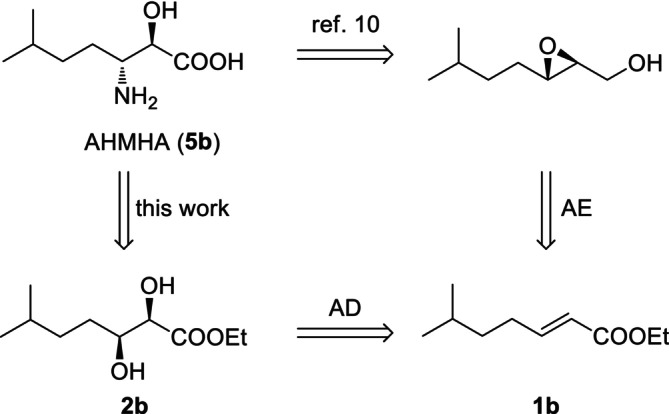
Retrosynthetic analyses of (2R,3R)‐3‐amino‐2‐hydroxy‐6‐methylheptanoic acid (AHMHA,5b).
Therefore, we found it worthwhile to apply to the synthesis of AHMHA (5b) our more direct and efficient approach. In fact, by introducing the two adjacent stereocenters through anadreaction on ester1b, it allows us to avoid the reduction and oxidation steps required in Zampella's synthesis (Scheme2).
Accordingly, commercially available 4‐methylpentanol (6) was oxidized to aldehyde7in quantitative yield by pyridinium chlorochromate (PCC) treatment (Scheme3). Subsequently, aldehyde7was subjected to a Horner–Wadsworth–Emmons (HWE) olefination reaction [25] with triethyl phosphonoacetate (TEPA) in the presence of LiOH, providing the α,β‐unsaturated ethyl ester1bin quantitative yield after chromatographic purification. Sharpless AD of ester1busing the AD‐mix‐α reagent and methanesulfonamide in a 1:1 tert‐butanol/water mixture provided (2R,3S)‐diol2bin 68% yield and high enantiopurity (vide infra) after chromatographic purification. The absolute configuration of diol2bwas preliminarily assigned by the Sharpless' mnemonic rule [14] and then confirmed by electronic circular dichroism (ECD) analysis with a biphenyl chiroptical probe (see the following paragraph). Diol2bwas then subjected to a Mitsunobu reaction with Me3SiN3as a nucleophile [19] to yield (2R,3R) azide3b. Notably, the latter reaction was again completely regioselective and stereoselective, thus allowing the achievement of theerythroester4bwith the correct relative and absolute configuration. The (2R,3R)‐amino hydroxy ester4bwas obtained by hydrogenation of (2R,3R)‐azide3bin the presence of hydrogen and palladium on carbon [20]. Finally, (2R,3R)‐5bwas obtained via a basic hydrolysis [26] of (2R,3R)‐4bwith a 2.0 M aqueous solution of LiOH in THF under reflux, followed by treatment with NaH2PO4·2H2O until neutrality. Optical rotation of the synthetic (2R,3R)‐AHMHA was [α]20D= +14.5 (c= 1.08 in methanol), in agreement in sign and order of magnitude with that of the natural compound having [α]20D= +8.8 (c= 0.55 in methanol) [22] and thus allowing it to confirm its (2R,3R) absolute configuration.
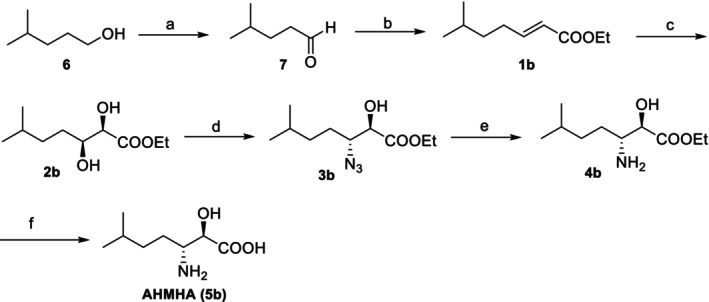
Synthetic sequence for AHMHA. Reagents and conditions: (a) PCC, CH3COONa, neutral Al2O3, CH2Cl2; (b) LiOH, TEPA, THF rt; (c)ad‐mix‐α,t‐BuOH/H2O, MeSO4NH2, 0°C; (d) Me3SiN3, PPh3, DIad, THF, 0°C to rt; (e) H2, Pd/C, EtOH, rt; (f) LiOH 2 M, reflux THF, then NaH2PO4·2H2O.
Stereochemical Analysis of Diol2b
To determine the enantiopurity of diol2bby HPLC on a chiral stationary phase (CSP), it was first necessary to insert a chromophoric moiety on the molecule to allow its UV detection. Therefore,2bwas converted in the corresponding 4‐biphenylboronate2cby reaction with 4‐biphenyl boronic acid in CHCl3in the presence of activated 4 Å molecular sieves [27,28]. Having only one enantiomer of2cin hand and to overcome the necessity of a racemate to identify the eluted enantiomers peaks, we resorted to the so‐called “inverted chirality columns approach” (ICCA), which consists of the use of CSPs available in both enantiomeric forms [29]. In this case, inversion of the elution order for a pair of enantiomers is observed in response to the change in column chirality, thus generating a virtual racemate. Accordingly,2cwas eluted on enantiomeric CSP (S,S)‐Whelk O1 and (R,R)‐Whelk O1, observing inverted peaks retention time on the two columns for the same sample and determining a 97.5% ee of boronate2cand then of chiral diol2b(Figure1).
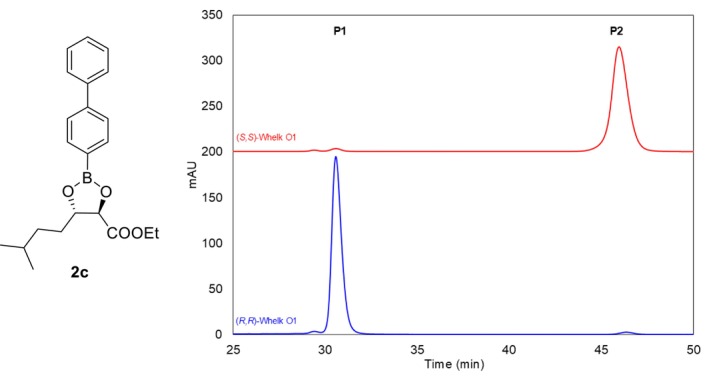
HPLC separation of2c. Blue traces: (R,R)‐Whelk‐O1, 250 mm × 4.6 mm (5 μm); red traces: (S,S)‐Whelk‐O1, 250 mm × 4.6 mm (5 μm). Mobile phase: hexane:isopropanol (99:1,v/v). Flow rate: 0.8 mL/min. UV detection at 260 nm. P1 = 30.57 min, P2 = 45.96 min. The blue chromatogram was shifted by +1.58 min for better comparison.
Due to the empirical nature and the potential for misassignments of the Sharpless mnemonic rule [30], the absolute configuration of diol2bwas independently assigned by the use of flexible biphenyl chiroptical probes. Such an approach has been extensively developed by our research group for determining the absolute configuration of flexible and non‐chromophoric compounds and applied to diols [16,31], amines [32], and carboxylic acids [33,34,35], including the application to fairly complex natural compounds [36]. This method proved to be particularly direct, simple, and general for determining the absolute configuration of non‐chromophoric aliphatic chiral cyclic and acyclic 1,2‐, 1,3‐, and 1,4‐diols [16,31]. Accordingly, diols are converted into their corresponding biphenyl dioxolanes (Scheme4), resulting in a pair of diastereomers, each characterized by either aPor anMbiphenyl twist.
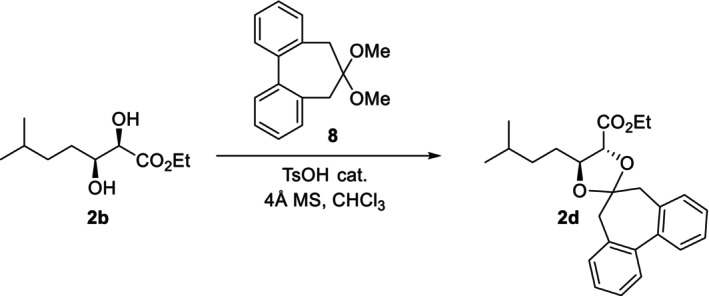
Synthesis of biphenyldioxolane2d.
At room temperature, the low rotational barrier of biphenyl (approximately 14 kcal/mol) allows thermodynamic equilibrium between the two diastereomers, with the more stable of the two being the most populated. The biphenyl twist can be derived by the sign of a diagnostic Cotton effect at 250 nm (biphenyl A‐band) in the ECD spectrum. A positive Cotton band corresponds to aMtwist, whereas aPtwist is associated with a negative band in the spectrum. After elucidating the mechanism of chirality induction from the chiral diol to the biphenyl probe, a simple nonempirical rule was established to relate the absolute configuration of the diol to the sign of the diagnostic ECD A band at 250 nm (Figure2) [37].
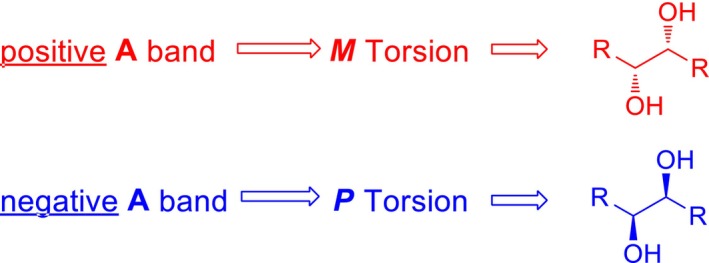
Nonempirical rule scheme relating the absolute configuration ofthreodiols with the sign of the A band (at ~250 nm) in the ECD spectrum of their biphenyl dioxolanes.
Such approach was applied to2b, converting it into its corresponding dioxolane2dby reaction with dimethyl acetal8in chloroform in the presence of trace amounts ofp‐toluenesulfonic acid and 4 Å molecular sieves (Scheme4). The product2dwas isolated after filtration, solvent evaporation, and purification by column chromatography.
The ECD and UV spectra of compound2d(Figure3) were recorded in the 190‐ to 320‐nm range in acetonitrile. The ECD spectrum shows the typical spectral shape observed in diol biphenyl dioxolanes displaying a high amplitude band with a negative Cotton effect occurring at 246 nm (i.e., in correspondence to the A band), followed by a negative and positive Cotton effects at 223 and 207 nm, respectively.
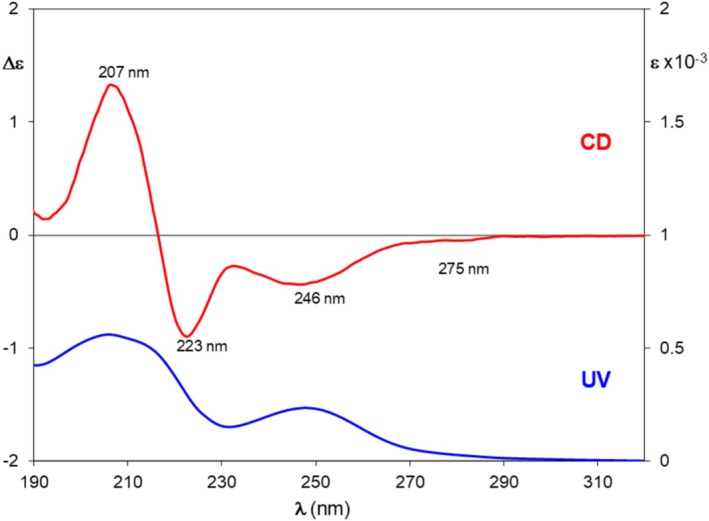
Experimental UV (blue line) and ECD (red line) spectra of biphenyldioxolane2d, recorded in ACN.
As reported in Figure2, a negative Cotton effect of the diagnostic A band is associated with aPtwist of the aryl‐aryl bond in the biphenyl. In the case ofthreodiols such as2b, this correlation leads to the assignment of the absolute configuration (2R,3S) for the C‐2 and C‐3 stereocenters [28], confirming the empirical assignment carried out by the Sharpless rule.
Conclusions
We described herein a straightforward enantioselective synthetic strategy to obtain chiralerythro3‐amino‐2‐hydroxy acids from aromatic and aliphatic α,β‐unsaturated esters and we applied it to the synthesis of optically active 3‐phenyl isoserine (5a) and AHMHA (5b), a component of perthamide C, an oligopeptide isolated from the Pacific spongeTheonella swinhoeiknown for its anti‐inflammatory and antipsoriatic properties. Both aminohydroxy acids were obtained in high enantiopurity (~98% ee) and 20%–30% overall yield. In particular, aminohydroxy acid (2R,3R)‐AHMHA (5b) was obtained with very high enantiopurity and in 30% overall yield in just six synthetic steps, starting from commercially available 4‐methylpentanol. The synthetic methodology we proposed has proven to be more efficient and direct compared to the one previously reported in the literature. While the previous procedure introduced the two stereocenters of the molecule through AE followed by regioselective opening of the oxirane ring, in this procedure we introduced the two stereocenters through Sharplessadand we achieved the regioselective and stereospecific amination at the β‐position by Mitsunobu reaction on the diol. The absolute configuration of diol2b, precursor of (2R,3R)‐AHMHA (5b), was assigned by ECD analysis of its biphenyl dioxolane, thereby also confirming the absolute configuration of the natural AHMHA.
References
- T. Okino, H. Matsuda, M. Murakami, andK. Yamaguchi, “Microginin, an Angiotensin‐Converting Enzyme Inhibitor From the Blue‐Green AlgaMicrocystis aeruginosa, ”Tetrahedron Letters34(1993): 501–504, . doi.org/10.1016/0040-4039(93)85112-A
- H. Umezawa, T. Aoyagi, H. Suda, M. Hamada, andT. Takeuchi, “Bestatin, an Inhibitor of Aminopeptidase B, Produced by Actinomycetes, ”Journal of Antibiotics29(1976): 97–99, . doi.org/10.7164/antibiotics.29.97
- H. Suda, T. Takita, T. Aoyagi, andH. Umezawa, “The Structure of Bestatin, ”Journal of Antibiotics29(1976): 100–101, . doi.org/10.7164/antibiotics.29.100
- T. Aoyagi, H. Tobe, F. Kojima, M. Hamada, T. Takeuchi, andH. Umezawa, “Amastatin, an Inhibitor of Aminopeptidase A, Produced by Actinomycetes, ”Journal of Antibiotics31(1978): 636–638, . doi.org/10.7164/antibiotics.31.636
- H. Tobe, H. Morishima, H. Naganawa, T. Takita, T. Aoyagi, andH. Umezawa, “Structure and Chemical Synthesis of Amastatin, ”Agricultural and Biological Chemistry43(1979): 591–596, . doi.org/10.1080/00021369.1979.10863474
- Z. Czajgucki, M. Zimecki, andR. Andruszkiewicz, “The Immunoregulatory Effects of Edeine Analogues in Mice, ”Cellular & Molecular Biology Letters12(2007): 149–161, . doi.org/10.2478/s11658-006-0061-z
- M. E. K. Rowinsky, “The Development and Clinical Utility of the Taxane Class of Antimicrotubule Chemotherapy Agents, ”Annual Review of Medicine48(1997): 353–374, . doi.org/10.1146/annurev.med.48.1.353
- W. C. Jefford, B. W. Jian, andZ. ‐. H. Lu, “A Concise Diastereospecific Synthesis of 3‐Amino‐2‐Hydroxy Acids, ”Tetrahedron Letters34(1993): 7557–7560, . doi.org/10.1016/S0040-4039(00)60398-2
- R. S. RohokaleandD. D. Dhavale, “Synthesis of (2S, 3R)‐3‐Amino‐2‐Hydroxydecanoic Acid and Its Enantiomer: A Non‐Proteinogenic Amino Acid Segment of the Linear Pentapeptide Microginin, ”Beilstein Journal of Organic Chemistry10(2014): 667–671, . doi.org/10.3762/bjoc.10.59
- K. HattoriandH. Yamamoto, “Practical Preparation of α‐Hydroxy‐β‐Amino Ester Units; Stereoselective Synthesis of Taxol Side Chain and Norstatine, ”Tetrahedron50(1994): 2785–2792, . doi.org/10.1016/S0040-4020(01)86992-1
- G. Righi, A. Chionne, R. D'Achille, andC. Bonini, “Metal Halide‐Mediated Opening of Three Membered Rings: Enantioselective Synthesis of (2S, 3R)‐3‐Amino‐2‐Hydroxydecanoic Acid and (3R)‐3‐Aminodecanoic Acid, ”Tetrahedron: Asymmetry8(1997): 903–907, . doi.org/10.1016/S0957-4166(97)00056-6
- Z. ‐M. Wang, H. C. Kolb, andK. B. Sharpless, “Large‐Scale and Highly Enantioselective Synthesis of the Taxol C‐13 Side Chain Through Asymmetric Dihydroxylation, ”Journal of Organic Chemistry59(1994): 5104–5105, . doi.org/10.1021/jo00096a072
- G. Li, H. Chang, andK. B. Sharpless, “Catalytic Asymmetric Aminohydroxylation (AA) of Olefins, ”Angewandte Chemie International Edition in English35(1996): 451–454, . doi.org/10.1002/anie.199604511
- H. C. Kolb, M. S. VanNieuwenhze, andK. B. Sharpless, “Catalytic Asymmetric Dihydroxylation, ”Chemical Reviews94(1994): 2483–2547, . doi.org/10.1021/cr00032a009
- S. Y. Ko, “Unusual Regioselection in the Mitsunobu Reactions ofsyn‐2, 3‐Dihydroxy Esters: Synthesis of Statine and Its Diastereomer, ”Journal of Organic Chemistry67(2002): 2689–2691, . doi.org/10.1021/jo015967f
- S. Superchi, D. Casarini, A. Laurita, A. Bavoso, andC. Rosini, “Induction of a Preferred Twist in a Biphenyl Core by Stereogenic Centers: A Novel Approach to the Absolute Configuration of 1, 2‐ and 1, 3‐Diols, ”Angewandte Chemie, International Edition40(2001): 451–454, . doi.org/10.1002/1521-3773(20010119)40:2<451::AID-ANIE451>3.0.CO;2-2
- E. J. Kim, “Enantioselective Synthesis of Cyclic Amino Alcohols: Cis‐1‐Amino‐2‐Indanol, ”Bulletin of the Korean Chemical Society27(2006): 2019–2022, . doi.org/10.5012/bkcs.2006.27.12.2019
- J. M. Andrés, M. A. Martínez, R. Pedrosa, andA. Pérez‐Encabo, “Stereoselective Cyanation of Chiral α‐Amino Aldehydes by Reaction With Nagata's Reagent: A Route to Enantiopure β‐Amino‐α‐Hydroxy Acids, ”Tetrahedron: Asymmetry12(2001): 347–353, . doi.org/10.1016/S0957-4166(01)00044-1
- L. He, M. Wanunu, H. ‐S. Byun, andR. Bittman, “Regioselective and Stereospecific Azidation of 1, 2‐ and 1, 3‐Diols by Azidotrimethylsilane via a Mitsunobu Reaction, ”Journal of Organic Chemistry64(1999): 6049–6055, . doi.org/10.1021/jo9906375
- E. P. Erdal, P. Martásek, L. J. Roman, andR. B. Silverman, “Hydroxyethylene Isosteres of Selective Neuronal Nitric Oxide Synthase Inhibitors, ”Bioorganic & Medicinal Chemistry15(2007): 6096–6108, . doi.org/10.1016/j.bmc.2007.06.038
- C. Festa, S. De Marino, V. Sepe, et al. , “Perthamides C and D, Two New Potent Anti‐Inflammatory Cyclopeptides From a Solomon Lithistid SpongeTheonella swinhoei, ”Tetrahedron65(2009): 10424–10429, . doi.org/10.1016/j.tet.2009.10.026
- V. Sepe, M. V. D'Auria, G. Bifulco, R. Ummarino, andA. Zampella, “Concise Synthesis of AHMHA Unit in Perthamide C. Structural and Stereochemical Revision of Perthamide C, ”Tetrahedron66(2010): 7520–7526, . doi.org/10.1016/j.tet.2010.07.060
- C. B'Hymer, M. Montes‐Bayon, andJ. A. Caruso, “Marfey's Reagent: Past, Present, and Future Uses of 1‐Fluoro‐2, 4‐Dinitrophenyl‐5‐L‐Alanine Amide, ”Journal of Separation Science26(2003): 7–19, . doi.org/10.1002/jssc.200390019
- T. KatsukiandV. Martin, “Asymmetric Epoxidation of Allylic Alcohols: The Katsuki–Sharpless Epoxidation Reaction, ” inOrganic Reactions, 1st ed. , ed. S. E. Denmark(Wiley, 1996), 1–299, . doi.org/10.1002/0471264180.or048.01
- K. Ando, “A Mechanistic Study of the Horner−Wadsworth−Emmons Reaction: Computational Investigation on the Reaction Pass and the Stereochemistry in the Reaction of Lithium Enolate Derived From Trimethyl Phosphonoacetate With Acetaldehyde, ”Journal of Organic Chemistry64(1999): 6815–6821, . doi.org/10.1021/jo9909150
- D. V. Patel, F. VanMiddlesworth, J. Donaubauer, P. Gannett, andC. Sih, “Synthesis of the Proposed Penultimate Biosynthetic Triene Intermediate of Monensin A, ”Journal of the American Chemical Society108(1986): 4603–4614, . doi.org/10.1021/ja00275a055
- S. Superchi, M. I. Donnoli, andC. Rosini, “Determination of the Absolute Configuration of 1‐Arylethane‐1, 2‐Diols by a Nonempirical Analysis of the CD Spectra of Their 4‐Biphenylboronates, ”Organic Letters1(1999): 2093–2096, . doi.org/10.1021/ol991146+
- S. Superchi, D. Casarini, C. Summa, andC. Rosini, “A General and Nonempirical Approach to the Determination of the Absolute Configuration of 1‐Aryl‐1, 2‐Diols, ”Journal of Organic Chemistry69(2004): 1685–1694, . doi.org/10.1021/jo035803u
- E. Badaloni, W. Cabri, A. Ciogli, et al. , “Combination of HPLC “Inverted Chirality Columns Approach” and MS/MS Detection for Extreme Enantiomeric Excess Determination Even in Absence of Reference Samples. Application to Camptothecin Derivatives, ”Analytical Chemistry79(2007): 6013–6019, . doi.org/10.1021/ac070776j
- P. Salvadori, S. Superchi, andF. Minutolo, “Anomalous Face‐Selectivity in Sharpless Asymmetric Dihydroxylation ofo‐Allylbenzamides, ”Journal of Organic Chemistry61(1996): 4190–4191, . doi.org/10.1021/jo9607323
- P. ScafatoandS. Superchi, “Biphenyl Dioxolanes as Circular Dichroism Probes for the Assignment of Absolute Configuration to Aliphatic Diols: Extending the Scope toanti1, n‐Diols and Cyclicsyn1, 2‐Diols, ”Chirality22(2010): E3–E10, . doi.org/10.1002/chir.20877
- S. Vergura, L. Pisani, P. Scafato, D. Casarini, andS. Superchi, “Central‐to‐Axial Chirality Induction in Biphenyl Chiroptical Probes for the Stereochemical Characterization of Chiral Primary Amines, ”Organic & Biomolecular Chemistry16(2018): 555–565, . doi.org/10.1039/C7OB02730C
- S. Superchi, R. Bisaccia, D. Casarini, A. Laurita, andC. Rosini, “Flexible Biphenyl Chromophore as a Circular Dichroism Probe for Assignment of the Absolute Configuration of Carboxylic Acids, ”Journal of the American Chemical Society128(2006): 6893–6902, . doi.org/10.1021/ja058552a
- S. Vergura, P. Scafato, S. Belviso, andS. Superchi, “Absolute Configuration Assignment From Optical Rotation Data by Means of Biphenyl Chiroptical Probes, ”Chemistry—A European Journal25(2019): 5682–5690, . doi.org/10.1002/chem.201806435
- S. Vergura, S. Orlando, P. Scafato, S. Belviso, andS. Superchi, “Absolute Configuration Sensing of Chiral Aryl‐ and Aryloxy‐Propionic Acids by Biphenyl Chiroptical Probes, ”Chemosensors9(2021): 154, . doi.org/10.3390/chemosensors9070154
- E. Santoro, S. Vergura, P. Scafato, et al. , “Absolute Configuration Assignment to Chiral Natural Products by Biphenyl Chiroptical Probes: The Case of the Phytotoxins Colletochlorin A and Agropyrenol, ”Journal of Natural Products83(2020): 1061–1068, . doi.org/10.1021/acs.jnatprod.9b01068
- G. Marsico, U. Calice, P. Scafato, S. Belviso, A. Evidente, andS. Superchi, “Computational Approaches and Use of Chiroptical Probes in the Absolute Configuration Assignment to Natural Products by ECD Spectroscopy: A 1, 2, 3‐Trihydroxy‐p‐Menthane as a Case Study, ”Biomolecules12(2022): 421, . doi.org/10.3390/biom12030421
Republished from the open web under CC-BY. Authors: Caporale M, Marsico G, Santoro E, Scafato P, Superchi S. Read the original.