PreClinAI: A Multi-Parametric Simulation Engine for Dynamic Physiological Trajectories
Abstract. A purely computational pipeline for preclinical drug evaluation would allow toxicity profiles and experimental protocols to be generated directly from molecular structures without premature reliance on live subjects. Standard in-silico models provide part of the solution, but the main ethical and financial benefits are lost if arbitrary in-vivo testing is still required to determine systemic physiological outcomes. We propose a solution to preclinical trial inefficiency using a multi-parametric digital twin framework. The system evaluates molecular features through a calibrated classifier to predict toxicity probabilities, then maps these risks onto simulated biological trajectories modulated by strain genetics, age, and baseline organ health. The resulting physiological simulation allows for precise statistical power analysis, generating the absolute minimum animal sample size required to achieve significance. To ensure interpretability, the architecture grounds its findings by mapping the predicted endpoints against a deterministic biological knowledge graph, forming a mechanistic explanation backed by literature retrieval. The framework requires minimal preliminary in-vivo data, allowing researchers to systematically reduce and refine animal testing models before physical trials commence.
1. Introduction
Modern preclinical drug development has come to rely almost exclusively on in-vivo animal experimentation serving as the trusted empirical baseline to evaluate systemic safety and toxicity. While this paradigm satisfies regulatory requirements for most compounds, it suffers from the inherent weaknesses of an uncalibrated, trial-and-error model. Completely deterministic safety assessments are not really possible, since researchers cannot avoid mediating unexpected physiological variances in live subjects. The cost of this uncertainty increases experimental overhead, limiting the minimum practical cohort size and cutting off the possibility for rapid, high-throughput exploratory testing, and there is a broader cost in the loss of biological translatability and the ethical burden of systemic animal consumption. With the possibility of trial failure, the need for over-provisioning spreads. Investigators must be wary of statistical insignificance, padding their experimental designs with larger sample sizes than they would mathematically need if baseline risks were known. A certain percentage of late-stage clinical attrition is accepted as unavoidable. These costs and ethical uncertainties can be avoided in some isolated assays using in-vitro methods, but no mechanism exists to simulate complex, multi-organ physiological trajectories over a temporal sequence without a live biological subject.
What is needed is a preclinical decision framework based on deterministic computational proof instead of premature empirical testing, allowing researchers to evaluate molecular structures and systemic outcomes directly without the immediate need for a live biological proxy. Toxicity predictions that are computationally rigorous would protect early-stage pipelines from late-stage failures, and automated power analysis mechanisms could easily be implemented to enforce minimal ethical cohort sizing. In this paper, we propose a solution to the preclinical attrition problem using a multi-parametric digital twin engine and a retrieval-augmented knowledge graph to generate computational proof of the physiological sequence of toxicity events. The framework remains biologically robust as long as the underlying classification algorithms and mechanistic networks maintain high calibration, outpacing unguided empirical testing and mathematically enforcing the principles of Replacement, Reduction, and Refinement before a physical trial ever begins.
2. Compound Evaluation
We define a compound evaluation as a sequence of deterministic structural transformations and calibrated prediction vectors. A candidate molecule is parsed from its canonical structural representation into a continuous feature vector of physicochemical descriptors and topological fingerprints. These features are evaluated by an ensemble classifier calibrated against multi-endpoint toxicity assays, yielding a discrete probability vector across target biological systems. A researcher can verify the calibrated probabilities to assess target-specific liabilities.
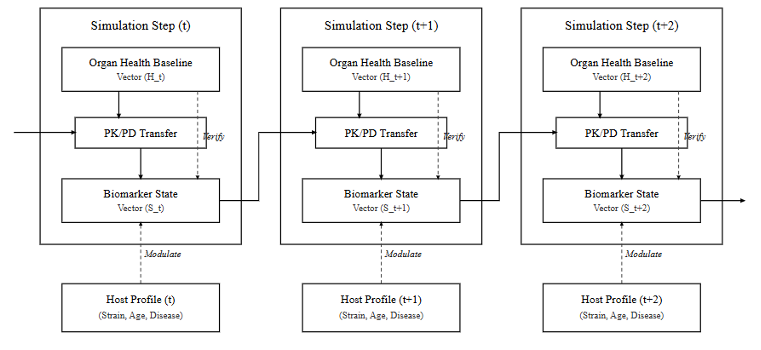
Figure 1: Compound Evaluation Chain. Each discrete simulation step models the transition of physiological biomarker states over time. The PK/PD dynamic transfer function computes clearance and toxicity accumulation from the prior state and current organ capacity, while host parameters modulate the trajectory to verify cumulative systemic damage without live animal attrition.
The limitation of this approach is that static probability vectors cannot verify how a molecule behaves dynamically within a complex physiological environment. The conventional solution is to introduce empirical animal models to observe organ degradation directly. Following chemical synthesis, the compound is administered to physical animal cohorts to measure pathological endpoints. The deficiency of this model is that the development pipeline becomes entirely dependent on empirical subject attrition, requiring substantial animal cohorts and financial overhead for every evaluated candidate.
We need a mechanism to evaluate dynamic physiological changes from molecular predictions without defaulting to physical subjects. For our purposes, the multi-day progression of systemic biomarkers— such as transaminase spikes and creatinine clearance—serves as the definitive proof of compound safety. To model this progression computationally, the static probability vector is mapped into a parameterized biological state space. The system projects biomarker trajectories across simulated organ compartments over time, allowing researchers to determine physiological outcomes and calculate statistical effect sizes prior to physical validation.
3. Digital Twin Engine
The solution we propose begins with a digital twin engine. The engine operates by taking a discrete state vector of an animal twin's physiological parameters, combining it with compound dosage influx data, and processing it through a pharmacokinetic/pharmacodynamic (PK/PD) state transition function to compute the subsequent biomarker state. The calculated state demonstrates that specific organ capacities were maintained or degraded at that precise time interval.
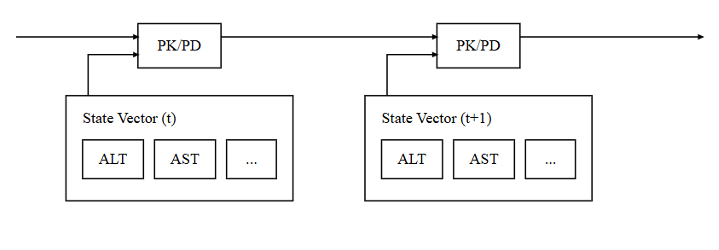
Figure 2: Digital Twin Trajectory Engine. The dynamic pharmacokinetic/pharmacodynamic (PK/PD) transition function processes incoming compound exposure along with the prior interval's state vector (containing discrete biomarker parameters such as ALT, AST, and renal clearance rates) to project continuous physiological trajectory chains across discrete temporal intervals.
Each state calculation includes the biomarker values of the previous time step in its transition function, forming an unbroken trajectory chain. Each subsequent state reinforces the cumulative toxicological profile, proving the dynamic progression of cellular clearance or tissue stress across the multi-day evaluation window without requiring live subject sacrifice.
4. Statistical Power Verification
To establish an objective preclinical trial design without arbitrary cohort inflation, we utilize a statistical power verification framework based on deterministic effect sizes. The verification involves calculating Cohen's 𝑑 directly from the simulated variance between control and treated digital twin biomarker trajectories, determining the critical non-centrality parameter required to satisfy a predetermined statistical power threshold (1 − 𝛽 ≥ 0.80) at a standard significance level 𝛼 = 0.05 The calculation derives the absolute lower bound of physical subjects (𝑁) required to confirm toxicity or efficacy endpoints:
This mathematical proof removes subjective human heuristics from study design. Once the minimum sample size is computed from continuous trajectory variance, experimental cohorts cannot be arbitrarily expanded without introducing redundant animal loss. As long as experimental parameters are calibrated against biological distribution models, the framework guarantees statistical validity while enforcing the absolute minimum physical subject exposure.
5. Evaluation Pipeline
The steps to execute the compound evaluation pipeline are as follows:
-
A new candidate compound is introduced to the system via its canonical structural representation (SMILES).
-
The feature extraction layer parses the molecular structure, computing a continuous mathematical vector of physicochemical descriptors and topological fingerprints.
-
The multi-endpoint inference engine evaluates the feature vector, calculating calibrated probability distributions across target toxicity pathways.
-
The digital twin engine accepts the probability matrix alongside exogenous host parameters (e.g., strain, age, baseline organ capacity) to project a multi-day physiological trajectory.
-
The statistical verification module calculates the variance between the treated simulation and a healthy control baseline, applying power analysis to define the absolute minimum physical subject cohort.
-
The mechanistic verification layer cross-references the flagged endpoints against a deterministic biological knowledge graph and vector-embedded literature, outputting the definitive biological rationale.
The computational modules operate sequentially on a best-effort basis. The system is inherently modular and requires minimal rigid supervision; researchers can adjust host parameters or chemical structures at will. When inputs are modified, the pipeline immediately recalculates the state transitions, accepting the newly generated trajectory and statistical bound as the definitive proof of the required preclinical protocol.
6. Economic and Ethical Incentive
By convention, the primary incentive for adopting the computational pipeline is the systemic reduction of preclinical development overhead. Identifying toxicological liabilities computationally allows pharmaceutical entities to avoid the capital expenditure associated with chemical synthesis, physical subject maintenance, and late-stage clinical attrition. This mechanism provides a direct financial motivation to verify biological safety before physical resources are expended.
The incentive is further reinforced by regulatory compliance. As oversight agencies increasingly mandate the reduction and refinement of animal testing, mathematical proof of minimized cohort sizing ensures adherence to ethical standards without sacrificing statistical validity.
If a research entity possesses the capital to conduct massive, arbitrary empirical animal trials, they will find it more profitable to use the digital twin engine to optimize their protocols instead. Leveraging the computational framework inherently reduces experimental waste and accelerates time-to-market, aligning the financial self-interest of the developer with the ethical integrity of the broader scientific ecosystem.
7. Reclaiming Computational Context
Once the physiological trajectory of a compound is computationally established, retaining the entirety of the biochemical knowledge graph and literature vectors in active memory is unnecessary. To reclaim computational bandwidth and preserve Large Language Model (LLM) context limits without breaking the integrity of the mechanistic proof, the biological pathways are evaluated hierarchically.
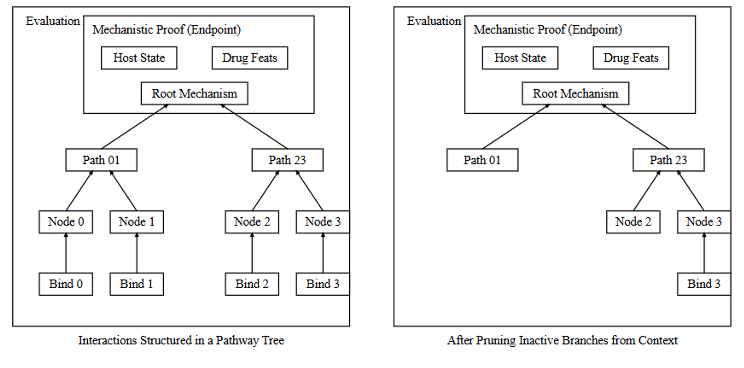
Figure 3: Pathway Pruning. Interactions (e.g., target binding) are hashed upward into sub-pathways and finally into a singular root mechanism. Once the inference engine verifies the primary toxicological route, inactive metabolic branches and non-relevant node bindings (left side of the pruned tree) can be discarded from the payload, preserving LLM context space without invalidating the final biological proof.
Molecular interactions are structured in a biological mechanism tree. Individual interactions (e.g., receptor binding, enzymatic cleavage) form the leaves of the tree. These aggregate into metabolic sub pathways, which ultimately culminate in a single systemic endpoint (the "Root Mechanism").
Once the active toxicological route is identified by the inference engine, inactive branches and non relevant off-target interactions can be pruned from the evaluation payload. A researcher’s interface does not need to store the entire discarded proteome; it only requires the retained mechanistic branch to verify the biological rationale. By compressing the graph in this manner, the system can process highly complex multi-organ evaluations without exhausting active memory or context windows.
8. Simplified Protocol Verification
It is possible to verify predicted toxicity endpoints and cohort protocols without running the full computational biology simulation locally. A regulatory reviewer or external researcher only needs to keep a copy of the physiological state headers of the complete multi-day trajectory, which they can obtain by querying the primary simulation nodes until they are convinced they have the longest biological trajectory chain, and obtain the specific mechanistic branch linking the targeted molecular interaction to the state in which the toxicity was flagged. They cannot run the entire high-dimensional inference matrix and knowledge graph retrieval for themselves, but by linking the specific pathway to a confirmed state in the simulated trajectory, they can see that the computational model has validated it, and subsequent state degradations further confirm the systemic outcome.
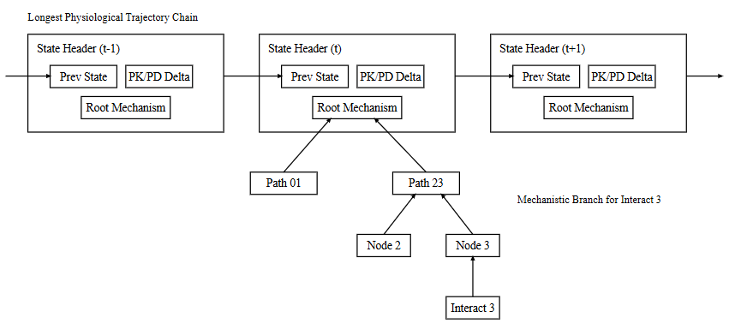
Figure 4: Simplified Protocol Verification. A regulatory reviewer or external researcher does not need to run the full computational biology simulation. By retaining the headers of the longest physiological trajectory chain and querying the specific mechanistic branch, they can mathematically verify that a distinct interaction (e.g., Interact 3) was validated by the network and correctly contributed to the cumulative biological state.
As such, the verification is reliable as long as the underlying predictive models remain faithfully calibrated against biological ground truth, but is more vulnerable if the inference engine is overpowered by corrupted or adversarial molecular data. While fully equipped research nodes can verify the complex multi-organ simulations by running the platform natively, the simplified verification method can be fooled by an externally fabricated trajectory if the baseline feature data is manipulated. One strategy to protect against this would be to accept alerts from independent toxicological databases when they detect an invalid biological edge, prompting the reviewer's software to download the full evaluation payload to confirm the inconsistency. Regulatory bodies that process frequent drug clearances will probably still want to run the full simulation locally for more independent security and deeper biological verification.
9. Combining and Splitting Biological Variables
Although it would be possible to model physiological pathways individually, it would be computationally unwieldy and biologically inaccurate to execute a separate simulation for every single tissue interaction. To allow systemic biological effects to be accurately integrated and differentiated, state evaluations contain multiple inputs and outputs.
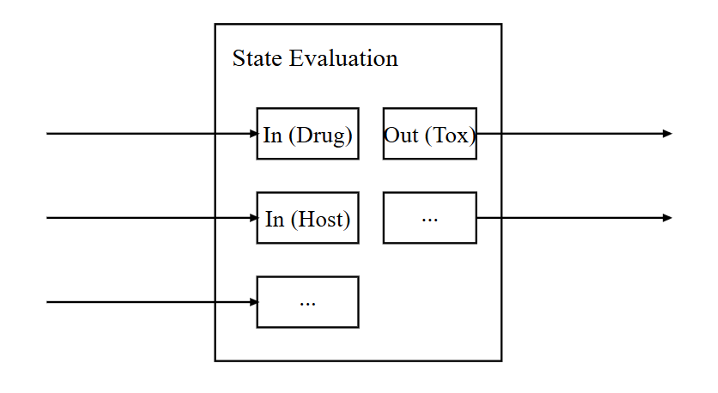
Figure 5: Combining and Splitting Biological Variables. A single state evaluation block integrates multiple input variables (e.g., molecular descriptors and host parameters) and splits the physiological trajectory into multiple distinct outputs, accurately modeling the downstream fan-out of systemic toxicity across various target organs.
Normally, there will be multiple inputs combining diverse molecular descriptors and host parameters (e.g., polypharmacy dosing profiles, baseline enzyme levels, and genetic strain), and multiple outputs representing distinct systemic endpoints (e.g., hepatic necrosis, renal clearance, and mitochondrial stress).
It should be noted that biological fan-out—where a single metabolic pathway affects several downstream organs, and those organs trigger cascading physiological responses—is an inherent feature of this design. There is never a need to extract a completely isolated, standalone trajectory for a single tissue type, as the multi-endpoint state transitions natively capture the combined, holistic physiological consequences in a single evaluation block.
10. Intellectual Property Privacy
The traditional preclinical development model achieves intellectual property privacy by limiting access to all experimental data, keeping both the proprietary chemical structures and the resulting physiological failures isolated within strict corporate silos. The necessity to computationally verify biological proofs and optimize cohort sizing across a decentralized or third-party network precludes this exact method, as the transition functions must be objectively evaluated.
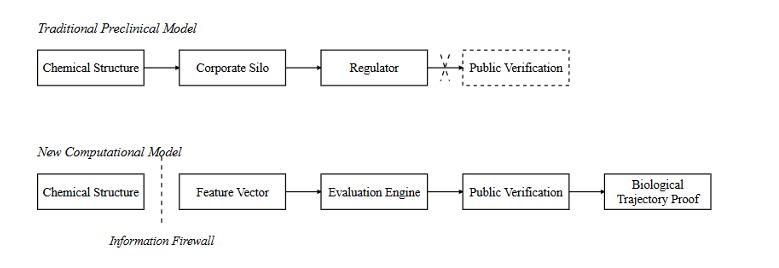
Figure 6: Intellectual Property Privacy Models. The traditional preclinical model relies on isolating both the chemical structure and the biological outcome within strict corporate silos, precluding independent validation. The computational model maintains proprietary privacy by introducing an information firewall at the feature extraction layer, allowing abstract mathematical features to be evaluated and publicly verified while the exact molecular identity remains anonymous.
Privacy can still be maintained by breaking the flow of information in another place: by keeping the specific molecular structures anonymous. The broader network or regulatory body can verify that a specific physiological trajectory, toxicity endpoint, and statistical cohort bound were mathematically proven, but without information linking that simulation to a proprietary chemical identity. This is similar to the level of information released by pharmaceutical blind studies, where the biological outcomes are visible, but the exact compound formulation is withheld.
As an additional firewall, the extraction of continuous mathematical features from the canonical molecular representation can occur strictly on the researcher’s local node. In this manner, only abstract physicochemical descriptors and topological weights are submitted to the evaluation pipeline. The risk is that if a highly specific feature vector is systematically linked to a known public database, clustering analysis could theoretically reverse-engineer the chemical structure. However, as long as the local node maintains structural secrecy and only broadcasts the abstracted evaluation parameters, the underlying intellectual property remains entirely protected while still permitting objective biological verification.
11. Calculations
We consider the scenario of a candidate compound’s cumulative toxicity attempting to breach a systemic biological threshold (e.g., triggering acute liver necrosis). The physiological trajectory can be modeled as a Binomial Random Walk. The baseline organ state begins with a natural physiological buffer, and at each discrete simulation interval, it takes either a step toward toxicity (cellular damage accumulation) or a step toward baseline (metabolic clearance). Let 𝑝 = probability the organ successfully metabolizes and clears the compound at a given interval. Let 𝑞 = probability the compound induces toxic accumulation at a given interval. Let 𝑞𝑧 = probability that the compound’s cumulative damage will eventually breach a biological threshold that is 𝑧 steps away.
Given our assumption that for a viable drug candidate, the metabolic clearance rate (𝑝) must be greater than the toxic accumulation rate (𝑞), the probability of a critical physiological failure drops exponentially as the baseline organ capacity (𝑧) increases. This mathematical dynamic is why pre existing conditions (which lower 𝑧) exponentially increase an animal's susceptibility to toxic endpoints.
To determine how many simulation intervals the digital twin must observe to guarantee a delayed toxic event is not missed, we consider the latent distribution of adverse reactions. If a compound has a delayed accumulation rate, the expected progress of cellular damage follows a Poisson distribution with an expected value.
To get the probability that the compound will still evade the toxicity threshold after 𝑧 simulation intervals, we multiply the Poisson density for each amount of accumulated damage by the probability that it could still theoretically breach the threshold from that point:
Transforming this into a computational model to evaluate the biological evasion probability in the trajectory engine (using Python):
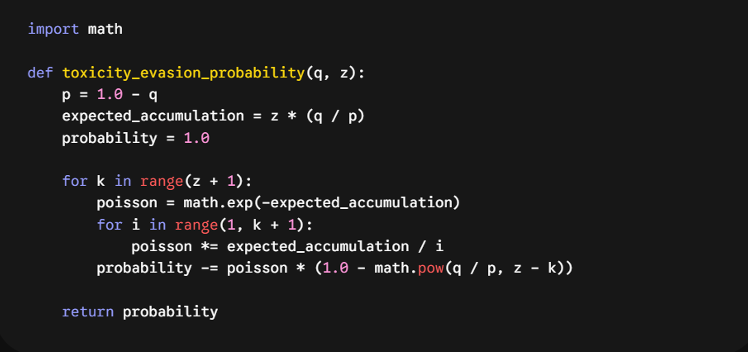
Running some results, we can see the probability of a toxic compound falsely presenting as safe drops off exponentially as the simulation evaluates extended temporal thresholds (𝑧):
q=0.1 z=0 P=1.0000000 z=1 P=0.2045873 z=2 P=0.0509779 z=3 P=0.0131722 z=4 P=0.0034552 z=5 P=0.0009137 z=6 P=0.0002428 z=7 P=0.0000647 z=8 P=0.0000173 z=9 P=0.0000046 z=10 P=0.0000012
q=0.3 z=0 P=1.0000000 z=5 P=0.1773523 z=10 P=0.0416605 z=15 P=0.0101008 z=20 P=0.0024804 z=25 P=0.0006132 z=30 P=0.0001522 z=35 P=0.0000379 z=40 P=0.0000095 z=45 P=0.0000024 z=50 P=0.0000006
Solving for 𝑃 less than 0.1% to guarantee statistical safety verification before physical animal trials are approved:
12. Conclusion
We have proposed a system for preclinical drug evaluation without relying on empirical animal attrition. We started with the standard framework of molecular feature classification, which provides strong baseline probabilities for toxicity, but is incomplete without a way to verify dynamic physiological outcomes over time. To solve this, we proposed a digital twin trajectory engine using sequential pharmacokinetic state transitions to form a physiological record that quickly becomes computationally impractical for a compound to evade if its toxic accumulation rate exceeds metabolic clearance.
The architecture is robust in its deterministic simplicity. The simulation modules operate sequentially with minimal rigid supervision. They do not require proprietary chemical structures to be exposed, maintaining intellectual property privacy by processing only abstracted mathematical feature vectors. The framework proves biological outcomes by linking simulated state degradations to a verified mechanistic knowledge graph, rejecting arbitrary and oversized animal cohorts by calculating the absolute minimum sample size required for statistical power. Any needed regulatory compliance, protocol optimization, or ethical mandates can be objectively enforced with this computational verification mechanism.
13. References
[1] W. Russell and R. Burch, The Principles of Humane Experimental Technique. Methuen, London, 1959.
[2] A. Mayr, G. Klambauer, T. Unterthiner, and S. Hochreiter, "DeepTox: Toxicity Prediction using Deep Learning," Frontiers in Environmental Science, vol. 3, 2016.
[3] J. Gilmer, S. S. Schoenholz, P. F. Riley, O. Vinyals, and G. E. Dahl, "Neural Message Passing for Quantum Chemistry," Proceedings of the 34th International Conference on Machine Learning, JMLR.org, 2017.
[4] L. E. Gerlowski and R. K. Jain, "Physiologically Based Pharmacokinetic Modeling: Principles and Applications," Journal of Pharmaceutical Sciences, vol. 72, no. 10, pp. 1103-1127, 1983.
[5] J. M. Stokes, K. Yang, K. Swanson, W. Jin, et al., "A Deep Learning Approach to Antibiotic Discovery," Cell, vol. 180, no. 4, pp. 688-702, 2020.
[6] J. Cohen, Statistical Power Analysis for the Behavioral Sciences, 2nd ed. Lawrence Erlbaum Associates, 1988.
[7] E. Niederer, M. S. Alber, and T. A. Henzinger, "Digital Twins in Computational Systems Biology," Nature Computational Science, vol. 1, pp. 312-320, 2021.
[8] W. Feller, An Introduction to Probability Theory and its Applications, 3rd ed. John Wiley & Sons, 1968.