Rapid Respiratory Microbiological Point-of-Care Testing and Antibiotic Use in Primary Care: A Randomized Clinical Trial.
Importance Most antibiotic prescribing takes place in primary care, driving antimicrobial resistance, a top-10 threat to global public health. There is considerable international interest in whether rapid multiplex microbiological point-of-care testing (RM-POCT) can safely reduce antibiotic prescribing in primary care. Objective To investigate whether the use of a RM-POCT can safely reduce same-day antibiotic prescribing for children and adults presenting to primary care with respiratory infections. Design, setting, and participants This parallel-group randomized clinical trial was conducted at 16 general practices in Southwest England between December 2022 and April 2024. Patients were eligible if they were aged 12 months or older, presented with any clinician-diagnosed acute (≤21 days) respiratory tract infection, and the patient or clinician believed antibiotic treatment was, or might be, necessary. Participants were randomized (1:1) to RM-POCT or usual care. The research team, including those conducting statistical analyses, were unaware of group allocation. Data were analyzed from November 21, 2024, to March 13, 2025. Intervention Patients in the intervention group were tested with RM-POCT to indicate the presence or absence of 19 respiratory viral pathogens and 4 atypical bacteria in approximately 45 minutes. Main outcomes and measures The primary outcome was same-day antibiotic prescribing. The safety outcome was patient-reported symptom severity on days 2 to 4. Results Among 552 included patients (mean [SD] age, 40.0 [21.2] years; 349 [63%] female), 276 were randomized to the intervention group and 276 to usual care. Primary outcome data were available for all participants, and safety outcome data were available in 216 intervention participants (78%) and 203 usual care participants (74%). Same-day antibiotics were prescribed to 124 participants (45%) in each group (odds ratio [OR], 1.00 [95% CI, 0.71 to 1.41]; P > .99). Prespecified subgroup analyses showed evidence of differentially reduced antibiotic prescribing in participants from whom a virus was detected (OR, 0.35 [95% CI, 0.20 to 0.63]; P for interaction Conclusions and relevance In this randomized clinical trial among patients with respiratory tract infections being considered for antibiotic treatment in primary care, use of an RM-POCT did not reduce same-day antibiotic prescribing or worsen patient outcomes. Trial registration isrctn.org Identifier: ISRCTN16039192.
Introduction
Point-of-care tests (POCTs) are widely viewed as key to reducing unnecessary antibiotic prescribing, with some policymakers calling for diagnostic testing to precede every prescription. There are currently 2 types of POCT available for this use in primary care. First, host-response tests measure nonspecific acute-phase inflammatory response proteins (such as C-reactive protein and procalcitonin). They have been available for decades, and there is strong evidence that the use of C-reactive protein POCT can safely reduce antibiotic prescribing for people with acute lower respiratory tract infections (RTIs) in primary care.
The second type of POCT are rapid microbiological POCTs (RM-POCT), designed to be infection specific. Developed more recently than host-response POCTs, these use polymerase chain reaction (PCR) or antibodies added to lateral flow test gels to detect the presence of microbes or microbe-specific antigens. PCR-based products can test for multiple microbes from a single sample but are more expensive than lateral flow tests, which usually test for no more than 3 microbes. Furthermore, evidence for RM-POCT use in primary care is sparse, particularly for PCR-based testing, with data limited to small observational studies assessing clinical acceptability, diagnostic performance, and turnaround times. Despite this lack of evidence, use of RM-POCT has started to appear in clinical pathways, such as group AStreptococcustesting for patients with sore throat. Indeed, the key weakness of RM-POCTs is the assumption that microbial detection equals microbial etiology. While this may be true for uncontaminated samples obtained from sterile sites, it is problematic for the nonsterile sites, such as nose and throat, where microbes like group AStreptococcuscan be commensal and pathogenic. There is also concern that widespread availability of RM-POCTs (and host-response POCT) could increase demand for scarce primary care appointments.
Therefore, there is a need for research to investigate the role of RM-POCTs. We conducted what we believe to be the first randomized clinical trial into the efficacy of a multiplex RM-POCT to reduce same-day antibiotic prescribing. Our key secondary clinical objective was to investigate whether use of an RM-POCT changed patients’ symptom severity on days 2 to 4.
Methods
This randomized clinical trial received ethical approval from the North West–Preston NHS research ethics committee. The trial protocol and statistical analysis plan are provided inSupplement 1and published elsewhere. All patients (or caregivers, if the patient was aged <16 years) agreeing to take part completed an electronic or paper consent form. Participants aged 12 to 15 years completed an assent form. This study is reported following the Consolidated Standards of Reporting Trials (CONSORT) reporting guideline.
Study Design
This was a controlled, parallel-group, randomized clinical trial conducted at 16 general practices in Southwest England (8 each in winters 1 and 2), measuring both antibiotic prescribing and patient-reported outcomes, as recommended for antimicrobial stewardship interventions. In addition to investigating effects on antibiotic prescribing and symptom severity on days 2 to 4, further secondary objectives were to investigate whether use of a RM-POCT changed duration and severity of symptoms, antibiotic prescribing up to day 28, antibiotic consumption, hospital admission for RTIs, patient (or caregiver, if the patient was aged <16 years) intention to consult for future similar illnesses, and health care contacts in the following 6 months.
Participants
Patients were eligible if they were aged at least 12 months and were presenting to primary care for the first time and within 21 days of onset with a clinician-diagnosed RTI, where the treating clinician or patient believed antibiotic treatment was, or might be, necessary. Patients also had to be willing to have a nasal and throat swab taken, wait for the RM-POCT result before an antibiotic treatment decision, complete a symptom diary for up to 28 days, and agree to data collection from their medical records. Patients were excluded if they were known to have cystic fibrosis, required hospital admission, had previously taken part in the study, or were taking part in a conflicting study.
Procedures
Recruitment
A study champion (ie, a trained receptionist or a member of the clinical team) monitored appointment requests to identify potentially eligible patients between December 2022 and April 2024. Potential participants were offered a participant information sheet and the opportunity to ask questions (eFigure 1 inSupplement 2). The treating clinician assessed the patient (per usual care), confirmed eligibility, and received informed consent (eFigure 1 inSupplement 2). Participants recorded baseline illness characteristics (eAppendix 1 and eAppendix 2 inSupplement 2), and clinicians recorded participant clinical details using an electronic case report form. Race and ethnicity were self-reported and categorized as Asian, Black, White, multiple races, or other race or ethnicity. Race and ethnicity data were collected to assess the representativeness of the final study sample.
Randomization and Masking
Following consent, participants completed a baseline questionnaire about their symptoms and provided a Sigma Σ-VIROCULT (MWE) combined nose and throat swab (eFigure 1 inSupplement 2). Swabs were placed in viral transport medium. Then participants were individually randomized 1:1 to intervention (RM-POCT) or usual care (no RM-POCT) (eFigure 1 inSupplement 2). Allocation was concealed by use of an internet-based randomization system, developed and maintained by Sealed Envelope. Randomization was stratified by age (<16 years vs ≥16 years) and chronic lung disease, defined as asthma, chronic obstructive pulmonary disease, emphysema, or bronchiectasis (present vs absent). Participants and clinicians were aware of allocation since trial procedures differed by group. The research team, including those conducting statistical analyses, were unaware of group allocation.
Intervention
The intervention involved providing the clinician with results from the portion of viral transport medium tested using the BioFire FilmArray Torch 1 in conjunction with BioFire RP2.1 plus reagent pouches (BioMérieux) (eFigure 1 inSupplement 2). Taking approximately 45 minutes, this indicated the presence or absence of 23 respiratory microbes: 19 viruses (influenza A [no subtype detected, H1, H1-2009, and H3], influenza B, adenovirus, coronaviruses [HKU1, NL63, 229E, OC43, Mers-CoV, and SARS-CoV-2], human metapneumovirus, human rhinovirus or enterovirus, parainfluenza [types 1, 2, 3, and 4], and respiratory syncytial virus); and 4 atypical bacteria (Bordetella pertussis, B parapertussis, Chlamydia pneumoniae, andMycoplasma pneumoniae). Sites were provided with instructions on how to process samples, and clinicians were given an information sheet describing the typical presentation of illnesses caused by the microbes tested (eAppendix 3 inSupplement 2). Clinicians were not provided with any guidance or training to guide treatment with the test results or on how to communicate results to patients, since communication skills training has previously been shown to influence antibiotic prescribing, and we wished to understand the effect of the RM-POCT only. Intervention clinicians were asked to wait for the RM-POCT result before deciding treatment (eFigure 1 inSupplement 2). All remaining viral transport media (from intervention and usual care participants) was sent within 24 hours to the UK Health Security Agency South West Regional Laboratory at Southmead Hospital for identical RM-POCT using the BioFire FilmArray Torch 1 platform. Intervention fidelity was assessed through a manual review by L.B. of the unique test identifiers provided by the RM-POCT, allowing confirmation of the patient identity and timing of testing.
End Points
The primary (superiority) end point was same-day antibiotic prescribing (immediate or delayed, where a prescription is provided but the patient is advised to delay pharmacy collection) for RTI (eFigure 1 inSupplement 2), as reported by the treating clinician using the electronic case report form. The key secondary (noninferiority) end point was symptom severity on days 2 to 4 using a validated trial diary (parts C and D; eAppendix 1 [adults] and eAppendix 2 [children] inSupplement 2). Participants were asked to report the presence and severity of key symptoms daily, from 0 (normal) to 6 (as bad as it could be), until either all symptoms resolved or 28 days.
Other secondary end points were antibiotic and antiviral prescribing within 28 days (primary care medical notes review), consultations for respiratory infections within 6 months (primary care medical notes review), hospital admissions within 28 days (primary care medical notes review), participant-reported antibiotic and antiviral consumption within 28 days (Trial Diary), participant-reported symptom severity and duration and length of time to return to usual activities (Trial Diary), and participant intention to consult for similar future illnesses (questionnaire at 2 months). Adverse event reporting is described in the eMethods inSupplement 2.
Statistical Analysis
Details of the sample size calculation and prespecified statistical analysis are presented in the trial protocol and statistical analysis plan inSupplement 1. In brief, assuming an antibiotic prescribing rate of 60% in the usual care group, 244 participants per group would allow a true reduction to 45% in the RM-POCT group to be detected with 90% power at 5% significance. A total randomization target of 514 allowed for 5% attrition. In terms of the key secondary end point, assuming no true difference between groups, 206 participants (80%) completing diaries in each group gave 90% power for a 1-sided 95% CI to exclude increases in the mean symptom score of 20% or more at days 2 to 4.
Analyses of primary and secondary end points were conducted on an intention-to-treat basis, including all participants who provided the necessary measures in their allocated groups. No formal adjustment for multiple tests was made, and the number of statistical tests performed should be considered when interpreting the results of secondary end point measures.
The primary end point measure, prescription of an antibiotic, was compared between allocated groups using a logistic regression model, adjusted for participants’ age (<16 vs ≥16 years) and presence of chronic lung disease. The estimated treatment effect was presented as an odds ratio (OR), 95% CI, and 2-sidedPvalue, the latter resulting from a likelihood ratio test.
This analytic approach was adapted to the secondary end point measures. The key secondary end point, mean symptom severity scores on days 2 to 4, was compared between groups using a linear mixed-effects model with participant fitted as a random effect, and days 2 to 4 distinguished by indicator variables. A 1-sided 95% CI is presented, and if it excluded a 20% greater symptom severity score in the RM-POCT group compared with the usual care group, then the RM-POCT group was considered noninferior on this measure.
Prespecified subgroup analyses compared estimated intervention effects on the primary end point between: detection or absence of a virus, presence or absence of chronic lung disease, child and adult participants, and baseline clinician-patient disagreement on antibiotic necessity (defined as the participant believes antibiotics are, or may be, needed and the clinician disagrees). A post hoc subgroup analysis estimated the intervention effect on the key secondary end point between those in whom a virus was and was not detected.
Further details on statistical methods are provided in the eMethods inSupplement 2. We used Stata software version 18 (StataCorp) for all statistical analyses. Data were analyzed from November 21, 2024, to March 13, 2025.
Results
A total of 552 patients (mean [SD] age, 40.0 [21.2] years; 349 [63%] female) from 16 general practices were enrolled and randomized between December 2022 and April 2024, with 276 patients randomized to RM-POCT–informed antibiotic prescribing and 276 patients randomized to usual care (Figure 1). The trial was stopped when symptom severity data were available for 412 participants, as prespecified. Overall, 11 participants (2%) were Asian, 520 participants (94%) were White, and 10 participants (2%) reported multiple races or other race or ethnicity. There were 140 participants (25%) with preexisting chronic lung disease (Table 1). Clinicians diagnosed a wide variety of upper and lower RTIs, typical in routine primary care. Compared to practices nationally, study practices tended to prescribe fewer antibiotics and serve less socioeconomically deprived populations (eTable 1 inSupplement 2).
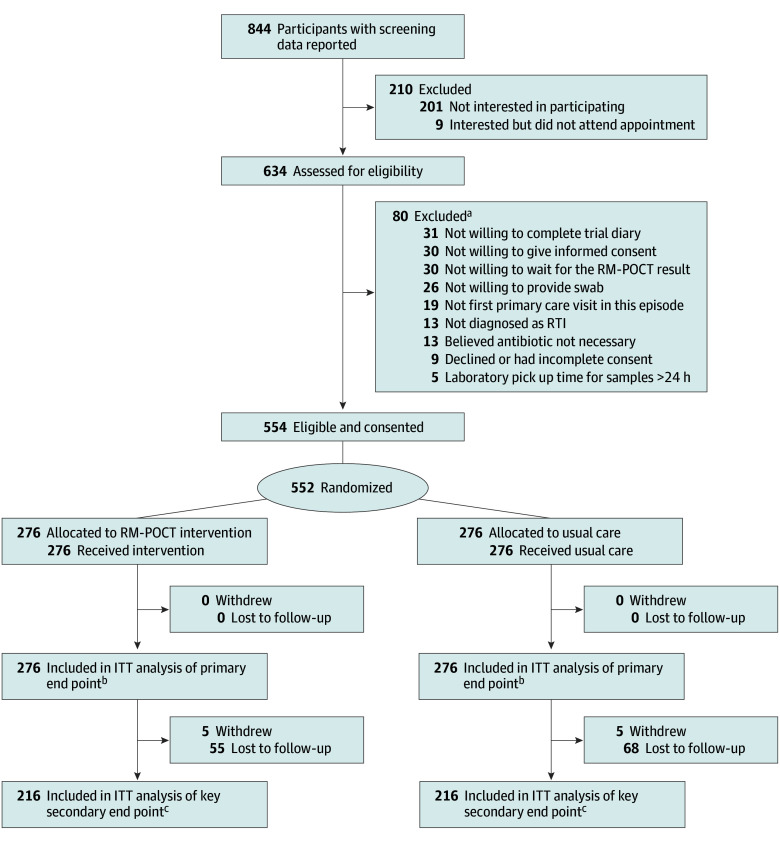
Participant Enrollment FlowchartITT indicates intention to treat; RTI, respiratory tract infection; RM-POCT, rapid microbiological point-of-care test.aParticipants may have been ineligible for more than 1 reason.bAntibiotic prescribing collected on day 1 at appointment 2 (eFigure 1 inSupplement 2).cSymptom severity on days 2 to 4 (eFigure 1 inSupplement 2).
Table: Participant Characteristics, Medical History, Clinician Findings and Diagnosis, and Microbiology
General practitioners and nurses recruited similar numbers of participants (230 participants [42%] and 217 participants [39%], respectively), with paramedics and physician assistants (now part of the UK’s primary care clinician workforce responsible for treating patients with RTIs) recruiting the remainder (66 participants [12%] and 33 participants [6%], respectively) (eTable 2 inSupplement 2). Nearly all participants were recruited at face-to-face consultations, and 552 participants (95%) provided a dual nose-throat swab, taken by site staff on more than 80% of occasions (eTable 2 inSupplement 2).
A valid RM-POCT result was received in 273 intervention participants (99%), and no additional tests were used for usual care participants. When comparing RM-POCT results obtained in general practice (intervention participants) with those obtained from laboratory testing (usual care participants), the proportions from whom no microbe was detected (141 samples [52%] vs 138 samples [51%]), and at least 1 virus or atypical bacterium was detected (238 samples [44%] and 39 samples [7%], respectively) were similar (Table 1).M pneumoniaewas the atypical bacterium most detected (15 samples [5%]) (Table 1). Primary end point data were available for all participants. Key secondary end point data were available for 215 intervention participants (78%) and 204 usual care participants (74%) (Figure 1).
Same-day antibiotics were prescribed to 124 participants (45%) in each groups (OR, 1.00 [95% CI, 0.71 to 1.41];P> .99) (Table 2). Immediate and delayed prescribing were used in 159 (64.1%) and 89 (35.9%) of 248 participants, respectively, and were also similar across groups. Results were unchanged by prespecified sensitivity analyses. Prespecified subgroup analyses showed differential antibiotic prescribing reductions in participants in whom the RM-POCT detected 1 or more viruses (OR, 0.35 [95% CI, 0.20-0.63];Pfor interaction < .001) and those with chronic lung disease (OR, 0.55 [95% CI, 0.28-1.09];Pfor interaction = .046), but not in children (OR, 1.75 [95% CI, 0.64-4.74];Pfor interaction = .24) or where participants and clinicians disagreed on antibiotic necessity (OR, 1.12 [95% CI, 0.63-1.98];Pfor interaction = .53) (Table 3).
Table: Antibiotic Prescribing, Consumption, and Symptom Severity End Points
Table: Subgroup Analyses
With regard to the key secondary end point, symptom severity on days 2 to 4, RM-POCT demonstrated noninferiority compared with usual care (difference in means, 0.09 [95% CI −0.10 to 0.27];P= .36) (Table 2) since the upper bound of the CI did not exceed the predefined 20% margin of 0.34 (derived from the mean symptom score over days 2, 3, and 4 in the usual care group of 1.7 × 0.2 = 0.34). A post hoc subgroup analysis showed no evidence of a change in symptom severity from days 2 to 4 in participants with a RM-POCT result positive for a virus (OR, 0.11 [95% CI, −0.18 to 0.39];Pfor interaction = .85) (Table 3).Figure 2shows the similarity of the 2 groups with regard to patient-reported overall symptom duration.
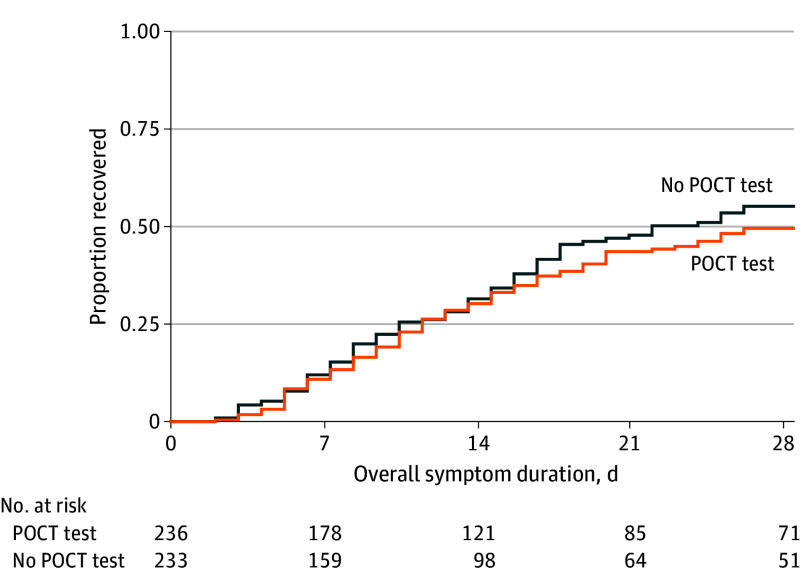
Kaplan-Meier Curve of Overall Symptom Duration by GroupPOCT indicates point-of-care test.
Antibiotic prescribing between days 2 and 28 was also similar between the groups (Table 2), and there was no difference in participant reported antibiotic consumption from days one to 28 (Table 2). Figure 2 and eFigures 2 to 4 and eTable 3 inSupplement 2show the similarity of groups with regard to symptom duration, severity, and rates of second sickening.
There was no evidence that use of the RM-POCT led to an increase in observed health care seeking, either for the index illness or in the subsequent 6 months. The 2-month questionnaire was returned by 66% of the intervention and 58% of the usual care group. These showed no evidence of between-group differences in the proportion intending to consult about similar infections in the future, nor in the proportion wanting a RM-POCT for a similar future illness (eTable 5 inSupplement 2). Two patients in the intervention group and 1 participant in the usual care group were hospitalized for RTI within 28 days of randomization (Table 4 inSupplement 2). Neither was considered related to the study intervention (eTable 7 inSupplement 2).
Discussion
To our knowledge, this is the first randomized clinical trial of a multiplex RM-POCT in primary care. We found the RM-POCT did not change overall same-day antibiotic prescribing and made no difference to patient-reported symptom outcomes. Interestingly, while antibiotic prescribing halved in the 40% of patients from whom a virus was detected, this reduction was offset by an increase in antibiotic prescribing when no virus or atypical bacteria were detected. We found a high rate of samples with positive results forM pneumoniae, coinciding with a UK national outbreak in the 2023 to 2024 winter, but numbers were too small to understand whether testing and treating improved outcomes in these patients. RM-POCT use did not increase consulting for RTI in the following 6 months, nor did patients express a preference for receiving the same RM-POCT for similar future illnesses.
It is widely believed that most RTIs treated in primary care are viral. However, fewer than half our study patients had test results positive for a virus. This discrepancy may be attributable to enrolling patients for whom antibiotic treatment was considered potentially necessary, use of nasal and throat swabs, and allowing the recruitment of patients with symptoms lasting up to 3 weeks. That said, we found that detecting a virus increased clinician confidence not to prescribe an antibiotic, consistant with the findings of our embedded qualitative research, and of concern, antibiotic prescribing increased when no microbe was observed. Importantly, this redistribution of antibiotic prescribing did not change patient outcomes. Given the RM-POCT used in this study does not test for typical bacteria, absence of a virus could have been interpreted as presence of a bacterium. This nuanced observation highlights a significant gap in current diagnostic capabilities, emphasizing the need for research to clarify which samples and which POCTs should be used to distinguish between pathogenic and commensal bacteria. However, ultimately, the highest priority is to establish which microbes should be tested for and treated to improve patient outcomes.
Our results are consistent with those investigating similar interventions in secondary care settings. Poehling et al found a single-plex influenza RM-POCT did not reduce antibiotic prescribing in children with RTIs attending emergency departments, and Mattila et al found use of another RM-POCT panel (testing for a similar panel of respiratory microbes to the panel used in this study) did not reduce antibiotic prescribing in children with RTIs attending emergency departments.
Strengths and Limitations
The main study strengths were the use of a randomized controlled design to address a question of importance to policymakers and clinicians internationally, as well as its originality, rigorous conduct, adequate power, intervention adherence, and high follow-up rates. We chose to investigate the efficacy of the RM-POCT only, without including communication skills training (shown to be an effective adjunct to POCT). We did provide some information regarding the typical presentations for each microbe to help clinician decision-making. Our null result likely reflects the clinical impact if this type of RM-POCT were introduced as-is to routine clinical care. Embedded qualitative research found the RM-POCT was acceptable to clinicians and patients. However, additional skills training and guidance on its use may have helped offset the increased use of antibiotics observed when no microbe was detected, and some policymakers would argue that a new diagnostic test should not be provided without training.
In terms of study limitations, the participating general practices had lower antibiotic prescribing rates than the national average and served more affluent and less diverse populations, potentially restricting the generalizability of our findings and possibly explaining the lower-than-expected antibiotic prescribing rate in the usual care group. That said, the wide range of primary care professionals recruiting patients is representative of the primary care workforce. Fewer children were recruited than expected, although recruited patients had a wide range of RTIs for which antibiotics are frequently thought to be necessary. We considered and discounted using nasopharyngeal sampling in favor of nose and throat sampling due to its acceptability during the COVID-19 pandemic. We encountered higher-than-expected attrition in symptom end point measures, possibly resulting in an underestimation of symptom severity and duration, although results were robust to missing data sensitivity analyses and were similar to previous studies. Although to our knowledge, no similar studies have been conducted, we consider our results are likely to be generalizable to other nations, such as the US, with broadly similar rates of antibiotic prescribing for RTIs.
Conclusions
This randomized clinical trial examined the effect of RM-POCT testing on antibiotic prescribing for RTIs. Commentators have suggested that primary care clinicians should only prescribe antibiotics after carrying out tests to prove an infection is bacterial and seem to regard RM-POCTs as an antimicrobial stewardship silver bullet. While there is strong trial evidence showing host-response POCTs (such as C-reactive protein) can safely reduce antibiotic prescribing in primary care, our results suggest an RM-POCT that only tests for viruses and atypical bacteria is unlikely to be clinically effective, let alone cost-effective, in primary care. While our null result may be a surprise to some commentators, we suspect the reasons relate to the complexity of the underlying sociopsychobiomedical mechanisms driving antibiotic prescribing, which we investigated in this study and plan to report in future work.
Associated Data
References
- World Health Organization . Antimicrobial resistance. Accessed April 13, 2026.https://www.who.int/news-room/fact-sheets/detail/antimicrobial-resistance/
- Bach J. The critical role of diagnostics in antimicrobial stewardship. Am Pharm Rev. 2025;28(3):14-17.
- O’Neill J. Antimicrobial resistance: tackling a crisis for the health and wealth of nations. Publised December 2014. Accessed April 13, 2026.https://amr-review.org/sites/default/files/AMR%20Review%20Paper%20-%20Tackling%20a%20crisis%20for%20the%20health%20and%20wealth%20of%20nations_1.pdf
- UK Parliament . Antimicrobial resistance: addressing the risks. Thirtieth Report of Session 2024-25. Published June 2025. Accessed April 13, 2026.https://publications.parliament.uk/pa/cm5901/cmselect/cmpubacc/646/report.html
- Boseley S. No antibiotics without a test, says report on rising antimicrobial resistance.The Guardian. May 18, 2016. Accessed April 13, 2026.https://www.theguardian.com/society/2016/may/19/no-antibiotics-without-a-test-says-report-on-rising-antimicrobial-resistance
- Brown E, Hay AD. Point-of-care tests: the key to reducing antibiotic prescribing for respiratory tract infections in primary care? Expert Rev Mol Diagn. 2024;24(3):139-141. doi.org/10.1080/14737159.2023.2217330
- Little P, Stuart B, Francis N, et al. ; GRACE consortium . Effects of internet-based training on antibiotic prescribing rates for acute respiratory-tract infections: a multinational, cluster, randomised, factorial, controlled trial. Lancet. 2013;382(9899):1175-1182. doi.org/10.1016/S0140-6736(13)60994-0
- Butler CC, Gillespie D, White P, et al. C-reactive protein testing to guide antibiotic prescribing for COPD exacerbations. N Engl J Med. 2019;381(2):111-120. doi.org/10.1056/NEJMoa1803185
- de Lusignan S, Hoang U, Liyanage H, et al. Integrating molecular point-of-care testing for influenza into primary care: a mixed-methods feasibility study. Br J Gen Pract. 2020;70(697):e555-e562. doi.org/10.3399/bjgp20X710897
- Bruning AHL, de Kruijf WB, van Weert HCPM, et al. Diagnostic performance and clinical feasibility of a point-of-care test for respiratory viral infections in primary health care. Fam Pract. 2017;34(5):558-563. doi.org/10.1093/fampra/cmx019
- Khalid TY, Duncan LJ, Thornton HV, et al. Novel multi-virus rapid respiratory microbiological point-of-care testing in primary care: a mixed-methods feasibility evaluation. Fam Pract. 2021;38(5):598-605. doi.org/10.1093/fampra/cmab002
- Community Pharmacy Wales . Common Ailments Service. Accessed April 13, 2026.https://cpwales.org.uk/clinical-services-2/ccps/common-ailments-service/
- Webster KE, Parkhouse T, Dawson S, et al. Diagnostic accuracy of point-of-care tests for acute respiratory infection: a systematic review of reviews. Health Technol Assess. 2024;1-75. Published online October 2, 2024. doi.org/10.3310/JLCP4570
- NICE . Suspected acute respiratory infection in over 16s: assessment at first presentation and initial management. Published October 2023. Accessed April 13, 2026.https://www.nice.org.uk/guidance/ng237
- Abbs SE, Armstrong-Buisseret L, Eastwood K, et al. Rapid respiratory microbiological point-of-care-testing and antibiotic prescribing in primary care: Protocol for the RAPID-TEST randomised controlled trial. PLoS One. 2024;19(5):e0302302. doi.org/10.1371/journal.pone.0302302
- Watson L, Little P, Moore M, Warner G, Williamson I. Validation study of a diary for use in acute lower respiratory tract infection. Fam Pract. 2001;18(5):553-554. doi.org/10.1093/fampra/18.5.553
- UK Health Security Agency .Mycoplasma pneumoniaesurveillance in England and Wales, January 2019 to March 2024. Updated November 2025. Accessed April 13, 2026.https://www.gov.uk/government/publications/mycoplasma-pneumoniae-surveillance-january-2019-to-march-2024/mycoplasma-pneumoniae-surveillance-in-england-and-wales-january-2019-to-march-2024
- Barrett B, Hayney MS, Muller D, et al. Meditation or exercise for preventing acute respiratory infection (MEPARI-2): A randomized controlled trial. PLoS One. 2018;13(6):e0197778. doi.org/10.1371/journal.pone.0197778
- Verheij TJ, Cianci D, van der Velden AW, et al. Clinical presentation, microbiological aetiology and disease course in patients with flu-like illness: a post hoc analysis of randomised controlled trial data. Br J Gen Pract. 2022;72(716):e217-e224. doi.org/10.3399/BJGP.2021.0344
- Clarke R, Brown E, Hay AD, et al. Rapid microbiological respiratory point-of-care testing: a qualitative study with primary care clinicians. Br J Gen Pract. 2025;75(753):e241-e249. doi.org/10.3399/BJGP.2024.0413
- Poehling KA, Zhu Y, Tang YW, Edwards K. Accuracy and impact of a point-of-care rapid influenza test in young children with respiratory illnesses. Arch Pediatr Adolesc Med. 2006;160(7):713-718. doi.org/10.1001/archpedi.160.7.713
- Mattila S, Paalanne N, Honkila M, Pokka T, Tapiainen T. Effect of point-of-care testing for respiratory pathogens on antibiotic use in children: a randomized clinical trial. JAMA Netw Open. 2022;5(6):e2216162. doi.org/10.1001/jamanetworkopen.2022.16162
- Clarke R, Brown E, Hay AD, et al. Patient perceptions of primary care rapid respiratory microbiological point-of-care testing: a qualitative study. BMJ Open. 2025;15(6):e099666. doi.org/10.1136/bmjopen-2025-099666
- Stuart B, Hounkpatin H, Becque T, et al. Delayed antibiotic prescribing for respiratory tract infections: individual patient data meta-analysis. BMJ. 2021;373(808):n808. doi.org/10.1136/bmj.n808
- Fleming-Dutra KE, Hersh AL, Shapiro DJ, et al. Prevalence of inappropriate antibiotic prescriptions among US ambulatory care visits, 2010-2011. JAMA. 2016;315(17):1864-1873. doi.org/10.1001/jama.2016.4151
- Pouwels KB, Dolk FCK, Smith DRM, Robotham JV, Smieszek T. Actual versus ‘ideal’ antibiotic prescribing for common conditions in English primary care. J Antimicrob Chemother. 2018;73(suppl 2):19-26. doi.org/10.1093/jac/dkx502
- NHS England . Combined adult and paediatric acute respiratory infection (ARI) hubs. Updated Feburary 2024. Accessed April 13, 2026.https://www.england.nhs.uk/long-read/combined-adult-and-paediatric-acute-respiratory-infection-ari-hubs/
Republished from the open web under CC-BY. Authors: Hay AD, Abbs S, Ridd M, Granier S, Lane JA, Muir P, Taylor J, Young G, Eastwood K, Dash H, Bradshaw L, Clarke R, Lui M, Bridgeman E, Brierley RCM, Brown E, Thornton HV, Mitchell PM, Zhu L, Yardley L, Metcalfe C. Read the original.