Serotype Characterization and Transmission Modelling of Foot-and-Mouth Disease in Dairy Farms, Bishoftu, Ethiopia.
Background Foot-and-mouth disease (FMD) is among the most important transboundary animal diseases, causing widespread economic losses due to decreased productivity, trade restrictions, and costly disease management efforts. Objectives This study aimed to characterize circulating FMDV serotypes and quantify within-farm transmission dynamics during active outbreaks in Bishoftu, Ethiopia. Methods Five epithelial tissue and 39 oral swab samples were collected from 11 dairy farms experiencing active FMD outbreaks. Samples were tested using quantitative reverse transcriptase polymerase chain reaction (RT-qPCR) and antigen-capturing enzyme-linked immunosorbent assay (ELISA) for FMDV detection and serotyping. A susceptible-infected-recovered (SIR) model was fitted to outbreak data to quantify transmission dynamics. Results Out of 44 samples, 37 (84.1%) were positive for FMDV using RT-qPCR, and 23 (52.3%) were positive by ELISA. Serotypes O, SAT-1, and SAT-2 were identified, with SAT-2 being predominant. Transmission modelling indicated an average transmission rate (λ) of 0.82 and a recovery rate (γ) of 0.32 per day, corresponding to a mean basic reproductive number (R 0 ) of 3.7. The trivalent vaccine demonstrated low effectiveness (31% against single serotypes; 26% when adjusted for mixed infections), which was insufficient to achieve herd immunity given the high transmission intensity. Conclusions These findings demonstrate that vaccination alone cannot control FMD in these systems. Control requires improved vaccine matching and the combination of vaccination with enhanced biosecurity measures, such as animal isolation and movement control.
Introduction
Livestock is considered an integral part of Ethiopian agriculture, which accounts for about 45% of the total value of agricultural production and supports the livelihoods of the largest portion of the population (Wakaso et al.2025). Dairy production is a high‐value sector that can stimulate agricultural and economic growth while providing valuable income opportunities for the poor (Minten et al.2020). However, the dairy production is constrained by several factors mainly by infectious diseases. Among these diseases, foot and mouth disease (FMD) ranks among the top five important livestock diseases that have a significant socio‐economic impact on Ethiopia dairy production (Gizaw et al.2020; W. T. Jemberu et al.2016).
FMD is a highly contagious transboundary viral disease of cloven‐hoofed animals (Calkins and Scasta2020). FMD is among the most important transboundary animal diseases, causing widespread economic losses due to decreased productivity, trade restrictions, and costly disease management efforts (Grubman and Baxt2004; Shapiro et al.2015). It is caused by a non‐enveloped RNA virus within the family Picornaviridae and genusAphthovirus(Grubman and Baxt2004; Office International des Épizooties (OIE)2021). Foot and mouth disease virus (FMDV) comprises seven antigenically distinct serotypes (O, A, C, SAT‐1, SAT‐2, SAT‐3, and Asia‐1), which exhibit limited cross‐protection, necessitating region‐specific vaccine formulations (Ayelet et al.2009; Davies2002). In Ethiopia, serotypes O, A, SAT‐1, and SAT‐2 have been documented, with frequent outbreaks causing substantial disruption to livestock production systems (Wubshet et al.2019).
Bishoftu represents one of Ethiopia's most intensive dairy production hubs, characterized by high cattle population density, a concentration of commercial and smallholder dairy farms, and frequent livestock movements associated with marketing, breeding, and feed acquisition (Megersa et al.2011). These factors increase the likelihood of direct and indirect animal contact, facilitating rapid FMD transmission within and between herds (Seyoum and Tora2023). In addition, informal marketing practices, limited biosecurity measures, and frequent introduction of replacement animals from surrounding areas further heighten the risk of viral introduction and persistence (Moje et al.2023). Consequently, Bishoftu functions as an epidemiological “hotspot” where FMD can spread quickly, evolve through circulating serotypes, and cause repeated outbreaks. A previous study reported a sero‐prevalence of 11% from Bishoftu (Belina et al.2016). This makes the area particularly suitable for studying within‐farm transmission dynamics, characterizing circulating serotypes, and generating evidence to inform region‐specific control strategies, including targeted vaccination and improved biosecurity.
Mathematical models are powerful tools for understanding the spread of infectious diseases, estimating key epidemiological parameters, and informing the design of effective control strategies (Brauer and Castillo‐Chavez2012). Among these, compartmental models, such as the susceptible‐infected‐recovered (SIR) model, are widely used in epidemiology to quantify transmission dynamics and predict disease progression (Kermack and McKendrick1927; Roosa and Chowell2019). The application of such models to FMD can provide valuable insights into disease spread within herds and inform targeted intervention strategies, such as vaccination or movement restrictions (Bauch et al.2005; Van Den Driessche and Watmough2002). In this study, the SIR model was selected because the outbreaks involved acute infections with clearly observable clinical states (susceptible, infected, recovered) and because of the limited availability of detailed latency‐period and animal‐contact data required for more complex models.
Although serotype circulation has been described in Ethiopia, quantitative evidence on within‐farm transmission dynamics remains scarce, particularly in semi‐intensive dairy systems where high animal densities may amplify FMD spread (Tadesse et al.2019). Therefore, this study aimed to (1) identify circulating FMDV serotypes in Bishoftu dairy farms during active outbreaks and (2) quantify within‐farm transmission dynamics using an SIR model to estimate key epidemiological parameters and inform targeted control measures.
Materials and Methods
Study Area
This study was conducted in dairy farms located in Bishoftu, Ethiopia, where active outbreaks of FMD were reported between November 2020 and March 2021. Bishoftu is situated in the Eastern Showa zone of the Oromia region, at an altitude of 1920 m above sea level, and coordinates 8°43′–8°45′N latitude and 38°56′–39°01′E longitude (Figure1). The area is known for its intensive dairy production systems.
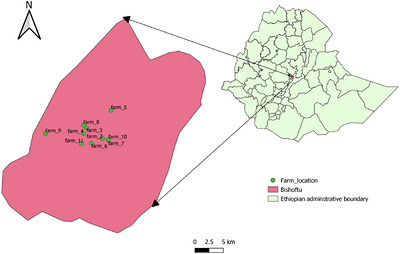
Map showing Bishoftu town and the specific locations of the dairy farms.
Study Population and Design
The study targeted dairy farms experiencing FMD outbreaks. Cattle of varying ages, sexes, and breeds within these farms were included in the study. An outbreak follow‐up investigation was conducted, and farms reporting active cases were visited within 24–72 h. Each farm was considered an independent epidemiological unit, and outbreak monitoring, animal management, and transmission estimation were conducted separately for each farm. Purposive sampling of clinically affected cattle was employed to maximize detection probability during acute infection.
Based on clinical status, cattle were categorized as susceptible (no signs), infected (clinical signs present), or recovered (lesions healed, no new signs for 7 days).
Sampling and Sample Collection
Purposive sampling targeted cattle exhibiting clinical signs consistent with FMD. A total of 44 (39 oral swabs and five epithelial tissue) samples were collected from 11 dairy farms. The epithelial tissue samples were collected from vesicular lesions using sterile plastic tubes containing a viral transport medium (VTM), and the oral swabs were collected from salivating cattle. Swabs were placed in tubes containing 2 mL of VTM, following OIE guidelines (OIE2021). Samples were transported to the Animal Health Institute virology laboratory using ice packs and stored at −20°C until analysis.
RNA Extraction, FMDV Detection, and Serotyping
Total RNA was extracted from epithelial suspensions and centrifuged swab suspensions by using an RNeasy mini kit (Qiagen, USA) according to the manufacturer's protocols with the final volume of 60 µL RNA, and the extracted RNA was stored at −80°C until further analysis. A probe‐based quantitative reverse transcriptase polymerase chain reaction (RT‐qPCR) assay was conducted to detect FMDV genomic RNA, using previously published primers FMD 3D forward (5'ACT GGG TTT TAC AAA CCT GTGA‐3') and FMD 3D reverse (5'GCG AGT CCT GCC ACG GA‐3') and TaqMan probe (5'‐[6FAM] TCC TTT GCA CGC CGT GGG AC [TAM]‐3′) targeting the 3D(pol) gene. The detailed description of the RT‐qPCR could be found in Callahan et al. (2002). FMDV serotypes were identified using an antigen‐capturing ELISA (IZSLER, Italy), as per the manufacturer's protocol. The ELISA microplates were pre‐coated with capture Monoclonal antibody (MAbs), and positive inactivated controls were incorporated into plates. Epithelial suspensions and centrifuged swab suspensions were incubated with the coated cells, allowing the virus to be captured by the corresponding serotype‐specific MAb and by the pan‐FMDV MAb. The assay is designed to detect and type FMDV serotypes O, A, C, SAT‐1, SAT‐2, and Asia‐1. The IZSLER serotyping ELISA has a reported sensitivity of 79% (Grazioli et al.2020), while its specificity is not reported in the available literature. Optical density values were measured at 450 nm, and results were interpreted based on the manufacturer's criteria.
Data Preparation for Modelling
For transmission modelling, daily case counts were compiled for each farm from outbreak onset until no new clinical cases were observed. Clinical status classifications (susceptible, infected, recovered) were verified through farm records and follow‐up visits.
Transmission Dynamics Modelling
To model the transmission dynamics of FMDV, a SIR compartmental model was developed using the “DeSolve” package in R (Soetaert et al.2010). The cattle population within each farm was divided into three compartments: susceptible (S), infected (I), and recovered (R). The following assumptions were made: (1) no birth or death occurred during the outbreak period; (2) infected individuals transmit the virus at a rateλ(transmission rate) and recover at a rateγ(recovery rate); and (3) the population was considered homogeneous, ignoring potential involvement of other species such as small ruminants (Van Den Driessche and Watmough2002).
The following ordinary differential equations governed the system:dS/dt = −λ× S × IdI/dt =λ× S × I—γ× IdR/dt =γ× I
Model Assumptions and Potential Sources of Bias
The assumption of homogeneous mixing within cattle herds was necessitated by the lack of detailed data on individual animal contacts, movement patterns, and interspecies interactions within the farms. However, FMD transmission in Ethiopia is known to be influenced by factors such as the presence of small ruminants, frequent milk container sharing, and occasional live animal movement between farms (Mohammed et al.2022; Sulayeman et al.2018). As these factors were not explicitly incorporated in the model, the estimated transmission rates (λ) and basic reproductive numbers (R0) should be interpreted as within‐cattle transmission potentials under minimal external contact influences, rather than representations of whole‐farm or multispecies transmission.
These assumptions were necessary due to limited animal movement and interspecies contact data during the outbreaks. Consequently, our estimates ofλand R0should be interpreted as within‐cattle transmission potentials under controlled conditions and may underestimate true farm‐level transmission if between‐species or between‐farm contacts occur.
Parameter Estimation
The transmission rate (λ) and recovery rate (γ) were estimated using the least squares method, fitting the model to the observed outbreak data (Cantó et al.2017; Capaldi et al.2012). Goodness‐of‐fit was evaluated using the sum of squared errors and root mean squared error. The basic reproduction number (R0), defined as the average number of secondary infections produced by one infected individual, was calculated as R0=λ/γ(Diekmann2025; Mehra et al.2020; Van Den Driessche and Watmough2002).
Vaccine Effectiveness Adjustment
Based on field trial data from Ethiopia, the trivalent vaccine (serotypes O, A, SAT‐2) demonstrated 31% effectiveness (W. Jemberu et al.2020). However, given the detection of SAT‐1 in mixed infections in our study, we adjusted the vaccine effectiveness downward to 26% to account for the lack of protection against this serotype. This adjusted value was used in critical vaccination coverage calculations.
Critical Vaccination Coverage
The critical vaccination coverage (Vc) required to control FMD outbreaks was calculated using the formula: Vc = (1 − 1/R0)/Ve, where Ve represents the vaccine effectiveness, adjusted based on the effectiveness of the trivalent vaccine against the circulating serotypes (W. Jemberu et al.2020).
Statistical Analysis
All data were analyzed using the R statistical software (R core team2020). Descriptive statistics were used to summarize the distribution of FMDV detection and serotyping results. Transmission and recovery rates, as well as the basic reproductive number, were estimated for each farm.
Results
FMDV Detection and Serotyping
A total of 44 samples were collected from 11 dairy farms experiencing active FMD outbreaks. Out of these, 37 samples (84.1%) tested positive for FMDV using RT‐qPCR (FigureS1and Table S1). Among the samples tested, 32 of 39 oral swabs (82.1%) and all five epithelial tissue samples tested positive for FMDV.
The results from the antigen capture ELISA assay revealed that 23 samples tested positive for FMDV. The detected serotypes included O, SAT‐2, and mixed serotypes involving SAT‐1 and SAT‐2, as well as O and SAT‐2. SAT‐2 was detected most frequently (8/23, 34.8%), followed by serotype O (4/23, 17.4%). Mixed infections involving O/SAT‐2 (5/23, 21.7%) and SAT‐1/SAT‐2 (3/23, 13.0%) were also observed. Furthermore, three samples could not be serotyped.
Transmission Dynamics
Using the SIR compartmental model, we estimated the within‐farm transmission dynamics of FMDV. The average daily transmission rate (λ) across all farms was calculated to be 0.82 (range: 0.48–1.14), and the average recovery rate (γ) was 0.32 (range: 0.12–0.90). The R0estimated to be 3.7 (ranged: 1.4–6.8), indicating substantial heterogeneity in transmission intensity across dairy farms (Table1). These findings suggest that FMDV transmission occurred rapidly within several farms, particularly in farms with high R0values, where a single infected animal could potentially infect multiple susceptible animals over a short period.
Table: Transmission and recovery rates, along with basic reproductive number estimates for each farm.
Farms 5, 6, and 10 showed the highest R0values (>5), indicating intense within‐farm transmission and a greater likelihood of rapid outbreak expansion. In contrast, Farms 2, 3, and 11 had relatively lower R0estimates (<2), suggesting comparatively slower transmission dynamics and potentially better containment or lower effective contact rates among animals.
Model‐predicted outbreak peaks occurred between 2 and 11 days post‐first detection (Table1). The highest number of clinically observed cases was recorded between days 3 and 12 across farms. In most farms, the predicted peak timings closely aligned with the observed outbreak peaks, indicating that the SIR model adequately captured the general progression of FMD outbreaks within the farms. However, discrepancies between model‐predicted and observed peak timings were noted in some farms and may reflect reporting delays, subclinical infections, delayed recognition of clinical signs, or variation in disease progression among animals.
Utilizing the estimated transmission and recovery rates, the SIR model was applied to analyze the FMD outbreaks in each farm. In Figure2, the black, red, and green lines represent the model‐predicted populations of susceptible, infected, and recovered individuals, respectively. The blue dots indicate the observed cases of infection recorded during the outbreak follow‐up. Overall, the observed data generally followed the predicted epidemic curves, supporting the usefulness of the model in describing the temporal dynamics of FMD outbreaks under field conditions.
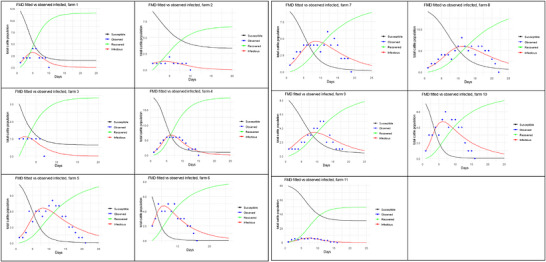
SIR model predictions of foot‐and‐mouth disease (FMD) outbreaks in dairy farms. The graph illustrates the dynamics of the outbreak across different farms, with the black, red, and green lines representing the model‐predicted numbers of susceptible, infected, and recovered individuals, respectively. The blue dots indicate the observed cases of infection recorded during the outbreak follow‐up, highlighting the alignment between the model predictions and actual infection data.
Critical Vaccination Coverage
Considering the presence of mixed infections with SAT‐1 and SAT‐2, the effectiveness of the trivalent vaccine, initially observed at 31% from field trials, was adjusted to 26%. Based on this revised vaccine effectiveness, the critical vaccination coverage required to control the outbreak was calculated to be 280%. A critical vaccination coverage exceeding 100% indicates that vaccination with the current trivalent vaccine alone cannot achieve herd immunity under the observed transmission conditions.
Discussion
This study examines the transmission dynamics and serotypes of FMDV within dairy farms in Bishoftu, Ethiopia, where the disease poses a significant threat to livestock health and the local economy. The findings reveal a concerning 84.1% detection rate of FMDV among the tested samples, underscoring the endemic nature of the disease in the region. The predominant serotype identified was SAT‐2, followed by serotype O, along with mixed infections of SAT‐1 and SAT‐2, as well as O and SAT‐2. The detection of multiple serotypes and mixed infections highlights the complex epidemiology of FMDV in Ethiopian dairy systems and emphasizes the continuous risk of viral evolution and co‐circulation.
These results are consistent with previous studies documenting the evolving epidemiological landscape of FMDV serotypes in Ethiopia, highlighting the urgent need for ongoing surveillance to inform effective control measures. Among the five serotypes reported in the country, this study detected serotypes O, SAT‐1, and SAT‐2, with SAT‐2 emerging as the dominant serotype. This aligns with the findings of Ayelet et al. (2009), which also identified serotypes O, A, C, SAT‐1, and SAT‐2. Additionally, SAT‐2 has been reported as the predominant FMD serotype in central Ethiopia (Mohammed et al.2022; Sulayeman et al.2018).
The SIR model results demonstrated a significant potential for FMDV transmission within the farms, with an average R0of 3.7. This suggests that each infected animal can infect more than three additional individuals, underscoring the epidemic risk associated with FMD. High transmission intensities suggest rapid amplification of FMD within confined dairy systems, especially where animal isolation is not practised immediately (Calkins and Scasta2020). The variability in R0values among farms (Table1) indicates that farm‐specific factors, including herd management practices, biosecurity measures, and environmental conditions, significantly influence disease dynamics (Tadesse et al.2019). For example, farms with higher R0values may reflect inadequate biosecurity protocols, higher animal densities, or delayed responses to early signs of disease. Previous studies by Belayneh et al. (2020) and Tadesse et al. (2019) also reported reproductive numbers of 1.27 and 1.98, respectively; although these numbers are less than the current finding, they both indicate the epidemic nature of FMD in Ethiopia.
The effectiveness of the trivalent vaccine produced by the National Veterinary Institute, which includes serotypes O, A, and SAT‐2, was found to be only 31% in field trials (W. Jemberu et al.2020). This level of effectiveness is notably low compared to the recommended threshold of over 75% protection (W. Jemberu et al.2020), which raises serious concerns about the vaccine's ability to control FMD outbreaks effectively. Moreover, the vaccine confers immunity for only 6 months (Belsham2020), necessitating frequent booster doses to maintain protection. Since the vaccine does not provide any efficacy against SAT‐1 infections, which were detected in this study, the reliance on the current trivalent vaccine is further compromised.
The estimated requirement for >100% vaccination coverage reflects the inadequacy of current vaccine effectiveness, demonstrating that herd immunity cannot be achieved through vaccination alone under current conditions. However, this estimate should be interpreted cautiously because vaccine effectiveness values were derived from previous outbreak‐specific field studies and were used primarily as contextual approximations for evaluating potential vaccination requirements. Vaccine performance in the field can vary substantially depending on antigenic matching between vaccine and circulating strains, vaccination schedules, cold‐chain maintenance, host immunity, and farm management conditions (Belsham2020). In many endemic regions, reliance on vaccination alone is often insufficient to achieve disease control. Historical FMD outbreaks in various parts of the world, such as in the United Kingdom and South Africa, highlight the importance of a multifaceted approach that combines vaccination with additional strategies such as movement restrictions, isolation of infected animals, and enhanced biosecurity measures (Hayer et al.2018; Keeling et al.2003). The need for more potent vaccines that can confer broader protection against multiple serotypes is critical, as current vaccines often fail to account for the genetic diversity of FMDV circulating in the field (Grubman and Baxt2004).
Several limitations should be acknowledged. First, our SIR model assumed homogeneous mixing and did not account for latent infection stages, between‐farm animal movements, or multispecies interactions, all of which may influence transmission dynamics. A Susceptible, Exposed, Infectious, Recovered (SEIR) framework incorporating an exposed (latent) compartment could provide a more biologically realistic representation of FMD transmission and should be considered in future studies with more detailed temporal outbreak data. Second, purposive sampling of clinically affected animals may have biased serotype detection toward more virulent strains. Third, vaccine effectiveness estimates were derived from previous field trials and may not fully reflect current field conditions in the study area.
Conclusion
This study demonstrated that FMD outbreaks in dairy farms in Bishoftu are characterized by high within‐farm transmission potential and predominance of the SAT‐2 serotype. The estimated R0values indicate substantial transmission heterogeneity between farms, suggesting that management practices and biosecurity measures play an important role in outbreak dynamics. The detection of SAT‐1 alongside SAT‐2 and serotype O further highlights the complexity of FMD epidemiology in the area and raises concerns regarding the adequacy of the currently used vaccine formulation.
The findings suggest that vaccination alone is unlikely to achieve effective outbreak control under existing field conditions, particularly given the reported low vaccine effectiveness and limited serotype coverage. Therefore, effective FMD control in endemic dairy systems such as Bishoftu requires an integrated approach that combines vaccination with strengthened farm‐level biosecurity measures, including rapid isolation of infected animals, temporary movement restrictions during outbreaks, proper disinfection of shared equipment, and continuous monitoring of vaccine matching with circulating field strains. Strengthening surveillance and improving vaccine strain selection will be essential for reducing FMD transmission and minimizing economic losses in Ethiopia's dairy sector.
Author Contributions
E.F. contributed to data collection, analysis, and manuscript writing. D.S., A.M., and A.A. performed laboratory analyses. J.P. contributed to conceptualization and supervision. F.T.W. contributed to conceptualization and supervision. H.N. contributed to conceptualization and supervision. S.L. contributed to conceptualization, supervision, data analysis, and manuscript writing.
Funding
This study received support from the KEET joint project (project number: KE2019JOI016A101), a VLIR‐UOS project, Belgium. Moreover, laboratory facilities were supported by the Animal Health Institute (AHI) of Ethiopia. The funder had no role in the conception, design of the study, data collection, analysis, and interpretation of the data reported in this manuscript.
Ethics Statement
Ethical approval for this study was granted by the animal research ethical review committee of the College of Veterinary Medicine and Agriculture of Addis Ababa University (reference number VM/ERC/03/12/2020). Animals were handled following the best veterinary care guidelines. Before conducting the research, animal owners were informed about the objectives and the benefits of the study, and they gave consent for their animal's inclusion in the study. The consent obtained from animal owners was verbal because owners are unable to write and read. Consent was taken in the presence of a third independent party and approved by the College of Veterinary Medicine and Agriculture of Addis Ababa University Ethics Committee.
Conflicts of Interest
The authors declare no conflicts of interest.
References
- Ayelet, G. , M. Mahapatra, E. Gelaye, et al. 2009. “Genetic Characterization of Foot‐and‐Mouth Disease Viruses, Ethiopia, 1981‐2007. ”Emerging Infectious Diseases15, no. 9: 1409–1417. . doi.org/10.3201/eid1509.090091
- Bauch, C. T. , J. O. Lloyd‐Smith, M. P. Coffee, andA. P. Galvani. 2005. “Dynamically Modeling SARS and Other Newly Emerging respiratory Illnesses: Past, Present, and Future. ”Epidemiology16, no. 6: 791–801. . doi.org/10.1097/01.ede.0000181633.80269.4c
- Belayneh, N. , W. Molla, M. Mesfine, andW. T. Jemberu. 2020. “Modeling the Transmission Dynamics of Foot and Mouth Disease in Amhara Region, Ethiopia. ”Preventive Veterinary Medicine181, no. 104673: 2–5. . doi.org/10.1016/j.prevetmed.2019.04.002
- Belina, D. , B. Girma, andS. Mengistu. 2016. “Sero‐Prevalence of Bovine Foot and Mouth Disease in Selected Districts of Eastern Showa Zone, Oromia Regional State, Ethiopia. ”Global Journal of Science Frontier Research: D Agriculture and Veterinary16, no. 4: 79–84. .
- Belsham, G. J. 2020. “Towards Improvements in Foot‑and‑Mouth Disease Vaccine Performance. ”Acta Veterinaria Scandinavica62, no. 20: 2–12. . doi.org/10.1186/s13028-020-00519-1
- Brauer, F. , andC. Castillo‐Chavez. 2012. “Epidemic Models. ” InMathematical Models in Population Biology and Epidemiology, 345–409. Springer. . doi.org/10.1007/978-1-4614-1686-9_9
- Calkins, C. M. , andJ. D. Scasta. 2020. “Transboundary Animal Diseases (TADs) Affecting Domestic and Wild African Ungulates: African Swine Fever, Foot and Mouth Disease, Rift Valley Fever (1996–2018). ”Research in Veterinary Science131, no. March: 69–77. . doi.org/10.1016/j.rvsc.2020.04.001
- Callahan, J. D. , F. Brown, F. A. Osorio, et al. 2002. “Use of a Portable Real‐Time Reverse Transcriptase‐Polymerase Chain Reaction Assay for Rapid Detection of Foot‐and‐Mouth Disease Virus. ”Journal of the American Veterinary Medical Association220, no. 11: 1636–1642. . doi.org/10.2460/javma.2002.220.1636
- Cantó, B. , C. Coll, andE. Sánchez. 2017. “Estimation of Parameters in a Structured SIR Model. ”Advances in Difference Equations1, no. 33: 2–13. . doi.org/10.1186/s13662-017-1078-5
- Capaldi, A. , S. Behrend, B. Berman, J. Smith, J. Wright, andA. L. Lloyd. 2012. “Parameter Estimation and Uncertainty Quantification for an Epidemic Model. ”Mathematical Biosciences and Engineering9, no. 3: 553–576. . doi.org/10.3934/mbe.2012.9.553
- Davies, G. 2002. “Foot and Mouth Disease. ”Research in Veterinary Science5288, no. 2: 195–199. . doi.org/10.1016/S0034-5288(02)00105-4
- Diekmann, O. , H. Inaba, andH. R. Thieme. 2025. “Mathematical Epidemiology of Infectious Diseases: an ongoing challenge. ”Japan Journal of Industrial and Applied Mathematics42: 1563–1590. . doi.org/10.1007/s13160-025-00742-1
- Gizaw, S. , H. Desta, B. Alemu, A. Tegegne, andB. Wieland. 2020. “Importance of Livestock Diseases Identified Using Participatory Epidemiology in the Highlands of Ethiopia. ”Tropical Animal Health and Production52, no. 4: 1745–1757. . doi.org/10.1007/s11250-019-02187-4
- Grazioli, S. , N. P. Ferris, G. Dho, et al. 2020. “Development and Validation of a Simplified Serotyping ELISA Based on Monoclonal Antibodies for the Diagnosis of Foot‐and‐ Mouth Disease Virus Serotypes O, A, C and Asia 1. ”Transboundary and Emerging Diseases67, no. 6: 3005–3015. . doi.org/10.1111/tbed.13677
- Grubman, M. J. , andB. Baxt. 2004. “Foot‐and‐Mouth Disease. ”Clinical Microbiology Reviews17, no. 2: 465–493. . doi.org/10.1128/CMR.17.2.465-493.2004
- Hayer, S. S. , K. VanderWaal, R. Ranjan, et al. 2018. “Foot‐and‐Mouth Disease Virus Transmission Dynamics and Persistence in a Herd of Vaccinated Dairy Cattle in India. ”Transboundary and Emerging Diseases65, no. 2: e404–e415. . doi.org/10.1111/tbed.12774
- Jemberu, W. , W. Molla, andT. Fentie. 2020. “A Randomized Controlled Field Trial Assessing Foot and Mouth Disease Vaccine Effectiveness in Gondar Zuria District, Northwest Ethiopia. ”Preventive Veterinary Medicine183, no. September: 105136. . doi.org/10.1016/j.prevetmed.2020.105136
- Jemberu, W. T. , M. Mourits, J. Rushton, andH. Hogeveen. 2016. “Cost‐Benefit Analysis of Foot and Mouth Disease Control in Ethiopia. ”Preventive Veterinary Medicine132: 67–82. . doi.org/10.1016/J.PREVETMED.2016.08.008
- Keeling, M. J. , M. E. J. Woolhouse, R. M. May, G. Davies, andB. T. Grenfell. 2003. “Modelling Vaccination Strategies Against Foot‐and‐Mouth Disease. ”Nature421, no. 6919: 136–142. doi.org/10.1038/nature01343
- Kermack, W. , andA. G. McKendrick. 1927. “A Contribution to the Mathematical Theory of Epidemics. ”Proceedings of the Royal Society of London Series A, Containing Papers of a Mathematical and Physical Character115, no. 772: 700–721. . doi.org/10.1098/rspa.1927.0118
- Megersa, M. , A. Feyisa, A. Wondimu, andT. Jibat. 2011. “Herd Composition and Characteristics of Dairy Production in Bishoftu Town, Ethiopia. ”Journal of Agricultural Extension and Rural Development3, no. 6: 113–117. .
- Mehra, A. A. H. , M. Shafieirad, Z. Abbasi, andI. Zamani. 2020. “Parameter Estimation and Prediction of COVID‐19 Epidemic Turning Point and Ending Time of a Case Study on SIR/SQAIR Epidemic Models. ”Computational and Mathematical Methods in Medicine2020, no. 1465923: 2–12. . doi.org/10.1155/2020/1465923
- Minten, B. , Y. Habte, S. Tamru, andA. Tesfaye. 2020. “The Transforming Dairy Sector in Ethiopia. ”PLoS ONE15, no. 8: 1–24. . doi.org/10.1371/journal.pone.0237456
- Mohammed, Z. , A. Aliy, Y. Jibril, andH. Negussie. 2022. “Epidemiological and Clinical Characteristics of the Foot and Mouth Disease Outbreaks in Cattle in central Ethiopia. ”Ethiopian Veterinary Journal26, no. 1: 105–121. . doi.org/10.4314/evj.v26i1.7
- Moje, N. , H. Waktole, R. Kassahun, et al. 2023. “Status of Animal Health Biosecurity Measures of Dairy Farms in Urban and Peri‐Urban Areas of central Ethiopia. ”Frontiers in Veterinary Science10: 1086702. . doi.org/10.3389/fvets.2023.1086702
- Office International des Épizooties (OIE). 2021. “Infection With Foot and Mouth Disease Virus. ” InTerrestrial Animal Health Code, 1–24. .
- R Core Team. 2020. R: A Language and Environment for Statistical Computing. R Foundation for Statistical Computing. .
- Roosa, K. , andG. Chowell. 2019. “Assessing Parameter Identifiability in Compartmental Dynamic Models Using a Computational Approach: Application to Infectious Disease Transmission Models 01 Mathematical Sciences 0104 Statistics 01 Mathematical Sciences 0102 Applied Mathematics 11 Medical. ”Theoretical Biology and Medical Modelling16, no. 1: 1–15. . doi.org/10.1186/s12976-018-0097-6
- Seyoum, W. , andE. Tora. 2023. “Foot and Mouth Disease in Ethiopia: A Systematic Review and Meta‐Analysis in the Last Fifteen Years (2007–2021). ”Bulletin of the National Research Centre47, no. 1: 1–14. . doi.org/10.1186/s42269-023-01004-1
- Shapiro, B. , G. Gebru, S. Desta, et al. 2015. Ethiopia Livestock Master Plan Roadmaps for Growth and Transformation. ILRI Project Report. .
- Soetaert, K. , T. Petzoldt, andR. W. Setzer. 2010. “Solving Differential Equations in R: Package deSolve. ”Journal of Statistical Software33, no. 9: 1–25. 0. 20808728 doi.org/10.18637/jss.v033.i09
- Sulayeman, M. , F. Dawo, B. Mammo, D. Gizaw, andD. Shegu. 2018. “Isolation, Molecular Characterization and Sero‐Prevalence Study of Foot‐and‐Mouth Disease Virus Circulating in Central Ethiopia. ”BMC Veterinary Research14, no. 1: 110. . doi.org/10.1186/s12917-018-1429-9
- Tadesse, B. , W. Molla, A. Mengsitu, andW. T. Jemberu. 2019. “Transmission Dynamics of Foot and Mouth Disease in Selected Outbreak Areas of Northwest Ethiopia. ”Epidemiology & Infection147, no. e189: 2–5. doi.org/10.1017/S0950268819000803
- Van Den Driessche, P. , andJ. Watmough. 2002. “Reproduction Numbers and Sub‐Threshold Endemic Equilibria for Compartmental Models of Disease Transmission. ”Mathematical Biosciences180, no. 1–2: 29–48. . doi.org/10.1016/S0025-5564(02)00108-6
- Wakaso, A. A. , Y. Y. Mummed, andY. K. Yesuf. 2025. “Examining Ethiopia's Live Animal and Meat Value Chain. ”Heliyon11, no. 1: e41752. . doi.org/10.1016/j.heliyon.2025.e41752
- Wubshet, A. K. , J. Dai, Q. Li, andJ. Zhang. 2019. “Review on Outbreak Dynamics, the Endemic Serotypes, and Diversified Topotypic Profiles of Foot and Mouth Disease Virus Isolates in Ethiopia From 2008 to 2018. ”Viruses11, no. 11: 1076. . doi.org/10.3390/v11111076
Republished from the open web under CC-BY. Authors: Fetene E, Shegu D, Muluneh A, Aliy A, Paeshuyse J, Woldemariyam FT, Negussie H, Leta S. Read the original.