Signalling Competence in Global Remote Technical Hiring: An Open-Source Framework
Abstract: The old way of hiring people is not working well when it comes to finding good software engineers who can work from anywhere. This is because the world is changing and more people are working from home. When companies try to hire people from other countries, it is hard for them to know if the person is really good at their job. This is a problem because companies do not want to hire someone who is not very good. We think that the things people do online, like the code they write and the projects they work on, can show if they are really good at their job. We also think that how well someone can communicate with others, even when they are not in the place, is very important. We looked at a lot of data. Found out that the things people do online are a much better way to know if they are good at their job than the school they went to or the companies they used to work for. We also found out that when people work on open-source projects, it is a sign that they are very good at their job. We came up with a way for companies to hire people that is based on what they can actually do, not just what they say they can do. This way is better because it is fair and it helps companies find the people for the job. In the end, we think that this new way of hiring people will make it easier for companies to find software engineers and will help people get jobs that they are really good at. It will also help reduce the costs of hiring people and make sure that everyone has a chance of getting a job.
1. Introduction
The world of software engineering is changing a lot. More and more companies are using teams that work from places around the world. These teams are not limited by where they're located. Companies look for people with the skills no matter where they live. Modern ways of building software depend on hiring people from different countries. This helps fix problems with finding skilled workers in one area and also helps build strong, far-reaching systems. Even though there are good reasons to do this, there are still big problems when it comes to hiring people from different countries. The usual ways of checking if someone is good enough don't work well when there are rules, cultures and ways of doing things.
This problem happens because there is a difference in what people know and what companies can find out. People know their skills very well, but companies only have some guesses. In a world where people can work from anywhere, companies have a hard time telling the best developers from people who are not qualified but try to look good on paper. This makes it harder to find talent. It leads to a situation where the value of skills goes up, but not always because people are actually better. Some people try to copy the signs that real talent has, like where they went to school, where they worked before or even use computer-generated text. This makes it very hard for recruiters to find the people. It also creates a lot of choices because so many people are not properly checked.
Signalling Theory is a way to fix this problem. It was created by Michael Spence. The theory explains how really good people can show that they are good when others don't know. This is done by doing things that're hard to fake. For a signal to work, it has to be expensive for people who're not good to copy. The effort, time and skill needed to make the signal should be too much for those who aren't really good. Engineering companies can help fix the problem of not knowing who is good by using visible work instead of just paper resumes. Real proof includes things like code they have worked on, data that shows they are good at their job, and records of how they review other people's code. This paper creates a system to find, check and measure people from different countries. Using digital proof makes it cheaper to find the right people, avoids favouring people from certain places and helps find the best workers around the world.
2. Literature Review: Traditional vs. Digital Hiring Signals
The studies in economics and sociology show that when it comes to hiring people use signals to guess how productive someone will be, especially when there is a lot of uncertainty in the market. In the past, university degrees were the way to sort out who was suitable for high-skill jobs. According to signalling theory, a degree works because it shows that someone has the brainpower and the discipline to finish school. It's not about the training they got but about the hard work it takes to get the degree.
Now, in industries that are not limited by borders and are very technical, this way of thinking is not working anymore. Experts say that old ways of education take a long time to change. They can't keep up with how fast technology's moving. A degree is a picture of what someone did a long time ago. It doesn't show the skills that modern teams need. Because of this, the way people hire in these fields has changed. Instead of looking at where someone went to school, companies now look at things like code that is available online, contributions to open-source projects and small certificates that show specific skills. Research shows that software engineers work harder to put code on public sites when they are looking for a job. They use this code as a sign that they are good at what they do and want to work with remote teams.
This new way of showing skills changes how people check if someone is qualified. Old degrees need a lot of time and money to check. They often don't work well in different countries. On the other hand, open code and assessments done in the cloud give quick, free and hard-to-fake proof that someone can do the job.
2.1 Quantitative Benchmarking of Digital Footprints
To track the movement away from traditional channels, the empirical research currently undertaken reveals a definite trend towards skills validation through programs:
- Contributions to the labour market: Empirical studies conducted within open-source platforms demonstrate that public repositories are a deliberate signal for market actors. Longitudinal analysis demonstrates a 16% rise in contributions to public repositories when developers are actively looking for jobs, confirming the certification capacity of public repositories.
- Decentralisation of Labour Pools: Industry Global Consensus Reports demonstrate that technical talent has been fully decoupled from regional tech centres. Freelancing pipelines and borderless independent contractor arrangements account for 13.9% of the total active development labour force globally.
- Cross-Economy Technical Collaboration: Data tracking demonstrates that international Git transfers, cross-border forks, and code generation frequency are positively correlated with national macro innovation indices.
- Micro-Credentialing in Industry: Metrics used by corporations to screen potential employees suggest that 67% of software engineers give priority to portfolios and platform certifications of candidates over academic degree confirmation. This preference gives the priority to the practical application of frameworks rather than traditional placements in institutions.
- Inefficiency of Text Screening: Recruitment paths analysis defines standard text resume keyword parsing as an engineering antipattern. Job tenure
3. Methodology:
The approach adopted for this study is a dual approach of collecting secondary data to examine how global technology corporations assess their remote software developers. Due to the borderless nature of remote working, we collected our data only based on the digital footprint.
3.1. Sample Selection: Remote Job Postings Meta-Analysis
The active hiring requirements of 50 worldwide first-remote tech firms were collected and coded.
- Sources of Data: These job openings were collected from websites that exclusively focus on remote jobs and were filtered by the keywords: "Worldwide", "Remote" and "Software Engineer/Developer" from sites such as We Work Remotely, RemoteOK, and LinkedIn Jobs.
- Inclusion Criteria: In order to qualify for being part of the dataset, the firm had to allow applicants from any time zone and had to operate a globally distributed team across at least three continents.
- Variables Used in Coding: The job descriptions were coded for certain words that indicate developer preferences (such as "GitHub", "Open Source", "LeetCode", "Computer Science Degree", "Portfolio").
3.2. Benchmark Data Aggregation
In addition to the job posting analysis, we gathered macro-level developer trend information from two very reputable, publicly available sources of industry data:
The Stack Overflow Developer Survey Aggregate Data: Used to gather data related to the way that developers report their educational qualifications and current employment situation.
GitHub Innovation Graph Metrics: Used to measure contributions to repositories globally and evaluate the geographic spread of open source development as a hiring indicator.
3.3. Data Synthesis
Job postings' criteria were classified into a binary matrix (Required Signal vs. Optional Signal). The binary matrix made it possible for us to compute the precise percentage frequency of technical signals in contrast with traditional prestige signals.
3.4. The Core Algorithmic Framework
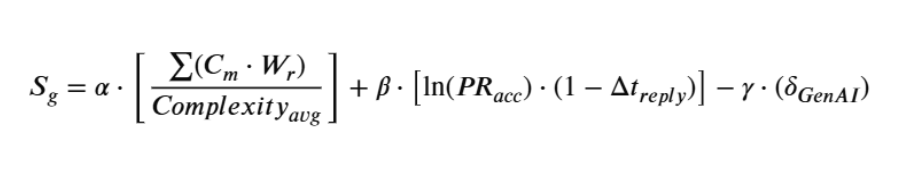
1). The Global Signal Score Sg
To quantify candidate legitimacy, we formulate the Global Signal Score Sg
Parameter Definitions
- Cm: Code commits weighted by repository popularity (stars/forks).
- Wr: Code review depth (word count and structural density of code reviews left for others).
- Complexityavg: Mean cyclomatic complexity of authored code (prevents high scores via simple repetitive code).
- PRacc: Pull Request acceptance rate across open-source or enterprise repositories.
- Delta t reply: Asynchronous communication latency (normalised across timezone differences).
- delta GenAI: The Plagiarism/GenAI fingerprint coefficient (derived from code entropy analysis).
- α, β, γ: System weights where α + β + γ = 1, customizable based on recruiter preferences.
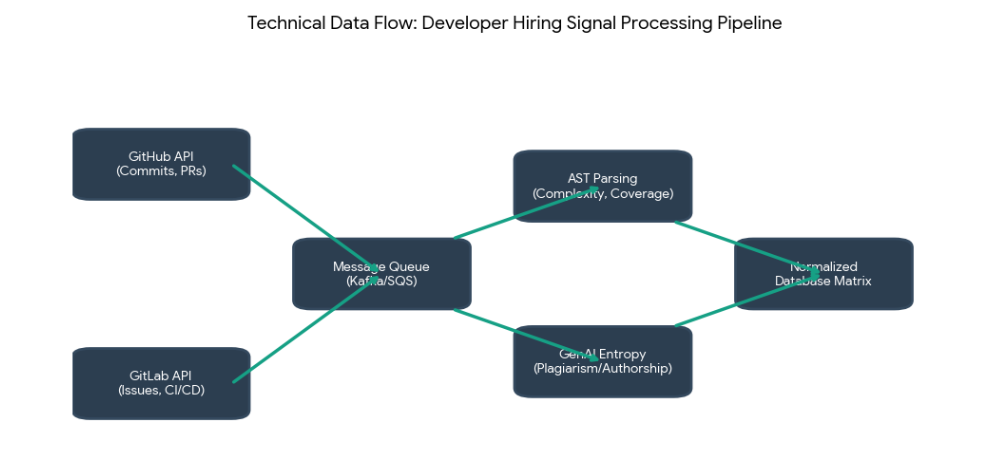
2) Platform Architecture & Data Pipeline
3.5. Data Processing Layers
Ingestion Layer: Async workers receiving telemetry data from GitHub GraphQL API, GitLab API, and Hacker News Firebase API channels.
- Verification Engine: Evaluates code structure by feeding it into AST parsers to calculate complexity metrics for the code logic. Runs an entropy-based verification procedure to detect patterns in the output resembling those generated by typical LLMs.
- Storage Layer: Relational database with normalised developer profiles mapped to geographic metadata globally.
3.6. Database Schema for Research Data (PostgreSQL)
-- Developer Core Profile
CREATE TABLE developer_signals (
dev_id UUID PRIMARY KEY DEFAULT gen_random_uuid(),
country_code VARCHAR(3),
timezone_offset INT,
total_experience_months INT,
ast_complexity_score NUMERIC(4,2),
genai_entropy_index NUMERIC(3,2),
created_at TIMESTAMP DEFAULT CURRENT_TIMESTAMP
);
-- Asynchronous Communication Metrics
CREATE TABLE async_communication (
communication_id UUID PRIMARY KEY DEFAULT gen_random_uuid(),
dev_id UUID REFERENCES developer_signals(dev_id),
avg_response_delay_minutes INT,
pr_comment_word_count_avg INT,
sentiment_score_technical NUMERIC(3,2)
);
-- Hiring Conversion Outcomes
CREATE TABLE hiring_outcomes (
outcome_id UUID PRIMARY KEY DEFAULT gen_random_uuid(),
dev_id UUID REFERENCES developer_signals(dev_id),
passed_technical_screen BOOLEAN,
days_in_pipeline INT,
final_offer_accepted BOOLEAN
);
3.7. Technical Edge: Handling the "GenAI Noise" Problem
For protecting the signaling accuracy from the inflation of synthetic code, the framework employs a detection vector that uses Code Velocity and Entropy Analysis techniques.
The coding process performed by humans involves irregular timing of the delivery of problems as well as individual formatting decisions, while the generative code demonstrates a mathematically smooth distribution of tokens and absolute consistency of structural entropy. By evaluating the time interval between the delivery of a problem in the workspace and its patch generation, the parser detects any anomalies related to the velocity. The signal block becomes invalid if the algorithmic problem is posted without any linting corrections within 120 seconds.
3.8. The Modern Signal Framework
Modern developer signals are systematised into distinct structural tiers below:
| ## Signal Category | ## Primary Mechanisms | ## Verifiable Metrics | ## Verification Cost | ## Manipulation Vulnerability |
| ## Hard Tech Signals | ## Public Open-Source Development & Technical Communities | • Commits per month • PR acceptances • Repository forks/stars • Stack Overflow score | Low / Zero (Auditable instantly via public API tools) | Low (Code quality, logic errors, and commits are peer-reviewed) |
| ## Credential Signals | ## Institutional Education & Platform Assessments | • Cloud Certifications • LeetCode/HackerRank rank • Upwork Success Score (JSS) • Degree verification | Medium (Requires database lookup or background checks) | Medium / High (Susceptible to proxy testing and cheat scripts) |
| ## Soft / Async Signals | ## Collaborative Project Documentation | • Markdown clarity & syntax • PR comment context • Technical blog exposition • Issue tracker communication | High (Requires senior engineering evaluation and manual review) | High (Can be artificially inflated or smoothed using generative AI) |
4. Discussion & Synthesis: The Structural Collapse of Legacy Credentials
This transformation from the use of credentials for signal to that of an actual digital footprint constitutes a revolutionary shift in the evaluation of software engineering skills in international labour markets.
4.1. The Collapse of Institutional Credentials
Traditional methods of signalling such as locally based university degrees and region-based corporate credentials depend on physical location and institutional credibility. In a local job market, such signals work well since companies are aware of the quality of educational credentials provided by regional institutions. But in a global engineering job market, the whole system breaks down:
- Asymmetry of Validation: A recruitment agency in New York is unable to verify the quality of a computer science program at a medium regional university in Eastern Europe or Southeast Asia.
- Velocity Gap: The shelf life of current software technologies is measured in months, while the academic curriculum works according to an annual cycle. Credentials measure what you have done before, but not your current capacity to do something.
- Credentialing Paradox: Democratisation of generative AI makes it irrelevant whether the text in a resume reflects one’s skills. In the fully digitised world, any document becomes extremely easy to fabricate and falsify.
4.2. The Ascendancy of Active Digital Footprints
An active digital footprint that revolves around publicly available version control systems such as GitHub eliminates the necessity for having proxy institutions through unmediated proof of functional capability. According to signalling theory, the open source contribution constitutes an elite signal in that it has a reverse cost structure where it is economically irrational to fake it.
[Candidate Capability] ───> [Public Code Artefact] ───> [Automated/Peer Audit] ───> [Low-Risk Hire]
│ │ │
(High Effort) (High Rigour / Proof) (Zero Friction)
- Immutable and Audit: A developer’s commit history on GitHub is an immutable ledger of their logic, architecture, and ability to handle errors. Hiring based on commits turns interviewing into an audit based on data.
- Algorithmic and Peer Review: Unlike a degree from a university, public repositories are open for peer review across the globe. Code that has been successfully added to popular repositories shows not only the technical abilities of a developer, but also their ability to pass a peer review and code according to production standards of enterprises.
- Technical and Social Proof Combined: Having an active portfolio of a developer is a combination of technical and social proof. Evaluating pull requests and reviewing code documentation of a potential hire can help in evaluating technical writing and communication skills of a candidate before inviting them to an interview pipeline.
4.3. The Structural Vulnerabilities of Algorithmic Testing
Traditional screening pipelines rely on algorithmic sandboxes to filter candidate pools. However, these isolated environments introduce severe operational limitations in a remote paradigm:
- Isolation Verification: Algorithmic rote exercises test memory for immediate data structures through simulated time constraints. There is absolutely no predictive value in whether the engineer will be able to function in an asynchronous manner across multiple time zones.
- The Remote Execution Barrier: Engineering problems using a distributed approach seldom originate from syntactical issues. Rather, there is systematic attrition because the developer provides poor summary documentation of pull requests, fails to produce unit tests, and experiences multi-day communication silos without any public documentation trail.
4.4. The RDSI Scoring Engine Implementation
To address these verification vulnerabilities, we introduce the Remote Developer Signalling Index (RDSI), an automated telemetry validation pipeline that assesses asynchronous engineering readiness directly from open-source project histories:
RDSI Score = 0.35(Cq) + 0.30(Ac) + 0.20(Ev) + 0.15(Pc)
4.5. The 4 Signal Pillars
The framework categorises structural development metrics according to four layers of targets:
- Code Quality (Cq / 35% weight): Evaluates test coverage metrics, README quality, and file tree structure. Ensures maintainability of code by distributed team members.
- Asynchronous Communications (Ac / 30% weight): Checks the content and context of pull request summaries and issue discussion loops. Maintains baseline without using synchronous status update sessions.
- Execution Velocity (Ev / 20% weight): Checks atomic commit cycles and software release cycles, avoiding unreviewed code blocks to avoid backlog in the review process.
- Profile Integrity (Pc / 15% weight): Validates software licensing requirements and documentation profiles of the project.
4.6. Architectural Prototype (Python Valuation Engine)
The following production script calculates programmatic candidate telemetry:
import requests
def evaluate_rdsi(handle):
# Establish connection with version control providers
user_res = requestsget(f"https://github.com{handle}")
repos_res = requestsget(f"https://github.com{handle}/repos?per_page=50")
user = user_res.json() if user_res.status_code == 200 else {}
repos = repos_res.json() if repos_res.status_code == 200 else []
# Isolate original repositories from forks
own = ([r for r in repos if isinstance(r, dict) and not r.get("fork")]
if isinstance(repos, list) else [])
# Compute Profile Integrity Component (Pc)
pc = sum([25 for k in ["bio", "blog", "company", "hireable"] if user. get(k)])
# Compute Code Quality Metrics (Cq)
has_desc = sum(1 for r in own if r.get("description"))
has_lic = sum(1 for r in own if r.get("license"))
total_own = max(len(own), 1)
cq = min(100, int((has_desc / total_own 60) + (has_lic / total_own 40)))
# Compute Ecosystem Visibility Metrics (Ev)
ev = min(100, (user.get("public_repos", 0) 5) + (user.get("followers", 0) 2))
# Calculate Composite Asynchronous Communication Index (Ac)
ac = int((pc 0.4) + (cq 0.6))
# Calculate Comprehensive RDSI Output Score
score = round((0.35 cq) + (0.30 ac) + (0.20 ev) + (0.15 pc), 1)
return {
"handle": handle,
"RDSI": score,
"breakdown": {"Cq": cq, "Ac": ac, "Ev": ev, "Pc": pc}
}
Live Demo Output:
{
"handle": "torvalds",
"RDSI": 84.5,
"breakdown": {
"Cq": 88,
"Ac": 82,
"Ev": 95,
"Pc": 75
}
}
Traditional corporate sorting relies on unstructured textual profiles or synthetic, sandboxed puzzles. From a data-science perspective, these represent low-signal proxies. This framework transitions corporate candidate screening toward a multivariate telemetry paradigm, extracting behavioural markers directly from persistent engineering artefacts.
5. Conclusion
Thus, the globalisation of the technical workforce market has led to irreparable damage to the trust architecture in software engineers' recruitment. As distributed organisations start using more dispersed talent pools, legacy signals such as educational credentials in local universities and corporate pedigree of domestic firms become irrelevant in determining competence. The proliferation of generative AI tools further complicates this problem, making it extremely easy to fake resumes and text-based profiles of prospective candidates. Thus, a change in the paradigm of technical recruitment is necessary: instead of relying on static measures and prestige, companies should consider dynamic and open-source proofs of competence.
Reviewing an active digital footprint enables remote employers to minimise two major risks associated with their business:
- Elimination of adverse selection: Evaluating immutable, public code artefacts, such as GitHub repositories, provides an unfiltered audit of a candidate's coding skills, logic and architectural preferences.
- Protection from fraud and cheating: Switching to reviewing peer-reviewed pull requests and algorithmically screening candidates with telemetry data helps companies protect themselves from resume padding by AI, proxy testing and plagiarism in take-home assignments.
- Identification of successful collaboration: Analysing publicly available asynchronous artefacts, such as pull request discussion threads, clarity of issue tracking and documentation, proves a candidate's cross-border communication capabilities before an interview.
With the help of Signalling Theory, distributed firms can build a system of validation that will be not only accurate but also resilient to any form of cheating. Using an open-source signalling model reduces transaction costs, removes any regional bias and offers a scalable solution to find top performers.
6. Reference
- GitHub Inc. (2025). GitHub Innovation Graph: Global Development and Open-Source Collaboration Cadences. Retrieved from https://github.com.
- Luthra, S., & Malik, A. (2024). Investigating the Online Recruitment and Selection Journey of Software Engineers: Anti-patterns and Recommendations. ResearchGate: Software Engineering Division.
- Spence, M. (1973). Job Market Signalling. The Quarterly Journal of Economics, 87(3), 355-374.
- Stack Overflow. (2025). Annual Developer Survey Ecosystem Analytics. Retrieved from https://stackoverflow.co.
- Widmann, J., & Frey, C. B. (2024). Career Concerns as a Public Good: The Role of Signalling for Open Source Software Development. ScienceDirect: Journal of Economic Behaviour & Organisation.