Socioeconomic Factors and Their Role in Metabolic Dysfunction-Associated Steatotic Liver Disease: A Comprehensive Review.
Metabolic dysfunction-associated steatotic liver disease (MASLD), a major public health concern, is influenced by an interplay of genetic, environmental, and lifestyle factors, with socioeconomic factors functioning as important upstream determinants whose roles remain not yet fully understood. This review synthesizes current evidence on how different indicators of socioeconomic status as well as related social determinants of health-income, poverty, food insecurity, health insurance, education, migration, and composite indices-relate to MASLD prevalence, severity, and outcomes across different world regions. Several studies associate these socioeconomic factors with an increased risk of MASLD, illustrating the disease's link with socioeconomic disadvantages. However, socioeconomic factors often lose or attenuate their independent association with MASLD once key downstream determinants-such as diet quality, physical inactivity, and metabolic comorbidities-are considered, supporting a model in which socioeconomic factors mainly shape exposure to metabolic and behavioural risk factors rather than exerting a direct causal effect. Among the factors examined, education and food insecurity demonstrate the most consistent independent associations with MASLD. Notably, the direction of socioeconomic gradients appears to differ by regional income level, with lower SES associated with higher MASLD burden in high-income countries but an inverse pattern in several middle-income settings. Evidence remains largely limited to the United States, Europe, and a small number of Asian cohorts, underscoring the need for more geographically diverse research. This review highlights the association of different socioeconomic factors with MASLD, while also revealing the need for more detailed studies which systematically disentangle individual and area-level social determinants of health, model mediating pathways and incorporate underrepresented regions and paediatric populations. A deeper understanding of how socioeconomic factors and downstream mediators jointly drive MASLD could inform targeted clinical strategies and multi-level policies aimed at mitigating the social gradient in MASLD.
Introduction
Metabolic dysfunction‐associated steatotic liver disease (MASLD) represents a disease of both medical and social relevance. With its prevalence rising in recent years [1] MASLD (formerly known as non‐alcoholic fatty liver disease, NAFLD) [2] has emerged as a global health concern [3] closely intertwined with the increase of obesity and metabolic disorders [4]. On an individual level, various well‐established risk factors for the development and progression of MASLD have been described. These include unfavourable dietary patterns rich in fructose and saturated fatty acids—leading to insulin resistance and other aspects of the metabolic syndrome [5,6]. Additionally, genetic predispositions (e.g., PNPLA3) and effects of the microbiome have been identified [7,8]. Beyond individual‐level determinants, socioeconomic factors have been recognized as central determinants of the incidence and outcomes of various diseases including diseases defining MASLD, such as diabetes and metabolic syndrome [9,10]. This comprehensive review aims to explore the interaction between socioeconomic factors and MASLD [2]. We use the term ‘socioeconomic factors’ to encompass indicators of socioeconomic status (SES) (e.g., income), related social determinants of health (e.g., food insecurity) as well as composite measures of these factors. Beyond solely documenting social gradients in MASLD, an important methodological challenge is distinguishing between SES as a proxy for upstream social conditions and the downstream metabolic and behavioural factors that more directly drive liver fat accumulation and fibrosis. In various epidemiological studies the apparent effect of socioeconomic factors on MASLD depends strongly on the covariates included in statistical models: Once factors including adiposity, diabetes, diet quality, or physical activity are accounted for, indicators of SES and social determinants of health often lose or attenuate their independent association. In this review we therefore aim to interpret these findings with particular attention to adjustment sets and—where available—explicitly reported mediators and highlight how differences in these modelling strategies may explain heterogeneous results across populations and world regions.
Socioeconomic Factors and Their Associations With MASLD
Understanding the diverse socioeconomic factors is pivotal for interpreting their relationship with MASLD. In this section we summarize how socioeconomic factors, including two core indicators of SES (income and education) as well as additional social determinants of health (food insecurity, health insurance status, and migration) and composite measures of SES, relate to MASLD prevalence, severity, and outcomes (Figure1, Tables1,2,3,4,5,6,7). Where possible, we distinguish between unadjusted and adjusted results and highlight factors mediating the association with MASLD.
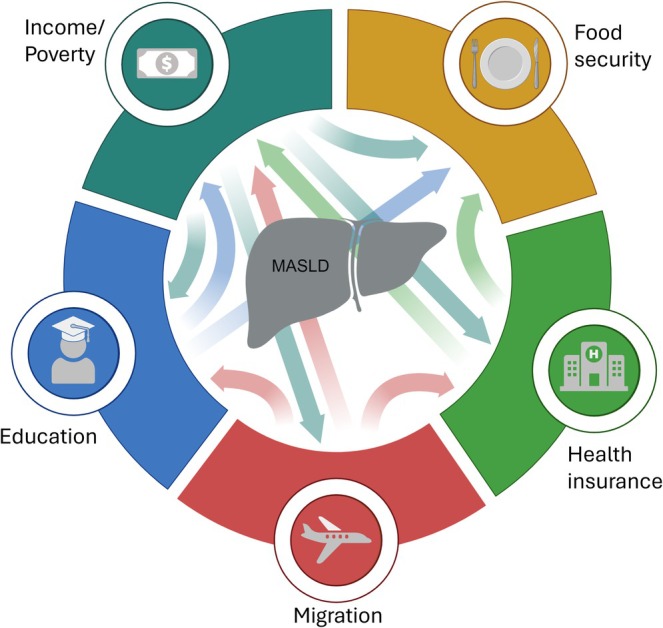
Social determinants of health influencing MASLD.
Table: Studies analysing the impact of income on MASLD.
Table: Studies analysing the impact of food insecurity on MASLD.
Table: Studies analysing the impact of health insurance on MASLD.
Table: Studies analysing the impact of education on MASLD.
Table: Studies analysing the impact of migration on MASLD.
Table: Studies analysing the impact of a combination of socioeconomic factors on MASLD.
Table: Studies analysing the impact of socioeconomic factors on MASLD in children.
Income/Poverty
Income and poverty are core indicators of SES, and their associations with MASLD prevalence and severity have been investigated in studies from the United States, Europe, and China (Table1).
United States
Across US studies—largely derived from the National Health and Nutrition Examination Survey (NHANES)—lower income is consistently associated with MASLD in unadjusted analyses but does not emerge as an independent risk factor after accounting for downstream behavioural and metabolic variables [11,12]. Although overall prevalence of MASLD as well as MASLD with advanced liver disease are both more common among individuals with lower income, these associations are attenuated in multivariable models. Instead, college education—partly mediated through higher diet quality and greater physical activity—as well as food insecurity were identified as independent risk factors. One biopsy‐based cross‐sectional study from New York did not confirm an association between lower income and higher rates of metabolic dysfunction‐associated steatohepatitis (MASH) or severe steatosis, though its reliance on neighbourhood‐level socioeconomic data rather than individual data and absence of adjustment for other risk factors limit its interpretability [13].
Europe
European studies also point to an indirect role of income in MASLD, rather than a direct effect, operating through lifestyle and other socioeconomic mediators, similar to evidence from the US [14,15]. In a Dutch cohort, lower household income was associated with a higher risk of MASLD, with effects partially mediated by physical activity and fructose intake [14]. A prospective Finnish MASLD cohort further showed that unemployment—an indicator of economic disadvantage—was associated with increased risks of both liver‐related outcomes as well as non‐liver‐related mortality, independent of metabolic comorbidities, though the study did not explore potential mediating pathways [15].
Asia
In contrast to findings from high‐income countries, three Chinese studies suggest that higher income is associated with greater MASLD prevalence [16,17,18]. This association persisted after adjustment for metabolic comorbidities in two cross‐sectional studies, although underlying mechanisms were not examined. A large prospective cohort study provides a potential explanation: higher household income and higher educational attainment were associated with a greater consumption of ultra‐processed foods, which in turn independently predicted MASLD risk [18].
Overall, income rarely remained an independent determinant of MASLD once downstream behavioural and metabolic factors were considered. The direction of association appears to be region‐specific. In high‐income settings, lower income is linked to higher MASLD risk through adverse lifestyle patterns as well as co‐occurring metabolic comorbidities. By contrast, in middle‐income countries such as China, higher income may increase MASLD risk through greater consumption of energy‐dense, ultra‐processed foods, resulting in an association in the opposite direction to that observed in the United States and Europe.
Food Insecurity
Food insecurity, a distinct social determinant of health, and its association with MASLD have been examined in several studies, with most evidence originating from the United States (Table2).
United States
US studies consistently link food insecurity to MASLD prevalence, and in some analyses also to advanced fibrosis and adverse outcomes—an association that, where examined, persists after adjustment for income, education, caloric intake, and physical activity [12,19,20]. The association with fibrosis appears to be partly mediated by obesity and diabetes, whereas the association with MASLD prevalence persists after accounting for these factors [19]. Beyond disease prevalence, analysis of NHANES‐linked mortality records shows higher all‐cause mortality and greater healthcare utilisation among food‐insecure individuals with MASLD, again independent of education and income [20]. Dietary quality may partly explain these findings, although available evidence suggests only modest but heterogeneous differences in diet quality by food insecurity and ethnicity, with poorer diet quality most prominently observed among food‐insecure White patients [21].
Asia
Outside the United States, evidence is limited to a single Iranian cross‐sectional study, which found food insecurity to be independently associated with higher prevalence and risk of MASLD, regardless of physical activity, education, or income [22]. This finding tentatively extends the US pattern to a middle‐income country, though generalisability is limited by the exclusion of patients with diabetes and hypertension.
Global (Ecological)
At the global level, an ecological analysis of data from the Global Burden of Disease study (GBD) of 204 countries suggested that the association between food insecurity and MASLD differs by national income level: In high‐income countries, food insecurity was associated with a higher MASLD risk, whereas in low‐income settings it was associated with a lower risk [23]. This contrast may reflect differences between poor diet quality in high‐income settings and true undernutrition in low‐income settings.
Overall, food insecurity represents one of the most consistently documented social determinants of health associated with MASLD, with an independent association with disease presence, advanced fibrosis, and mortality demonstrated across multiple analyses. In high‐income countries, this association appears to be driven less by caloric excess and more by poor diet quality, obesity, and diabetes. In low‐ and middle‐income countries, where food insecurity may reflect true undernutrition, the relationship with MASLD appears more heterogeneous, underscoring the need for context‐specific studies that explicitly model mediating nutritional and metabolic factors.
Health Insurance
Health insurance, a distinct social determinant of health, has been examined in only a few studies in the context of MASLD (Table3).
United States
Available US studies link private or more stable insurance coverage primarily to better in‐hospital outcomes with limited evidence for an association with MASLD prevalence [13,24,25]. Evidence derives from a large retrospective cohort of over 200 000 hospitalised patients with MASLD, in which publicly insured or uninsured patients experienced higher mortality, longer hospital stays, and lower rates of discharge to home compared to patients with private health insurance, independent of patient and hospital characteristics [24]. Household income and comorbid burden were additional independent risk factors for these adverse outcomes. Beyond insurance type, continuity of coverage also appears relevant: A case–control study found that patients with advanced MASLD had shorter periods of continuous insurance coverage compared to those with MASLD without cirrhosis [25]. While this may suggest that gaps in coverage are relevant to disease progression, socioeconomic factors were not analysed as independent risk factors in this study, limiting direct conclusions.
Whether insurance status acts primarily as a proxy for higher SES and healthier lifestyles or exerts a more direct protective effect by facilitating earlier diagnosis, access to specialised care and use of emerging pharmacotherapies remains to be studied.
Education
Education, a core indicator of SES, is among the most frequently studied socioeconomic factors in relation to MASLD (Table4).
United States
Across US studies, lower educational attainment is associated with MASLD prevalence and—more consistently—advanced liver disease, with associations persisting after adjustment for metabolic risk factors as well as income, if multivariable statistical models were reported [11,25,26,27]. Diet quality and physical activity appear to partly mediate this relationship [11]. Additional analyses suggest that education and other socioeconomic factors may attenuate the genetic risk of PNPLA3 and may also influence disease awareness, which is higher among more educated individuals [26,27].
Europe
European studies largely mirror findings from the United States, with higher educational attainment being associated with lower MASLD risk and more favourable liver outcomes [14,28,29]. These associations appear at least partly independent of income and employment and may be mediated by physical activity and diet quality. One Finnish cohort did not replicate this association, but co‐occurring socioeconomic factors were not jointly modelled, limiting interpretation [15].
In summary, higher educational attainment is consistently associated with a lower risk of advanced liver disease across US and European cohorts, even though its relationship with overall MASLD prevalence is more heterogeneous. Proposed mediators include physical activity, higher diet quality, and disease awareness, but formal mediation analyses are scarce. Notably, several studies report that the protective effect of education persists after adjustment for income, suggesting education captures advantages beyond income.
Migration
Migration is a social determinant of health that has not been well studied in relation to MASLD (Table5).
United States and Europe
The available evidence—drawn from the United States and Europe—is limited and inconsistent with no clear association between migration and MASLD [13,28,30]. A New York study reported higher odds of MASH and severe steatosis among migrants, but the analysis was unadjusted and relied on neighbourhood‐level socioeconomic data [13]. By contrast, Swedish and Spanish studies did not show a clear association with liver outcomes or MASLD prevalence [28,30].
Overall, migration status appears to be an imprecise proxy for social disadvantage in MASLD. Existing studies do not account for language proficiency, legal status, healthcare access, occupation, or discrimination and therefore may conflate vastly different migrant experiences, ranging from refugees to highly skilled expatriates. Observed associations are therefore difficult to interpret and likely reflect a complex interplay of different socioeconomic factors. Future studies should therefore prioritise more granular, structural variables over crude binary migration indicators.
Composite SES Measures and Global Geographic Patterns
Some studies did not analyse individual socioeconomic factors but instead composite measures or indices (Table6).
United States
US studies using such composite measures consistently indicate that overall socioeconomic disadvantage is independently associated with higher MASLD risk and worse outcomes [13,31]. The cross‐sectional study from New York found that the cumulative number of socioeconomic risk factors predicted MASH, with a trend emerging at three or more factors and a significant association at four or more risk factors, independent of demographic variables [13]. A large retrospective cohort study similarly found that composite affluence was associated with reduced overall mortality and liver‐related events, even after adjustment for patients' demographics and metabolic comorbidities [31]. Notably, in both studies, socioeconomic data was assigned geographically rather than self‐reported, which may introduce misclassification at the individual level.
Asia
Findings from Asian studies are more heterogeneous and appear to vary by national economic context, consistent with the income‐specific patterns described in Section1. In South Korea—a high‐income country—lower SES was associated with higher MASLD prevalence, mirroring the US pattern [32]. By contrast, studies from India and Iran—both middle‐income countries—report a contrary trend, where higher socioeconomic class is associated with an increased risk of MASLD [33,34]. However, these studies used different composite measures and had limited adjustment for behavioural confounders (e.g., physical activity), restricting comparability.
Global (Ecological)
Ecological studies, such as those based on the GBD, complement individual‐level findings by capturing broader global variations. Utilising the Socio‐Demographic Index (SDI)—a composite of per capita income, education, and fertility rates—GBD data show that the relationship between socioeconomic development and MASLD burden at a national level is heterogeneous across world regions. While MASLD prevalence has risen globally since 1990, the most substantial increases have been recorded in high‐middle SDI countries, whereas the greatest absolute incidence and relative growth were observed in middle and low‐middle SDI countries [35,36]. Notably, higher SDI is associated with lower disease severity in both MASLD and MASH‐related hepatocellular carcinoma [36,37]. These ecological findings need nonetheless to be interpreted cautiously. GBD estimates rely on modelled data, particularly in regions with limited diagnostic capacity or incomplete mortality reporting. Consequently, MASLD‐related estimates may rather reflect overall liver‐related mortality, and interpretation of prevalences and incidences should be contextualised accordingly [48].
In summary, studies using composite SES measures in high‐income countries consistently associate lower SES with higher MASLD prevalence and worse outcomes, whereas studies from middle‐income countries again suggest the opposite trend, reinforcing the pattern observed in income‐specific analysis.
MASLD In Children
The increasing prevalence of MASLD is observed not only in adults but also in children and adolescents, and several studies have explored the role of socioeconomic factors in this context (Table7). Paediatric data broadly mirror adult findings, with socioeconomic disadvantage being associated with a greater burden of MASLD in high‐income settings, whereas an inverse gradient is observed in middle‐income settings.
United States
In the US, low household income and food insecurity consistently emerge as key risk factors for MASLD in children, with food insecurity mediating the pathway between low income and increased disease risk [38,39,40,41,42]. Children from deprived backgrounds are diagnosed at a younger age, though not with greater disease severity at presentation in descriptive analyses [40,41]. Food insecurity independently associates with increased MASLD risk, even after adjustment for age, sex, and BMI, underscoring the disproportionate burden in vulnerable populations [42].
Europe
European longitudinal data highlight a long‐term impact of early‐life socioeconomic disadvantage on MASLD risk. The Young Finns Study, a unique 30‐year prospective cohort from Finland, found that low childhood SES independently predicted MASLD in adulthood, after adjustment for demographic and early‐life metabolic factors [43,44]. Mediating factors included BMI, physical activity, blood pressure, insulin levels, lipid profiles, and red meat consumption. Socioeconomic differences in diet emerged by age six, physical activity by age 12, and BMI by age 21, indicating that the socioeconomic gradient in MASLD risk is established well before adulthood. Data on migration from a Swedish cohort study carry the same caveats discussed in section 5 [45].
Mexico and Australia
The high‐ versus middle‐income divergence observed in adult studies is also found in children. In Australia (a high‐income country), higher family income predicts lower MASLD risk in adolescence, consistent with US and European patterns [46]. Conversely, a small study of Mexican children (a middle‐income country) with obesity found higher MASLD prevalence among those with higher parental education and higher SES, confirming the pattern observed in other middle‐income countries for adults [47]. Neither study reported adjusted results.
Taken together, income and food insecurity emerge as more robust independent risk factors for paediatric MASLD than parental education, though formal mediation analyses remain rare. The Young Finns Study uniquely shows how early‐life socioeconomic disadvantage shapes diet, physical activity, obesity, and cardiometabolic risk trajectories from childhood onward, eventually manifesting as fatty liver disease in adulthood. Evidence from low‐ and middle‐income countries and from ethnically diverse paediatric populations remains scarce, representing a critical gap given the high burden of MASLD in these groups.
Discussion
Overall, the available literature supports a meaningful association between socioeconomic factors and MASLD, but the strength, independence, and even direction of that association vary by indicator, outcome definition, and geographic setting. Income, food insecurity, and education have the strongest evidence base; among these, food insecurity demonstrates the most consistent independent association, whereas the effect of income often attenuates after adjustment for downstream behavioural and metabolic factors. A recurring regional pattern emerges across the results: Lower SES is associated with greater MASLD burden in high‐income countries, but with a lower burden in several middle‐income settings, likely reflecting differences in nutrition transition and access to energy‐dense, ultra‐processed foods. Even among countries with similar income levels, the generalisability of findings might be limited. While most European countries, like the United States, are high‐income countries, the applicability of American data to European countries and vice versa remains uncertain. The nature of government social support (e.g., unemployment benefits or food assistance programmes) and other support structures may be vastly different. Most European countries have national health insurance systems, whereas the American health insurance system is a mix of public and private coverage potentially leaving patients with high out‐of‐pocket costs. These structural differences in social protection and healthcare coverage likely contribute to divergent health outcomes and costs between the United States and European countries, as illustrated by higher unemployment‐related mortality and markedly higher annual MASH‐related medical costs in the United States [49,50]. It is therefore possible that some of the study results from the United States may have been less pronounced if stronger social support systems were in place. However, several European studies also report an association between socioeconomic factors and MASLD suggesting that while currently existing social security systems may attenuate some socioeconomic disparities, they do not eliminate them.
While some relationship between socioeconomic factors and MASLD has been shown in most studies, the current body of evidence has various limitations, and several questions remain unanswered. As noted, data from several regions with high prevalence of MASLD, such as the Middle East and several South American and African countries, are sparse or missing [36,51]. As we discuss above there seem to be relevant differences in the relation of low SES with MASLD between high‐ and middle‐ or low‐income countries. Whether this relation differs further within low‐income countries remains speculative, as studies below a national level are missing from these regions. Further research is urgently needed to better understand the association of socioeconomic factors and MASLD in low‐ and middle‐income countries. In addition to these contextual differences, heterogeneity in reporting of confounders and modelling strategies likely contributes to the heterogeneous effects of socioeconomic factors. Across studies, the strength and even direction of the association of socioeconomic factors with MASLD depend strongly on the covariates taken into account and the modelled outcomes: While low income or unemployment are often associated with higher MASLD prevalence or advanced fibrosis in minimally adjusted models, these effects often weaken or disappear after adjustment for diet quality and physical activity as well as food insecurity; in contrast, educational gradients in advanced liver disease frequently persist after controlling for income, but they are partly attenuated when lifestyle and comorbidity burden are included. This pattern supports a model in which socioeconomic factors rarely act as a direct cause of MASLD but instead structure exposure to proximal risk factors—unhealthy diet, physical inactivity, central obesity, insulin resistance, diabetes, and suboptimal healthcare access—which drive steatosis and fibrosis. Methodologically socioeconomic factors can function as confounders, mediators, or colliders depending on the causal question. Future studies should therefore pre‐specify hypothesised pathways and apply suitable methods to separate direct from indirect effects on MASLD.
Another limitation lies in the observational nature of most studies on socioeconomic factors and MASLD. Even though many of the discussed studies are large prospective cohort studies, they should still be interpreted with caution, as they cannot establish causal relationships. Regarding data quality, most studies relied on self‐reported socioeconomic information. However, some studies used area‐level socioeconomic indicators (e.g., zip‐code matched) rather than individual‐level data [13,31,40]. This approach may represent a limitation, as it may reduce the accuracy and specificity of the socioeconomic data. As an example, Giammarino et al. found no association between poverty and MASLD, a finding that contrasts with much of the literature and may be partly attributable to the use of matched, aggregate‐level socioeconomic data [13]. The definitions of MASLD used in the studies exhibit considerable differences. Some studies include only patients with biopsy‐confirmed MASLD or MASH [13], while others rely on various imaging methods (e.g., ultrasound [44], MRI [40]). Yet others use different scores based on laboratory parameters and clinical data [12,20]. The heterogeneity of these inclusion criteria may also explain differing results. Uniform criteria based on guidelines would be desirable to achieve better comparability and transferability of results between different regions, countries, and social systems. In 2023, the definition and nomenclature of steatotic liver diseases were changed therefore several of the studies included in this review are still based on the previous definition of NAFLD [2]. However, it has been consistently reported that the diagnoses of NAFLD and MASLD exhibit a very high concordance [39,52,53]. Therefore, we are confident that findings from studies on socioeconomic factors in NAFLD can be reliably transferable to MASLD, provided that a proper definition of NAFLD was applied. In addition to pure MASLD, the disease entity of MASLD and increased alcohol intake (MetALD) was newly defined. For this newly described entity there are no valid data on its association with socioeconomic factors yet and new studies are needed to differentiate the role of socioeconomic factors in these patients with both aspects of metabolic syndrome and relevant alcohol consumption. While this review concentrates on the association of socioeconomic factors with MASLD, an individual's risk for developing MASLD is influenced by many other factors, including sex and ethnicity. These aspects often interact with socioeconomic factors, adding complexity to the relationship. Their impact on MASLD has been thoroughly addressed elsewhere and is beyond the scope of the present review [54,55].
Implications for Clinical Practice and Policy
Despite these limitations, the available evidence already has implications for hepatology practice and public health. Clinicians should recognise low SES, including low educational attainment, as well as food insecurity, as markers of increased MASLD risk and potentially delayed diagnosis, and consider proactive case‐finding strategies, tailored counselling, and linkage to social and nutritional support services in these groups. At a policy level, interventions that improve access to affordable, healthy food, promote safe opportunities for physical activity in deprived neighbourhoods and ensure equitable coverage of non‐invasive liver assessment and specialist referral are likely to yield disproportionate benefits for socioeconomically disadvantaged populations. Finally, integrating SES and food insecurity screening into routine MASLD care and clinical trials could help identify high‐risk patients, refine risk stratification tools, and inform resource allocation.
Conclusion
In conclusion, this review highlights that socioeconomic factors are strongly associated with MASLD prevalence and outcomes across diverse settings, but rarely act as isolated, independent determinants. Income, poverty, food insecurity, health insurance, education, migration, and composite SES measures all relate to MASLD, predominantly by shaping exposure to downstream metabolic and behavioural risk factors and possibly modifying access to timely diagnosis and specialist care. Global variations—including opposing social gradients between high‐ and middle‐income countries—underscore the need to interpret findings within their regional social, nutritional, and healthcare contexts rather than extrapolating results across settings. Future research should systematically disentangle individual and area‐level socioeconomic factors, apply robust causal and mediation approaches, and explore the role of socioeconomic factors in the newly defined entities of MASLD and MetALD. Ultimately, integrating socioeconomic factors into risk stratification, clinical pathways, and multi‐level policy interventions will be essential to mitigate the social gradient in MASLD and ensure that advances in diagnostics and therapy translate into equitable liver health gains.
Funding
The authors have nothing to report.
Conflicts of Interest
The authors declare no conflicts of interest.
Acknowledgements
Open Access funding enabled and organized by Projekt DEAL.
Wiering L. and Demir M., “Socioeconomic Factors and Their Role in Metabolic Dysfunction‐Associated Steatotic Liver Disease: A Comprehensive Review,” Liver International 46, no. 7 (2026): e70731, 10.1111/liv.70731.
Data Availability Statement
Data sharing not applicable to this article as no datasets were generated or analysed during the current study.
Associated Data
Data Availability Statement
Data sharing not applicable to this article as no datasets were generated or analysed during the current study.
References
- Younossi Z. M., Koenig A. B., Abdelatif D., Fazel Y., Henry L., and Wymer M., “Global Epidemiology of Nonalcoholic Fatty Liver Disease‐Meta‐Analytic Assessment of Prevalence, Incidence, and Outcomes,” Hepatology 64, no. 1 (2016): 73–84, 10.1002/hep.28431. doi.org/10.1002/hep.28431
- Rinella M. E., Lazarus J. V., Ratziu V., et al., “A Multisociety Delphi Consensus Statement on New Fatty Liver Disease Nomenclature,” Hepatology 78, no. 6 (2023): 1966–1986, 10.1097/HEP.0000000000000520. doi.org/10.1097/HEP.0000000000000520
- Geier A., Rinella M. E., Balp M. M., et al., “Real‐World Burden of Nonalcoholic Steatohepatitis,” Clinical Gastroenterology and Hepatology 19, no. 5 (2021): 1020–1029.e7, 10.1016/j.cgh.2020.06.064. doi.org/10.1016/j.cgh.2020.06.064
- Eslam M., Sanyal A. J., George J., and International Consensus P , “MAFLD: A Consensus‐Driven Proposed Nomenclature for Metabolic Associated Fatty Liver Disease,” Gastroenterology 158, no. 7 (2020): 1999–2014.e1, 10.1053/j.gastro.2019.11.312. doi.org/10.1053/j.gastro.2019.11.312
- Wiering L. and Tacke F., “Treating Inflammation to Combat Non‐Alcoholic Fatty Liver Disease,” Journal of Endocrinology 256, no. 1 (2023): e220194, 10.1530/JOE-22-0194. doi.org/10.1530/JOE-22-0194
- Yki‐Jarvinen H., Luukkonen P. K., Hodson L., and Moore J. B., “Dietary Carbohydrates and Fats in Nonalcoholic Fatty Liver Disease,” Nature Reviews. Gastroenterology & Hepatology 18, no. 11 (2021): 770–786, 10.1038/s41575-021-00472-y. doi.org/10.1038/s41575-021-00472-y
- Anstee Q. M., Seth D., and Day C. P., “Genetic Factors That Affect Risk of Alcoholic and Nonalcoholic Fatty Liver Disease,” Gastroenterology 150, no. 8 (2016): 1728–1744.e7, 10.1053/j.gastro.2016.01.037. doi.org/10.1053/j.gastro.2016.01.037
- Demir M., Lang S., Hartmann P., et al., “The Fecal Mycobiome in Non‐Alcoholic Fatty Liver Disease,” Journal of Hepatology 76, no. 4 (2022): 788–799, 10.1016/j.jhep.2021.11.029. doi.org/10.1016/j.jhep.2021.11.029
- Christine P. J., Auchincloss A. H., Bertoni A. G., et al., “Longitudinal Associations Between Neighborhood Physical and Social Environments and Incident Type 2 Diabetes Mellitus: The Multi‐Ethnic Study of Atherosclerosis (MESA),” JAMA Internal Medicine 175, no. 8 (2015): 1311–1320, 10.1001/jamainternmed.2015.2691. doi.org/10.1001/jamainternmed.2015.2691
- Berkowitz S. A., Basu S., Venkataramani A., Reznor G., Fleegler E. W., and Atlas S. J., “Association Between Access to Social Service Resources and Cardiometabolic Risk Factors: A Machine Learning and Multilevel Modeling Analysis,” BMJ Open 9, no. 3 (2019): e025281, 10.1136/bmjopen-2018-025281. doi.org/10.1136/bmjopen-2018-025281
- Vilar‐Gomez E., Nephew L. D., Vuppalanchi R., et al., “High‐Quality Diet, Physical Activity, and College Education Are Associated With Low Risk of NAFLD Among the US Population,” Hepatology 75, no. 6 (2022): 1491–1506, 10.1002/hep.32207. doi.org/10.1002/hep.32207
- Golovaty I., Tien P. C., Price J. C., Sheira L., Seligman H., and Weiser S. D., “Food Insecurity May be an Independent Risk Factor Associated With Nonalcoholic Fatty Liver Disease Among Low‐Income Adults in the United States,” Journal of Nutrition 150, no. 1 (2020): 91–98, 10.1093/jn/nxz212. doi.org/10.1093/jn/nxz212
- Giammarino A. M., Qiu H., Bulsara K., et al., “Community Socioeconomic Deprivation Predicts Nonalcoholic Steatohepatitis,” Hepatol Commun 6, no. 3 (2022): 550–560, 10.1002/hep4.1831. doi.org/10.1002/hep4.1831
- Ren Z., Bosma H., Wesselius A., et al., “Traditional Lifestyle Factors Partly Mediate the Association of Socioeconomic Position With Intrahepatic Lipid Content: The Maastricht Study,” JHEP Rep 5, no. 11 (2023): 100855, 10.1016/j.jhepr.2023.100855. doi.org/10.1016/j.jhepr.2023.100855
- Mannisto V. T., Salomaa V., Farkkila M., et al., “Incidence of Liver‐Related Morbidity and Mortality in a Population Cohort of Non‐Alcoholic Fatty Liver Disease,” Liver International 41, no. 11 (2021): 2590–2600, 10.1111/liv.15004. doi.org/10.1111/liv.15004
- Hu W., Liu Z., Hao H. R., et al., “Correlation Between Income and Non‐Alcoholic Fatty Liver Disease in a Chinese Population,” Annales d'Endocrinologie 81, no. 6 (2020): 561–566, 10.1016/j.ando.2020.07.1109. doi.org/10.1016/j.ando.2020.07.1109
- Zhou X., Li Y., Zhang X., et al., “Independent Markers of Nonalcoholic Fatty Liver Disease in a Gentrifying Population‐Based Chinese Cohort,” Diabetes/Metabolism Research and Reviews 35, no. 5 (2019): e3156, 10.1002/dmrr.3156. doi.org/10.1002/dmrr.3156
- Zhang S., Gan S., Zhang Q., et al., “Ultra‐Processed Food Consumption and the Risk of Non‐Alcoholic Fatty Liver Disease in the Tianjin Chronic Low‐Grade Systemic Inflammation and Health Cohort Study,” International Journal of Epidemiology 51, no. 1 (2022): 237–249, 10.1093/ije/dyab174. doi.org/10.1093/ije/dyab174
- Kim D., Perumpail B. J., Cholankeril G., and Ahmed A., “Association Between Food Insecurity and Metabolic Dysfunction‐Associated Steatotic Liver Disease/Significant Fibrosis Measured by Fibroscan,” European Journal of Nutrition 63, no. 3 (2024): 995–1001, 10.1007/s00394-024-03327-9. doi.org/10.1007/s00394-024-03327-9
- Kardashian A., Dodge J. L., and Terrault N. A., “Food Insecurity Is Associated With Mortality Among U.S. Adults With Nonalcoholic Fatty Liver Disease and Advanced Fibrosis,” Clinical Gastroenterology and Hepatology 20, no. 12 (2022): 2790–2799.e4, 10.1016/j.cgh.2021.11.029. doi.org/10.1016/j.cgh.2021.11.029
- Kardashian A., Dodge J. L., and Terrault N. A., “Racial and Ethnic Differences in Diet Quality and Food Insecurity Among Adults With Fatty Liver and Significant Fibrosis: A U.S. Population‐Based Study,” Alimentary Pharmacology and Therapeutics 56, no. 9 (2022): 1383–1393, 10.1111/apt.17219. doi.org/10.1111/apt.17219
- Tutunchi H., Saghafi‐Asl M., Ebrahimi‐Mameghani M., and Ostadrahimi A., “Food Insecurity and Lipid Profile Abnormalities Are Associated With an Increased Risk of Nonalcoholic Fatty Liver Disease (NAFLD): A Case‐Control Study,” Ecology of Food and Nutrition 60, no. 4 (2021): 508–524, 10.1080/03670244.2021.1875453. doi.org/10.1080/03670244.2021.1875453
- Younossi Z. M., Zelber‐Sagi S., Kuglemas C., et al., “Association of Food Insecurity With MASLD Prevalence and Liver‐Related Mortality,” Journal of Hepatology 82, no. 2 (2024): 203–210, 10.1016/j.jhep.2024.08.011. doi.org/10.1016/j.jhep.2024.08.011
- Adejumo A. C., Samuel G. O., Adegbala O. M., et al., “Prevalence, Trends, Outcomes, and Disparities in Hospitalizations for Nonalcoholic Fatty Liver Disease in the United States,” Annals of Gastroenterology 32, no. 5 (2019): 504–513, 10.20524/aog.2019.0402. doi.org/10.20524/aog.2019.0402
- Noureddin M., Zelber‐Sagi S., Wilkens L. R., et al., “Diet Associations With Nonalcoholic Fatty Liver Disease in an Ethnically Diverse Population: The Multiethnic Cohort,” Hepatology 71, no. 6 (2020): 1940–1952, 10.1002/hep.30967. doi.org/10.1002/hep.30967
- Rieman‐Klingler M. C., Jung J., Tesfai K., Loomba R., and Non A. L., “Integrating Genetic and Socioeconomic Data to Predict the Progression of Nonalcoholic Fatty Liver Disease,” American Journal of Biological Anthropology 184, no. 4 (2024): e24979, 10.1002/ajpa.24979. doi.org/10.1002/ajpa.24979
- Le M. H., Yeo Y. H., Cheung R., Wong V. W., and Nguyen M. H., “Ethnic Influence on Nonalcoholic Fatty Liver Disease Prevalence and Lack of Disease Awareness in the United States, 2011‐2016,” Journal of Internal Medicine 287, no. 6 (2020): 711–722, 10.1111/joim.13035. doi.org/10.1111/joim.13035
- Nasr P., Shang Y., Wester A., et al., “Socioeconomic Factors Associated With the Presence of and Outcomes in Metabolic Dysfunction‐Associated Steatotic Liver Disease,” Liver International 44 (2024): 3050–3059, 10.1111/liv.16091. doi.org/10.1111/liv.16091
- Koutny F., Aigner E., Datz C., et al., “Relationships Between Education and Non‐Alcoholic Fatty Liver Disease,” European Journal of Internal Medicine 118 (2023): 98–107, 10.1016/j.ejim.2023.07.039. doi.org/10.1016/j.ejim.2023.07.039
- Rivera‐Esteban J., Jimenez‐Masip A., Munoz‐Martinez S., et al., “Prevalence and Risk Factors of MASLD and Liver Fibrosis Amongst the Penitentiary Population in Catalonia: The PRISONAFLD Study,” Journal of Clinical Medicine 12, no. 23 (2023): 7276, 10.3390/jcm12237276. doi.org/10.3390/jcm12237276
- Chen V. L., Song M. W., Suresh D., Wadhwani S. I., and Perumalswami P., “Effects of Social Determinants of Health on Mortality and Incident Liver‐Related Events and Cardiovascular Disease in Steatotic Liver Disease,” Alimentary Pharmacology and Therapeutics 58, no. 5 (2023): 537–545, 10.1111/apt.17631. doi.org/10.1111/apt.17631
- Cho J., Lee I., Park D. H., Kwak H. B., and Min K., “Relationships Between Socioeconomic Status, Handgrip Strength, and Non‐Alcoholic Fatty Liver Disease in Middle‐Aged Adults,” International Journal of Environmental Research and Public Health 18, no. 4 (2021): 1–11, 10.3390/ijerph18041892. doi.org/10.3390/ijerph18041892
- Singh S. P., Singh A., Misra D., et al., “Risk Factors Associated With Non‐Alcoholic Fatty Liver Disease in Indians: A Case‐Control Study,” Journal of Clinical and Experimental Hepatology 5, no. 4 (2015): 295–302, 10.1016/j.jceh.2015.09.001. doi.org/10.1016/j.jceh.2015.09.001
- Sadeghianpour Z., Cheraghian B., Farshchi H. R., and Asadi‐Lari M., “Non‐Alcoholic Fatty Liver Disease and Socioeconomic Determinants in an Iranian Cohort Study,” BMC Gastroenterology 23, no. 1 (2023): 350, 10.1186/s12876-023-02964-4. doi.org/10.1186/s12876-023-02964-4
- Ge X., Zheng L., Wang M., Du Y., and Jiang J., “Prevalence Trends in Non‐Alcoholic Fatty Liver Disease at the Global, Regional and National Levels, 1990‐2017: A Population‐Based Observational Study,” BMJ Open 10, no. 8 (2020): e036663, 10.1136/bmjopen-2019-036663. doi.org/10.1136/bmjopen-2019-036663
- Chen H., Zhan Y., Zhang J., et al., “The Global, Regional, and National Burden and Trends of NAFLD in 204 Countries and Territories: An Analysis From Global Burden of Disease 2019,” JMIR Public Health and Surveillance 8, no. 12 (2022): e34809, 10.2196/34809. doi.org/10.2196/34809
- Zhang T., Xu J., Ye L., et al., “Age, Gender and Geographic Differences in Global Health Burden of Cirrhosis and Liver Cancer due to Nonalcoholic Steatohepatitis,” Journal of Cancer 12, no. 10 (2021): 2855–2865, 10.7150/jca.52282. doi.org/10.7150/jca.52282
- Tang M., Liu M., Zhang Y., and Xie R., “Association of Family Income to Poverty Ratio and Vibration‐Controlled Transient Elastography Quantified Degree of Hepatic Steatosis in U.S. Adolescents,” Front Endocrinol (Lausanne) 14 (2023): 1160625, 10.3389/fendo.2023.1160625. doi.org/10.3389/fendo.2023.1160625
- Paik J. M., Duong S., Zelber‐Sagi S., Lazarus J. V., Henry L., and Younossi Z. M., “Food Insecurity, Low Household Income, and Low Education Level Increase the Risk of Having Metabolic Dysfunction‐Associated Fatty Liver Disease Among Adolescents in the United States,” American Journal of Gastroenterology 119, no. 6 (2024): 1089–1101, 10.14309/ajg.0000000000002749. doi.org/10.14309/ajg.0000000000002749
- Orkin S., Brokamp C., Yodoshi T., et al., “Community Socioeconomic Deprivation and Nonalcoholic Fatty Liver Disease Severity,” Journal of Pediatric Gastroenterology and Nutrition 70, no. 3 (2020): 364–370, 10.1097/MPG.0000000000002527. doi.org/10.1097/MPG.0000000000002527
- Orkin S., Zhao X., Setchell K. D. R., et al., “Food Insecurity and Pediatric Nonalcoholic Fatty Liver Disease Severity,” Journal of Pediatrics 265 (2024): 113818, 10.1016/j.jpeds.2023.113818. doi.org/10.1016/j.jpeds.2023.113818
- Maxwell S. L., Price J. C., Perito E. R., Rosenthal P., and Wojcicki J. M., “Food Insecurity Is a Risk Factor for Metabolic Dysfunction‐Associated Steatotic Liver Disease in Latinx Children,” Pediatric Obesity 19, no. 6 (2024): e13109, 10.1111/ijpo.13109. doi.org/10.1111/ijpo.13109
- Kivimaki M., Vahtera J., Tabak A. G., et al., “Neighbourhood Socioeconomic Disadvantage, Risk Factors, and Diabetes From Childhood to Middle Age in the Young Finns Study: A Cohort Study,” Lancet Public Health 3, no. 8 (2018): e365–e373, 10.1016/S2468-2667(18)30111-7. doi.org/10.1016/S2468-2667(18)30111-7
- Laitinen T. T., Vahtera J., Pahkala K., et al., “Childhood Socioeconomic Disadvantage and Risk of Fatty Liver in Adulthood: The Cardiovascular Risk in Young Finns Study,” Hepatology 71, no. 1 (2020): 67–75, 10.1002/hep.30804. doi.org/10.1002/hep.30804
- Hagstrom H., Simon T. G., Roelstraete B., Stephansson O., Soderling J., and Ludvigsson J. F., “Maternal Obesity Increases the Risk and Severity of NAFLD in Offspring,” Journal of Hepatology 75, no. 5 (2021): 1042–1048, 10.1016/j.jhep.2021.06.045. doi.org/10.1016/j.jhep.2021.06.045
- Ayonrinde O. T., Oddy W. H., Adams L. A., et al., “Infant Nutrition and Maternal Obesity Influence the Risk of Non‐Alcoholic Fatty Liver Disease in Adolescents,” Journal of Hepatology 67, no. 3 (2017): 568–576, 10.1016/j.jhep.2017.03.029. doi.org/10.1016/j.jhep.2017.03.029
- Leon‐Plascencia M., Larrosa‐Haro A., Romero‐Velarde E., Bravo‐Nunez E. C., and Lopez‐Marure E., “Dietary and Sociodemographic Factors Associated With Nonalcoholic Fatty Liver in Obese Pediatric Patients,” Rev Gastroenterol Mex (Engl ed) 86, no. 3 (2021): 236–243, 10.1016/j.rgmxen.2021.05.005. doi.org/10.1016/j.rgmxen.2021.05.005
- Paik J. M., Henry L., and Younossi Z. M., “Nonalcoholic Fatty Liver Disease Mortality May Not Be Decreasing: A Need for Careful Interpretation of GBD 2019 Estimates of Liver Deaths,” Cell Metabolism 35, no. 7 (2023): 1087–1088, 10.1016/j.cmet.2023.06.012. doi.org/10.1016/j.cmet.2023.06.012
- McLeod C. B., Lavis J. N., MacNab Y. C., and Hertzman C., “Unemployment and Mortality: A Comparative Study of Germany and the United States,” American Journal of Public Health 102, no. 8 (2012): 1542–1550, 10.2105/AJPH.2011.300475. doi.org/10.2105/AJPH.2011.300475
- O'Hara J., Finnegan A., Dhillon H., et al., “Cost of Non‐Alcoholic Steatohepatitis in Europe and the USA: The GAIN Study,” JHEP Rep 2, no. 5 (2020): 100142, 10.1016/j.jhepr.2020.100142. doi.org/10.1016/j.jhepr.2020.100142
- Younossi Z. M., Golabi P., Paik J., et al., “Prevalence of Metabolic Dysfunction‐Associated Steatotic Liver Disease in the Middle East and North Africa,” Liver International 44, no. 4 (2024): 1061–1070, 10.1111/liv.15852. doi.org/10.1111/liv.15852
- Younossi Z. M., Paik J. M., Stepanova M., Ong J., Alqahtani S., and Henry L., “Clinical Profiles and Mortality Rates Are Similar for Metabolic Dysfunction‐Associated Steatotic Liver Disease and Non‐Alcoholic Fatty Liver Disease,” Journal of Hepatology 80, no. 5 (2024): 694–701, 10.1016/j.jhep.2024.01.014. doi.org/10.1016/j.jhep.2024.01.014
- Hagstrom H., Vessby J., Ekstedt M., and Shang Y., “99% of Patients With NAFLD Meet MASLD Criteria and Natural History Is Therefore Identical,” Journal of Hepatology 80, no. 2 (2024): e76–e77, 10.1016/j.jhep.2023.08.026. doi.org/10.1016/j.jhep.2023.08.026
- Kardashian A., Serper M., Terrault N., and Nephew L. D., “Health Disparities in Chronic Liver Disease,” Hepatology 77, no. 4 (2023): 1382–1403, 10.1002/hep.32743. doi.org/10.1002/hep.32743
- Talens M., Tumas N., Lazarus J. V., Benach J., and Pericas J. M., “What Do we Know About Inequalities in NAFLD Distribution and Outcomes? A Scoping Review,” Journal of Clinical Medicine 10, no. 21 (2021): 5019, 10.3390/jcm10215019. doi.org/10.3390/jcm10215019
Republished from the open web under CC-BY. Authors: Wiering L, Demir M. Read the original.