Technical Feasibility Analysis of a Low-Cost UAV-Based Computer Vision System for Wildlife Monitoring
Abstract. Wildlife monitoring in forested and environmentally challenging regions requires observation systems that can provide sufficient coverage while reducing the dependence on continuous manual surveillance. Unmanned aerial vehicles (UAVs) combined with computer vision provide a potential approach for automated wildlife observation; however, practical deployment is constrained by factors such as payload capacity, propulsion requirements, wireless communication, computational resources, environmental conditions, and detection performance. This paper presents a technical feasibility analysis of a low-cost UAV-based wildlife monitoring system integrating a Pixhawk 2.4.8 flight controller, GPS-assisted navigation, an ESP32-CAM for image acquisition, Wi-Fi-based video transmission, and YOLOv8s for animal detection. The detection model was trained for ten wildlife classes using a dataset containing 5,553 images and 8,014 annotated object instances, with 4,442 images used for training and 1,111 for validation. The model was trained for 100 epochs at an image size of 640 × 640 pixels with a batch size of 8. At the final training epoch, the model achieved a validation precision of 94.01%, recall of 94.01%, mAP@50 of 96.76%, and mAP@50–95 of 83.54%. The system was also examined at the system level with respect to wireless communication, image acquisition, and environmental conditions. The UAV configuration uses A2212/13T 1000-KV brushless motors, 10 × 4.5 propellers, and an 11.1-V 5400-mAh Li-Po battery, with a UAV mass of approximately 2.0 kg and a considered payload range of 1.2–1.5 kg. Engineering calculations are used to examine the propulsion requirements for the resulting take-off mass, while flight endurance is treated as a theoretical parameter because an experimentally measured endurance value was not established. The analysis evaluates the technical feasibility of integrating low-cost UAV hardware with external computer-vision processing while identifying communication dependence, low-light degradation, and the absence of onboard AI processing as important limitations.
1. Introduction
Wildlife monitoring in forested and difficult-to-access environments can be challenging because conventional ground-based observation is limited by terrain, vegetation, observation range, and the need for continuous human effort. Unmanned aerial vehicles (UAVs) provide an alternative platform for obtaining aerial observations, while computer vision can assist in automatically identifying animals from captured images and video [1].
However, a practical low-cost UAV monitoring system must consider more than detection accuracy. Payload capacity, propulsion requirements, wireless communication, computational resources, and environmental conditions can directly affect system performance. In the developed system, an ESP32-CAM captures the visual data and transmits it through Wi-Fi to an external computer, where YOLOv8s performs animal detection.
This paper therefore investigates the technical feasibility of a low-cost UAV-based computer vision system for wildlife monitoring. The study evaluates the UAV configuration, propulsion requirements, communication and processing architecture, and YOLOv8s detection performance for ten wildlife classes. The analysis also identifies the practical limitations of the system and the requirements for improving its reliability in future deployment.
2. System Architecture
The proposed wildlife-monitoring system consists of two main subsystems: the UAV platform responsible for flight and image acquisition, and the ground-based processing system responsible for video processing and animal detection. The UAV uses a Pixhawk 2.4.8 flight controller [6] with GPS-assisted navigation. An Arduino UNO is also included as an auxiliary controller in the prototype; its role is not separately evaluated in the present feasibility analysis. The platform also includes brushless motors, electronic speed controllers (ESCs), a Li-Po battery, telemetry, and a radio-control system for flight operation.
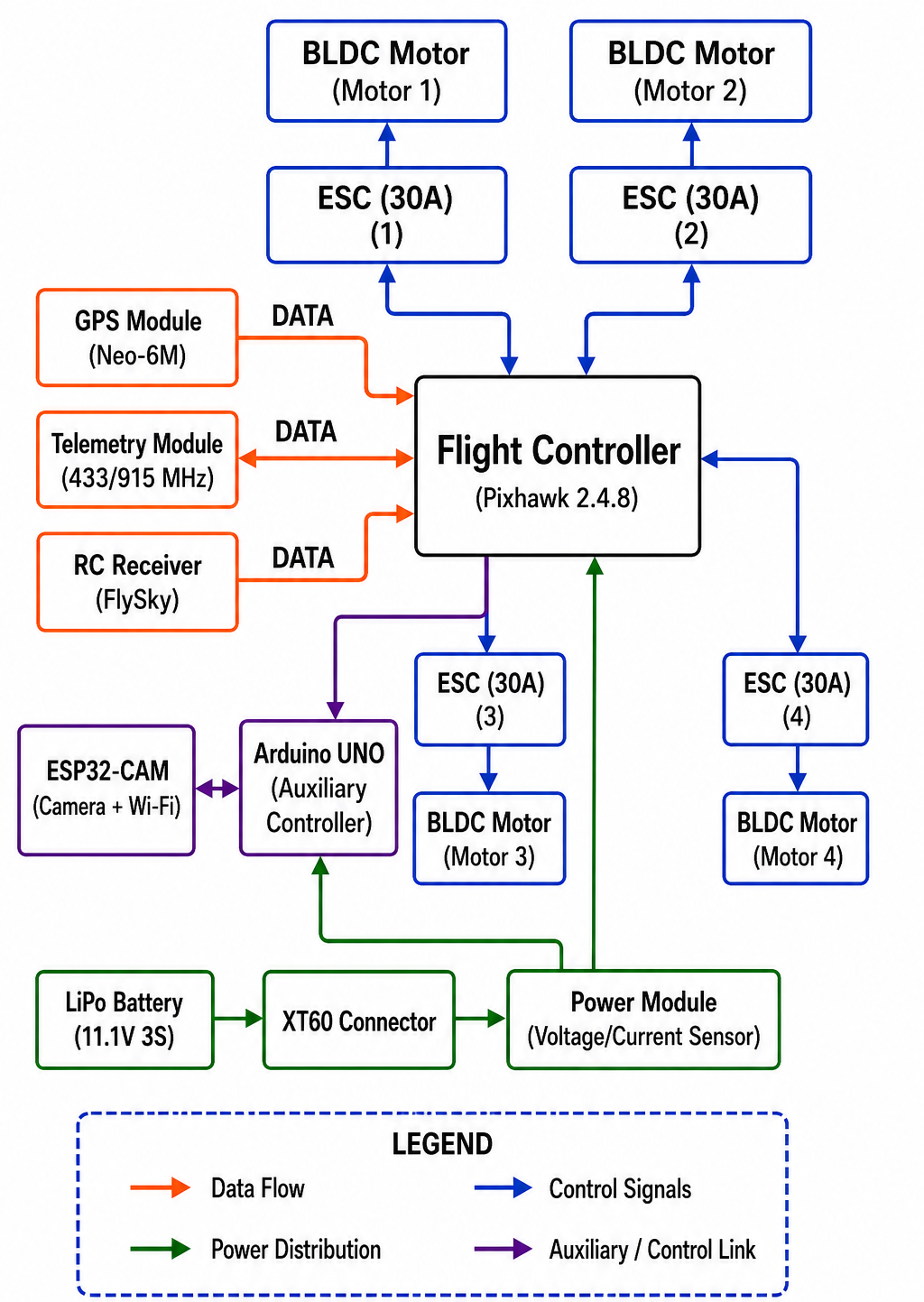
Fig. 1. Electrical and control architecture of the proposed UAV platform.
During operation, the ESP32-CAM captures video and provides the stream through a Wi-Fi connection. The video stream is received by an external laptop, where the frames are processed using Python and OpenCV before being passed to the YOLOv8s object-detection model. The detection output consists of the predicted animal class, confidence value, and bounding box corresponding to the detected object.
The overall processing sequence can therefore be represented as:
UAV → ESP32-CAM → Wi-Fi Stream → Ground Laptop → OpenCV → YOLOv8s → Animal Detection
This architecture separates flight control and image acquisition from computationally intensive AI processing. Such an arrangement reduces the onboard computing requirement but introduces dependence on the wireless communication link and the external processing system. These trade-offs are considered in the subsequent feasibility analysis.
3. UAV Engineering Analysis
The UAV platform is based on a 450-mm quadcopter frame and uses four A2212/13T 1000-KV brushless DC motors with 10 × 4.5 propellers. Each motor is driven by a 30-A electronic speed controller, while an 11.1-V, 5400-mAh Li-Po battery supplies power to the propulsion and onboard systems. The measured UAV mass without the considered payload is approximately 2.0 kg. A payload range of 1.2–1.5 kg is considered for the wildlife-monitoring equipment and associated components.
3.1 Take-off Mass
The total take-off mass is obtained by adding the UAV mass and payload:
For the minimum payload:
For the maximum payload:
Therefore, the considered take-off mass ranges from 3.2 kg to 3.5 kg. The 3.5-kg configuration is used as the conservative design case for the subsequent thrust analysis.
3.2 Hover Thrust Requirement
For steady hover, the total upward thrust generated by the four motors must approximately balance the gravitational force acting on the UAV:
where,
For the 3.5-kg design case:
Since the UAV uses four motors, the ideal thrust required per motor during hover is:
This corresponds to approximately 0.875 kgf of thrust per motor under ideal static conditions.
For the propulsion design assessment, a total thrust-to-weight ratio of approximately 2:1 is considered as a design target. The corresponding total thrust requirement is:
This corresponds to approximately 7.0 kgf of total thrust, or approximately 1.75 kgf per motor.
Typical specifications for A2212 1000-KV motors with 10 × 4.5 propellers on a 3S Li-Po indicate static thrust in the approximate range of 0.8–0.9 kgf per motor, although the actual value depends on the specific motor, propeller, battery, ESC, and operating conditions [8]. At the considered 3.5-kg take-off mass, the calculated hover requirement is approximately 0.875 kgf per motor. Therefore, the selected propulsion configuration may provide only a limited thrust margin at the upper end of the considered mass range. Experimental static-thrust testing of the assembled propulsion system is required to determine its actual capability.
These values represent engineering requirements rather than measured motor thrust. Actual propulsion capability depends on the motor, propeller, battery voltage, ESC, and operating conditions.
3.3 Flight Endurance
The UAV uses an 11.1-V, 5400-mAh Li-Po battery. Although battery capacity and propulsion parameters can be used to estimate theoretical endurance, an experimentally measured flight-endurance value was not established for the developed UAV. Therefore, endurance is treated as a theoretical parameter in this study and is not presented as an experimentally validated performance result.
4. Wildlife Detection Methodology
The visual detection subsystem uses a YOLOv8s object-detection model [2] to identify wildlife from the video frames captured by the ESP32-CAM [5]. The model was selected as a relatively lightweight detector suitable for the available computational resources while providing multi-class object detection.
The ESP32-CAM provides the video stream through an HTTP connection. At the ground station, individual frames are captured from the stream and resized to 640 × 480 pixels before being passed to the detection model. The YOLOv8s model processes each frame and generates bounding boxes, predicted animal classes, and confidence values for detected objects. A confidence threshold of 0.5 is used during inference to reduce low-confidence detections.
The detection pipeline can therefore be represented as:
ESP32-CAM → HTTP Video Stream → Frame Capture → Image Resizing → YOLOv8s → Bounding Box and Class Prediction
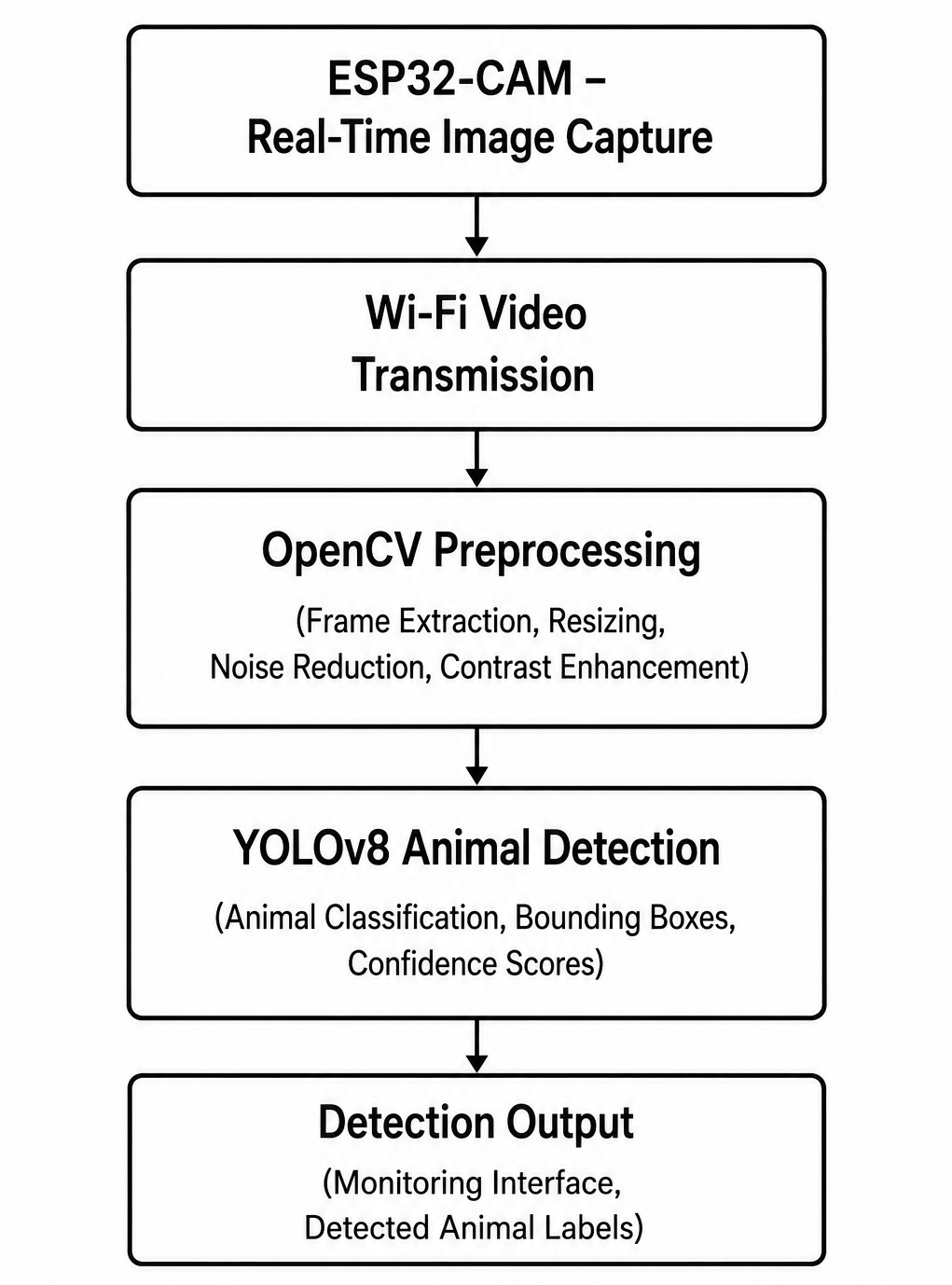
Fig. 2. AI-based image acquisition and wildlife detection pipeline.
The model was trained to detect ten wildlife classes: bear, deer, lion, fox, tiger, cheetah, elephant, zebra, rhino, and buffalo. The trained model and inference implementation were developed using the Ultralytics YOLO framework [2] with Python and OpenCV [3].
4.1 Model Training
The YOLOv8s model was initialized using pretrained weights and subsequently trained using the wildlife dataset. The training configuration used an image size of 640 × 640 pixels, a batch size of 8, and 100 training epochs. The training process used GPU acceleration and included validation during training. The validation metrics obtained during training are analyzed later in Section 6.
4.2 Detection Output
For each input frame, the detector produces three primary outputs:
· Bounding box — location of the detected animal.
· Class label — predicted wildlife category.
· Confidence score — confidence associated with the prediction.
This allows the system to provide an interpretable detection result rather than only indicating whether an animal is present.
5. Dataset and Experimental Methodology
The wildlife dataset contained 5,553 images and 8,014 annotated animal instances across ten wildlife classes. Of these, 4,442 images were used for training, and 1,111 images were used for validation.
The wildlife images were obtained from publicly available datasets and prepared for object detection using Roboflow [7]. Bounding-box annotations were assigned to the corresponding animal classes, and dataset augmentation was applied during dataset preparation to improve variation in the training samples. The resulting annotations were exported in YOLO-compatible format for model training.
The distribution of annotated object instances across the ten classes is shown in Table I. The dataset contains a higher number of elephant and zebra instances compared with some of the other classes, indicating some variation in class representation.
Table I. Distribution of Annotated Wildlife Instances
| CLASS | ANNOTATED INSTANCES |
| Bear | 639 |
| Deer | 717 |
| Lion | 682 |
| Fox | 632 |
| Tiger | 670 |
| Cheetah | 738 |
| Elephant | 1,219 |
| Zebra | 1,207 |
| Rhino | 766 |
| Buffalo | 744 |
| Total | 8,014 |
The dataset was organized into separate training and validation sets, with the corresponding images and YOLO-format annotation files. Each annotation contains the animal class and the normalized bounding-box coordinates required for object detection.
5.1 Experimental Configuration
The model used for the experiment was YOLOv8s, initialized with pretrained weights. Training was performed for 100 epochs with an input image size of 640 × 640 pixels and a batch size of 8. GPU acceleration was enabled during training. The main training parameters are summarized in Table II.
Table II. YOLOv8s Training Configuration
| PARAMETER | CONFIGURATION |
| Model | YOLOv8s |
| Number of classes | 10 |
| Training images | 4,442 |
| Validation images | 1,111 |
| Total images | 5,553 |
| Total annotated instances | 8,014 |
| Image size | 640 × 640 |
| Batch size | 8 |
| Epochs | 100 |
| Validation split | Validation set |
| Pretrained weights | Yes |
| GPU acceleration | Yes |
The model was evaluated on the validation set during training using precision, recall, mAP@50, and mAP@50–95. Since the available dataset does not contain an independent test split, the reported detection metrics are treated as validation results rather than test-set performance.
6. Results and Analysis
The trained YOLOv8s model was evaluated on the validation set during the 100-epoch training process. The evaluation considered precision, recall, mAP@50, and mAP@50–95 as the primary detection-performance metrics.
At the final training epoch (epoch 100), the model achieved:
Table III. Final Validation Performance of YOLOv8s
| Metric | Validation Result |
| Precision | 94.01% |
| Recall | 94.01% |
| mAP@50 | 96.76% |
| mAP@50–95 | 83.54% |
The model showed substantial improvement during training. At epoch 1, the validation precision, recall, mAP@50, and mAP@50–95 were 67.69%, 67.82%, 72.24%, and 48.77%, respectively. By epoch 50, these values had increased to 91.22%, 91.58%, 95.29%, and 78.09%, indicating continued improvement in detection performance during training. The highest recorded mAP@50 was 96.79% at epoch 98, while the final epoch produced a slightly lower mAP@50 of 96.76%. However, the final epoch achieved a higher mAP@50–95 of 83.54%, compared with 83.25% at epoch 98.
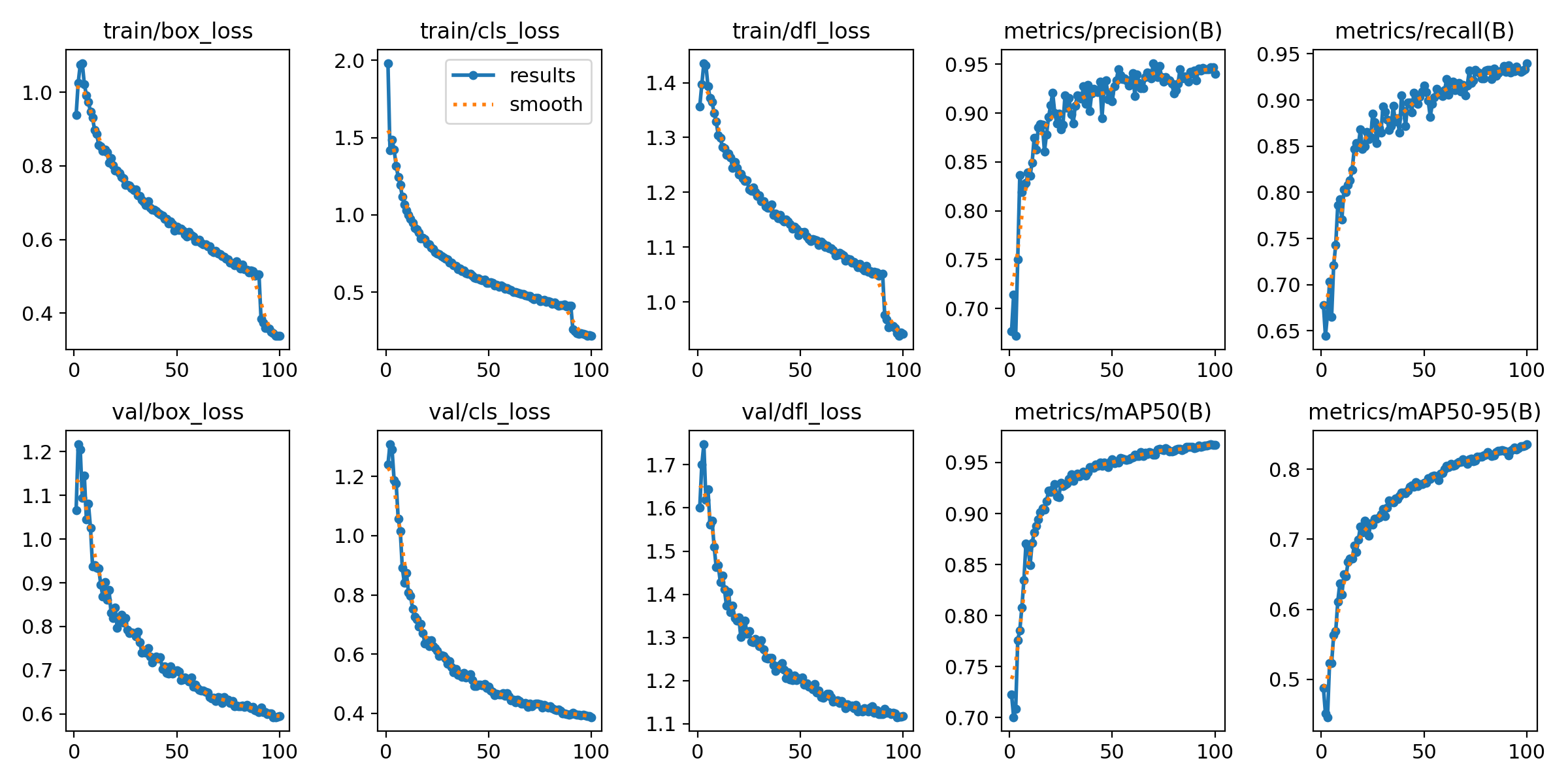
Fig. 3. YOLOv8s training and validation performance over 100 epochs.
7. Communication and System-Level Evaluation
The proposed system uses a wireless communication link to transfer the video stream from the ESP32-CAM mounted on the UAV to the ground-based processing computer. The ESP32-CAM provides the video through an HTTP stream, which is accessed by the Python and OpenCV-based processing program. The received frames are subsequently passed to the YOLOv8s model for wildlife detection.
The communication architecture enables the computationally intensive detection process to be performed on the ground station rather than on the UAV. This reduces the onboard computational requirement and allows the system to use a comparatively low-cost camera module. However, the approach makes the detection pipeline dependent on the availability and quality of the wireless connection. The practical operating range of the wireless link depends on transmit power, antenna characteristics, interference, obstacles, and the operating environment. Therefore, the communication range should be experimentally characterized before deployment over larger wildlife-monitoring areas.
During functional testing, the system was able to capture the ESP32-CAM stream, receive frames at the ground station, process the frames, and display the resulting detection output. The project testing indicated that communication was functional under the tested operating conditions. The complete processing path can therefore be summarized as:
ESP32-CAM → Wi-Fi/HTTP → Ground Laptop → OpenCV → YOLOv8s → Detection Output
From a system-level perspective, the architecture shows that wildlife detection can be performed using low-cost onboard imaging hardware together with external computation. However, the overall response of the system is influenced not only by the YOLOv8s inference process but also by frame transmission, network conditions, frame acquisition, and image processing. Therefore, the detection performance of the model and the end-to-end responsiveness of the UAV system should be considered as separate aspects of system evaluation.
The system was also functionally examined under the available operating conditions, including variations in lighting and wireless communication. The observations indicate that environmental conditions can affect the quality of the captured images and consequently influence detection performance. These observations are considered together with the model results and hardware constraints in the following discussion.
8. Discussion and Limitations
The evaluation indicates that the developed system is technically capable of performing multi-class wildlife detection using a low-cost UAV platform and an externally processed vision system. The YOLOv8s model achieved a validation precision and recall of 94.01%, with a validation mAP@50 of 96.76% and mAP@50–95 of 83.54% at the final training epoch. The results indicate strong detection performance on the validation dataset used in this study. However, the results should be interpreted within the scope of the experimental setup and dataset used.
One important limitation is the absence of an independent test dataset. The available dataset consists of training and validation sets, and therefore the reported metrics represent validation performance rather than performance on a completely unseen test set. Consequently, the results cannot by themselves establish how well the detector would generalize to new wildlife populations, locations, or environmental conditions.
Another limitation is the difference between the dataset used for model development and the conditions encountered during actual aerial wildlife monitoring. The model evaluation is based on the available annotated dataset, while real UAV operation can involve changes in viewing angle, altitude, object scale, background, vegetation, illumination, and motion. Such differences may introduce a domain gap between validation images and real aerial observations.
The communication architecture also introduces a system-level limitation. Since the ESP32-CAM transmits the video to an external laptop for processing, wildlife detection depends on the wireless connection and the availability of the ground computer. Loss of connectivity or degraded communication conditions can interrupt the processing pipeline even when the detection model itself is functioning correctly.
Lighting is another practical limitation. The project observations suggest that detection performance may decrease under low-light conditions. This is particularly relevant to wildlife monitoring because some animals may be active during dawn, dusk, or nighttime periods. The current camera and processing arrangement therefore does not provide sufficient evidence for reliable operation under all lighting conditions.
Finally, the UAV flight endurance and propulsion performance were not experimentally characterized across the complete 3.2–3.5 kg take-off mass range. The thrust calculations presented earlier represent engineering requirements, while flight endurance remains a theoretical parameter in this study. Therefore, the present work should be considered a technical feasibility evaluation rather than a complete field-validation study.
Overall, the evaluation supports the technical feasibility of integrating low-cost UAV hardware with computer vision for wildlife monitoring, while also indicating that reliable real-world deployment requires further validation under actual aerial, environmental, communication, and flight conditions.
9. Future Scope
The present system provides a foundation for low-cost UAV-based wildlife monitoring, but several improvements can be considered to increase its reliability and suitability for field deployment.
First, the current system performs AI processing on an external laptop. Future development can investigate onboard or edge-based inference, allowing detection to be performed directly on the UAV or on a compact computing platform. This could reduce dependence on continuous wireless video transmission and improve the autonomy of the monitoring system.
Second, the wildlife dataset can be expanded using actual aerial imagery collected at different altitudes, viewing angles, lighting conditions, and environmental backgrounds. Additional data from low-light and nighttime conditions would also help improve robustness under challenging illumination.
Third, an independent test dataset should be introduced in future experiments to provide an unbiased evaluation of model generalization. Performance can also be evaluated separately for different animal classes and environmental conditions.
The communication subsystem can be further improved through more reliable data links or by transmitting only detection results instead of continuously streaming raw video. This could reduce communication bandwidth requirements and improve system robustness. Future work should also include experimental flight testing with the complete payload configuration. Flight time, power consumption, propulsion performance, communication performance, end-to-end latency, and detection performance can then be measured under controlled and real-world conditions.
Finally, the system can be extended toward greater autonomy by integrating automated waypoint planning, real-time wildlife geolocation, detection logging, and event-based alerts. Such developments could enable the UAV to perform longer-duration monitoring missions with reduced dependence on continuous human supervision.
10. Conclusion
This paper presented a technical feasibility analysis of a low-cost UAV-based computer vision system for wildlife monitoring. The developed platform combines a Pixhawk 2.4.8 flight controller, GPS-assisted navigation, an ESP32-CAM for image acquisition, Wi-Fi-based video transmission, and YOLOv8s for multi-class wildlife detection.
The detection model was trained on 5,553 images containing 8,014 annotated wildlife instances across ten animal classes. Using 4,442 training images and 1,111 validation images, the YOLOv8s model achieved a final validation precision of 94.01%, recall of 94.01%, mAP@50 of 96.76%, and mAP@50–95 of 83.54% after 100 training epochs.
The engineering analysis also examined the UAV configuration for a considered take-off mass of 3.2–3.5 kg, including the corresponding propulsion requirements. The propulsion assessment indicates that the selected motor-propeller configuration may provide only a limited thrust margin at the upper end of the considered take-off mass range, highlighting the need for experimental thrust and flight validation. The system successfully integrated low-cost aerial imaging with external computer-vision processing, while the evaluation identified wireless communication dependence, low-light conditions, the absence of an independent test set, and the lack of experimentally measured flight endurance as important limitations.
Therefore, the developed platform can be considered a technically feasible prototype for UAV-assisted wildlife monitoring under the evaluated conditions; however, further aerial data collection, independent testing, onboard/edge processing, and experimental flight validation are required before deployment in demanding real-world wildlife-monitoring environments.
11. References
[1] J. Linchant, J. Lisein, J. Semeki, P. Lejeune, and C. Vermeulen, “Are unmanned aircraft systems (UASs) the future of wildlife monitoring? A review of accomplishments and challenges,” Mammal Review, vol. 45, no. 4, pp. 239–252, 2015.
[2] G. Jocher, A. Chaurasia, and J. Qiu, “Ultralytics YOLOv8,” version 8.0.0, 2023. [Online]. Available: https://github.com/ultralytics/ultralytics
[3] G. Bradski, “The OpenCV Library,” Dr. Dobb's Journal of Software Tools, 2000. [Online]. Available: https://opencv.org/
[4] ArduPilot Development Team, “ArduPilot Copter Documentation,” ArduPilot, 2023. [Online]. Available: https://ardupilot.org/copter/
[5] AI-Thinker, “ESP32-CAM WiFi + BT + BLE SoC with 2MP Camera Datasheet,” AI-Thinker Technology Co., Ltd., 2021. [Online]. Available: https://docs.ai-thinker.com/
[6] Pixhawk, “Pixhawk Autopilot Hardware Standards and Specifications,” Dronecode Foundation. [Online]. Available: https://pixhawk.org/
[7] Roboflow, “Roboflow Documentation: Computer Vision Datasets and Preprocessing,” Roboflow Inc., 2023. [Online]. Available: https://docs.roboflow.com/
[8] Micron Robotics, “A2212 1000KV BLDC Brushless DC Motor for Drone Datasheet and Specifications,” Micron Robotics, 2023. [Online]. Available: https://micronrobotics.com/product/a2212-1000-kv-bldc-brushless-dc-motor-for-drone/