UrbanNexus: A Digital Twin-Enabled Framework for Multi-Objective Evaluation of Sustainable Urban Interventions
Abstract Rapid urbanization has intensified interconnected challenges such as air pollution, urban heat, inadequate green cover, and increasing pressure on urban infrastructure. Although artificial intelligence and geospatial technologies have enabled effective prediction and monitoring of individual urban phenomena, existing approaches often address these problems independently and provide limited support for comparing alternative interventions before their real-world implementation. This creates a need for decision-support systems capable of evaluating environmental, health, economic, and implementation trade-offs within a unified framework. This paper proposes UrbanNexus, a Digital Twin-enabled urban decision intelligence framework for the multi-objective evaluation of sustainable urban interventions. The framework integrates heterogeneous environmental, geospatial, demographic, and infrastructure data with machine learning-based urban-state prediction and a simulation-oriented Digital Twin. Alternative interventions, such as tree plantation, green infrastructure, electric public transportation, and hybrid strategies, are represented as scenarios and evaluated according to their potential environmental benefits, health impacts, implementation costs, feasibility, and deployment requirements. A multi-objective decision layer identifies trade-offs among competing strategies, while an explainable decision layer provides interpretable justification for scenario rankings and recommendations. A supporting agentic layer is proposed to coordinate the interpretation of outputs from environmental, health, economic, optimization, and explanation components. The primary contribution of UrbanNexus is a unified framework for cross-domain, multi-objective evaluation and explainable ranking of heterogeneous urban interventions before deployment. The proposed framework establishes the architecture, mathematical decision formulation, and experimental protocol required for future empirical validation. Keywords: Urban AI, Digital Twin, Decision Intelligence, Sustainable Urban Planning, Multi-Objective Optimization, Scenario Simulation, Explainable AI, Multi-Agent Systems
Co-Author: Arpita Maity (arpitamaity123@gmail.com/Amity School of Engineering and Technology, Uttar Pradesh)
Introduction
Rapid urbanization has brought a range of interconnected environmental challenges to cities, including air pollution, increasing urban temperatures, loss of green cover, traffic-related emissions, and growing pressure on land and infrastructure. These challenges are closely related to one another, which means that an intervention designed to address one problem can also influence several other urban outcomes. For instance, expanding urban vegetation can improve air quality and reduce heat exposure, whereas transportation-related interventions may lower emissions but require significant infrastructure and financial investment. Sustainable urban planning, therefore, is not only about understanding the existing environmental conditions of a city. It also involves deciding which intervention should be implemented, where it should be applied, and what benefits, limitations, or trade-offs it may introduce.
Recent advances in artificial intelligence, remote sensing, geospatial analytics, and Digital Twin technologies have created new opportunities for monitoring, predicting, and simulating urban conditions. Machine learning models can be used to estimate environmental indicators, while GIS and remote-sensing methods provide valuable spatial information on land use, vegetation, pollution, and patterns of urban development. Digital Twins extend these capabilities by enabling urban systems to be represented digitally and allowing alternative scenarios to be explored before changes are implemented in the physical environment. However, many existing approaches are still developed around individual prediction tasks, specific urban domains, or particular types of interventions. As a result, a system may successfully identify areas with poor air quality or high heat exposure, yet still lack a systematic way to compare fundamentally different interventions while considering real-world urban constraints [1].
This limitation becomes particularly important when different interventions offer different combinations of benefits, costs, and practical requirements. Tree plantation, green infrastructure, electric public transportation, and hybrid strategies may vary considerably in terms of their environmental benefits, potential health effects, cost, feasibility, implementation time, and spatial requirements. Focusing on a single objective can therefore result in an intervention that performs well in one area but is less suitable when the broader requirements of urban planning are taken into account. In addition, decision-makers need recommendations that can be understood and traced back to the evidence and factors that produced them, rather than relying on rankings whose underlying reasoning is difficult to interpret.
To address this challenge, this paper proposes UrbanNexus, a Digital Twin-enabled framework for evaluating sustainable urban interventions from multiple perspectives. UrbanNexus combines heterogeneous urban data with predictive models to establish an understanding of the current state of an urban area. Candidate interventions are then represented as scenarios within a simulation-oriented Digital Twin, allowing their potential consequences to be assessed across multiple objectives. A multi-objective decision layer is used to examine the trade-offs between alternative interventions, while an explainable recommendation layer presents the factors and constraints that contribute to the resulting decisions. An additional agentic layer coordinates information from the environmental, health, economic, optimization, and explanation components. Importantly, this layer supports the interpretation and coordination of model outputs rather than replacing the underlying numerical models.
The primary contribution of UrbanNexus is therefore not the introduction of a new machine-learning algorithm, Digital Twin technology, optimization technique, or agent architecture in isolation. Instead, the framework focuses on a specific urban decision-making problem that how heterogeneous urban interventions can be compared and ranked across environmental, potential health, economic, and implementation objectives before they are deployed in the real world. By bringing together urban-state prediction, scenario-based simulation, multi-objective evaluation, and explainable decision support, UrbanNexus provides a unified approach for examining intervention trade-offs while keeping the final decision under human oversight.
Related Work
Recent research has increasingly explored the use of artificial intelligence, Digital Twins, optimization, and explainable decision-support methods for addressing complex urban planning problems. However, these studies generally focus on specific urban domains, intervention types, or decision objectives. The most relevant studies to the proposed UrbanNexus framework are discussed below.
Luo et al. developed a perception-powered Urban Digital Twin for human-centered urban planning and sustainable city development. Their framework integrates semantic segmentation, immersive virtual reality, and photo-realistic scenario simulation to evaluate objective environmental features and subjective human perceptions. A case study in Singapore demonstrated how alternative urban scenarios could be evaluated before physical implementation. This study demonstrates the potential of Digital Twins for pre-deployment scenario evaluation, but its primary focus is visual perception and public engagement rather than the cross-domain optimization of heterogeneous environmental interventions [1].
Chen et al. (2024) proposed an interpretable machine-learning and multi-objective optimization framework for city-scale green-infrastructure planning in Beijing. Their approach integrates an SVM-based flood-susceptibility model with SHAP and NSGA-II to identify effective green-infrastructure configurations. The study demonstrates how predictive modelling, explainability, and optimization can be combined to support a specific urban intervention. However, the framework is focused primarily on green infrastructure planning for urban flood mitigation, rather than comparing fundamentally different intervention categories across multiple environmental, health, economic, and implementation objectives [2].
Research has also begun integrating Digital Twins with broader urban decision-support systems. A recent study on Digital Twin-based predictive risk management in urban renewal combines scenario simulation with multi-criteria decision analysis to evaluate alternatives according to factors such as time, cost, safety, environmental impact, and community impact. This demonstrates the feasibility of using Digital Twins as a mechanism for testing and ranking interventions before implementation. However, its application is focused on urban-renewal risk management, whereas UrbanNexus targets a broader set of sustainable environmental interventions and incorporates predictive environmental intelligence and explainable recommendations into the decision workflow [3].
Another recent study proposed MORL-SGF, a governance-aware multi-objective reinforcement learning framework that combines Digital Twin policy validation, sustainability-oriented objectives, and Pareto-based policy auditing. Importantly, this work demonstrates that Digital Twins and multi-objective decision mechanisms can be integrated for pre-deployment policy evaluation. It therefore represents an important closely related direction and means that UrbanNexus cannot claim novelty simply from combining Digital Twins with multi-objective optimization. Instead, the distinction must be established around the cross-domain comparison of heterogeneous urban interventions and the integration of predictive, scenario-based, and explainable decision support [4].
Multi-agent approaches are also emerging in urban planning. Zhou et al. proposed an LLM-based multi-agent framework for participatory urban planning in which planner and resident agents collaboratively generate and refine land-use plans. Their experiments on real-world regions in Beijing demonstrated the potential of LLM-based agents to model diverse stakeholder perspectives and support planning decisions. Similarly, Ni et al. introduced a cyclical multi-agent framework in which planning, simulated urban living, and evaluation agents iteratively generate and refine urban plans. These studies establish that multi-agent AI can support complex urban decision processes. However, their emphasis is on plan generation, participation, and iterative evaluation, rather than quantitatively comparing heterogeneous environmental interventions using predictive models, scenario simulation, and multi-objective optimization [5].
Finally, recent studies on the integration of AI and Digital Twin technologies for sustainable smart cities show a growing connection between machine learning, Digital Twins, explainable AI, and environmental planning. A 2024 systematic review highlights the potential of combining AI with Urban Digital Twins to support data-driven environmental planning, while also pointing out several challenges related to interoperability, data integration, explainability, and practical deployment. These findings provide an important technological foundation for UrbanNexus. At the same time, they suggest that further work is needed to move beyond individual technological capabilities and develop integrated decision-support systems that can support practical urban planning decisions [6].
Research Gap
Existing studies have demonstrated the use of AI, Digital Twins, multi-objective optimization, and multi-agent systems for specific urban planning tasks. However, these approaches are largely domain- or intervention-specific, limiting their ability to compare fundamentally different interventions under a common decision framework. A gap therefore remains in jointly evaluating heterogeneous urban interventions across environmental, health, economic, and implementation objectives before deployment. UrbanNexus addresses this gap by integrating urban-state prediction, Digital Twin-based scenario simulation, multi-objective evaluation, and explainable decision support into a unified framework for cross-domain intervention comparison and ranking.
Problem Formulation
UrbanNexus formulates sustainable urban planning as a multi-objective intervention selection problem. Let the current state of an urban area at time t be represented by:
Where Xₜ is the Overall urban state at time t, Aₜ is Air Quality state, Wₜ is Weather conditions, Gₜ is the Green-cover state, Hₜ is Urban Heat state, Tₜ is Transportation characteristics, Iₜ is Urban Infrastructure characteristics and Pₜ is the Population characteristics.
Let Sᵢ denote a candidate intervention scenario, such as tree plantation, green infrastructure, electric public transportation, or a combination of interventions. Each scenario is defined by parameters such as its location, scale, intensity, implementation cost, and applicable constraints.
The expected urban state after applying intervention S
Here, f(·) denotes the scenario transition function that estimates the resulting urban state using predictive models, intervention parameters, and scenario-specific assumptions.
The objective is not to optimize a single outcome, but to evaluate each intervention across multiple competing criteria. Therefore, the framework considers objectives such as environmental improvement, potential health benefit, implementation cost, feasibility, deployment time, and risk. The intervention-selection problem can be expressed as:
subject to practical constraints such as available budget, land availability, infrastructure capacity, and intervention-specific requirements.
Rather than assuming that a single intervention is optimal for every objective, UrbanNexus seeks to identify Pareto-efficient alternatives that provide different trade-offs among competing objectives. The final decision layer can then rank or present these alternatives with explanations of their expected benefits, costs, constraints, and trade-offs.
Thus, the core problem addressed by UrbanNexus is Given the current state of an urban area and a set of feasible intervention scenarios, how can their potential impacts be simulated and jointly evaluated across environmental, health, economic, and implementation objectives to support an explainable pre-deployment decision? This formulation establishes the foundation for the Digital Twin, scenario simulation, multi-objective optimization, and explainable recommendation mechanisms described in the following sections.
Proposed Framework
UrbanNexus is proposed as an integrated framework that transforms heterogeneous urban data into scenario-based and explainable decision support for sustainable urban planning. The framework begins by constructing a unified representation of the current urban state from environmental, climatic, ecological, transportation, infrastructure, and population-related information. This state is analysed through predictive models and incorporated into a simulation-oriented Digital Twin, where alternative urban interventions can be represented and evaluated before physical deployment. The resulting scenario information is then coordinated and interpreted through a supporting decision layer and ultimately presented as an explainable recommendation for human planners. The framework therefore follows a sequential workflow from urban data and state construction to prediction, Digital Twin-based scenario simulation, decision coordination, and explainable decision support, while the formal multi-objective formulation used to compare intervention alternatives is presented separately in Section 5.
Urban Data and State Representation
The framework begins by integrating heterogeneous information describing the selected urban area. The primary data categories include air quality, weather, satellite imagery, GIS information, transportation characteristics, infrastructure, and population or exposure-related information. Since these sources differ in spatial and temporal resolution, preprocessing is required to ensure consistency before they are incorporated into the urban model.
The current urban condition at time t is represented as a multidimensional state vector in equation 1 above. This representation provides a common state description that can be used by subsequent prediction and scenario-evaluation components.
Urban Intelligence and Prediction
The second stage applies appropriate machine learning or deep learning models to estimate relevant urban indicators from the integrated data. Depending on data availability, these models may address variables such as air quality, urban heat, green-cover characteristics, and environmental impact indicators.
The purpose of this stage is not to develop a new prediction algorithm, but to establish a data-driven baseline urban state and provide quantitative inputs for subsequent scenario evaluation. Model selection will therefore depend on the characteristics of each prediction task and will be evaluated using appropriate performance metrics.
Digital Twin and Intervention Scenario Simulation
The Digital Twin in UrbanNexus is defined as a dynamic virtual representation of the selected urban area that is informed by observed and processed urban data and used to evaluate hypothetical intervention scenarios. Unlike a static GIS representation or visualization dashboard, the proposed Digital Twin maintains a relationship between the observed urban state and its virtual representation, allowing the virtual state to be updated as new observations or model outputs become available [7].
The observed urban condition is represented by the urban state vector xₜ, which captures the relevant environmental, climatic, ecological, transportation, infrastructure, and population-related characteristics of the study area. This state serves as the baseline condition for the virtual urban representation. As new observations become available, the virtual representation can be updated to reflect changes in the underlying urban state.
The Digital Twin then provides a controlled environment for what-if scenario evaluation. Candidate interventions sᵢ, such as tree plantation, green infrastructure, electric public transportation, or hybrid strategies, are introduced into the virtual representation without requiring immediate physical deployment. The resulting scenario state is represented as in equation 2.
Decision Coordination Layer
A supporting multi-agent layer is introduced to coordinate the interpretation of different analytical outputs. Specialized agents may be assigned to environmental, health, economic, optimization, and explanation-related tasks. The agents do not replace the underlying predictive or optimization models. Instead, they operate on structured outputs produced by these components and coordinate their interpretation. This separation is important because numerical environmental predictions and optimization results should remain grounded in data and formal computational models rather than being generated solely by a language model.
Explainable Decision Support
The final stage converts the analytical results into an interpretable decision-support output. Instead of providing only a ranked intervention, UrbanNexus is designed to explain why a strategy was preferred, which objectives contributed to its ranking, what trade-offs were involved, and what constraints influenced the decision. For example, a hybrid intervention may achieve a higher overall environmental benefit than tree plantation alone but require greater investment and implementation time. Such trade-offs should be visible to the decision-maker rather than hidden within an aggregated score. Consequently, the framework produces a decision output of the form like this.
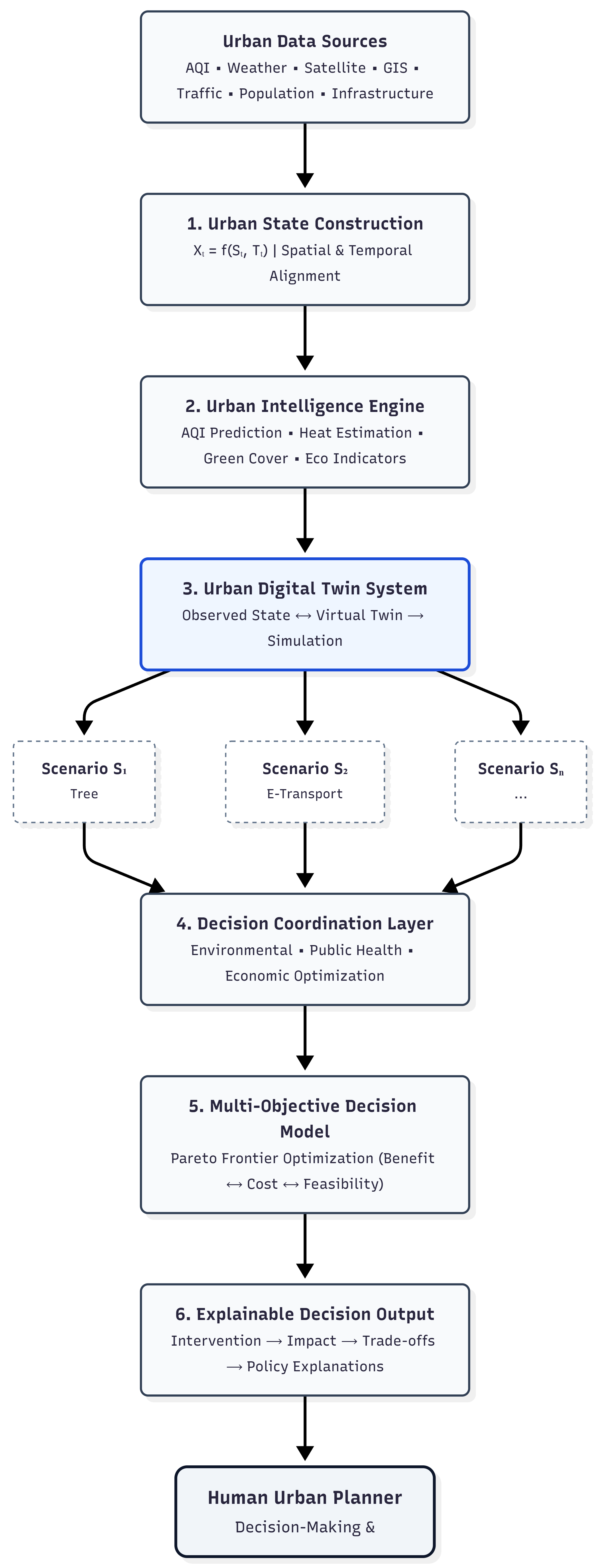
Fig 1: Overall architecture of UrbanNexus, illustrating the flow from heterogeneous urban data and state construction through urban intelligence, Digital Twin-based scenario simulation, decision coordination, multi-objective evaluation, and explainable decision support for human urban planners.
Multi-Objective Decision Model
UrbanNexus treats urban intervention selection as a multi-objective decision problem rather than a single prediction task. The purpose of the decision model is to compare alternative interventions according to their expected benefits, costs, feasibility, and implementation constraints. This allows the framework to identify not only which intervention performs well, but also how different interventions trade off against one another.
Let sᵢ represent the i-th intervention scenario. After scenario simulation, each intervention is evaluated using a set of objective functions. The primary objectives considered by UrbanNexus are environmental benefit, potential health benefit, and implementation feasibility, while cost, implementation time, and risk are treated as objectives to be minimized:
where fₑₙᵥ, fₕₑₐₗₜₕ and f𝒇ₑₐₛ represent the estimated environmental benefit, potential health benefit, and feasibility of intervention Sᵢ, respectively. Similarly, f𝒄ₒₛₜ, fₜᵢₘₑ and fᵣᵢₛₖ represent its implementation cost, required deployment time, and associated risk.
The decision process is subject to practical constraints, such as available budget, land availability, infrastructure capacity, and intervention-specific requirements. Therefore, an intervention with high environmental benefit may not necessarily be the preferred option if it exceeds the available budget or violates spatial or infrastructure constraints.
Instead of reducing all objectives to a single score, UrbanNexus can identify Pareto-efficient solutions. An intervention is considered Pareto-dominated when another feasible intervention provides equal or better performance across all objectives and strictly better performance in at least one objective. The resulting Pareto set represents alternative strategies that provide different trade-offs between environmental, health, economic, and implementation considerations.
For example, a tree-plantation scenario may provide strong environmental benefits with relatively low implementation complexity, whereas an electric-public-transport scenario may provide broader emission reductions but require greater investment and infrastructure changes. A hybrid strategy may provide a different balance between these objectives. UrbanNexus therefore presents these trade-offs to the decision-maker rather than assuming that a single intervention is universally optimal.
The final decision layer converts the evaluated scenarios into an interpretable ranking or Pareto set, which is subsequently passed to the explainability component. This enables the system to answer not only which intervention is preferable, but also why it is preferable, what trade-offs it involves, and which constraints influence the decision. This formulation makes multi-objective intervention comparison the central decision mechanism of UrbanNexus, while the Digital Twin, predictive models, and agentic components provide the data and analytical support required to perform the evaluation.
Proposed Evaluation Framework
The evaluation of UrbanNexus is designed to examine whether the proposed framework can provide a more effective basis for urban intervention selection than approaches that consider prediction or optimization in isolation. The experimental design therefore evaluates the framework at three complementary levels: urban-state prediction, intervention-level decision quality, and explainability of the resulting recommendations. The experiments will be conducted on a selected urban study area using heterogeneous environmental and geospatial data, followed by controlled simulation of alternative intervention scenarios.
Experimental Setup
A representative urban area will be selected based on the availability of reliable environmental, geospatial, and demographic data. The dataset will combine air-quality measurements, meteorological observations, satellite-derived information, GIS layers, transportation characteristics, and relevant population or exposure indicators. These data will first be spatially and temporally aligned to construct the urban state vector.
The predictive models will then establish the baseline environmental state of the study area. This baseline will serve as the reference condition against which alternative intervention scenarios are evaluated. Candidate scenarios will include interventions such as tree plantation, green infrastructure, electric public transportation, and a hybrid strategy, with scenario parameters defined according to their spatial extent, intensity, cost, and applicable constraints.
Comparative Evaluation
To determine whether the integration proposed by UrbanNexus provides an advantage over simpler decision approaches, the framework will be evaluated against progressively more complex baselines:
Table 1. Comparison of Existing Urban Decision-Support Approaches and UrbanNexus
| Approach | Prediction | Scenario Evaluation | Multi-Objective Decision | Explanation |
|---|---|---|---|---|
| Prediction-only | Yes | No | No | No |
| Rule-based Decision | Yes | Yes | No | Limited |
| Prediction + Optimization | Yes | Yes | Yes | No |
| UrbanNexus | Yes | Yes | Yes | Yes |
The prediction-only baseline represents systems that estimate urban conditions without evaluating interventions. The rule-based approach evaluates interventions using predefined decision rules. The prediction and optimization baseline introduces formal optimization but does not include the complete scenario-based and explainable decision workflow. UrbanNexus incorporates all proposed components. This comparison is intended to determine whether the proposed integration improves the quality and interpretability of intervention selection rather than merely increasing architectural complexity.
Evaluation Criteria
The evaluation will consider both model-level performance and decision-level performance. Environmental prediction models will be assessed using established metrics such as MAE, RMSE, r² and for continuous variables, while classification or spatial detection tasks will use metrics such as F1-score and IoU where applicable.
At the intervention level, scenarios will be compared according to their estimated environmental improvement, potential health benefit, cost, feasibility, implementation time, and risk. The quality of the resulting decision set will be assessed through objective improvement, constraint satisfaction, and Pareto-optimality. Sensitivity analysis will further examine whether recommendations remain stable when objective priorities or intervention constraints are changed [8].
Ablation and Explainability Analysis
An ablation study will be conducted to determine the contribution of the major components of the proposed framework. The complete UrbanNexus system will be compared with variants in which scenario simulation, multi-objective optimization, or explainable recommendation is individually removed. The explainability analysis will additionally examine whether the final recommendations can be traced to the underlying predictive outputs, scenario impacts, objective values, and constraints. An explanation will therefore be considered useful only when it is consistent with the numerical evidence used by the decision model.
Research Validation
The experimental evaluation is intended to examine the main proposition of this study: whether integrating urban prediction, intervention simulation, multi-objective evaluation, and explainable decision support can provide a more comprehensive basis for selecting sustainable urban interventions than approaches that rely only on prediction or address individual decision tasks separately. Accordingly, the experiments will assess not only the predictive performance of the individual models but also how effectively their outputs work together to produce consistent, constraint-aware, and interpretable intervention rankings. The quantitative results will be reported after the proposed framework has been implemented and evaluated using the selected study area and experimental settings.
Discussion
UrbanNexus approaches sustainable urban planning as a multi-objective decision problem rather than treating it as a prediction-only task. Although existing predictive models can estimate conditions such as air quality, urban heat, and green cover, these predictions alone are not sufficient to determine which intervention is most appropriate. By assessing different types of interventions within a common decision framework, UrbanNexus aims to make the trade-offs between environmental benefits, potential health impacts, cost, feasibility, implementation time, and risk more transparent.
An important component of the proposed framework is the use of a simulation-oriented Digital Twin to evaluate potential interventions before they are physically implemented. By representing different interventions within a virtual urban environment, planners can explore their possible consequences in a controlled setting and compare alternative scenarios. At the same time, the reliability of these evaluations depends on the quality of the available data, the performance of the predictive models, and the assumptions used to represent intervention effects. Therefore, the Digital Twin should be viewed as a decision-support representation of the urban system rather than as an exact prediction of future conditions [9].
The multi-agent component of UrbanNexus is designed primarily to support coordination and interpretation, while the actual predictions and intervention evaluations remain based on data-driven models and formal decision procedures. This separation helps maintain traceability by clearly distinguishing between the outputs produced by computational models and the contextual interpretation provided by the agentic layer. Similarly, explainability is considered at the decision-making level, allowing planners to understand the major factors and trade-offs influencing an intervention rather than simply receiving an unexplained ranking.
Despite its potential, the proposed framework has several limitations. The actual effects of an intervention may differ from its simulated outcomes because urban systems involve complex interactions that cannot always be fully captured by available data and models. Estimates of potential health impacts may also vary depending on assumptions about population exposure and responses. Furthermore, differences in the spatial and temporal resolution of the available datasets may influence the accuracy of scenario evaluation. These limitations emphasize the importance of empirical validation using real-world urban datasets and carefully defined intervention scenarios.
Overall, UrbanNexus provides a structured approach for bringing together urban prediction, Digital Twin-based scenario evaluation, multi-objective decision-making, and explainable decision support. The framework is intended to assist human planners in comparing alternative interventions and understanding their associated trade-offs, rather than making urban policy decisions autonomously. Further implementation and empirical evaluation will be necessary to determine how reliably the proposed framework can support practical and meaningful comparisons of sustainable urban interventions.
Conclusion
This paper presented UrbanNexus, a Digital Twin-enabled decision intelligence framework designed to evaluate sustainable urban interventions across multiple objectives. The framework addresses an important limitation of many existing urban decision-support approaches, where environmental prediction, intervention analysis, optimization, and recommendation are often treated as separate tasks. UrbanNexus brings these capabilities together in a unified workflow, beginning with the characterization of the current urban state and progressing through scenario simulation, multi-objective evaluation, and explainable decision support.
A central feature of the framework is its ability to evaluate different types of urban interventions while considering several competing objectives, including environmental improvement, potential health benefits, implementation cost, feasibility, deployment time, and risk. By representing interventions as alternative scenarios within a Digital Twin, UrbanNexus provides a structured way to examine their potential outcomes and compare the associated trade-offs. This can help support more transparent and evidence-based planning decisions before resources are committed to real-world implementation.
The framework does not claim that machine learning, Digital Twins, multi-agent systems, or multi-objective optimization are individually novel. Rather, the contribution lies in bringing these technologies together around the specific problem of cross-domain intervention evaluation and explainable decision-making. The proposed experimental framework will be used to examine whether this integrated approach can produce intervention rankings that are more consistent, constraint-aware, and interpretable than those obtained through prediction-only or isolated decision approaches.
At its current stage, UrbanNexus remains a proposed framework and therefore requires empirical validation. Future work will focus on implementing the framework using real-world urban datasets, conducting scenario-based simulations and comparative experiments, and performing sensitivity and ablation analyses to assess the contribution of individual components. Further development could also incorporate privacy-preserving federated learning, real-time data streams, higher-fidelity Digital Twins, and evaluations involving human planners. Ultimately, UrbanNexus is intended to provide a practical foundation for data-driven, explainable, and multi-objective urban planning, helping decision-makers understand the potential consequences of different interventions before committing real-world resources.
References
[1] J. Luo, P. Liu, W. Xu, T. Zhao, and F. Biljecki, “A perception-powered urban digital twin to support human-centered urban planning and sustainable city development,” Cities, vol. 156, Art. no. 105473, 2025, doi: 10.1016/j.cities.2024.105473.
[2] H. Chen, Y. Dong, H. Li, S. Tian, L. Wu, J. Li, and C. Lin, “Optimized green infrastructure planning at the city scale based on an interpretable machine learning model and multi-objective optimization algorithm: A case study of central Beijing, China,” Landscape and Urban Planning, vol. 252, Art. no. 105191, 2024, doi: 10.1016/j.landurbplan.2024.105191.
[3] T. O. Okimi, O. Adeoye, and O. Omoboye, “Integrating digital twins and decision support systems for predictive risk management in urban renewal,” Digital Twin, 2026, doi: 10.1080/27525783.2025.2612464.
[4] S. Alharbi, “MORL-SGF: A governance-aware multi-objective reinforcement learning framework with digital twin policy validation for sustainable smart cities,” Systems, vol. 14, no. 3, Art. no. 294, 2026, doi: 10.3390/systems14030294.
[5] Z. Zhou, Y. Lin, D. Jin, and Y. Li, “Large language model for participatory urban planning,” arXiv preprint arXiv:2402.17161, 2024, doi: 10.48550/arXiv.2402.17161.
[6] H. Ni, Y. Wang, and H. Liu, “Planning, living and judging: A multi-agent LLM-based framework for cyclical urban planning,” arXiv preprint arXiv:2412.20505, 2024, doi: 10.48550/arXiv.2412.20505.
[7] B. Ketzler, V. Naserentin, F. Latino, C. Zangelidis, L. Thuvander, and A. Logg, “Digital twins for cities: A state of the art review,” Built Environment, vol. 46, no. 4, pp. 547–573, 2020, doi: 10.2148/benv.46.4.547.
[8] S. E. Bibri, J. Huang, S. K. Jagatheesaperumal, and J. Krogstie, “The synergistic interplay of artificial intelligence and digital twin in environmentally planning sustainable smart cities: A comprehensive systematic review,” Environmental Science and Ecotechnology, vol. 20, Art. no. 100433, 2024, doi: 10.1016/j.ese.2024.100433.
[9] S. M. Lundberg and S.-I. Lee, “A unified approach to interpreting model predictions,” in Advances in Neural Information Processing Systems, vol. 30, 2017, pp. 4765–4774.