Verbal and Visuospatial Working Memory Performance During the CO2 Challenge Model of Anxiety.
Objective Anxiety influences working memory performance, but the effects on clinical neuropsychological assessments of working memory are not well known. Methods We examined the effect of anxiety, induced using the 7.5% carbon dioxide model of anxiety on standardized clinical neuropsychological tests of working memory and executive function in a single-blind, placebo-controlled, randomized, crossover within-subjects design. Results The CO 2 -challenge reduced spatial working memory performance and verbal working memory performance accuracy when task demands were high. The CO 2 -challenge increased effort and reduced processing efficiency across all verbal and spatial working memory tasks. Conclusions The CO 2 -challenge resulted in significant reductions in working memory performance and processing efficiency. These results encourage the routine assessment of anxiety when administering and interpreting neuropsychological measures of working memory function in clinical practice.
Introduction
Neuropsychological factors that influence cognitive functioning can be broadly classed into ‘primary’ and ‘secondary’ influences (Arnett2013). Primary (i.e., organic) influences include direct insult/injury to the brain (e.g., traumatic head injury, stroke), whereas secondary (i.e., functional) influences include fatigue, pain, mood and anxiety. Anxiety is widely reported by those attending clinical appointments in primary care (Wiegner et al.2015) and secondary/tertiary clinical services (Walker et al.2021). It can affect patients' description of their symptoms (Granot and Ferber2005) and adherence/clinical response to treatment (Santana and Fontenelle2011; Suls and Howren2012). During a neuropsychological assessment in clinical practice, anxiety is often reported by clients who are concerned about their diagnosis and prognosis (Dorenkamp and Vik2018). However, the effects of anxiety on cognitive performance measures that are used in routine neuropsychological assessment are not well understood.
Cognitive models predict that anxiety reduces attentional control in working memory and increases distractibility (Derakshan and Eysenck2009; M. Eysenck and Derakshan2011) with deficits in processing efficiency (time/effort) observed before effects on performance effectiveness (e.g., accuracy). Specifically, anxiety is considered to impact the efficiency of executive functioning (inhibition, shifting, and updating) which is mediated by both ‘top‐down’ (goal‐directed attention) and ‘bottom‐up’ (stimulus‐driven attention). When cognitive tasks require attentional control, anxiety can reduce processing efficiency due to increased top‐down and reactive attention networks (M. W. Eysenck et al.2023), which result in measurable performance deficits, despite efforts to compensate. Cognitive and physiological symptoms of anxiety may also have different effects on cognition; anxious‐apprehension (i.e., verbal worry about future negative outcomes) is likely to interfere with verbal working memory due to competition in the dorsal, medial and left ventral prefrontal regions (D'Esposito et al.1998; Engels et al.2007; Kalisch et al.2006; Paulesu et al.2010) and anxious‐arousal (i.e., the physiological/somatic experience of anxiety) affects spatial working memory due to competition for resources in the right prefrontal and posterior‐parietal cortex (Balderston et al.2017; Lavric et al.2003; Murphy et al.2003; Nee et al.2013).
The cognitive effects of anxious apprehension and arousal may differ with task demands; while high levels of autonomic arousal may affect performance across high and low load tasks, the effects of anxious apprehension may be over‐ridden when task demands and compensatory effort increase (Balderston et al.2016; K. Vytal et al.2013). Few studies have directly investigated the effects of anxiety on mental effort in clinical assessments, despite evidence that effort increases with anxiety on non‐clinical cognitive tasks (Edwards et al.2015,2016; Hadwin et al.2005; Kalisch et al.2006). Early studies of digit span performance observed detrimental effects of anxiety in healthy young adults (Hodges and Spielberger1969; Hodges and Durham1972). Furthermore, the use of clinical neuropsychological assessments may be beneficial due to their widespread availability, standardisation and known psychometric properties (Coy et al.2011), and to determine the ‘clinical’ significance of anxiety in clinical assessment and practice. Correlational and between‐subjects designs often do not adequately consider individual differences in working memory ability (Daily et al.2001; Mella et al.2016), nor susceptibility to mood‐induction procedures (Gomez et al.2000; Scherrer and Dobson2009), and mood induction procedures may elicit only transient effects that do not sustain throughout the experimental/clinical assessment (see Moran2016for a review).
The inhalation of air enriched with 7.5% carbon dioxide (CO2) is an established anxiety‐induction procedure which produces a temporary generalized anxiety state that demonstrates some chronic symptoms that are resolved after cessation of the 20‐min inhalation. The procedure allows performance measures (e.g., cognitive tasks) to be completed during sustained periods of elevated anxiety (Bailey et al.2005). Studies using this approach have found increased reports of anxiety as well as increases in physiological arousal such as heart rate, blood pressure and respiratory rate (Bailey et al.2005,2011; Gillan et al.2021; Gnacek et al.2025; Pinkney et al.2014; Poma et al.2005).
Between‐group studies comparing the effects of 7.5% CO2versus air inhalation on cognition, provide evidence that the CO2challenge increases attention to threat distractors (Garner et al.2011) and increases hypervigilance (alerting and orienting attention network function; Garner et al.2012). To date, only a single study has used this induction procedure to investigate anxiety and working memory measures from the CANTAB (Savulich et al.2019). Results provided evidence that CO2inhalation impaired executive measures of cognitive flexibility and working memory. However, a measure of verbal working memory was not included to test domain‐specific predictions and only a smaller subset of participants completed the spatial working memory task.
Here we used a single‐blind, placebo‐controlled, randomized, crossover within‐subjects design to examine the effects of 7.5% CO2induced‐anxiety on working memory performance using standardised neuropsychological assessments of auditory‐verbal (Digit Span) and visuospatial (Spatial Span) working memory, which are commonly used in clinical practice (Camera et al.2000; Rabin et al.2005). We examined the effects of anxiety on both working memory performance (i.e., total score for each measure), effort, and efficiency (i.e., the relationship between performance and invested mental effort) and under conditions of low cognitive load (forwards span) and high load (backwards span). The effect of anxiety on executive processes (set‐shifting) was also measured using the Trail‐Making test, which is routinely used in clinical neuropsychology practice. We predicted that CO2inhalation will replicate previous findings and increase subjective anxiety, heart rate and blood pressure. Furthermore, we predicted that CO2inhalation will reduce performance (effectiveness) and increase effort on spatial and verbal working memory tasks and corresponding measures of performance efficiency. We predicted that the effects of anxiety on processing efficiency would be most pronounced on high load WM tasks where anxiety prevented compensatory effort required to perform tasks effectively.
Method
Participants
Thirty‐six healthy participants were recruited from the community. Five participants withdrew after the first test session (5 CO2, 0 air) and one participant was removed due to English‐language difficulties. The final sample comprised 30 healthy young adults (25 female sex) between the ages of 18–26 years (M= 19.8 years, SD = 2.3). A‐priori power size calculations were based on large effect sizes (within‐subjects) of induced anxiety on working memory/cognitive control in CO2‐induced anxiety manipulations (Garner et al.2011,np2= 0.152) and expectancy manipulations of anxiety (K. Vytal et al.2012,n20.13). Consequently, we calculated a conservative sample size = 20+ participants was required, assuming power at 80% and alpha = 0.05 to reveal effects across multiple task conditions. Participants received course credit or payment for participation. The study received ethical approval from the University of Southampton Research Ethics and Governance Committee (ERGO 18175).
Consistent with previous 7.5% CO2challenge studies, participants completed a telephone pre‐screening interview based on DSM‐5 criteria (Mini International Neuropsychiatric Interview; Sheehan et al.1998). Exclusion criteria included recent use of medication (past 8 weeks except aspirin, paracetamol, contraceptive pill), pregnancy, history of asthma/respiratory illness, high blood pressure (> 140/90 mmHg), cardiovascular disease, migraines, current or lifetime history of psychiatric illness (including family history of panic attacks), smoker, under‐or over‐weight (body‐mass index < 18 or 28 >), current or past drug or alcohol dependence and recent use of illicit drugs, or alcohol (breath test). Participants completed standardized measures of trait anxiety (STAI‐Trait; Spielberger et al.1983) and trait worry (Penn State Worry Questionnaire; Meyer et al.1990). Levels of trait anxiety (M= 35.17, SD = 8.00) and worry (M= 43.47, SD = 11.25; PSWQ) were comparable to those reported in healthy samples following similar screening protocols (e.g., Garner et al.2011; Savulich et al.2019).
Materials and Procedure
The study used a single‐blind mixed multi‐factorial design with each participant attending two testing sessions in person following the telephone screen. All participants provided informed written consent prior to taking part. During the first session participants were randomly assigned to either the experimental (CO2) or control inhalation condition (normal air), completing the alternate condition between 7 and 14 days after session 1 (M= 10.7 days, SD = 5.9). This variable interval was due to participant availability, but ensured at least a 7 day interval to reduce carry‐over effects from session 1. Inhalation condition order was counterbalanced. Participants were blind to the condition, although 93.3% (n= 28) correctly guessed the order at debrief.
Physiological measures of anxiety (heart rate and blood pressure using Omron‐M6, arm‐collar; Medisave‐UK) and questionnaire measures of state anxiety (modified GAD‐7; Spitzer et al.2006& STAI‐State; Spielberger et al.1983) were taken at baseline and immediately after the 20 min inhalation of either air enriched with 7.5% CO2(21% O2, balance N2) or normal air via oro‐nasal face mask. Anxiety symptoms were measured using a modified version of the GAD‐7 questionnaire (Spitzer et al.2006). The GAD‐7 is a 7‐item questionnaire used to screen for generalized anxiety disorder (GAD) and assess its severity. In this modified version, participants respond indicating how often they have been bothered by common generalized anxiety symptoms ‘During the last 5 min’. Each item is scored on a visual analogue scale (VAS) ranging from 0 ‘not at all’ to 100 ‘all of the time’. This version of the GAD‐7 VAS has previously shown good sensitivity to changes in anxiety during acute anxiety challenges (Huneke et al.2020,2022,2024; Özhan et al.2026).
Two minutes after the start of the inhalation, participants completed the standard paper‐based neuropsychological assessments in fixed order: (i) executive set‐shifting task (Trail‐Making from the Delis‐Kaplin Executive Function System; Delis et al.2001), (ii) verbal working memory (Forwards, Backwards and Sequencing Digit Span subtests from the Wechsler Adult Intelligence Scale–Fourth Edition; Wechsler2008), and (iii) spatial working memory (Forwards and Backwards Spatial Span subtest from the Wechsler Memory Scale–Third Edition; Wechsler1997).
Participants were asked to rate ‘mental effort’ after completing each subtest (Rating Scale for Mental Effort; Zijlstra1993; Range 0–100). Tests were administered by either a trainee clinical psychologist or research assistant with appropriate training. The approximate start times for each cognitive test/subtest during the 20 min (air inhalation) were as follows: Trail Making (2 min—visual search, 3 min—number sequencing, 4 min—letter sequencing, 5 min—number‐letter switching, 8 min—motor speed), Digit Span (9 min—forwards, 11 min—backwards, 13 min—sequencing), and Spatial Span (15 min—forwards, 18 min—backwards). Test order intentionally began with the non‐verbal executive switching task and control conditions to allow time for the cumulative effects of CO2inhalation to become apparent within 3 min. Previous research has found physiological changes (e.g., galvanic skin response and respiration rate) peaking within approximately 3 min in response to the CO2challenge (Bailey et al.2005; Gnacek et al.2025).
Data Preparation
The total number of successfully repeated number strings for each condition (e.g., Digit Span Forwards) before meeting the discontinue criteria was used to measure working memory performance (as per test manual). In contrast, the Trail Making Performance scores reflect task completion speeds (seconds) and are analysed separately. To measure the processing efficiency of working memory, mental effort ratings and working memory performance scores were converted to a common standardised metric (T‐Scores;M= 50, SD = 10; de Beurs et al.2022), using participants performance across the two inhalation conditions. These were weighted against each other using the mental efficiency formula from Paas and Merriënboer (1993):
Large positive scores reflect improved processing efficiency (i.e., high levels of performance achieved with low levels of effort), whereas negative scores reflect poor efficiency (i.e., low levels of performance despite high levels of effort).
Results
Manipulation Check: Effect of CO2on Anxiety and Cardiovascular Function
Effects on psychological and physiological measures of state anxiety were examined in 2 (Inhalation: Air vs. CO2) × 2 (Time: Pre vs. Post) ANOVA. Consistent with previous studies the inhalation of 7.5% CO2increased state anxiety, heart rate and systolic blood pressure (see Table1and Figure1).
Table: Descriptive statistics for psychological and physiological measures of state anxiety.
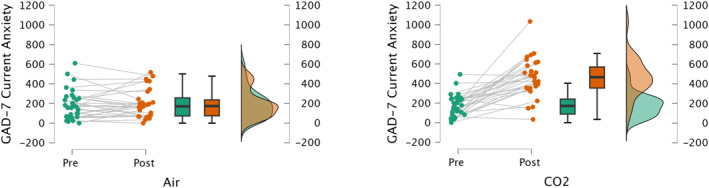
GAD‐7 Anxiety before and after the inhalation of air (left panel) and CO2(right panel). Box plots display median, lower quartile, upper quartile and range of non‐outlier values (< 1.5 × IQR) for each time × inhalation condition.
Working Memory Performance
Repeated‐measures ANOVA explored the effect of inhalation on measures of spatial, verbal and executive working memory performance. Performance scores are shown in Table2and Figure2.
Table: Descriptive statistics for performance (P) and mental effort (ME) ratings for working memory measures.
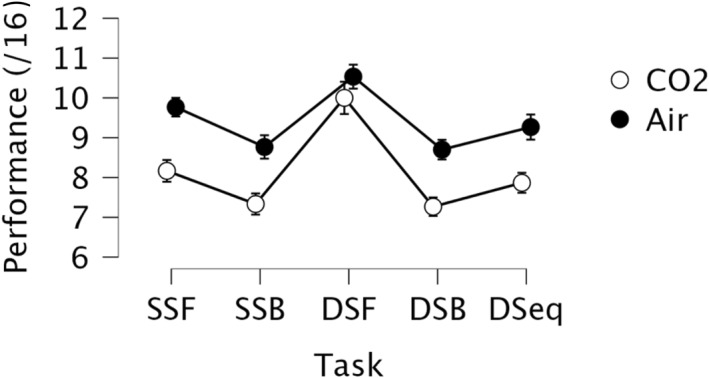
Spatial and verbal performance during CO2inhalation and air inhalation (scores/16).
To compare performance across spatial and verbal tasks we entered performance scores (/16 max) in a 2 (Inhalation) × 5 (Task) ANOVA. The effect of CO2(vs. air) differed across tasks [Task × Inhalation, F(4,116) = 2.543,p= 0.043,np2= 0.081]. Regarding spatial working memory, CO2inhalation impaired performance on Spatial Span Forwards (SSF),F(1,29) = 37.622,p< 0.001,n2= 0.565, and Spatial Span Backwards (SSB),F(1,29) = 24.362,p< 0.001,n2= 0.457 tasks (Figure2). Regarding verbal working memory tasks, CO2inhalation impaired performance on the Digit Span Backwards (DB),F(1,29) = 36.206,p< 0.001,np2= 0.555 and Digit Span Sequencing (DSeq),F(1,29) = 199.234,p< 0.001,d= 0.873 tasks, but did not impact Digit Span Forwards (DF) performanceF(1,29) = 2.303,p= 0.140,np2= 0.074 (Figure2).
Repeated‐measures MANOVA did not provide evidence that CO2inhalation impacted performance across Trail‐Making (TM) conditions,F(5,25) = 1.031,p= 0.421,np2= 0.171 (including the primary measure condition 4: number‐letter switching; Table2).
Mental Effort
Effort ratings are displayed in Figure3. Repeated measures 2 × 6 ANOVA examined the effect of Inhalation, Task and Inhalation × Task on reported levels of mental effort. Participants reported substantially more effort when completing tasks during the inhalation of CO2versus air, F(1,29) = 8.43,p= 0.007. This effect was largest for verbal Digit Span tasks and the Trail Making task and smallest on visual Spatial Span tasks (though the effect of Task × Inhalation was small,F< 1). A main effect of Task, F(5,145) = 10.09,p< 0.001, reflected greater effort during high load verbal (DB) and spatial (SSB) ‘backwards tasks’ and sequencing (DSeq) tasks.
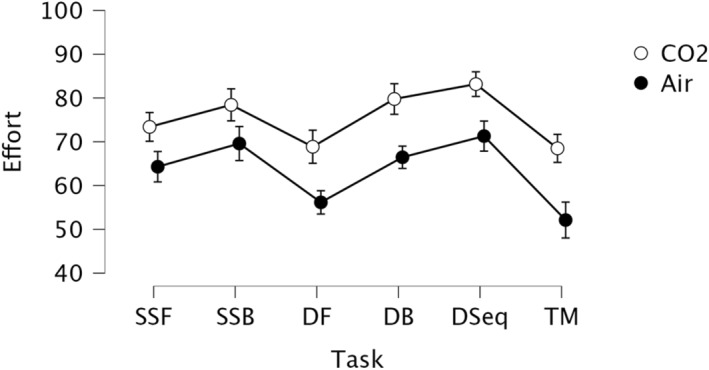
Reported effort ratings for each task completed during CO2inhalation and air inhalation.
Processing Efficiency
Processing efficiency scores and corresponding T‐scores for performance effectiveness and effort are displayed in Figure4. A 2 (inhalation) × 6 (task) ANOVA examined the effects of inhalation, task and their interaction on processing efficiency.
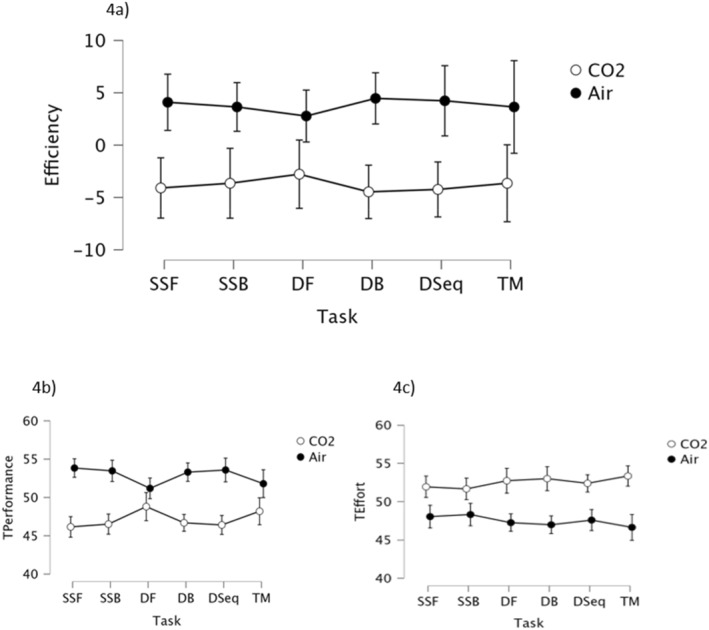
Processing efficiency scores for working memory measures during inhalation of CO2and air (4a). Corresponding standardized (T‐scores) for CO2and air on performance (4b) and effort (4c).
CO2inhalation had a negative impact on processing efficiency across tasks, F(5, 145) = 25.763,p< 0.001,n2= 0.470. CO2impaired processing efficiency on SSF (d= 0.86), SSB (d= 0.74), DB (d= 0.89) and DSeq tasks (d= 0.83), but the effects on DF (d= 0.56) and TM were small (d= 0.29) (Figure4a). Inspection of Figure4and earlier analyses of performance and effort measures show that CO2impaired processing efficiency by both impairing performance effectiveness (Figure4b)andincreasing effort (Figure4c) on SSF, SSB, DB and DSeq tasks, whereas CO2impaired processing efficiency on the DF and TM tasks by increasing effort required to complete the task.
Discussion
We explored the effects of experimentally‐induced anxiety on clinical neuropsychological assessments of working memory. CO2inhalation produced large increases in subjective anxiety, heart rate and blood pressure. These within‐subjects effects were consistent with those observed in previous 20‐min 7.5% CO2challenge studies (Gillan et al.2021; Garner et al.2011,2012) and supports the use of this method in anxiety induction studies.
Working Memory Performance
During CO2inhalation participants demonstrated poorer working memoryperformance. We observed CO2‐induced deficits in visuo‐spatial working memory, in both low and high cognitive load conditions, consistent with previous studies that have shown anxiety‐related disruption in spatial WM regardless of task difficulty (K. Vytal et al.2013). In contrast, the effect of CO2‐induced anxiety on verbal working memory performance varied according to the cognitive load of the task. Performance on the low‐load digit span forward task was unaffected by CO2‐induced anxiety, whereas performance on higher‐load tasks (backwards and sequencing tasks) were impaired during CO2challenge. K. Vytal et al.2013observed anxiety‐impairment in low and medium‐load verbal WM n‐back tasks, but not on high load tasks, suggesting high load tasks may consume resources that limit the magnitude and effect of anticipatory (verbally mediated) anxiety during threat of shock on verbal WM performance. It is not possible to compare (across studies) WM load across digit span and n‐back effects, however our results converge to suggest the effects of anxiety on verbal WM appear sensitive to task demands. Consequently, measures of effort and efficiency will prove useful in profiling the general and load‐dependent effects of anxiety on WM function.
Effort and Efficiency
Participants reported substantially more effort when completing all tasks during the inhalation of CO2—particularly for high load verbal digit span forward and sequencing tasks. The effect of CO2versus air on effort was largest on ‘low load’ digit forward and the trail making tasks—these tasks required least effort to complete during normal air, and suggests participants may have had capacity to increase effort on these tasks to maximise performance. These results suggest that regardless of modality or task demands, greater mental effort was invested to compensate for the adverse effects of anxiety, consistent with attentional control theory (Derakshan and Eysenck2009; M. W. Eysenck et al.2023). The analysis of efficiency scores support this interpretation—during low‐load verbal tasks with minimal central executive involvement, compensatory effort was successful in maintaining performance, but at a cost of reduced efficiency. However, across higher load verbal and both spatial working memory tasks, the investment of additional resources was not sufficient to maintain performance, reflected in particularly poor working memory efficiency during CO2‐induced anxiety. This extends previous research on the impact of induced anxiety on mental effort and WM efficiency (Edwards et al.2015,2016; Hadwin et al.2005).
Limitations and Future Research
Our study was powered to examine the effects of CO2inhalation on working memory, but not further interactions with trait anxiety. Our healthy participants were appropriately screened to ensure good physical and mental wellbeing prior to CO2challenge and, consequently, levels of trait anxiety were low across our sample. Future studies should examine whether the effects of acute anxiety (e.g., CO2challenge or situational stress) are moderated by concurrent high levels of trait anxiety and/or depression. K. E. Vytal et al. (2016) found that individuals with clinical anxiety (GAD) under threat (of shock) showed verbal WM impairments (n‐back) on high and low load tasks, whereas low anxious individuals improved their performance on high load tasks during threat. Our study was not designed to covary individual differences in CO2response (self‐report or autonomic response) with WM function—our measurement of subjective anxiety and autonomic arousal at baseline and immediately post‐inhalation prevented time‐course analyses that could link individual differences in response to CO2with WM behavioural measures of effectiveness and efficiency during the 20 min inhalation. Consequently, it remains unclear whether early autonomic effects (see Gnacek et al.2025) precede subjective experiences of anxiety and greater impairment in WM, and whether perceptible increases in effort further exacerbate subjective and autonomic markers of anxiety. We are mindful that five participants withdrew after completing the CO2inhalation—likely due to experiencing a strong response—and drop‐out rates in mood induction procedures remains a challenge for within‐subject repeated measures designs. We administered the neuropsychological assessments in fixed order to reduce within‐subject variability, but we were not able (within the 20 min inhalations) to include additional clinical neuropsychological measures of executive functioning, such as inhibition (e.g., DKEFS Colour‐Word Interference). Instead, we included self‐report measures of effort to determine measures of processing efficiency. While ‘off‐line’ self‐report measures of effort are likely to be most appropriate (accessible and affordable) in clinical settings, we encourage future studies to validate self‐report effort measures alongside objective ‘on‐line’ measures that are sensitive to the trajectory and peak effects of arousal (Gnacek et al.2025) and cognitive load (e.g., pupilometry and EEG/evoked potentials; Hepsomali et al.2019). Finally, it is important to note that cognitive testing was undertaken using in‐person, paper‐based tests rather than digital tools, which may have resulted in administration variability. However, manualised procedures were followed for each test and using clinical tools allows findings to be generalised into clinical settings.
Conclusion
We observed strong effects of CO2‐induced anxiety on WM effectiveness and efficiency. Our results highlight the need to consider anxiety in clinical neuropsychological assessments, particularly in neurological populations where a deficit in working memory is suspected or where anxiety is likely to be elevated for example acute stroke (Grosdemange et al.2015). In our study the effect of CO2on state anxiety measured by the modified GAD‐7 was greater than the effect on the longer STAI‐S. Consequently, short anxiety screeners (e.g., modified GAD‐7, or single item visual analogue measures) may be a practical but important addition to neuropsychological assessments in clinical practice.
Author Contributions
Warren Dunger:conceptualization, methodology, formal analysis, investigation, writing – original draft, visualization, project administration.Marc Edwards:investigation, writing – review and editing, project administration.Alex Board:investigation, writing – review and editing, project administration.Matthew Garner:conceptualization, methodology, formal analysis, resources, writing – review and editing, supervision.
Funding
No funding was received for this research. This research was undertaken as part of an educational project for a Doctorate in Clinical Psychology by the lead author.
Conflicts of Interest
The authors declare no conflicts of interest.
Acknowledgements
The authors thank the participants who volunteered for this project and thank Paul Reynolds for technical support.
Data Availability Statement
Data supporting the results of this paper are stored in the University of Southampton data repository and can be requested by contacting the lead author. PURE UUID: dbfd6ee8‐4245‐486d‐824d‐c45fa6f1f12c.
Associated Data
Data Availability Statement
Data supporting the results of this paper are stored in the University of Southampton data repository and can be requested by contacting the lead author. PURE UUID: dbfd6ee8‐4245‐486d‐824d‐c45fa6f1f12c.
References
- Arnett, P. 2013. “Introduction to Secondary Influences on Neuropsychological Test Performance.” In Secondary Influences on Neuropsychological Test Performance: Research Findings and Practical Applications, edited by Arnett P.. Oxford University Press.
- Bailey, J. , Arguropoulos S., Kendrick A., and Nutt D.. 2005. “Behavioral and Cardiovascular Effects of 7.5% CO2 in Human Volunteers.” Depression and Anxiety 21, no. 1: 18–25. 10.1002/da.20048. doi.org/10.1002/da.20048
- Bailey, J. , Papadopoulos A., Diaper A., et al. 2011. “Preliminary Evidence of Anxiolytic Effects of the CRF1 Receptor Antagonist R317573 in the 7.5% CO2Proof‐of‐Concept Experimental Model of Human Anxiety.” Journal of Psychopharmacology 25, no. 9: 1199–2015. 10.1177/0269881111400650. doi.org/10.1177/0269881111400650
- Balderston, N. L. , Quispe‐Escudero D., Hale E., et al. 2016. “Working Memory Maintenance Is Sufficient to Reduce State Anxiety.” Psychophysiology 53, no. 11: 1660–1668. 10.1111/psyp.12726. doi.org/10.1111/psyp.12726
- Balderston, N. L. , Vytal K. E., O'Connell K., et al. 2017. “Anxiety Patients Show Reduced Working Memory Related dlPFC Activation During Safety and Threat.” Depression and Anxiety 34, no. 1: 25–36. 10.1002/da.22518. doi.org/10.1002/da.22518
- Camera, W. , Nathan J., and Puente A.. 2000. “Psychological Test Usage: Implications in Professional Psychology. Professional Psychology.” Research and Practice 31: 141154. 10.1037/0735-7028.31.2.141. doi.org/10.1037/0735-7028.31.2.141
- Coy, B. , O’Brien W., Tabaczynski T., Northern J., and Carels R.. 2011. “Associations Between Evaluation Anxiety, Cognitive Interference and Performance on Working Memory Tasks.” Applied Cognitive Psychology 25, no. 5: 823–832. 10.1002/acp.1765. doi.org/10.1002/acp.1765
- Daily, L. , Lovett M., and Reder L.. 2001. “Modeling Individual Differences in Working Memory Performance: A Source Activation Account.” Cognitive Sciences 25, no. 3: 315–353. 10.1207/s15516709cog2503_1. doi.org/10.1207/s15516709cog2503_1
- de Beurs, E. , Boehnke J. R., and Fried E. I.. 2022. “Common Measures or Common Metrics? A Plea to Harmonize Measurement Results.” Clinical Psychology & Psychotherapy 29, no. 5: 1755–1767. 10.1002/cpp.2742. doi.org/10.1002/cpp.2742
- Delis, D. , Kaplan E., and Kremer J.. 2001. Delis‐Kaplan Executive Function System. (D‐KEFS). Psychological Corporation.
- Derakshan, N. , and Eysenck M. W.. 2009. “Anxiety, Processing Efficiency, and Cognitive Performance.” European Psychologist 14, no. 2: 168–176. 10.1027/1016-9040.14.2.168. doi.org/10.1027/1016-9040.14.2.168
- D'Esposito, M. , Aguirre G. K., Zarahn E., Ballard D., Shin R. K., and Lease J.. 1998. “Functional MRI Studies of Spatial and Nonspatial Working Memory.” Cognitive Brain Research 7, no. 1: 1–13. 10.1016/S0926-6410(98)00004-4. doi.org/10.1016/S0926-6410(98)00004-4
- Dorenkamp, M. A. , and Vik P.. 2018. “Neuropsychological Assessment Anxiety: A Systematic Review.” Practice Innovations 3, no. 3: 192–211. 10.1037/pri0000073. doi.org/10.1037/pri0000073
- Edwards, M. , Edwards E., and Lyvers M.. 2015. “Cognitive Trait Anxiety, Situational Stress, and Mental Effort Predict Shifting Efficiency: Implications for Attentional Control Theory.” Emotion 15, no. 3: 350–359. 10.1037/emo0000051. doi.org/10.1037/emo0000051
- Edwards, M. , Edwards E., and Lyvers M.. 2016. “Cognitive Trait Anxiety, Stress and Effort Interact to Predict Inhibitory Control.” Cognition & Emotion 2, no. 4: 1–16. 10.1080/02699931.2016.1152232. doi.org/10.1080/02699931.2016.1152232
- Engels, A. S. , Heller W., Mohanty A., et al. 2007. “Specificity of Regional Brain Activity in Anxiety Types During Emotion Processing.” Psychophysiology 44, no. 3: 352–363. 10.1111/j.1469-8986.2007.00518.x. doi.org/10.1111/j.1469-8986.2007.00518.x
- Eysenck, M. , and Derakshan N.. 2011. “New Perspectives in Attentional Control Theory.” Personality and Individual Differences 50, no. 7: 955–960. 10.1016/j.paid.2010.08.019. doi.org/10.1016/j.paid.2010.08.019
- Eysenck, M. W. , Moser J. S., Derakshan N., Hepsomali P., and Allen P.. 2023. “A Neurocognitive Account of Attentional Control Theory: How Does Trait Anxiety Affect the Brain's Attentional Networks?” Cognition & Emotion 37, no. 2: 220–237. 10.1080/02699931.2022.2159936. doi.org/10.1080/02699931.2022.2159936
- Garner, M. , Attwood A., Baldwin D., James A., and Munafò M.. 2011. “Inhalation of 7.5% Carbon Dioxide Increases Threat Processing in Humans.” Neuropsychopharmacology 36, no. 8: 1557–1562. 10.1038/npp.2011.15. doi.org/10.1038/npp.2011.15
- Garner, M. , Attwood A., Baldwin D., and Munafò M.. 2012. “Inhalation of 7.5% Carbon Dioxide Increases Alerting and Orienting Attention Network Function.” Psychopharmacology 223, no. 1: 67–73. 10.1007/s00213-012-2690-4. doi.org/10.1007/s00213-012-2690-4
- Gillan, C. M. , Vaghi M. M., Hezemans F. H., et al. 2021. “Experimentally Induced and Real‐World Anxiety Have No Demonstrable Effect on Goal‐Directed Behaviour.” Psychological Medicine 51, no. 9: 1467–1478. 10.1017/S0033291720000203. doi.org/10.1017/S0033291720000203
- Gnacek, M. , Özhan N., Broulidakis J., et al. 2025. “Multi‐Modal Physiological Markers of Arousal Induced by CO2 Inhalation in Virtual Reality.” Information Fusion 126: 103643. 10.1016/j.inffus.2025.103643. doi.org/10.1016/j.inffus.2025.103643
- Gomez, R. , Cooper A., and Gomez A.. 2000. “Susceptibility to Positive and Negative Mood States: Test of Eysenck’s, Gray’s and Newman’s Theories.” Personality and Individual Differences 29, no. 2: 351–365. 10.1016/S0191-8869(99)00198-1. doi.org/10.1016/S0191-8869(99)00198-1
- Granot, M. , and Ferber S. G.. 2005. “The Roles of Pain Catastrophizing and Anxiety in the Prediction of Postoperative Pain Intensity: A Prospective Study.” Clinical Journal of Pain 21, no. 5: 439–445. 10.1097/01.ajp.0000135236.12705.2d. doi.org/10.1097/01.ajp.0000135236.12705.2d
- Grosdemange, A. , Monfort V., Richard S., Toniolo A., Ducrocq X., and Bolmont B.. 2015. “Impact of Anxiety on Verbal and Visuospatial Working Memory in Patients With Acute Stroke Without Severe Cognitive Impairment.” Journal of Neurology Neurosurgery and Psychiatry 86, no. 5: 513–519. 10.1136/jnnp-2014-308232. doi.org/10.1136/jnnp-2014-308232
- Hadwin, J. , Brogan J., and Stevenson J.. 2005. “State Anxiety and Working Memory in Children: A Test of Processing Efficiency Theory.” Educational Psychology 25, no. 4: 379–393. 10.1080/01443410500041607. doi.org/10.1080/01443410500041607
- Hepsomali, P. , Hadwin J. A., Liversedge S. P., Degno F., and Garner M.. 2019. “The Impact of Cognitive Load on Processing Efficiency and Performance Effectiveness in Anxiety: Evidence From Event‐Related Potentials and Pupillary Responses.” Experimental Brain Research 237, no. 4: 897–909. 10.1007/s00221-018-05466-y. doi.org/10.1007/s00221-018-05466-y
- Hodges, W. F. , and Durham R. L.. 1972. “Anxiety, Ability, and Digit Span Performance.” Journal of Personality and Social Psychology 24, no. 3: 401–406. 10.1037/h0033732. doi.org/10.1037/h0033732
- Hodges, W. F. , and Spielberger C. D.. 1969. “Digit Span: An Indicant of Trait or State Anxiety?” Journal of Consulting and Clinical Psychology 33, no. 4: 430–434. 10.1037/h0027813. doi.org/10.1037/h0027813
- Huneke, N. T. , Broulidakis M. J., Darekar A., Baldwin D. S., and Garner M.. 2020. “Brain Functional Connectivity Correlates of Response in the 7.5% CO2Inhalational Model of Generalized Anxiety Disorder: A Pilot Study.” International Journal of Neuropsychopharmacology 23, no. 4: 268–273. 10.1093/ijnp/pyaa019. doi.org/10.1093/ijnp/pyaa019
- Huneke, N. T. , Cross C., Fagan H. A., et al. 2024. “Placebo Effects Are Small on Average in the 7.5% CO2 Inhalational Model of Generalized Anxiety.” International Journal of Neuropsychopharmacology 27, no. 4: pyae019. 10.1093/ijnp/pyae019. doi.org/10.1093/ijnp/pyae019
- Huneke, N. T. , Rowlatt H., Hyde J., et al. 2022. “A Novel Procedure to Investigate Social Anxiety Using Videoconferencing Software: A Proof‐of‐Concept Study.” Psychiatry Research 316: 114770. 10.1016/j.psychres.2022.114770. doi.org/10.1016/j.psychres.2022.114770
- Kalisch, R. , Wiech K., Critchley H., and Dolan R.. 2006. “Levels of Appraisal: A Medial Prefrontal Role in High‐Level Appraisal of Emotional Material.” NeuroImage 30, no. 4: 1458–1466. 10.1016/j.neuroimage.2005.11.011. doi.org/10.1016/j.neuroimage.2005.11.011
- Lavric, A. , Rippon G., and Gray J. R.. 2003. “Threat‐Evoked Anxiety Disrupts Spatial Working Memory Performance: An Attentional Account.” Cognitive Therapy and Research 27, no. 5: 489–504. 10.1023/A:1026300619569. doi.org/10.1023/A:1026300619569
- Mella, N. , Fagot D., and de Ribaupierre A.. 2016. “Dispersion in Cognitive Functioning: Age Differences Over the Lifespan.” Journal of Clinical and Experimental Neuropsychology 38, no. 1: 111–126. 10.1080/13803395.2015.1089979. doi.org/10.1080/13803395.2015.1089979
- Meyer, T. , Miller M., Metzger R., and Borkovec T.. 1990. “Development and Validation of the Penn State Worry Questionnaire.” Behaviour Research and Therapy 28, no. 6: 487–495. 10.1016/0005-7967(90)90135-6. doi.org/10.1016/0005-7967(90)90135-6
- Moran, T. P. 2016. “Anxiety and Working Memory Capacity: A Meta‐Analysis and Narrative Review.” Psychological Bulletin 142, no. 8: 831–864. 10.1037/bul0000051. doi.org/10.1037/bul0000051
- Murphy, F. C. , Nimmo‐Smith I., and Lawrence A. D.. 2003. “Functional Neuroanatomy of Emotions: A Meta‐Analysis.” Cognitive, Affective, & Behavioral Neuroscience 3: 207–233. 10.3758/CABN.3.3.207. doi.org/10.3758/CABN.3.3.207
- Nee, D. , Brown J., Askren M., et al. 2013. “A Meta‐Analysis of Executive Components of Working Memory.” Cerebral Cortex 23, no. 2: 264–282. 10.1093/cercor/bhs007. doi.org/10.1093/cercor/bhs007
- Özhan, N. , Graf E. W., and Garner M.. 2026. “Social Anxiety in Online Social Interactions: Examining the Effects of Self and Audience Images on Anxiety, Self‐Awareness and Performance Evaluations.” Journal of Anxiety Disorders 118: 103111. 10.1016/j.janxdis.2026.103111. doi.org/10.1016/j.janxdis.2026.103111
- Paas, F. , and Merriënboer J.. 1993. “The Efficiency of Instructional Conditions: An Approach to Combine Mental Effort and Performance Measures.” Human Factors 35: 737–743. 10.1177/001872089303500412. doi.org/10.1177/001872089303500412
- Paulesu, E. , Sambugaro E., Torti T., et al. 2010. “Neural Correlates of Worry in Generalized Anxiety Disorder and in Normal Controls: A Functional MRI Study.” Psychological Medicine 40, no. 1: 117. 10.1017/S003329170900564. doi.org/10.1017/S003329170900564
- Pinkney, V. , Wickens R., Bamford S., Baldwin D., and Garner M.. 2014. “Defensive Eye‐Blink Startle Response in a Human Experimental Model of Anxiety.” Journal of Psychopharmacology 28, no. 9: 874–880. 10.1177/0269881114532858. doi.org/10.1177/0269881114532858
- Poma, S. , Milleri S., Squassante L., et al. 2005. “Characterization of a 7% Carbon Dioxide (CO2) Inhalation Paradigm to Evoke Anxiety Symptoms in Healthy Subjects.” Journal of Psychopharmacology 19, no. 5: 494–503. 10.1177/0269881105056533. doi.org/10.1177/0269881105056533
- Rabin, L. , Barr W., and Burton L.. 2005. “Assessment Practices of Clinical Neuropsychologists in the United States and Canada: A Survey of INS, NAN, and APA Division 40 Members.” Archives of Clinical Neuropsychology 20, no. 1: 33–65. 10.1016/j.acn.2004.02.005. doi.org/10.1016/j.acn.2004.02.005
- Santana, L. , and Fontenelle L. F.. 2011. “A Review of Studies Concerning Treatment Adherence of Patients With Anxiety Disorders.” Patient Preference and Adherence 5: 427–439. 10.2147/PPA.S23439. doi.org/10.2147/PPA.S23439
- Savulich, G. , Hezemans F. H., van Ghesel Grothe S., et al. 2019. “Acute Anxiety and Autonomic Arousal Induced by CO2Inhalation Impairs Prefrontal Executive Functions in Healthy Humans.” Translational Psychiatry 9, no. 1: 1–10. 10.1038/s41398-019-0634-z. doi.org/10.1038/s41398-019-0634-z
- Scherrer, M. , and Dobson K.. 2009. “Predicting Responsiveness to a Depressive Mood Induction Procedure.” Journal of Clinical Psychology 65, no. 1: 20–35. 10.1002/jclp.20537. doi.org/10.1002/jclp.20537
- Sheehan, D. , Lecrubier Y., Harnett‐Sheehan K., et al. 1998. “The Mini International Neuropsychiatric Interview (M.I.N.I.): The Development and Validation of a Structured Diagnostic Psychiatric Interview.” Journal of Clinical Psychiatry 59: 22–33. 10.1016/S0924-9338(97)83296-8. doi.org/10.1016/S0924-9338(97)83296-8
- Spielberger, C. , Gorsuch R., Lushene R., Vagg P., and Jacobs G.. 1983. Manual for the State‐ Trait Anxiety Inventory. Consulting Psychologists Press.
- Spitzer, R. , Kroenke K., Williams J., and Löwe B.. 2006. “A Brief Measure for Assessing Generalised Anxiety Disorder: The GAD‐7.” Archives of Internal Medicine 22: 1092–1097. 10.1001/archinte.166.10.1092. doi.org/10.1001/archinte.166.10.1092
- Suls, J. , and Howren M. B.. 2012. “Understanding the physical‐symptom Experience: The Distinctive Contributions of Anxiety and Depression.” Current Directions in Psychological Science 21, no. 2: 129–134. 10.1177/0963721412439298. doi.org/10.1177/0963721412439298
- Vytal, K. , Cornwell B., Letkiewicz A., Arkin N., and Brillon C.. 2013. “The Complex Interaction Between Anxiety and Cognition: Insight From Spatial and Verbal Working Memory.” Frontiers in Human Neuroscience 7: 1–11. 10.3389/fnhum.2013.00093. doi.org/10.3389/fnhum.2013.00093
- Vytal, K. , Cornwell B., Arkin N., and Grillon C.. 2012. “Describing the Interplay Between Anxiety and Cognition: From Impaired Performance Under Low Cognitive Load to Reduced Anxiety Under High Load.” Psychophysiology 49, no. 6: 842–852. 10.1111/j.1469-8986.2012.01358.x. doi.org/10.1111/j.1469-8986.2012.01358.x
- Vytal, K. E. , Arkin N. E., Overstreet C., Lieberman L., and Grillon C.. 2016. “Induced‐Anxiety Differentially Disrupts Working Memory in Generalized Anxiety Disorder.” BMC Psychiatry 16, no. 1: 62. 10.1186/s12888-016-0748-2. doi.org/10.1186/s12888-016-0748-2
- Walker, J. , van Niekerk M., Hobbs H., et al. 2021. “The Prevalence of Anxiety in General Hospital Inpatients: A Systematic Review and Meta‐Analysis.” General Hospital Psychiatry 72: 131–140. 10.1016/j.genhosppsych.2021.08.004. doi.org/10.1016/j.genhosppsych.2021.08.004
- Wechsler, D. 1997. Wechsler Memory Scale ‐Third Edition. Psychological Corporation.
- Wechsler, D. 2008. Wechsler Adult Intelligence Scale‐Forth Edition. Pearson Assessment.
- Wiegner, L. , Hange D., Björkelund C., and Ahlborg G.. 2015. “Prevalence of Perceived Stress and Associations to Symptoms of Exhaustion, Depression and Anxiety in a Working Age Population Seeking Primary Care‐An Observational Study.” BMC Family Practice 16, no. 1: 1–8. 10.1186/s12875-015-0252-7. doi.org/10.1186/s12875-015-0252-7
- Zijlstra, F. 1993. Efficiency in Work Behaviour: A Design Approach for Modern Tools. Delft University Press.
Republished from the open web under CC-BY. Authors: Dunger W, Edwards M, Board A, Garner M. Read the original.